
Optoma UHD55 Review
Optoma, a staunch advocate for optimizing projectors for gaming, consistently upgrades specifications like refresh rates and input lag with each new product release. This dedication caters to the growing demands of modern gaming for smoother visuals and instantaneous command synchronization. Optoma’s current gaming projector lineup is also diversifying based on light source technology.
Early models like the UHD50X and UHD35+ utilized lamps, while last year’s UHC50 marked Optoma’s first gaming projector incorporating laser technology. The UHC50’s outstanding performance was widely praised upon release, even earning recognition as a Product of the Year for 2021-2022 by this publication, signaling Optoma’s leading position in the competitive gaming projector market.
Following the success of the UHC50, many were curious about Optoma’s next move. The answer arrived with the UHD55. Its specifications are similar to the UHC50, capable of achieving a 240Hz refresh rate with 1080p input and an input lag of around 4ms. The primary difference between the two models lies in the light source: the UHD55 is a lamp-based projector. Although it doesn’t use a laser, Optoma has still meticulously calibrated the projector’s colors.
The UHD55 not only boasts a wide color gamut but also benefits from a price advantage, making it more accessible to a broader range of consumers.
Enhanced Gaming Mode
The “Enhanced Gaming” mode, introduced with the UHD35+, has become the core performance highlight of Optoma’s gaming projectors. In this mode, the projector specifically targets the unique characteristics of gaming visuals. Through chip processing, it utilizes frame interpolation technology to boost the frame rate per second, achieving a speed effect up to four times that of standard displays. This results in significantly improved clarity and fluidity for dynamic scenes.
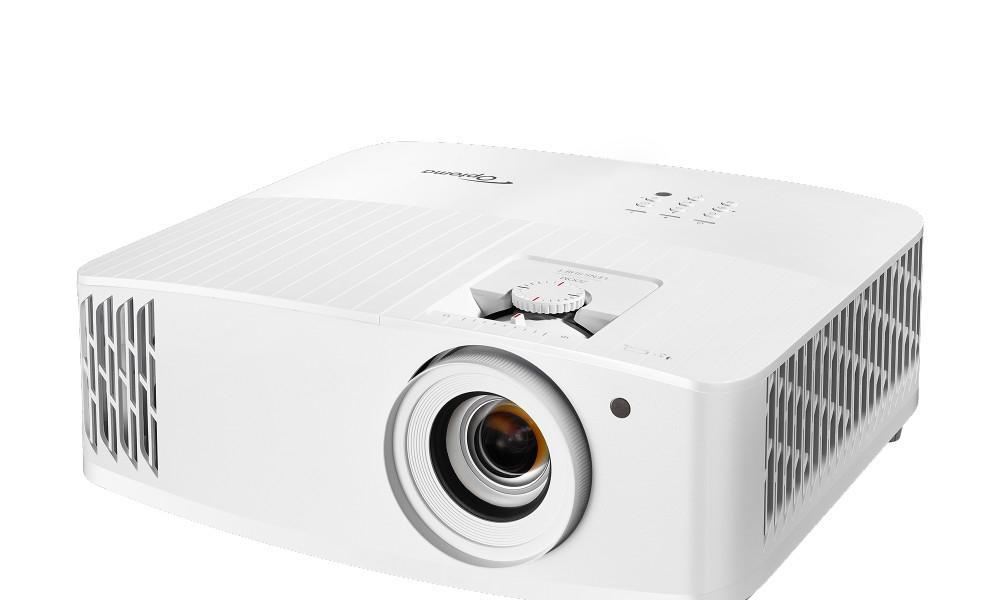
Simultaneously, within this mode, the projector’s image processing chip reduces the image signal processing pipeline, thereby decreasing input lag. Gaming visuals not only exhibit smoother, more continuous motion free from ghosting or trailing, but also ensure seamless synchronization between controller commands and on-screen actions.
Lag Performance
The UHD55, like the UHC50 released last year, maintains this characteristic. In Enhanced Gaming mode, when handling 4K/60Hz and 1080p/240Hz signals, the input lag is 16.9ms and 4ms, respectively. In other words, when you connect your gaming console to the projector and input 1080p/240Hz video for gaming, you achieve the best input lag performance currently available on the projector market.

This provides a zero-latency link between commands and actions, perfect for playing racing games, sports games, and shooting games.
Light Source and Brightness
As mentioned earlier, the UHD55 is a 4K projector that uses a lamp as its light source. Utilizing DLP XPR technology, it can precisely project 8.3 million pixels for a 4K image with ample brightness and good contrast. The lamp life of the UHD55’s light source is 4,000, 10,000, and 15,000 hours in Bright, Standard, and Dynamic modes, respectively.

While not as long as the 20,000+ hours typically offered by laser models, for typical home projector usage hours, it still eliminates the hassle of frequent maintenance or replacement.
The UHD55 boasts a light output of 3,600 lumens and a dynamic contrast ratio of 1,200,000:1. This excellent brightness and contrast performance means that even in environments with the indoor lights fully on or where curtains don’t completely block sunlight, you can still see a projected image with good clarity and high color definition.
HDR and Color
The UHD55 supports HDR10 and HLG, just like its predecessors such as the UHC50, UHD35+, and UHD50X. It delivers ideal results when displaying 4K HDR content from sources like 4K Blu-rays, video games, YouTube, BBC, and NHK. In terms of color, the Optoma team has professionally calibrated the UHD55 based on the characteristics of its color wheel, giving it approximately 97% DCI-P3 color gamut coverage.
Whether playing SDR or HDR content, the image exhibits outstanding wide color gamut performance, continuing the consistent Optoma style of vivid and exquisite colors.
Smart Platform and Streaming
Over the years, Optoma projectors have developed very robust smart features, with new versions introduced every time a new model is released. This allows consumers to operate functions as easily as using a smart TV. The UHD55 is equipped with Optoma’s proprietary Smart+ smart TV platform, which runs on an Android OS.
This platform lets you download and enjoy streaming services like Netflix, Prime Video, Spotify, and NBA TV via the “Marketplace App” store, experiencing online entertainment on the large projected screen just like a TV.

Connectivity and Cloud Features
Naturally, you also have access to the various wireless connectivity features found on models like the UHC50 or P2 laser TV. These include wireless projection functions via the Creative Cast App, such as screen mirroring from your phone, voice control, desktop synchronization, and wireless camera capabilities. The projector also comes equipped with Optoma’s renowned IFTTT smart home IoT functionality and cloud file management capabilities.
Through the Manager App, you can directly connect the projector to Google Drive, MS OneDrive, Dropbox, and Cloud Media Player to store files and set a secure PIN to protect your cloud accounts.

Game-Specific Aspect Ratios
Given the UHD55’s strong gaming focus, it includes more features specifically suited for projecting game visuals compared to standard multimedia projectors. For instance, in addition to the standard 16:9 aspect ratio, it also supports ultra-wide ratios of 21:9 and 32:9, allowing you to switch based on the game’s requirements.
Flexible Projection Setup
For image adjustments, the UHD55 not only offers ±30° horizontal/vertical keystone correction, four-corner correction, and 1.3x manual zoom, but also supports Lens Shift, enabling 105% to 115% vertical lens displacement.
Combining these adjustment features, the UHD55 can project a 100-inch screen from a distance of 2.68 meters, making it suitable for most living rooms in typical homes.
Grid Correction and 3D
Furthermore, the UHD55, like the UHC50, features 3×3 grid surface adjustment. This means if your projection surface is not flat, you can use grid calibration to adjust the projected content to fit the specific surface’s proportions. This makes the projector highly suitable for applications in exhibition spaces, projection mapping art, or flight simulators where unique projection surfaces are required.

Another feature shared with the UHC50 is that the UHD55 also supports 3D projection and can display 3D content from any 3D source, including movies and games, offering comprehensive versatility.
Image Quality Impressions
After years of development, Optoma projectors have largely solidified their picture tonality and color style. Yet, interestingly, every time I test a new model, I always discover subtle image quality optimizations. With the same resolution and similar light output intensity, the engineering team still manages to refine details like color tuning, giving the projected image a refreshing feel.
The UHD55 left me with this impression. When testing RGB white balance and CIE color gamut effects, I could see the precise and spot-on settings implemented by the color calibration team. The actual image reflects neutral, saturated, and ideal colors. In Cinema mode, the D65 color temperature accurately restores the visual effect of real-world perception.
This level of color mastery, combined with the delicate 4K resolution image, allows a hundred-inch screen to display refined, clear, and high-quality visuals. While I wouldn’t say it’s as crystal clear as a high-end 4K TV, compared to many products in the same class, you’ll definitely want to spend more time appreciating the UHD55.
Motion Performance
As a gaming model in the brand’s lineup, the UHD55’s performance in terms of refresh rate and low-latency dynamic effects is naturally among the highest standards in the current projector market. Just like when I tested the UHC50 a few months ago, I examined the dynamic effects using several Blu-ray movies and video games. The results were similar to the high performance of the UHD50.
When displaying at 1080p/240Hz in Game mode, fast-moving vehicles and running characters showed no trailing or fragmentation. Smooth and natural moving objects and scenes maintained a certain level of detail, making it very suitable for showcasing dynamic scenes in movies and games on a large screen.
Conclusion
Optoma now offers multiple projector models designed for gaming needs. This evolution has led to the UHD55, which demonstrates considerable maturity in all aspects of design and performance. Furthermore, players now have the choice between laser and lamp-based models. The UHD55, reviewed this month, is the latest lamp-based model. Its outstanding performance makes it suitable not only for gaming but also for home theater projection.
Coupled with its smart features, it is undoubtedly an excellent choice for building a living room projection theater.
Specifications
* Type: 4K DLP Projector
* Display Technology: Texas Instruments DLP XPR technology
* Resolution: 3840×2160
* Aspect Ratio: 16:9 (supports 21:9 / 32:9 native aspect ratios)
* Light Output: 3,600 ANSI lumens
* Contrast Ratio: 1,200,000:1
* Maximum Light Source Life: 4,000/10,000/15,000 hours (Bright/Standard/Dynamic)
* Lens: F#1.94~2.23/ f 12.81~16.74mm
* Zoom: 1.3x Manual
* Projection Size: 34.1~302.4 inches
* Image Adjustment: 95%~125% Digital Zoom, Vertical ±30°/Horizontal ±30° Keystone Correction, 105%~115% Lens Shift, 3×3 Grid Surface Adjustment
* Video Inputs: HDMI×2, VGA in, Audio in (3.5mm jack), Audio out, S/PDIF, USB-A (power 5V/1.5A), USB-A×2 (USB stick and WiFi Dongle), RS232, 12V trigger
* Speaker: 10W
* Noise: 26dB
* Dimensions: 337×265×108mm (WHD)
* Weight: 3.7±0.2kg