
Organic Reference Power Distributor Review
Organic Referene Power Distributor
This is a power distributor that you will fall in love with once you use it.
At least, that’s certainly the case for me.
Originating from Denmark, Organic Audio shares roots with the renowned cable brand Argento. It was founded in 2009 by Ulrik Gydesen Madsen, the founder of Argento.
His initial intention was simple: to create high-performance, cost-effective cable products using high-quality copper conductors.
Argento primarily uses silver wires, naturally resulting in much higher prices.
However, Organic Audio opted for copper instead of silver to lower costs, thereby making their products more accessible.
This is undoubtedly good news for consumers who prioritize value for money.
Distinctive Packaging
Organic Audio’s product packaging is quite intriguing.
HiFiReport sent over the Organic Reference power distributor, along with the accompanying Reference power cable.
I had seen the round, cookie-box-like packaging for their power cables before, but the cylindrical outer packaging for the power distributor was a first for me, resembling a bottle of whiskey.
However, whiskey is gone once you drink it, while a power distributor is meant to last for a very long time.
Metal-Minimized Design
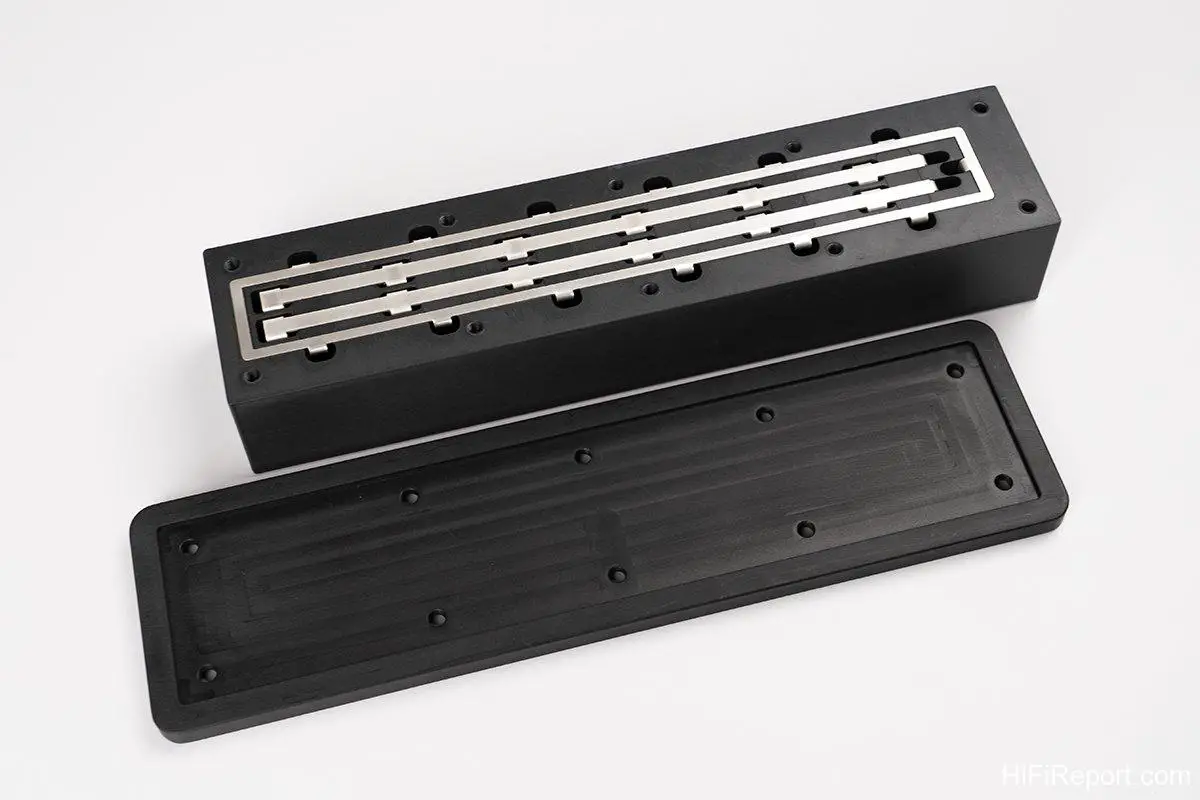
The Reference power distributor’s appearance truly embodies minimalist design principles.
Its substantial weight might lead one to believe it’s made of aluminum alloy. However, upon closer inspection of some pre-existing marks from its journey to the editorial office, the dents revealed no aluminum color, suggesting it’s not aluminum alloy.
So, what is it made of? The official website doesn’t specify. I inquired, and the answer was quite unexpected: Organic Audio uses Teflon, a material that would likely be the last thing on anyone’s mind.
Wouldn’t aluminum alloy be simpler? Isn’t that what everyone else uses? Even though aluminum alloy is non-magnetic and non-conductive to magnetism, Organic Audio still avoids it.
Even the hexagonal screws that secure the baseplate to the main body are made of Teflon.
This alone makes this power distributor quite interesting.
Silver-Plated Copper Strips, Minimized Contacts
Upon removing the baseplate, the internal design is equally unconventional.
Typically, power distributors boast about using high-end sockets, special internal wiring, or perhaps electromagnetic wave absorbing materials or unique grounding technologies.
However, the Organic Reference power distributor takes a different approach from the outset.
It eschews commercially available sockets, wiring, and components. Instead, it uses entire strips of metal as conductors, with separate paths for live, neutral, and ground wires. This drastically reduces the number of contact points. To be precise, there are virtually no contact points after the power inlet socket.
This method of using solid metal strips as conductors is somewhat similar to household power strips.
However, the conductors in typical household power strips are often made of lower purity brass or bronze, which are alloys. These materials have significantly higher impedance compared to pure copper.
Organic Audio uses silver-plated pure copper, giving it a bright, shiny appearance. This approach combines the high conductivity of silver with protection against oxidation on the contact surfaces, as oxidized silver still has better conductivity than pure copper.
20A Power Cord Requirement
The only inconvenience is that the Reference power distributor uses a 20A power inlet socket, unlike the more common 15A type.
Purchasing the Organic Reference power distributor necessitates also acquiring a power cord with a 20A female connector.
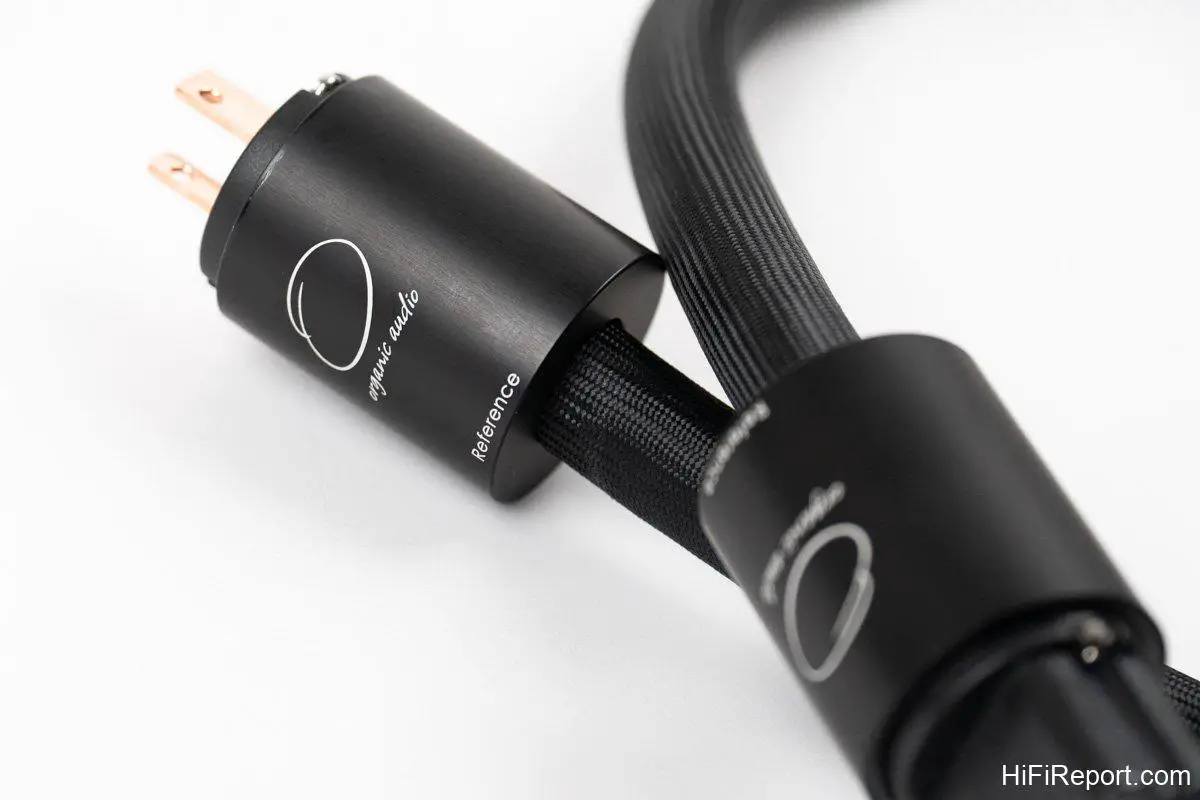
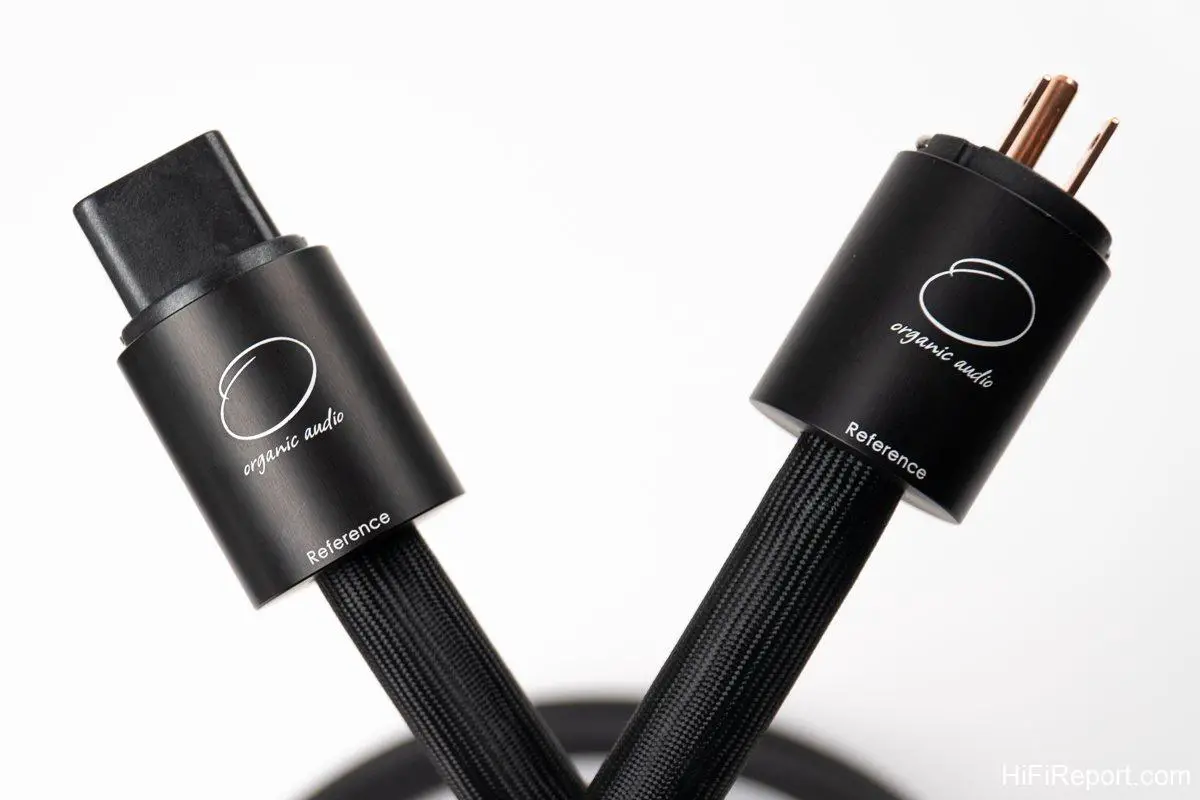
This explains why the Reference power cable was included in the package. This cable features a 20A male connector, perfectly suited for the Reference power distributor.
DAD Insulation Power Cord
This cable uses 99.999% pure OFC oxygen-free copper conductors. In Organic Audio’s high-end Reference series power cables, compared to the entry-level Organic MK. II power cables, the gauge of the live and neutral wires is increased by 66%, and the ground conductor is tripled in size.
The power plugs are also custom-made, with non-magnetic metal casings, adhering to the same design philosophy.
The Reference power cable is flexible and lightweight. The manufacturer explains that this is due to their use of “DAD” (Damped Air Dielectric) insulation technology.
This involves using a minimal amount of lightweight fiber as insulation, minimizing the contact area with the conductors to maintain the lowest possible dielectric constant, while also providing good vibration damping.

Natural Refinement
Since the Reference power distributor has a 20A power inlet, it must be used with the Reference 20A power cable. Therefore, my listening impressions are based on the combined performance of these two components.
As I mentioned at the beginning of this article, I’ve fallen in love with this power distributor. The sound is simply to my taste.
It is natural, exceptionally natural. I cannot discern any coloration that it adds to the sound.
Many power conditioning devices, when connected, noticeably enhance power and dynamics, especially active power conditioners, where the effect is particularly pronounced, and the character of these devices is more prominent.
However, the Organic Reference power distributor is different. It doesn’t overtly exhibit these kinds of effects. Yet, after connecting equipment to it, the sound becomes more rounded and smoother, the three-dimensionality of the sound naturally forms, and the sonic images become more focused, with clearer shapes and outlines.
The soundstage expands wider and deeper, especially when the music has significant spatial layering. Using it makes the sense of space more apparent.
Although I emphasize its neutrality in terms of tonal color, I do perceive a touch of refinement in the sound. This subtle characteristic might not be immediately obvious, but once you perceive this delicate change, the “nobility” it imparts becomes a primary reason why you won’t want to part with it.
Effortless Texture, Vocal Imagery
Its naturalness and its rounded, smooth texture make vocals sound particularly lifelike.
Take Anne Sofie von Otter’s rendition of “Dis, quand reviendras-tu?” as an example. Von Otter’s presence is palpable, and the subtle details of her enunciation are fully present without being overemphasized.
French pronunciation often occurs in the front of the mouth, light and quick, sometimes with a guttural quality.
With the Organic Reference power distributor in use, these details of enunciation and pronunciation are clearly audible, making von Otter’s performance even more visually evocative.
We don’t seek out these details for their own sake when listening to music through a Hi-Fi system, nor do we need them amplified.
Rather, these sounds are integral to the performance, and hearing what the performers intend to convey is the purpose of our music appreciation.
The Organic Reference power distributor assists in this regard.
On the same album, “La vie en rose” adds double bass, guitar, and strings to the piano accompaniment, enriching the arrangement.
The double bass provides low-end support, adding depth to the music.
The Organic Reference power distributor does not emphasize any frequency range, as evidenced by its handling of the double bass. It simply follows the musical flow, delivering the low notes with depth and the high notes with brilliance.
Listening to the guitar playing, you perceive rounded and radiant notes with a touch of warmth. The gentle rise and lingering decay of the notes are truly captivating.
It’s natural, and naturally lifelike.
Immersive Live Ambiance
Sticking with female vocals, listening to Sara Bareilles’ “Brave Enough: Live at the Variety Playhouse,” a live recording from her “Brave Enough” solo tour at the Variety Playhouse in Atlanta.
Sara Bareilles has a rich vocal tone and a wide range, skillfully using body resonance to generate powerful sonic energy. When she holds high notes, the effect is often breathtaking.
This album is no exception, showcasing Bareilles’ impressive vocal prowess throughout.
Accompanying herself on electric piano and interacting with the audience, the laughter and applause from the crowd create a palpable sense of being there.
This is a live recording, but when my system is powered by the Organic Reference distributor, listening to this album feels like traveling back in time to the Variety Playhouse ten years ago, experiencing Sara Bareilles’ performance alongside the live audience.
I’m not describing sonic characteristics, but rather the feeling of listening to this album. That sense of being drawn into the song and moved by the music is more important than anything else, isn’t it?
Airy Sound
Listening to “Kanamb Noel,” an album of French Christmas folk songs (the title is Breton, meaning “Let Us Sing on Christmas Night”).
It features children’s and female choirs, along with folk instruments like the Breton bagpipes.
In “C’etait a l’heure de minuit,” the timpani roll at the beginning is powerful and crisp, creating a dramatic opening.
Folk percussion instruments are also incorporated. With the Organic Reference power distributor in use, these percussion sounds become more focused, solid, full-bodied, and impactful.
The gently ringing chimes at the beginning imitate the midnight bells.
These percussion instruments delineate the space—a space with width, depth, and height.
The choir voices layer upon each other, with the counterpoint and harmonies unfolding in an orderly manner.
As the singing begins, the natural reverberation of the stone church where the recording was made creates a comfortable and pleasing acoustic environment.
In “Entre le boeuf et l’ane gris,” the double bass notes are full and deep, while the cello provides a slightly nasal accompaniment.
The children’s choir sings with innocent voices, and both the vocals and accompaniment are imbued with folk charm.
The addition of percussion instruments further enriches the songs and provides a clearer rhythmic framework.
All of this is not only lifelike but also evokes the very air of the church.
This is what “airy” sound is.
It’s difficult to translate well into Chinese. A forced translation might be “” (fùyǒu kōngqì gǎn – full of air feeling), but it still doesn’t fully capture the essence.
This album effectively illustrates what “airy” means, and it demonstrates just how airy the sound of the Organic Reference power distributor is.
Holistic Music Appreciation
Let’s use another album to further illustrate its merits.
Listening to George Prêtre’s final album conducting the Orchestra of Teatro alla Scala, the first track, the “Egmont Overture,” begins with the orchestra playing an F note fortissimo, followed by a softening of the music, introducing a solemn motif led by the strings, with the violins and woodwinds then presenting a tender melody.
This combination is repeated twice, leading into the exposition of the main theme.
In this Egmont Overture, the 92-year-old Prêtre, with his characteristically sensitive and expressive approach, conducts this dramatic piece.
He imbues the march-like theme with a stately and elegant forward momentum.
The transparent recording preserves ample sonic information from the stage, revealing how diligently and attentively the members of the Scala string section perform.
From a macro perspective, the musical arrangement, the interplay and counterpoint between sections, and the natural and visually evocative soundstage are among the strengths of the Organic Reference power distributor.
From a micro perspective, the performance of the string players, the textured sounds created by the bow on the strings at the point of contact, are also clearly presented.
Especially after the exploration of the development section, when the recapitulation reintroduces the theme, the gradual crescendo, with the entire orchestra producing a bright and exhilarating sound, fully embodies the Beethovenian essence of “struggling through darkness to embrace the light.” This passage is truly exhilarating to listen to.
Without this power distributor, is it no longer Beethoven? Is it no longer Prêtre conducting? No, it is still Beethoven, still Prêtre, but the feeling is diminished, the resonance it evokes is weaker.
Defining Organic Music
My first experience with Organic Audio products, the Reference power distributor, has left a very deep impression. During the time I’ve spent with it, listening to music has become even more enjoyable.
It presents music to me in a more musical way.
The word “organic” has become increasingly common in the audio world in recent years, often used to describe sound as “the sound is organic.”
How should we interpret this term when describing sound? What exactly does “organic sound” mean? The Organic Reference power distributor provides a tangible explanation.
Organic Audio’s owner, Madsen, aims to enable listeners to hear more of the music, to make the sound fluid, airy, smooth, continuous, and stress-free.
With the Organic Reference power distributor (and the Reference power cable), what I hear aligns perfectly with Madsen’s vision.
After incorporating it into the system, even more musical information is revealed.
It brings improvements in sonic texture, increased detail, and expansion of the soundstage. These enhancements in all aspects contribute to making music more approachable and emotionally engaging.
If your pursuit aligns with Madsen’s vision, I encourage you to try the Organic Reference power distributor and see if you, too, will find it as indispensable as I have.
Specifications
* Type: Power Distributor
* Outlets: 6
* Input: 20A
“`