
PMC Prodigy 5 Floorstanding Speakers Review
If you follow Hi-Fi news, you’ll know that PMC unveiled a brand new series in 2023, positioned at the entry-level segment, making it a potential market disruptor.
If you attended the audio shows last August and December and visited the Jadex room, you would have seen this newly launched PMC series.
This “market disruptor” speaker I’m referring to is PMC’s Prodigy series.
With the Prodigy series, PMC is aiming at a broader audience, particularly the younger generation.
PMC has always been deeply connected to the music industry. As one of the most renowned studio monitor brands, PMC is prevalent in major recording studios, serving as a trusted partner for recording engineers in music production.
What PMC aims to showcase with the Prodigy series is the application of their engineering expertise and high-fidelity philosophy, honed over years in studio monitoring, into a new range of compact and affordable speakers.
Transmission Line Expertise Refined
The Prodigy series consists of two models: the Prodigy 1 bookshelf speaker and the Prodigy 5 compact floorstanding speaker. Both utilize PMC’s newly designed drivers and feature PMC’s signature Advanced Transmission Line (ATL) technology.
PMC is among the very few manufacturers who continue to champion transmission line loudspeakers.
Though transmission line speakers emerged as early as the 1930s, they often ended up bulky and heavy to accommodate the transmission path. Moreover, issues like resonance frequency control, driver-to-transmission line coupling, and optimization of the transmission line opening presented challenges. While transmission line designs could reproduce deep bass, they came with their own set of problems to overcome.
As many manufacturers retreated, and transmission line speakers gradually faded from the spotlight, PMC emerged.
They upheld the lineage of transmission line speakers, investing significant resources in research and development to refine transmission line design. Today, when we talk about transmission line speakers, PMC is the first name that comes to mind.
(Image / Source: PMC Official) PMC was the first to establish specifications for the acoustic foam damping material within the transmission line, achieving a balanced absorption of high and mid frequencies, and appropriately managing low-frequency resonance.
They also designed specialized resonance absorbing chambers within the speaker cabinet. This allows PMC to further control unwanted resonance frequencies, thereby reducing distortion and achieving more linear sound reproduction.
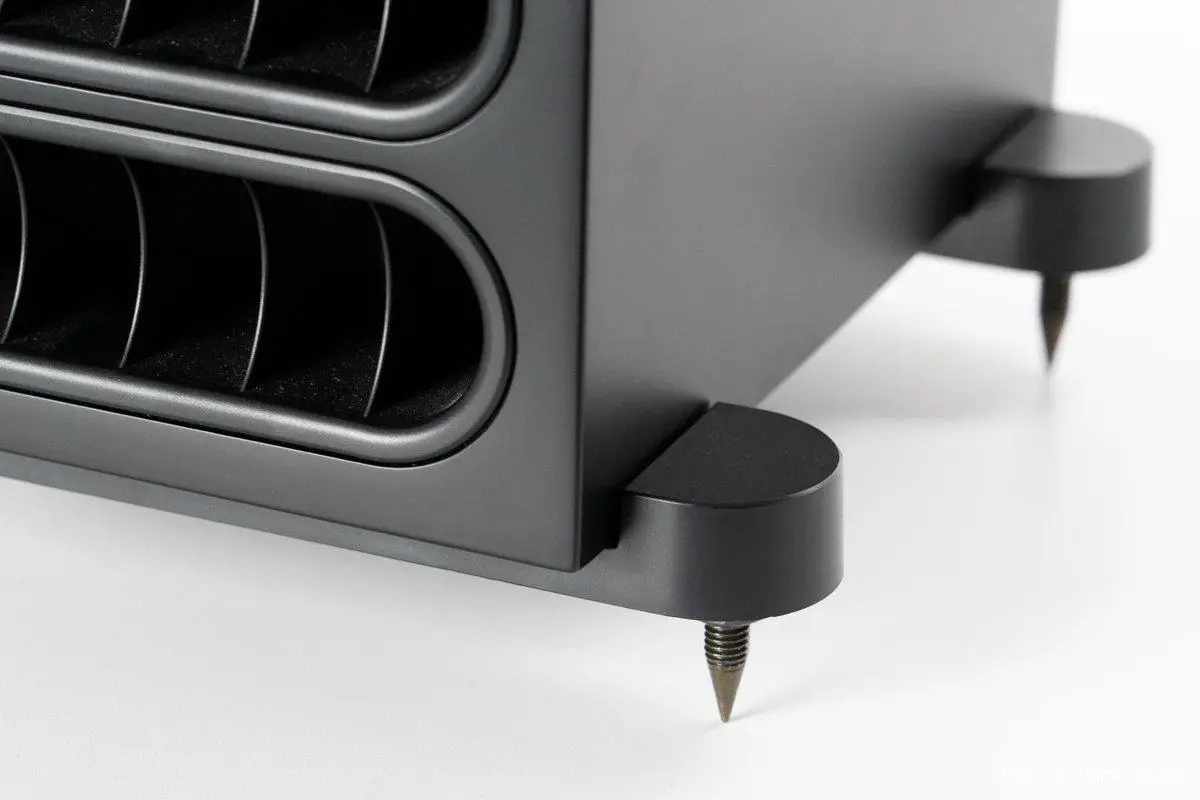
Furthermore, the vent is also a crucial element. To ensure smoother airflow and minimize turbulence-induced air noise at the opening, PMC drew inspiration from Formula 1 fluid dynamics design and developed the Laminair patent technology. This involves implementing layered vents at the transmission line opening, reducing unnecessary air turbulence, minimizing air noise, and enhancing bass agility and clarity.
Thanks to the ATL advanced transmission line enclosure, PMC speakers can produce bass that surpasses their cabinet size and offer greater dynamic headroom.
Additionally, conventional bass-reflex speakers often require a certain volume level to achieve adequate bass response and sound their best.
However, PMC’s ATL enclosure design enables the speakers to maintain full bandwidth and dynamics at any volume level.
Despite being PMC’s entry-level series, the Prodigy series still employs the ATL transmission line enclosure, which is more costly to manufacture than bass-reflex designs.
(Image / Source: PMC Official)
High-Frequency Driver Derived from Professional Studio Monitors
Both the Prodigy 5 and Prodigy 1 share the same specially developed PMC drivers.
The tweeter is a 27mm silk soft dome, slightly larger than the common one-inch diameter tweeters.
This tweeter is derived from PMC’s professional studio monitor, the Result 6, and is also used in their Ci series of in-wall speakers.
The tweeter’s faceplate is slightly contoured with a waveguide effect, and it is protected by a honeycomb metal grille. This grille not only safeguards the driver but also enhances dispersion and efficiency through its perforated design.
LTTM Natural Fibre Cone Woofer
For the bass, a 133mm long-throw driver is used, featuring an LTTM natural fibre cone. The cone’s center lacks the typical dome-shaped dust cap. Instead, it seamlessly integrates with the cone angle, forming a complete, smooth surface.
The manufacturer states that this design reduces unwanted high-frequency reflections from the driver surface.
The bass driver utilizes a powerful ferrite magnet as its motor and incorporates a long-throw design. Although the driver size is not large, it delivers ample low-frequency energy.
The Prodigy 5, like the Prodigy 1, maintains a low profile with a matte black finish. There are no veneers or multiple color options available.
At the base, extended outriggers allow for the installation of metal spikes. These screw-in spikes are adjustable in height, enabling users to level the speakers.
The speaker terminals are a single set, simplifying connections and making setup more straightforward.
Prodigy 5: A Taller Prodigy 1
I previously reviewed the Prodigy 1 about half a year ago, and this time I’m listening to the floorstanding Prodigy 5.
In essence, the Prodigy 5 is a taller version of the Prodigy 1. The width and depth are identical, and the driver configuration is also the same. It is essentially a Prodigy 1 that has been elongated.
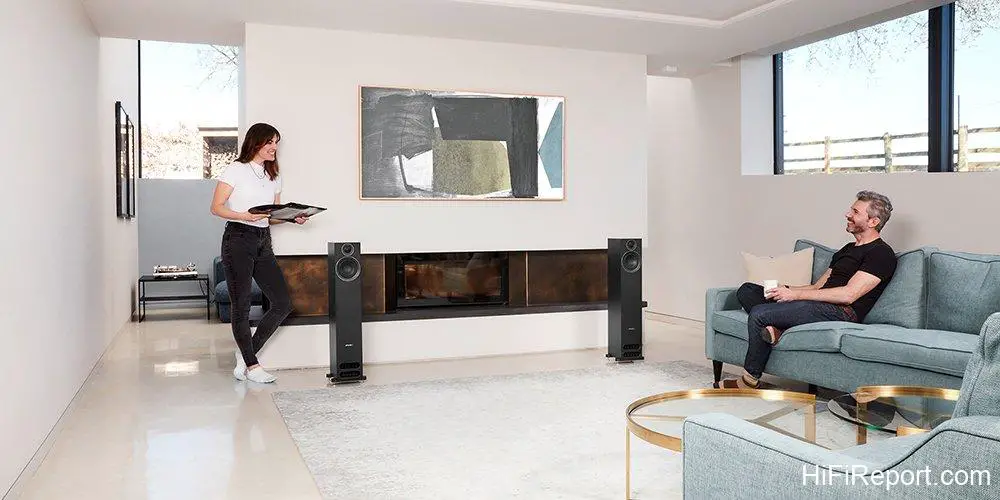
Comparing their specifications side-by-side, one might be surprised by the number of identical or nearly identical figures.
The most significant difference lies in the frequency response. The Prodigy 1’s bass extends down to 50Hz, while the Prodigy 5 reaches 35Hz.
Sharing many design elements, the Prodigy 5’s sonic character is very similar to the Prodigy 1. However, the added cabinet volume provides the Prodigy 5 with a more relaxed sound, deeper bass, and a richer sonic foundation.
The Prodigy 1 sounds more pristine, while the Prodigy 5 is more composed and substantial.
If space permits and you can accommodate floorstanding speakers, investing a bit more for the Prodigy 5 is definitely worthwhile.

Lightweight Chassis, Heavyweight Performance
In the HiFiReport listening room, I used the Pass XP-12 preamplifier paired with the X250.8 power amplifier to drive the Prodigy 5.
While this pairing might seem disproportionate in terms of price, utilizing the X250.8’s 350W of power to drive the Prodigy 5 allowed me to fully appreciate its capabilities.
Taking Friend’ n Fellow’s rendition of “Light My Fire” as an example, female vocalist Constanze Friend’s voice is full-bodied and warm, with vocal textures presented with confident clarity, underpinned by a satisfying richness.
Guitarist Thomas Fellow’s guitar notes are crisp and resonant. When he plays lower notes, the bouncy, articulate notes spring to life, creating a vivid sonic picture.
As a powerful chord strikes, the energy from the Prodigy 5 surges forth instantly.
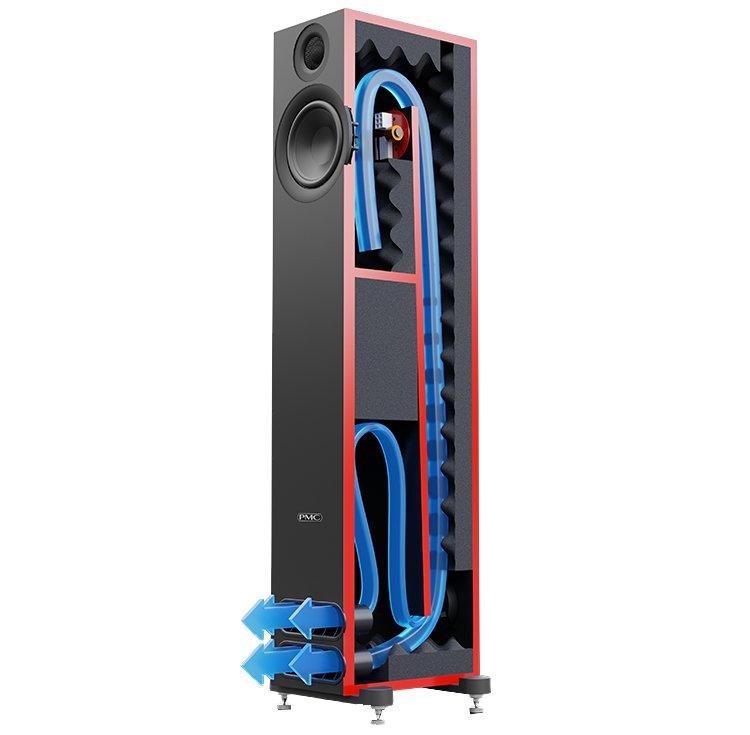
Despite being a floorstanding model, it is slender and lightweight, weighing only 10 kg—truly a featherweight contender.
Yet, listening to its powerful dynamics, full-bodied vocals, bright and clear timbre, and expansive soundstage, you would never guess this sound emanates from such small speakers.
Drum Sounds That Will Blow You Away
Playing Dire Straits’ “Brother in Arms” album further reveals the Prodigy 5’s prowess.
In “So Far Away,” a steady rhythm pervades the track, with the electric bass entering first, followed by the powerful drum groove.
Listen to the tom-tom drums—powerful and crisp. Several bass drum kicks later, the rounded, full, and weighty drum sound immediately enriches the rhythm.

Electric guitar, electric bass, keyboards, synthesizers, and layered vocals are mixed and presented with lifelike presence. Personally, I think nothing in this song surpasses the drums.
The drum sounds from the Prodigy 5 are truly remarkable. It should be renamed “Prodrumgy 5”!
“Money for Nothing” opens with distant vocals and accompaniment, almost like a dreamlike murmur, which is shattered by the forceful drums.
The drums build gradually, culminating in an explosive outburst that introduces the distorted electric guitar melody.
Listen to this track, turn up the volume a bit. In the transparent soundstage, unrestrained musicians seem to burst forth. Think Dire Straits is too old-school? Listening with the Prodigy 5, you’ll be blown away regardless of your age.

Bass Performance Beyond Expectations
How powerful can the bass be from such small floorstanding speakers? Let the duo markusphilippe demonstrate.
Listening to their album “Saxnbass,” the album title itself reveals its content.
Indeed, it’s a simple arrangement: a tenor saxophone and a double bass.
The tenor saxophone’s raw, gravelly, metallic sound and its intricate textures are fully unveiled.
As for the double bass, it is massive and deep. “Massive” refers to its physical scale, and “deep” naturally refers to its low pitch.

Such a large double bass, reproduced on floorstanding speakers, should offer a sense of scale that bookshelf speakers cannot match.
However, for floorstanding speakers as small as the Prodigy 5, with only a 5-inch woofer, the bass extends remarkably deep while maintaining a certain level of resolution. This allows the plucked notes of the double bass to be clearly discernible.
Being able to reproduce the rich and weighty low frequencies of the double bass so clearly, it’s no wonder PMC confidently showcased a pair of Prodigy 5s at the 2023 Munich High End Show, demonstrating the strength of PMC’s engineering foundation to seasoned audiophiles in a large venue.
I’ve been praising it so much; if you haven’t heard it yourself, I wouldn’t blame you for thinking I’m exaggerating.
Magnificent Soundstage, Truly Impressive!
I mentioned earlier that it can handle large-scale performances. I used “The World of Hans Zimmer” live recording as an example. In the “Lion King Suite,” the music describing the birth of Simba, the young lion prince, unfolds with orchestra and vocals, harmonious and full of hope.
Then, a tense and exciting passage is introduced, depicting Simba being tricked and caught in a stampede of wildebeests, with his father, the Lion King, rushing to rescue him, ultimately perishing in the gorge.
Listen to the powerful rhythm and dense harmonies. The Prodigy 5, in a manner that rivals larger speakers, uses this music to transport you back to the movie scene.
The final movement of the suite is the most magnificent. It depicts adult Simba defeating his evil uncle and becoming king, fathering offspring, symbolizing the endless cycle of life and vitality on the land.
Here, the harmonies are richest, fullest, and heaviest. The orchestra, combined with vocals and powerful percussion, creates a grand and majestic atmosphere.
For such small speakers to create such a large soundstage is not just impressive; it’s incredibly impressive!

Deep Bass, Clear Layers, Expansive Scale – Consistently Surprising
PMC has a classic slogan: “the speakers that make the movies.” Whose speakers are they? Of course, PMC.
Their speakers are prevalent in major professional recording studios and even received an Emmy Award in 1996 for “Contribution to Recording Excellence.”
Therefore, whenever I encounter PMC speakers, I always want to listen to movie soundtracks.
Taking the “Dune” soundtrack as an example, in “Dream of Arrakis,” powerful, energetic percussion with a crisp texture sweeps in, followed by deep, resonant drums. The heartbeat-like rhythm draws you into the boundless imagination of an unknown universe.
The final layers of vocals create a sound that makes your blood surge.
As for “Herald of the Change,” the specially crafted wind instruments produce a voice-like sound. The repeated melody is broken by a powerful bass note, and the sonic texture then becomes progressively richer and denser.
The bass is deep and weighty; the layers are distinct; the scale is expansive.
Again, the Prodigy 5’s performance is truly surprising.
Swapping to a 40W Tube Amp: Sweet, Charming, and Fulfilling
The Pass X250.8 has formidable driving power, and considering its price, most Prodigy 5 buyers won’t pair them this way.
I switched to a Walker Audio EL34 vacuum tube integrated amplifier to listen to Alice Sara Ott’s “Nightfall” solo piano album. Debussy’s “Rêverie” (Dream), with its soft and hazy timbre created through pedal work and touch, sounds absolutely beautiful here.
As for “Suite Bergamasque,” the Prelude, filled with singing, lyrical melodies, creates a poetic and dreamy atmosphere through arpeggiated chords.
The piano notes are crystalline and rounded, with a touch of sweetness imparted by the EL34 tubes, like sugar-frosted pastries. This charming quality is completely different from the grand and powerful style mentioned earlier.
This is another facet of the Prodigy 5.
The Menuet, with its folk-like style and light steps, is playful yet retains an elegant demeanor.
As for “Clair de Lune” (Moonlight), listen to the moon reflecting on a tranquil lakeside at night, gently rippling in the evening breeze, shimmering and swaying with the waves. The warm glow and rich sonority are simply exquisite.
Driven by a 40W EL34 tube amplifier, this sweetness and charm, this endearing quality, the Prodigy 5 still manages to convey the beauty of Debussy’s music with full expression.
Can You Tell Me a Better Alternative?
British in-house manufacturing, transmission line enclosure, endorsed by major recording studios—for a pair of floorstanding speakers with a price under $2465 USD (Roughly converted from 79,500 NTD), can you tell me a better alternative? The Prodigy 5 not only carries the reputation PMC has built over thirty years but also truly possesses the capability.
And its capabilities are something PMC can be genuinely proud of.
Specifications
* Type: 2-driver 2-way transmission line floorstanding speaker
* Drivers: 27mm soft dome tweeter × 1, 133mm long-throw LTTM natural fibre mid-bass driver × 1
* Frequency Response: 35Hz – 25kHz (-3dB)
* Impedance: 6 ohms
* Crossover Frequency: 1.7 kHz
* Sensitivity: 87.3 dB
* Maximum SPL: 123dB
* Recommended Amplifier Power: 20 – 250W
* Effective Transmission Line Length: 1.96m
* Horizontal Dispersion: 80 degrees
* Vertical Dispersion: 70 degrees
* Dimensions: 905 × 162 × 237 mm (H×W×D)
* Weight: 10 kg