
Sampo EM-65QB220 Review
Taiwanese home appliance brand Sampo has, over the past two years, actively sought to redefine the impression people have of its television lineup. For a long-standing television brand, this ambition to transform is truly commendable. For many appliance brands, their product offerings tend to remain fixed over the years, making it difficult to break away from established thinking and integrate new ideas.
This is especially true for necessities like televisions, which are essential for daily life and entertainment. Once consumers form a perception of your product, changing their minds becomes an exceptionally challenging task.
Realistically, we all know that the market share landscape for television brands in Taiwan, whether foreign or domestic, has long been established based on annual sales volumes. For a brand like Sampo, shifting its product positioning requires an investment in more technology and marketing costs, but also a highly accurate grasp of the ever-changing trends in the audio-visual industry.
Brand Strategy and Evolution
Last year, when they launched their first Quantum Dot TV, the WA series, it became quite clear that they were determined to alter their brand image. Not only did this QLED TV deliver significantly better picture quality and color performance than previous models, but Sampo’s signature audio processing technology also managed to create a better sound experience than many competing products, potentially saving consumers the budget they might otherwise spend on external speakers.
However, the only slight drawback at the time was the use of the Linux operating system for the smart TV features, rather than the Android system more familiar to Taiwanese users.
Introducing the Android TV Experience
This year, in an effort to better align their products with Taiwanese usage habits, Sampo officially introduced its first LED 4K TV series powered by Android TV – the QB series. This allows users to access various Android smart TV content within the familiar Google Play service framework and interface.
Beyond downloading a wide range of applications from the Google Play Store, several of the more popular OTT platforms in the Taiwanese market, including Netflix, YouTube, and LiTV, are readily available on the QB series.
While Android TV is now quite common, Sampo has managed to differentiate its interface planning from other brands. For instance, they have specifically designed the S-Channel menu to feature several streaming platforms and applications commonly used by Taiwanese consumers. Once connected to the internet and downloaded, users can simply select these directly for viewing and use.
Naturally, you can also leverage the Google Assistant voice assistant function within Android TV to perform content searches, inquire about daily information, and more using voice commands. Furthermore, the convenient and easy-to-use Chromecast built-in feature allows you to effortlessly cast content from your phone or tablet to the TV for large-screen playback, eliminating the need to install a separate external Chromecast device – a truly convenient addition.
Picture Performance
The WA series, featuring QLED technology introduced last year, boasted a wide color gamut display capability as its standout picture quality characteristic. Sampo achieved this by covering the LED backlight panel with a layer of quantum dot film, allowing the WA series to achieve approximately 120% coverage under the Rec.709 standard, thereby setting the tone for the rich, full, and vibrant style of the new generation of Sampo televisions.
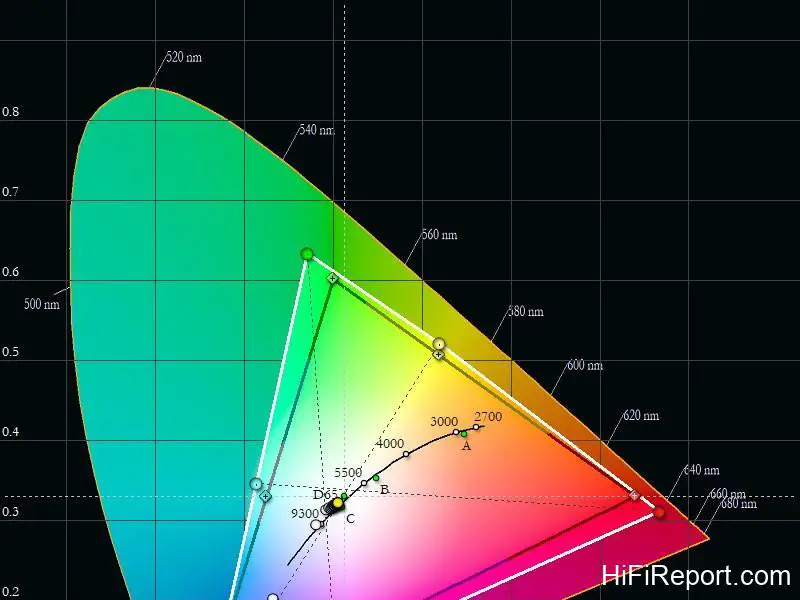
This year, Sampo has extended this color style to the QB series. While testing the color gamut performance of the EM-65QB220, I was surprised to find that its color gamut range was actually comparable to that of their flagship models using quantum dot technology. With a price difference of around $1,000 USD, this performance certainly piqued my curiosity.
Upon inquiring with the original manufacturer, I learned that they employed KSF LED backlighting in this TV. This technology utilizes the narrow half-width spectrum characteristic of red phosphor to enhance the color purity of the LCD panel. Through careful color calibration by their engineering team, this TV, which already possesses excellent backlighting capabilities, is able to present an exceptionally wide color display range thanks to the enhancement of color tuning technology.
Based on actual testing, it boasts approximately 120% color space coverage under Rec.709 and achieves about 90% color gamut fill rate for DCI-P3. Honestly, for a domestic brand television in this price segment, such color performance is not commonly seen.
The EM-65QB220 is an LED LCD television employing direct-lit backlight technology. Besides delivering vibrant color effects, it also offers excellent backlight performance and a wide viewing angle. The EM-65QB220 utilizes Micro Dimming technology, which partitions and refines most details within the pixels.
With 1296 zones, it performs nuanced adjustments to brightness and darkness based on the input video signal, resulting in better contrast compared to regular LCD TVs and enhancing the naturalness of color depth variations.
In terms of HDR compatibility, while the EM-65QB220 doesn’t support Dolby Vision like the WA series, it does support HDR10, commonly found on 4K Blu-rays, and HLG for 4K videos on YouTube. Therefore, when viewing 4K content corresponding to these two HDR formats, you can still experience the enhanced contrast, richer highlight details, and more complete color gradations that characterize 4K HDR effects.
When watching Netflix, this TV also supports Netflix 4K HDR, which is undoubtedly the best quality assurance for friends who enjoy binge-watching.
Sound Quality
Television audio processing has long been a strength of Sampo TVs. From their early Thunderclap to the New Thunderclap sound technologies, Sampo has consistently excelled at incorporating unique built-in speaker designs within the limited confines of the TV chassis.
In recent years, they have also embraced market trends by integrating new audio technologies, such as collaborating with renowned audio companies to design TV speakers or incorporating specifications that align with software audio formats. Essentially, Sampo manages to achieve new milestones in audio processing with each new model year.
The EM-65QB220’s audio processing technology this year presents several key features. First, it adopts the down-firing speaker design typically found only in higher-end models in the past. The 2-way, 4-driver speaker system is independently positioned below the screen, driven by a 12W+12W output power, delivering direct sound and a spacious soundstage.
Second, the audio signal tuning technology utilizes the DBX-TV intelligent sound processing technology, which has won multiple Emmy Awards. This technology allows the TV to set the most suitable sound mode based on the playback content.
The EM-65QB220’s built-in sound modes include News, Movie, Sports, Music, Volume Boost, Night, and User modes. Each mode is fundamentally designed to provide the most appropriate sound effect depending on the content being played. Based on my actual listening experience, the Movie and Music modes are two modes consumers can frequently use. Both modes deliver clear audio quality and a spacious soundstage.
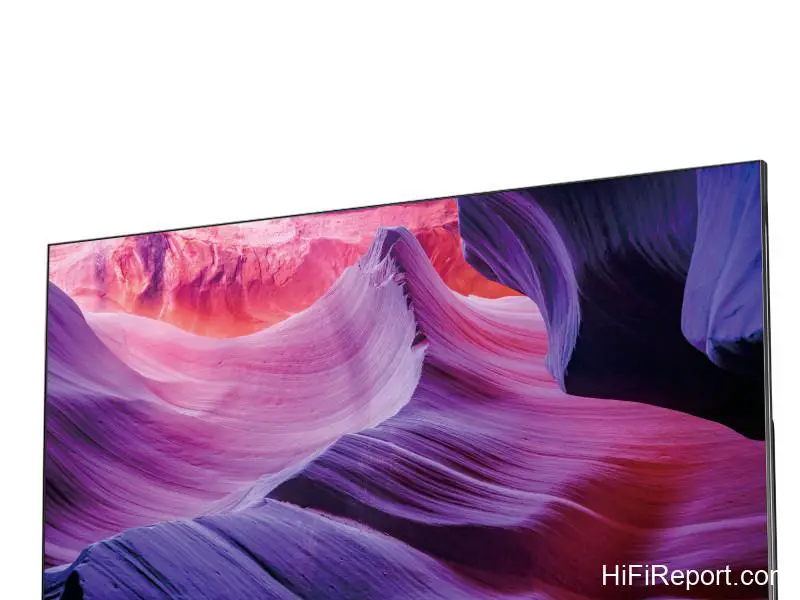
The difference lies in the Movie mode having slightly stronger sound energy, making it very suitable for experiencing the powerful audio performance while watching movies or TV series.
Viewing Experience
As I mentioned in my review of the QM-65WA500 previously, Sampo TVs over the past two years have adopted a rich and full color tuning style, presenting a vibrant and colorful tone in 4K images. The EM-65QB220 continues this style. With a wide color gamut and strong contrast that doesn’t sacrifice detail, the images can exhibit high-density imaging effects and a sense of depth, significantly enhancing the narrative tension of movie scenes.
The increasing emphasis on picture quality refinement in Sampo TVs over the past two years is also evident in the EM-65QB220. While its colors are saturated, the variation in color depth still exhibits subtle gradient effects. The separation between adjacent colors is excellent, completely avoiding the common blurriness and poor convergence issues often seen in budget models.
These aspects are crucial for enhancing image refinement, as this type of color performance allows for sharper outlines and richer detail information in the images.
Another point is that if you want to assess the quality of picture performance in mid-to-low range large-screen TVs, the HDR effect is an excellent criterion. Many TVs on the market list impressive HDR specifications, but when actually playing 4K HDR content, the performance of highlight details isn’t handled very well. The EM-65QB220 is different; it clearly renders the detail information in bright areas.
For example, when looking from a dimly lit indoor space towards the bright outdoors in a movie scene, the scenery outside the door can be seen clearly. This is another area where I commend this television.

Conclusion
Sampo’s EM-65QB220 can be said to be the most value-for-money domestic model I have reviewed in the first half of this year. Not only does it offer a certain level of picture quality, but its comprehensive smart TV planning coupled with excellent audio processing technology can completely satisfy the current needs of people for watching audio-visual entertainment via television.
If you watch movies or TV series, prioritize both high picture quality and sound quality, but are limited by budget from purchasing high-priced Japanese or Korean brand TVs, I believe the EM-65QB220 would be your best option at this time.