
PS Audio PMG Signature 512 DAC Review
Last year, American audio manufacturer PS Audio grandly introduced its new top-tier flagship series, the PMG Signature Series. This represents the most significant milestone in PS Audio’s 50-year history and marks the first time a product line has been named after founder Paul McGowan’s initials (PMG). Designed completely from scratch by analog circuit wizard Darren Myers, this entirely new framework breaks away from existing conventions.
The complete series includes the PMG Signature Preamplifier, PMG Signature 512 DAC digital-to-analog converter, PMG Signature SACD Transport, and PMG Signature Phono Preamplifier. In the first half of this year, power amplifiers such as the PMG Signature M800, M400, S400, and S200 were also unveiled, completing the full PMG Signature lineup.
Local audio distributor HiFiReport provided us with the PMG Signature 512 DAC for review. This unit completely abandons commercially available off-the-shelf decoding chips. Instead, it utilizes an in-house developed FPGA computation engine and PureStream DSD512 core architecture to uniformly upsample all digital signals to 8x DSD (DSD512) for decoding, subsequently outputting analog signals through a Class A fully balanced direct-coupled circuit designed by Darren Myers.
The remote control of the PMG Signature Series. While DACs are typically operated via tablets or smartphone streaming apps, having a remote control remains very convenient for basic operations or when managing multiple PS Audio components.
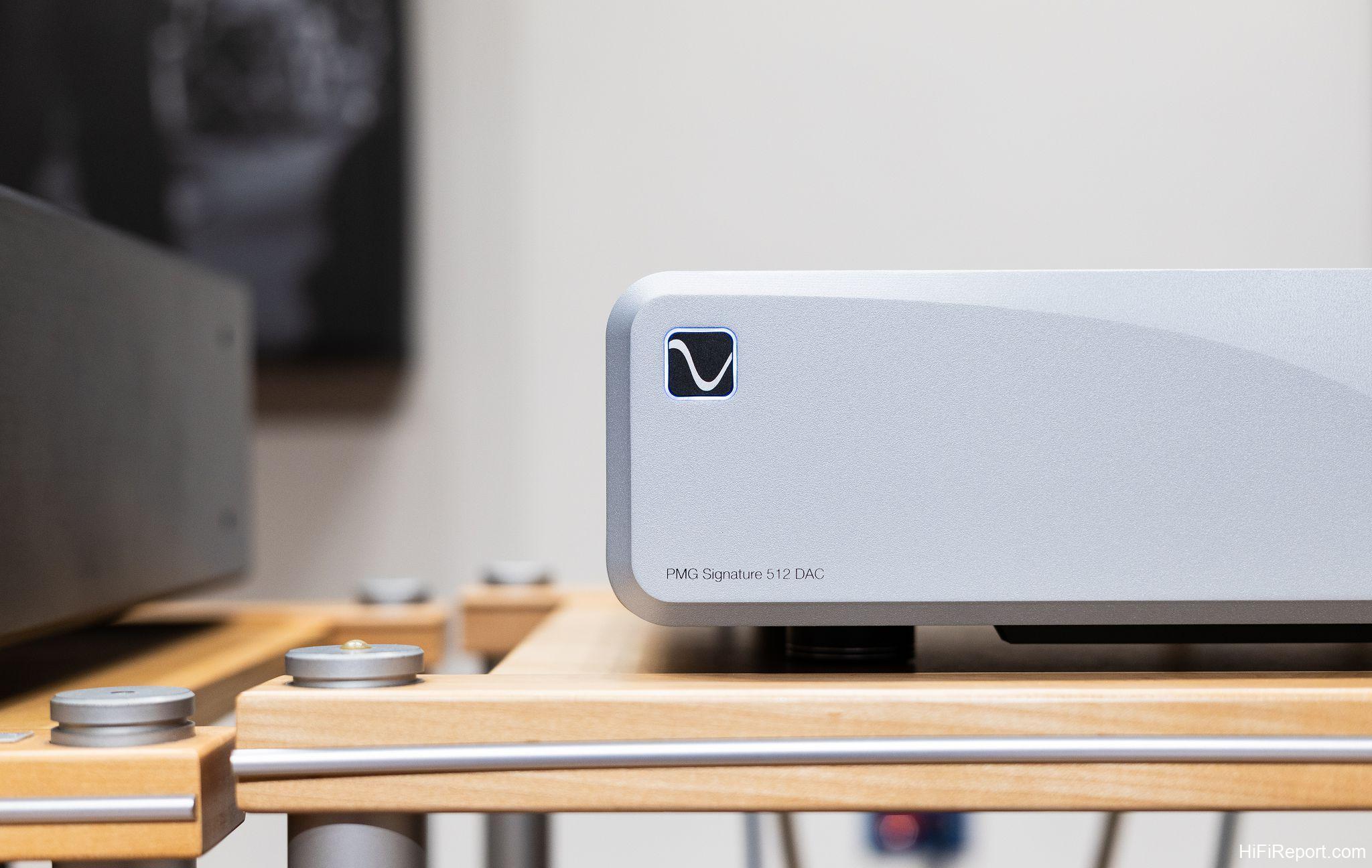
The flagship PMG Signature Series features an all-aluminum chassis with an elegance explicitly carved into the front panel through a “sine wave curve.” Inside, a dual-layer isolation structure provides enhanced anti-resonance and electromagnetic interference rejection capabilities.
The PS Audio logo on the left functions as the power switch and illuminates when the power is turned on.
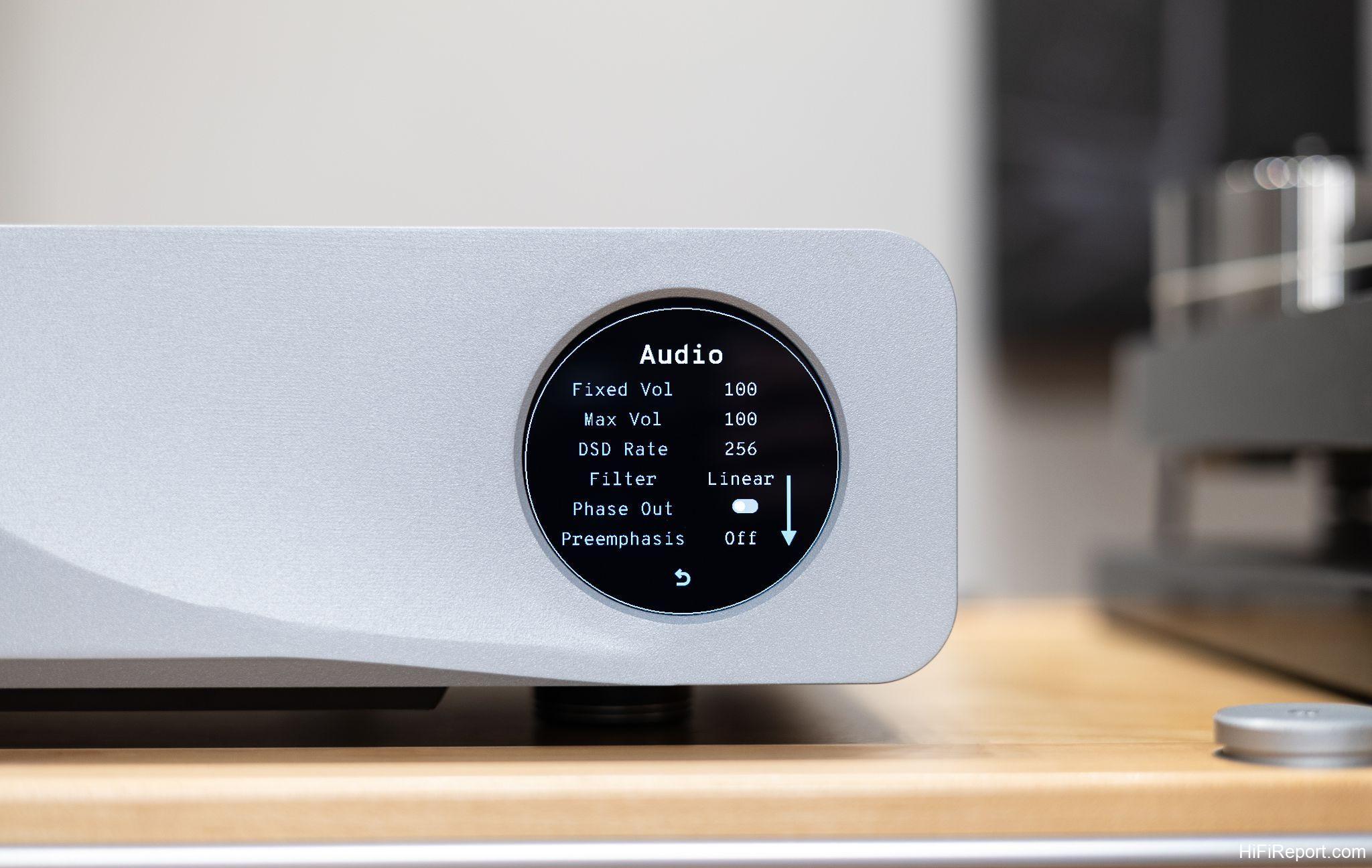
The circular display screen on the right features a touch design, allowing users to perform various settings. The capacitive touch operates much like a smartwatch, offering extremely precise and responsive feedback.
The rear panel layout is exceptionally rich, perfectly reflecting its positioning as a “high-end system core.” It is primarily divided into four sections: digital inputs, network streaming, analog outputs, and system integration. The I²S transmission terminal is PS Audio’s most praised and highest-quality transmission interface.
By using an HDMI cable to transmit clock and audio data separately, it completely eliminates jitter, making it ideally suited for connecting to their own PMG Signature SACD Transport. Through DSD Direct technology, the raw pure DSD signal within the SACD is transmitted losslessly to the 512 DAC for decoding. It directly supports Roon Ready, Tidal, Qobuz, Spotify, and DLNA/UPnP.
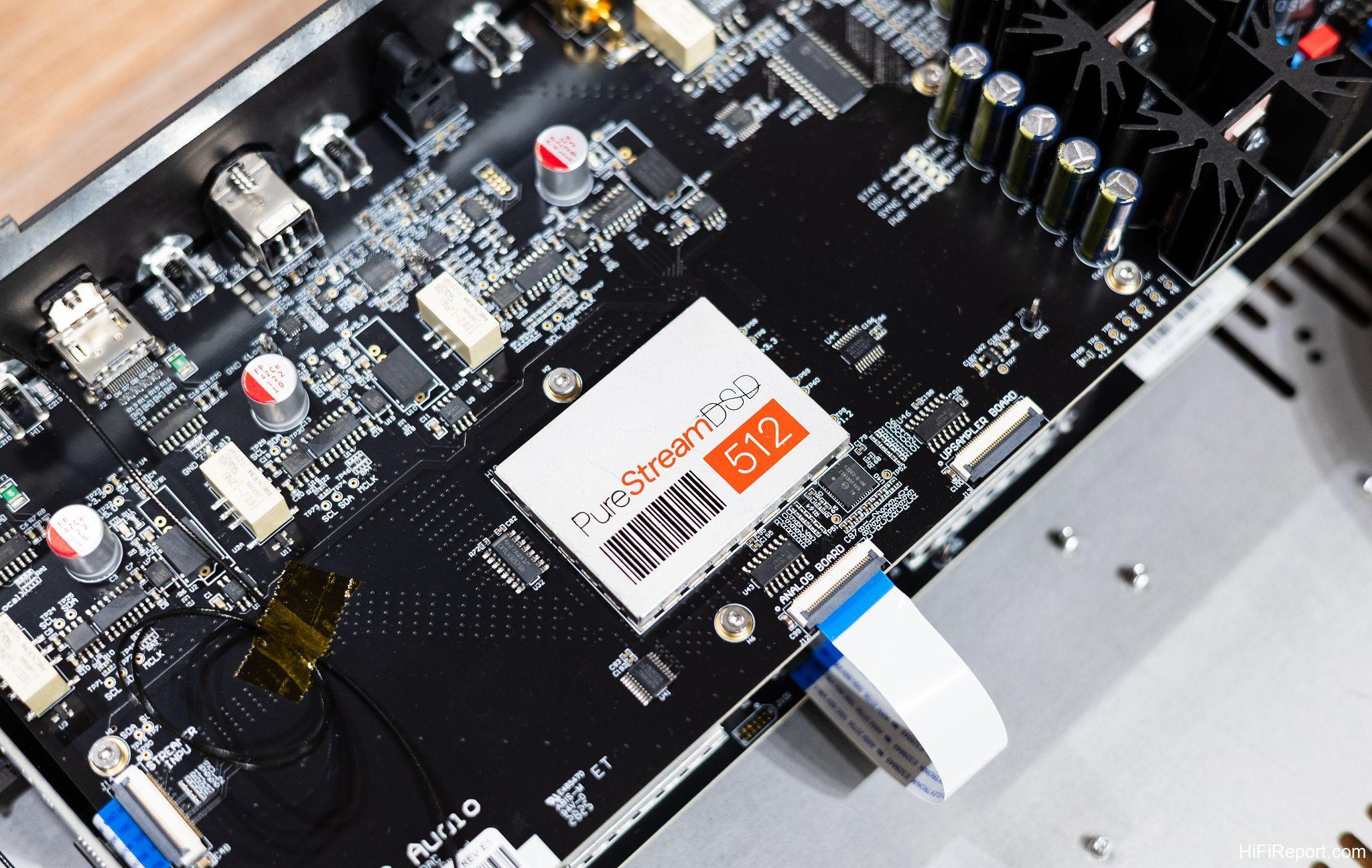
With assistance, we opened the chassis to inspect the interior. The circuit layout is remarkably orderly, featuring an oversized toroidal transformer thoroughly isolated from other circuits, while the digital and analog circuits reside on separate upper and lower circuit boards. Upon entering, digital signals first pass through PS Audio’s signature Digital Lens digital reclocking technology to reprocess the clock and eliminate source-level jitter.
Afterward, the PureStream DSD512 engine upsamples the signal and feeds it into the newly designed SpectraWave 64-Tap Sequencer (a 64-tap finite impulse response digital filter) specifically engineered to handle ultra-high-speed digital audio (DSD512), precisely correcting the digital signal time base and eliminating time phase distortion.
The analog amplification circuit discards output transformers and coupling capacitors traditionally favored in audio equipment, adopting a direct-coupled circuit instead. With no redundant components in the signal path, it boasts ultra-low output impedance and high-current drive capability, alongside a pure analog volume control system.
PS Audio’s renowned “DirectStream Power Plant” regeneration technology is miniaturized and extended within the 512 DAC. AC power entering the unit does not undergo standard step-down rectification; instead, it first passes through multiple precision filters before an exclusive internal oscillator circuit regenerates an extremely pure, flawless internal power supply curve free from external interference.
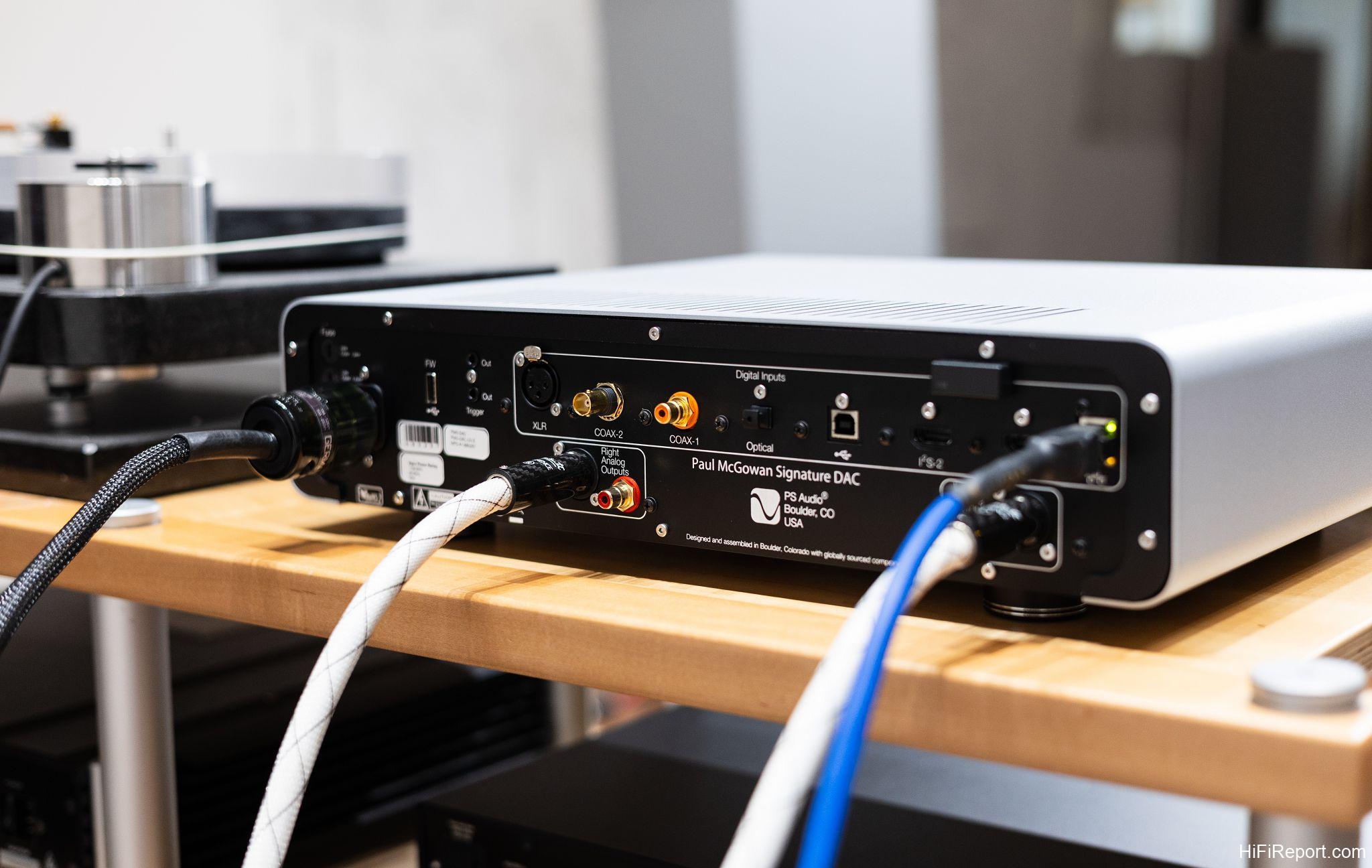
To prevent noise interference from wired networks, USB ports, or the power line, comprehensive galvanic isolation is implemented internally between the digital input stage, FPGA core, and analog output stage.
During our audition, we used Roon for playback.
Combining Rational Detail with Emotional Expression
For the beginning of the evaluation, we played The Police’s track “Every Breath You Take” as a reference. The PMG Signature 512 DAC demonstrated a perfect fusion of delicacy and warmth, maintaining an exceptionally high background transparency alongside swift, clean transient response. Instruments unfolded across a pristine, uncolored background, where the guitar’s steady plucking possessed palpable weight.
The deep, muffled notes remained restrained rather than heavy, diffusing through the space like a light mist to reveal intricate layers and dynamic details. It rendered the rock style with effortless smoothness, stripping away harshness to deliver a presentation that balanced rational detail with emotional resonance, bringing nostalgic sentiment to life with vivid delicacy.
Vocals were exceptionally well-focused, emerging centrally and pairing with the background percussion to establish a profound soundstage depth. The lead singer’s slightly raspy, seductive, and magnetic voice was magnified accordingly, rendering vocal cord vibrations and breathing nuances with heightened intensity. The emotional tension resonated directly with the listener, complemented by the springy, resilient background strings.
Overall, the presentation offered richer dynamics, with instrumental weight slightly set back, weaving back and forth with the vocals at distinct spatial intervals. This alternating delivery imparted greater elasticity to the soundstage, restoring stage proportions and layering with such meticulous detail that it culminated in an outstanding live-performance experience.
Quiet, Pitch-Black Airiness
Next, we listened to The Civil Wars’ track “Poison & Wine.” The PMG Signature 512 DAC articulated pure and entangled emotions to the absolute fullest. The track began unfolding against a quiet, pitch-black background, where light yet solidly weighted sounds evoked a heavy, sluggish emotional weight. The instrumental texture of the guitar plucking felt remarkably authentic; the subtle friction and resonant vibration of fingertips brushing strings carried a warm, delicate density.
Left-to-right localization imaging and layer separation were distinct and sharp. Set against a transparent background, the minimalist instrumental arrangement exuded a strong sense of liveness, effortlessly building an expansive soundstage filled with dynamic airiness.
Vocal performance was equally stellar. In the contrasting yet highly harmonious duet between the male and female voices, the system exhibited exceptional three-dimensionality and density. The female vocals sounded sweet, accompanied by delicate dynamics featuring subtle vibrato; the male vocals, raspy yet warm and mellow, possessed rich fullness.

The lip-and-tongue dynamics, breath exchanges, and slightly restrained throat tones during their singing conveyed intense emotional fluctuations with remarkable precision. Intertwining and colliding to complement one another, these elements delivered raw emotion straight to the heart, allowing the listener to fully experience a breathtakingly moving yet tenderly entangled scene.
Distinct Instrumental Layering
While previous listening sessions used default settings, we decided to experiment by upsampling tracks already upscaled to DSD 256 further up to DSD 512. Playing Ed Sheeran’s track “Eyes Closed” as a reference, the PMG Signature 512 DAC rendered pop music with striking warmth. The track opened with elastic, deeply descending string tones completely devoid of turbidity, soon joined by guitar playing executed with exquisite detail.
The wooden resonance of the instrument was faithfully restored—warm yet crisp in texture—making the instrument’s physical presence exceptionally clear. As the vocals and instruments unfolded, elements were neatly arranged within a spacious environment, maintaining distinct front-to-back separation that felt exceptionally comfortable and deeply layered.
The intense emotion within the vocals was conveyed with powerful penetration by the PMG Signature 512 DAC. The singing voice within the soundstage was warm yet slightly raspy, displaying high density. Whether capturing the slightly suppressed choking in the throat or the subtle breath changes, every detail felt as intimate and authentic as a whisper right at the ear.
As the song progressed into the chorus, the density of various instruments grew immensely robust, yet precise front-to-back spatial positioning remained intact, deepening the soundstage further. Elements were stacked together with natural clarity and zero awkwardness, revealing a sincere and emotionally infectious sonic landscape.
Perfect Proportions of Depth and Intersection
Finally, we played the soundtrack piece “Lumière.” The opening section of the track is relatively soft, and the PMG Signature 512 DAC captured that softness and purity with uncanny realism. Commencing against a silent background via understated instrumental solos and whispered murmurs, the soundstage felt remarkably expansive; even the sound of a gentle breath appeared exceptionally distinct.
The string and vocal lines were slender yet possessed distinct physical presence, delivering a restrained and delicate performance. From the very beginning, it showcased superb transparency, shaping the instruments with exceptional elegance to forge an ethereal, mysterious, and wide-open space that served as a flawless prelude to the subsequent sonic climax.
As the track progressed, the gentle atmosphere at the rear of the stage stacked up layer by layer, transforming into a grander, more massive, and impactful arrangement. The ethereal and beautiful vocals began to drift and soar across the soundstage, with high-frequency extensions mapped out in a crisp and smooth manner, vividly outlining throat vibrations and breath modulation.
The strings and chorus at the rear lined up neatly, establishing a deeply interlocked depth of field against the female lead upfront. Drawing a picture from background grandeur to delicate, soft, and graceful front-stage vocals, these elements intertwined to generate an epic style defined by living contrast and a lingering sense of melancholy.
Specifications
* Digital Inputs: I2S (2), Coax (2), XLR Balanced (2), Optical, USB
* Decoding Capability: Up to 768kHz 32-bit, DSD 512
* Streaming: Roon Ready, Tidal via Roon, Qobuz Connect, Spotify Premium, DLNA/UPnP, ShairPort
* Network: 10/100/1000 Ethernet, WiFi: IEEE 802.11 b/g/n/ac (2.4 & 5GHz dual band)
* Analog Outputs: RCA x1 pair, XLR x1 pair
* Output Level: 2 VRMS Single-Ended, Maximum 4 VRMS Balanced
* Output Impedance: < 100Ω / 200Ω
* Frequency Response: 20Hz–20kHz ±0.25dB
* Total Harmonic Distortion: THD+N @ 1kHz (full scale) < 0.001%
* Power Consumption: 30W
* Dimensions: 375 mm x 445 mm x 112 mm (with feet)
* Weight: 13.61 kg