
QUAD 33 Preamp / 303 Power Amp Review
During the early era of solid-state amplification when transistor amps suffered from a poor reputation, Peter Walker bravely met the challenge. In 1967, he introduced the QUAD 33 preamplifier and QUAD 303 power amplifier combination.
True to his design philosophy, this duo was simple and reliable, making it an instant hit across the UK and continental Europe. Audiophiles praised the setup for its excellent linearity, low distortion, precision, and highly musical sound. Even now, nearly six decades after the original release, refurbished vintage QUAD 33 and 303 units are still cherished by audiophiles who continue to use them to enjoy music today.
Reading this, you might think vintage enthusiasts are listening to nostalgia rather than music. I beg to differ. I believe classic audio components from the golden era possess a unique signature style, much like iconic vocalists from decades past whose voices are instantly recognizable.
This is not to say modern gear lacks character, but contemporary audio components generally have a less distinct sonic identity. The vintage “grandfather-level” amplifiers that audiophiles still spend good money to restore almost always share a common trait: a “warm sound.” It is rich, musical, and fatigue-free for all-day listening. Simply put, this is what enthusiasts refer to as the “analog sound.”
The new QUAD 33 preamp and 303 power amp reviewed here were announced in December 2024 and have only recently hit global markets. With an antique aesthetic that feels like a time machine from the 1960s, I was highly anticipating whether they could deliver that classic, vintage flavor before I even began my listening tests.
Making a new amp sound vintage seems simple enough—just copy the original circuit, right? There is nothing wrong with this logic; indeed, many reissue vacuum tube amplifiers do exactly that, fulfilling the enthusiast’s dream of owning a “brand-new vintage” unit.
While that approach works well for tube gear, what about solid-state designs? Rather than glossing over this with lazy marketing buzzwords like “recreating the classic,” I want to dive deep into the differences and connections between the past and present lives of the QUAD 33 and QUAD 303.
Legacy and Engineering
After studying the original 1960s schematics for the QUAD 33 and QUAD 303, let’s look at the original circuitry. To facilitate easy repairs, the original QUAD 33 featured a modular design. The “DISC Adaptor” card for turntable inputs utilized entirely passive components to switch between different cartridge types (MM/MC). The subsequent phono stage module used two BC550 transistors per channel alongside passive components to form the RIAA equalization circuit.
Bypassing the Tape and Disc Adaptor modules, the main preamplifier circuit employed three transistors per channel to form a single-ended, three-stage amplification circuit. It also featured bass and treble controls, along with three low-pass filters at 5 kHz, 7 kHz, and 10 kHz. Strip away these adjustment features, and the original QUAD 33 circuit was nearly as simple and elegant as a classic tube amplifier.
If both solid-state and tube amplifiers exhibit high harmonic distortion, they behave very differently. Transistor amps produce primarily odd-order harmonic distortion, which sounds harsh and piercing to the human ear.
Conversely, tube amps generate mostly even-order harmonics. Even with high distortion, even-order harmonics simply make the sound warmer and slightly softer, even if resolution and clarity drop.
This is the inherent disadvantage of solid-state designs: given equal amounts of high distortion, listeners will prefer the tube amp, often mistaking its high even-order distortion for “analogue warmth.” This is precisely why the original QUAD 303 had to push distortion levels incredibly low during the dawn of the transistor era to compete with contemporary tube designs.
Working with limited component availability at the time, QUAD aimed for low distortion and high stability. The QUAD 303 amplification circuit was remarkably elegant, utilizing just three low-noise transistors per channel for the input and voltage gain stages.
The output stage employed a Quasi-Complementary Symmetry design—specifically, QUAD’s famous “symmetrical triples” output topology. The first two stages of this triple configuration used four NPN and PNP transistors combined into complementary Darlington pairs to drive a final push-pull output pair of 2N3055 power transistors.
The advantages of this circuit included excellent simultaneous control of both voltage and current, high electrical and thermal stability, and low crossover distortion. Crucially, it applied only a small amount of local negative feedback within individual stages, completely avoiding global loop negative feedback from the output back to the input.
This resulted in exceptionally low transient intermodulation distortion (TIMD), yielding a sound that was remarkably natural rather than stiff or sterile. The success of the QUAD 303 profoundly influenced amplifier design philosophies for generations, proving that “low negative feedback” and “circuit simplicity” offer genuine sonic advantages.
Modern Reinvention
How does the 2024 reissue of the QUAD 33 and 303 approach this legacy? If Peter Walker were alive today, I doubt he would have simply cloned the vintage circuits. He famously stated his goal was “the closest approach to the original sound” and believed that “the perfect amplifier is a straight wire with gain.”
Compared to the electronic components of the 1960s, modern semiconductors and passive components offer vastly superior quality and performance, aligning much closer to Walker’s original ideals.
Although many of the original electronic components used in the vintage QUAD 33 and 303 are still obtainable, Peter Walker was a lifelong innovator. If he were here, he would have undoubtedly utilized newer materials and technologies to redesign the reissues for superior sound quality and performance.

QUAD treated the reissue of this legendary pair with the utmost importance. The development team at the UK headquarters was led by Jan Ertner (chief designer for QUAD and Audiolab), alongside senior QUAD engineers Rob Flain and Paul McConville, industrial design director David McNeill, and acoustic director Peter Comeau.
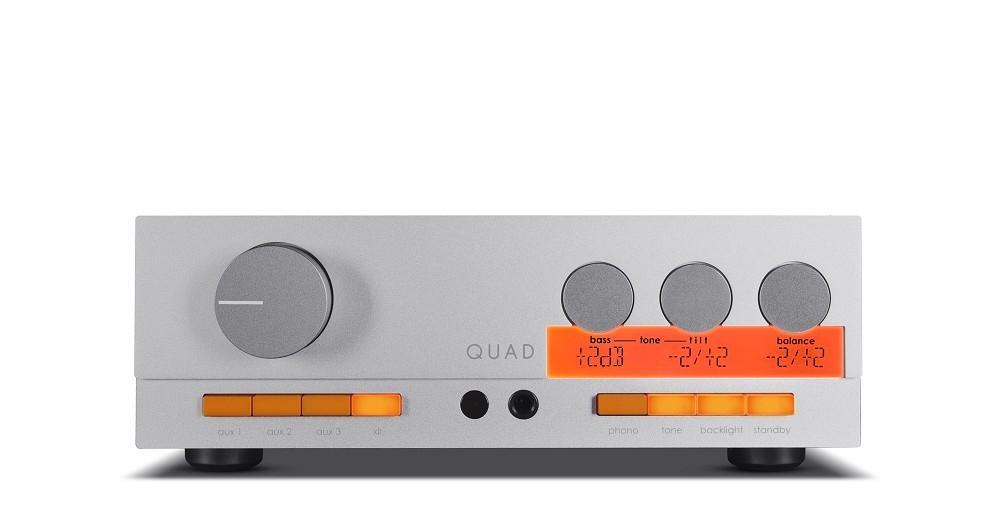
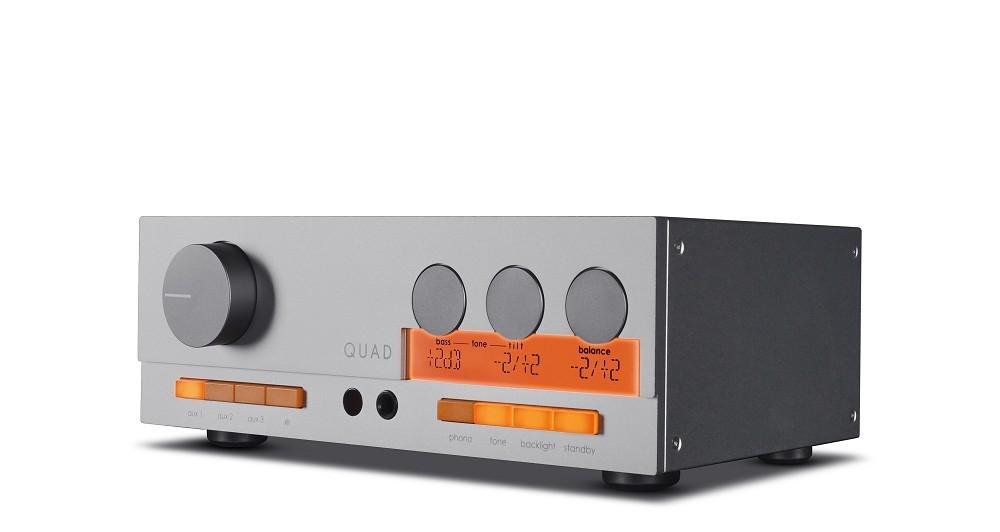
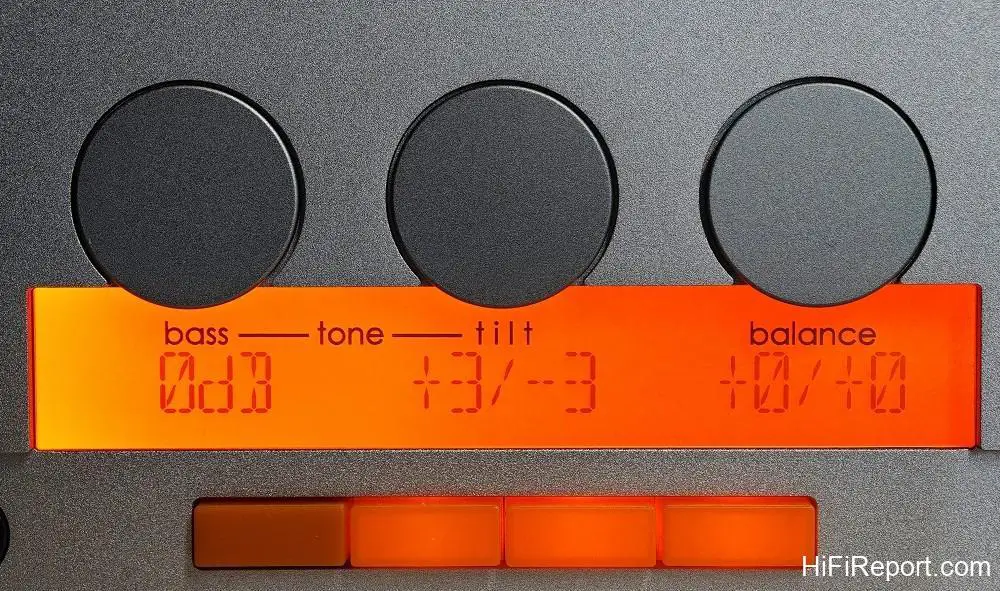
The overall look, color palette, and the placement, shape, and quantity of the knobs and buttons on the reissue remain remarkably close to the original. However, the new QUAD 33 replaces the vintage three-position variable slope filters with a channel balance control. It replaces the traditional treble control with QUAD’s famous “Tilt” function while retaining the bass adjustment.
Modern updates include a dedicated headphone output, an LED text display, and a remote control—something unheard of in 1967 but absolutely essential today.
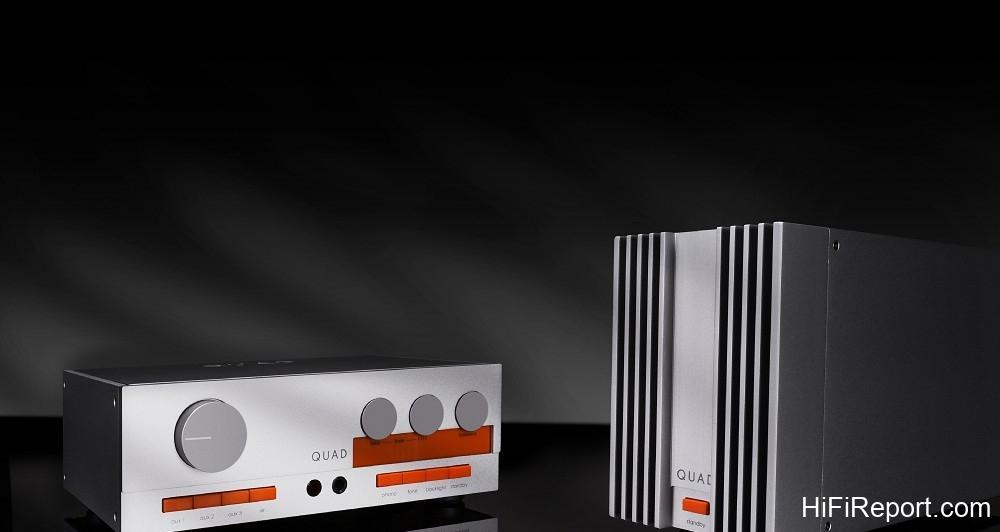
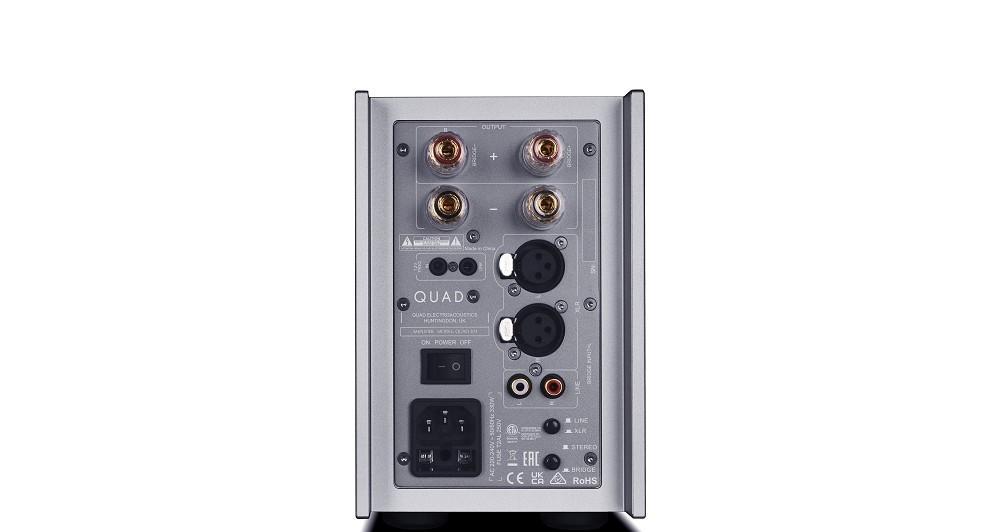
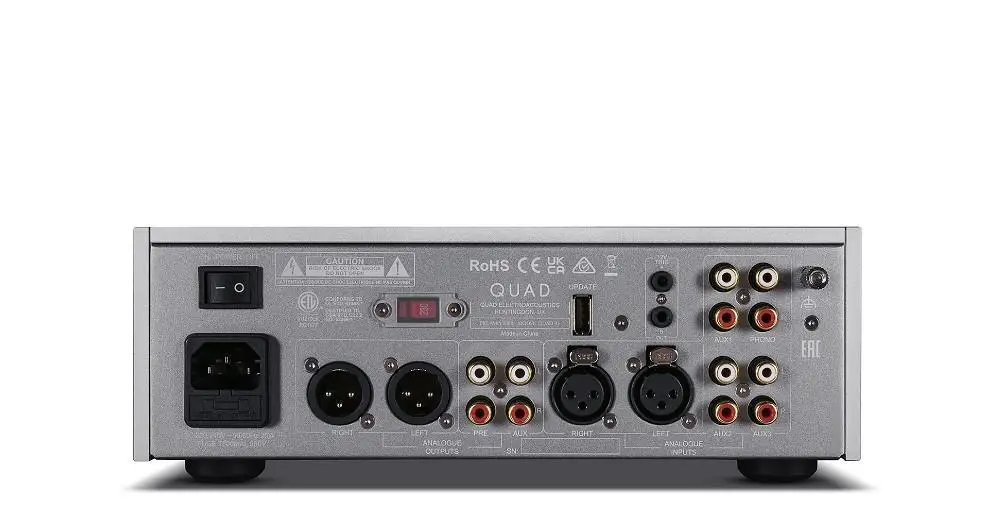
Regarding connectivity, the original units relied entirely on DIN connectors for signal input and output. Naturally, the new QUAD 33 and QUAD 303 have been updated to modern RCA and balanced XLR audio terminals.
Preamplifier Architecture
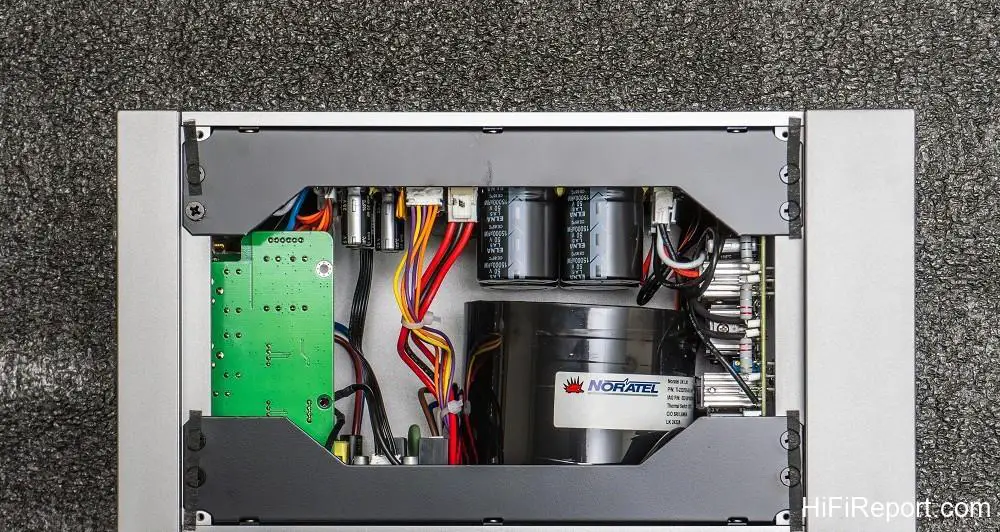
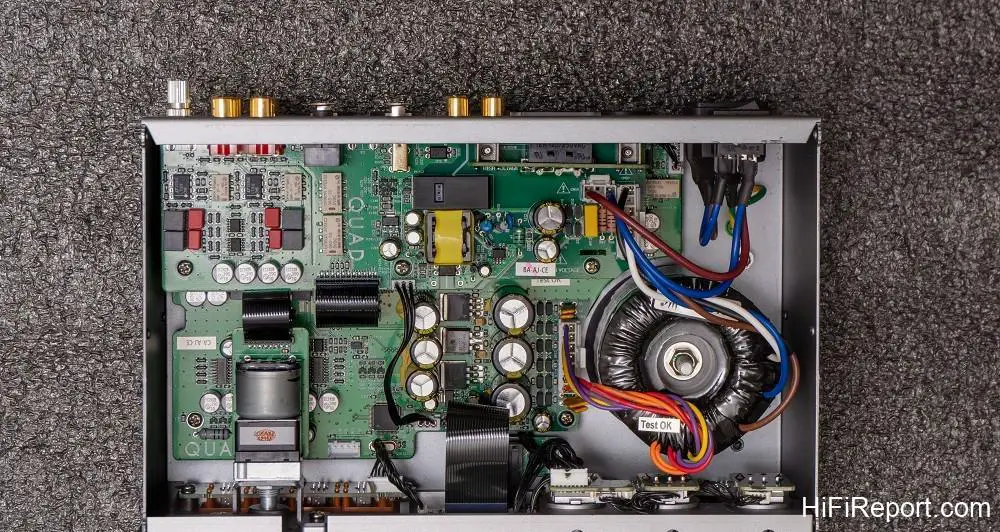
The reissue QUAD 33 is a pure analog preamplifier without built-in streaming or a DAC. It features a dedicated MM/MC phono stage mounted on an independent PCB in the upper-left rear of the chassis. This phono stage utilizes the Analog Devices OP275 operational amplifier, which combines bipolar (BJT) and JFET inputs. This hybrid design offers the high precision and low noise of BJTs alongside the speed and musicality of JFETs.
It is paired with the LT1115, one of the lowest-noise, highest-speed, and lowest-distortion audio op-amps available, primarily optimized for highly precise RIAA equalization. The passive components are equally premium, featuring MELF resistors—which sound far superior to standard SMD chip resistors—and renowned WIMA MKP capacitors.
Volume control is handled by a classic dual-gang ALPS 50KA potentiometer located at the front left, representing the most iconic form of analog volume control before the advent of digital volume chips. The main high-level line stage features a highly simplified, high-performance circuit layout that continues to use Analog Devices OP275 op-amps and MELF components.
Via the line-level inputs, the total harmonic distortion (THD) is under 0.0005%, with a signal-to-noise ratio (SNR) exceeding 108 dB. These specs closely rival, and in some cases exceed, those of far more expensive high-end preamplifiers.
Acoustic Customization
Although this pre-power amplifier combination is solid-state, it possesses the warmth and musical charm typically associated with vacuum tube systems. Listening to vintage recordings and vinyl records on this setup is incredibly satisfying.
However, the reissue QUAD 33 and 303 also feature a true wideband frequency response. This sets them apart from the stereotypical “tube sound” that some enthusiasts associate with rolled-off high frequencies (though excellent tube amps do not suffer from this), where a softened top end yields a polite, non-fatiguing sound.
Regardless of your personal definition of “tube sound,” the QUAD 33 offers plenty of room for acoustic customization. It features the classic “Tilt” control designed by Peter Walker. This function acts like a sonic seesaw to balance the overall frequency spectrum.
The control offers three “left-high, right-low” curves (boosting bass while attenuating treble) and three “left-low, right-high” curves (attenuating bass while boosting treble). The pivot point for these curves is fixed at 700 Hz in the midrange.
During my testing, I was delighted to find that adjusting the Tilt and Bass controls caused virtually no degradation in sound quality compared to the bypass mode. This makes it an incredibly practical tool for system tuning. For instance, when streaming modern pop recordings, you can set the Tilt to a “left-high, right-low” setting. This imparts a lovely vintage, tube-like warmth to otherwise bright or aggressive modern mixes.
Power Amp Performance
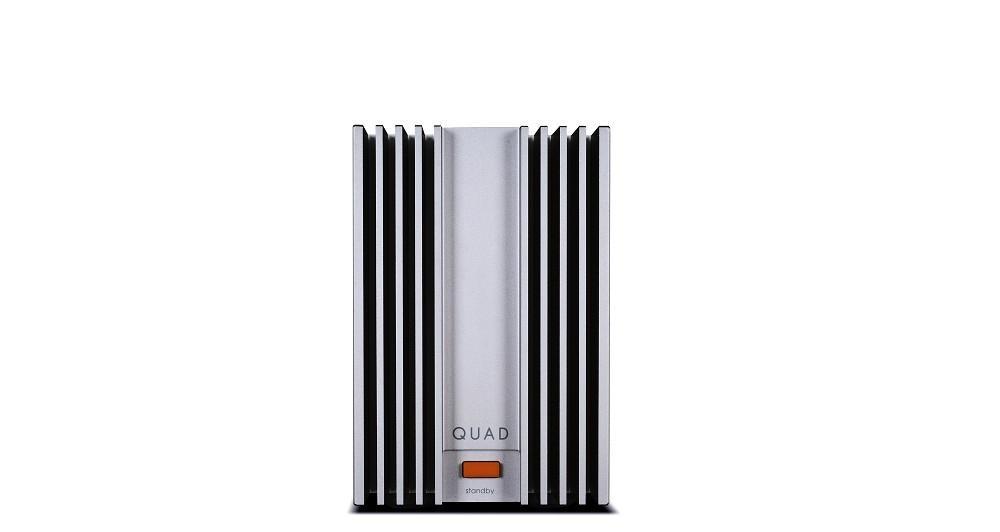
The QUAD 303 is a stereo power amplifier that can also be bridged for mono operation. Its input-stage small-signal circuitry uses the exact same high-quality components as the QUAD 33 (including the same op-amps and passive components). The main amplifier board is mounted at the front, with the front panel itself acting as the heatsink. This is a Class AB solid-state design.
While it retains the famous “symmetrical triples” output topology of the original 303, it has been upgraded from “quasi-complementary” to “fully complementary.”
While the vintage output stage used a pair of NPN transistors per channel, the new version utilizes ON Semiconductor MJL3281A (NPN) and MJL1302A (PNP) power transistors in a push-pull configuration. This symmetrical complementary design yields far lower harmonic distortion than the original.
Furthermore, while the vintage 303 used a single-rail power supply with an OTL (Output Transformer-Less, capacitor-coupled) output, the new QUAD 303 is built to modern standards with a dual-rail power supply and a capacitor-free OCL (Output Capacitor-Less) circuit. This significantly improves ultra-low frequency extension and overall sound quality, while ensuring all active components exhibit wideband characteristics with excellent high-frequency extension.
Sonic Performance
Although the circuitry of the reissue differs significantly from the original, the developers’ exceptional tuning expertise has successfully captured the warm, “analog sound” of the 1967 original. When playing recordings from the 1950s, 60s, and 70s on vinyl, the rich, vintage flavor is absolutely captivating.
I should emphasize that this vintage charm is not exclusive to vinyl; listening to digital master-tape transfers or high-resolution streams of those eras still delivers a beautiful, warm tonal color.
It is fascinating to note that the original duo was born during the golden age of tube amplification, where convincing audiophiles to switch to solid-state required making the new amps sound like vacuum tubes. Today, even though the reissue utilizes high-performance modern semiconductors, it still delivers that unmistakable, glorious tube-like character.
The treble of this system is incredibly smooth and rounded, ensuring even aggressive anime tracks never sound harsh or fatiguing. When using two bridged QUAD 303s (one per channel as monoblocks), the midrange becomes exceptionally rich and full, backed by a meaty mid-bass and a highly stable low-end foundation. This mature, powerful presentation closely resembles a high-power vacuum tube amplifier (such as a 6550A push-pull design).
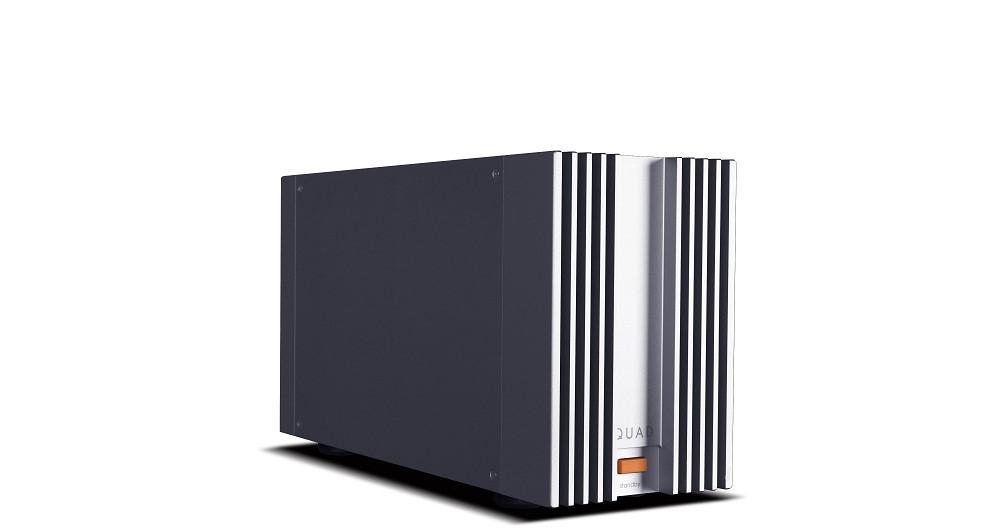
By contrast, running a single stereo QUAD 303 driven by the QUAD 33 yields a presentation more akin to a low-to-medium power tube amp (like a 6L6 push-pull). It is less heavy and dense than the bridged configuration, offering a more youthful, nimble, and fluid texture. This combination has a highly approachable, intimate quality—distinctly artistic and refined.
I realize some audiophiles define “tube flavor” as having a heavily rolled-off or embellished treble. If you prefer that specific presentation, you can easily dial it in using the Tilt and Bass controls on the QUAD 33 as described earlier. Remarkably, when comparing the sound with and without the tone controls engaged, there was virtually no loss in core sound quality. This is an incredible engineering feat, so users can enjoy these adjustments guilt-free.
For critical listening, I also highly recommend turning off the display backlight. This elevates the sonic purity to an even higher level, adding an extra layer of micro-detail and air.
It is truly remarkable that this reissue system doesn’t just look vintage; its entire sonic character transports you back to the golden tube era of sixty years ago. Let us be clear: this is a solid-state system, not a tube design. Yet because of this, it costs half (or even less) of what a tube amplifier with comparable sound quality and driving power would command.
Combining superb musicality with a natural, comfortable analog presentation for modern digital sources, this system is a rare and precious find. It comes highly and enthusiastically recommended.
QUAD 33 Preamplifier Specifications
* Type: Analog Preamplifier
* Signal-to-Noise Ratio (SNR): > 108 dB (A-weighted, Line/XLR), > 82 dB (A-weighted, Phono MM), > 74 dB (A-weighted, Phono MC)
* Frequency Response: 20 Hz – 20 kHz (+/-0.2 dB)
* Total Harmonic Distortion (THD): < 0.0005% (1 kHz, Line/XLR), < 0.002% (1 kHz, Phono MM / MC)
* Headphone Output: THD < 0.01% (1 kHz, 50 mW), load impedance 20 to 600 ohms
* Input Terminals: 2-channel analog (RCA) x 3, 2-channel balanced (XLR) x 1, Phono (MM/MC switchable) x 1
* Output Terminals: 2-channel analog (RCA) x 1, 2-channel balanced (XLR) x 1, headphone x 1, 12V Trigger Out x 2
* Dimensions (W x H x D): 258 x 94 x 165 mm
* Weight: 4 kg
QUAD 303 Power Amplifier Specifications
* Type: Class AB Power Amplifier
* Gain: +29 dB
* Signal-to-Noise Ratio (SNR): > 108 dB (A-weighted)
* Rated Power Output: 50 W x 2 (8 ohms, THD < 1%), 70 W x 2 (4 ohms, THD < 1%); Bridged Mono: 140 W (8 ohms), 170 W (4 ohms, full-band harmonic distortion 0.07%)
* Maximum Output Current: 10 A
* Frequency Response: 20 Hz – 20 kHz (+/-0.3 dB)
* Total Harmonic Distortion (THD): < 0.002% (1 kHz)
* Input Terminals: 2-channel single-ended (RCA) x 1, 2-channel balanced (XLR) x 1
* Output Terminals: Speaker output x 2, 12V Trigger
* Dimensions (W x H x D): 226 x 312 x 462 mm
* Weight: 8.5 kg