
Quad Artera Solus Play All-in-One System Review
Quad’s Artera Solus Play redefines the concept of an “all-in-one” Hi-Fi system, taking it to a whole new level of completeness. Its predecessor, the Artera Solus, was already a highly versatile amplifier, integrating a CD player, CD transport, DAC, analog inputs, preamp outputs, Bluetooth connectivity, and a robust 75 watts of power – making it a formidable contender in the market.
Now, the next-generation Artera Solus Play extends its lead even further. Building upon its already impressive foundation, it incorporates wireless streaming capabilities, granting users effortless access to over ten major music streaming platforms and internet radio services. This enhancement further elevates its value proposition, pushing the boundaries of performance and features for its price.
Streaming Service Support
The Artera Solus Play’s wireless streaming functionality is built upon the robust DTS Play-Fi platform.
Play-Fi’s cross-platform compatibility is a significant advantage. Whether you use an iPhone or Android phone, a Mac or Windows PC, or even Amazon’s Kindle Fire tablets or popular smartwatches, there are corresponding Play-Fi apps available for controlling playback devices. This contrasts with some audio brands whose proprietary remote apps are only available for iOS, neglecting Android users.
Furthermore, Play-Fi boasts compatibility with a wide array of music streaming services. Popular platforms like Spotify, Tidal, Qobuz, KKBox, TuneIn Radio, HDtracks, and many others are supported, allowing users to seamlessly access their preferred services.
Play-Fi also offers excellent support for various music formats and sampling rates. It can handle WAV, FLAC, AIFF, MP3, MP4A, AAC, and more. Over Wi-Fi wireless networks, it supports up to 24-bit/192kHz resolution, which is more than sufficient for the vast majority of streaming music.
The Artera Solus Play also provides comprehensive DAC functionality.
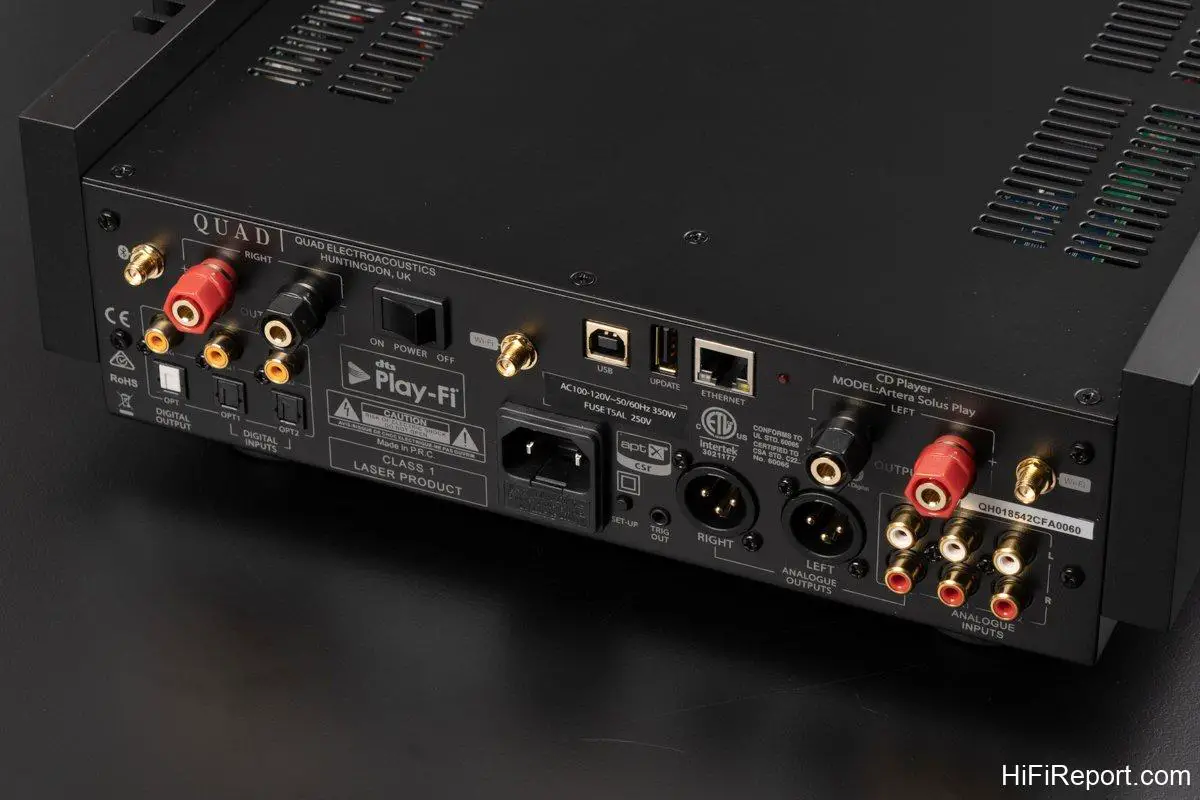
It employs the high-performance ES9018 Sabre32 Reference chip, a DAC favored in many high-end components. Via USB input, it supports up to 32-bit/384kHz PCM and DSD256 formats.
In addition, the Artera Solus Play includes two optical inputs and two RCA coaxial inputs, accommodating connections from other digital sources in your home, such as set-top boxes, media streamers, and gaming consoles.
For CD enthusiasts, simply insert a disc into the front-loading drive. The mechanism first reads the data into a buffer before feeding it to the asynchronous DAC for decoding.
The Artera Solus Play also offers four digital filter modes, allowing users to tailor the sound to their listening preferences or music genres.
Balanced Circuitry: Pre and Power Stages
Moving on to the analog amplification section, the Artera Solus Play employs balanced circuits in both the preamplifier and power amplifier stages. This design approach is beneficial for reducing noise and enhancing dynamic performance.
The power amplifier stage incorporates Quad’s renowned “Current Dumping” technology. This ingenious design combines a low-distortion Class A amplifier circuit with a high-power Class B amplifier. The power stage dynamically adapts to demand, ensuring ample current delivery as needed.
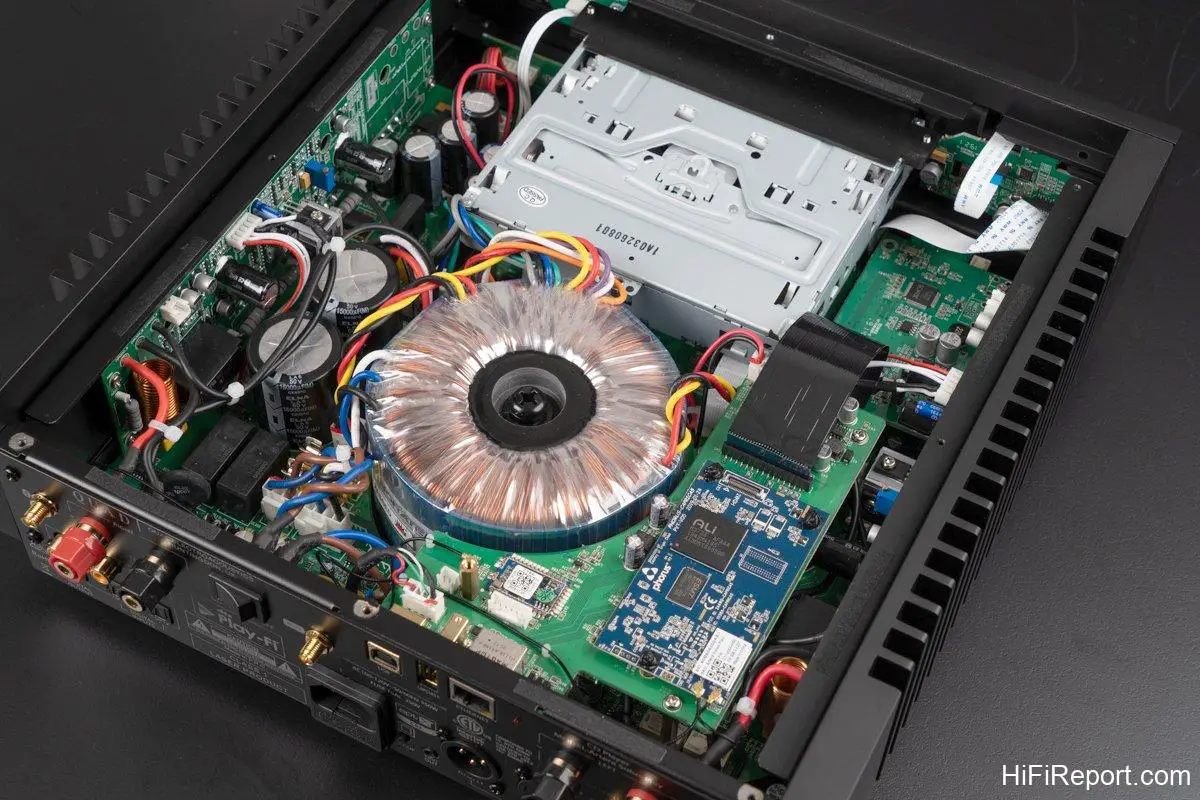
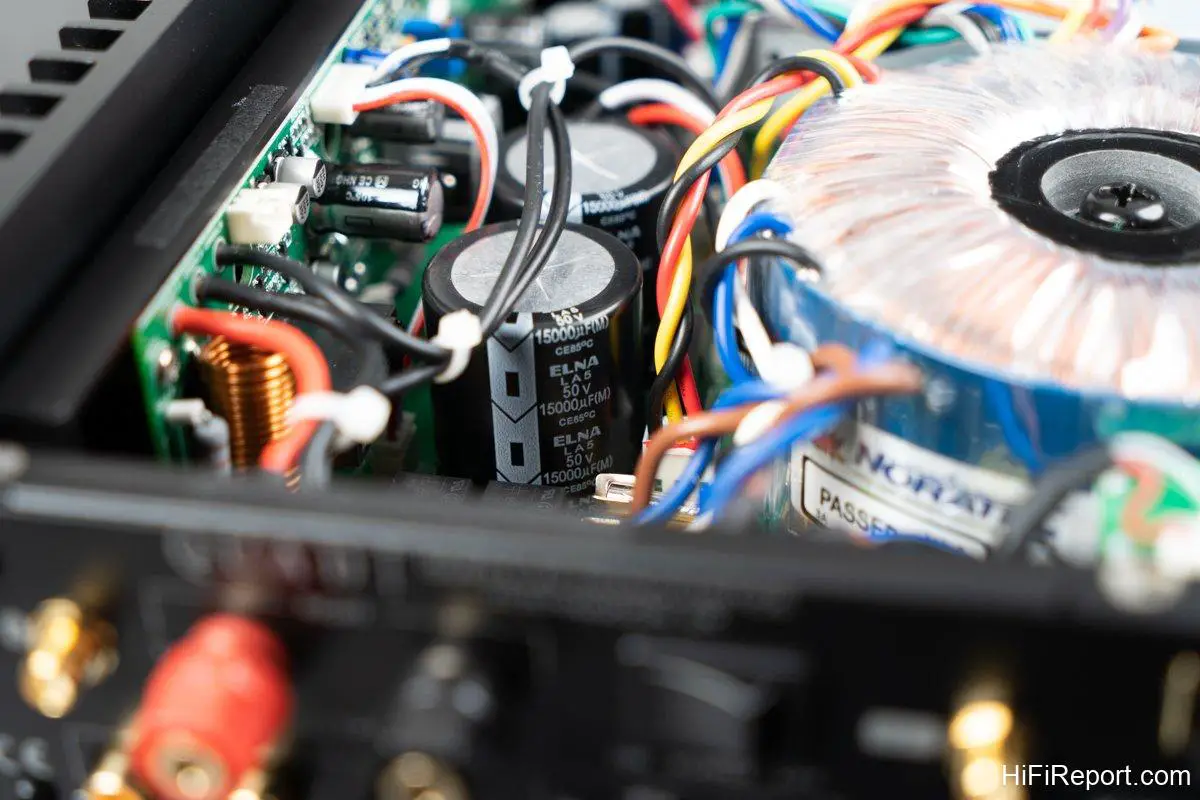
Despite its compact chassis, the Artera Solus Play houses a substantial 300VA toroidal transformer. Independent secondary windings supply power to each of the monaural power amplifier sections. Each channel also benefits from 2 × 15,000uf of filter capacitance, providing a robust power foundation for its 75 watts × 2 output.
To enhance versatility, the Artera Solus Play is equipped with both analog input and output interfaces. It offers two RCA inputs for connecting conventional sources, along with both RCA and XLR preamplifier outputs. These preamp outputs facilitate connection to external power amplifiers, allowing audiophiles to explore bi-amping configurations for increased power and listening enjoyment.
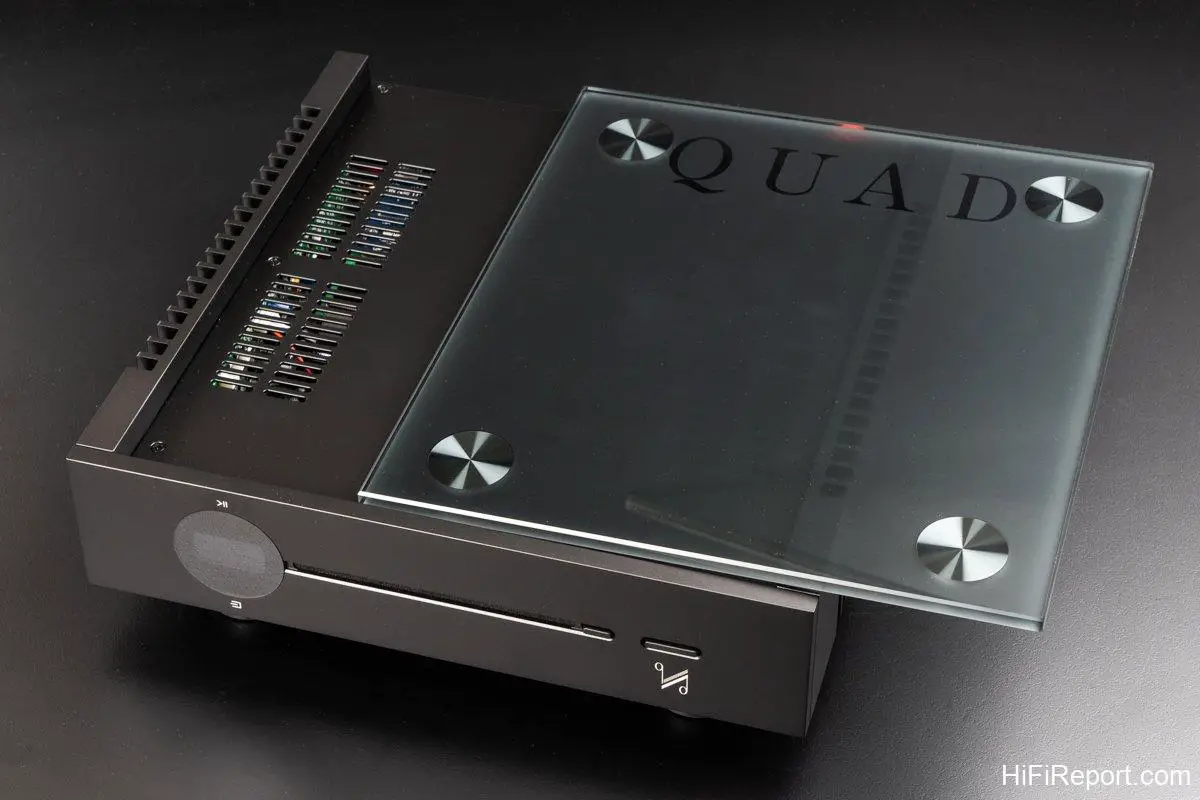
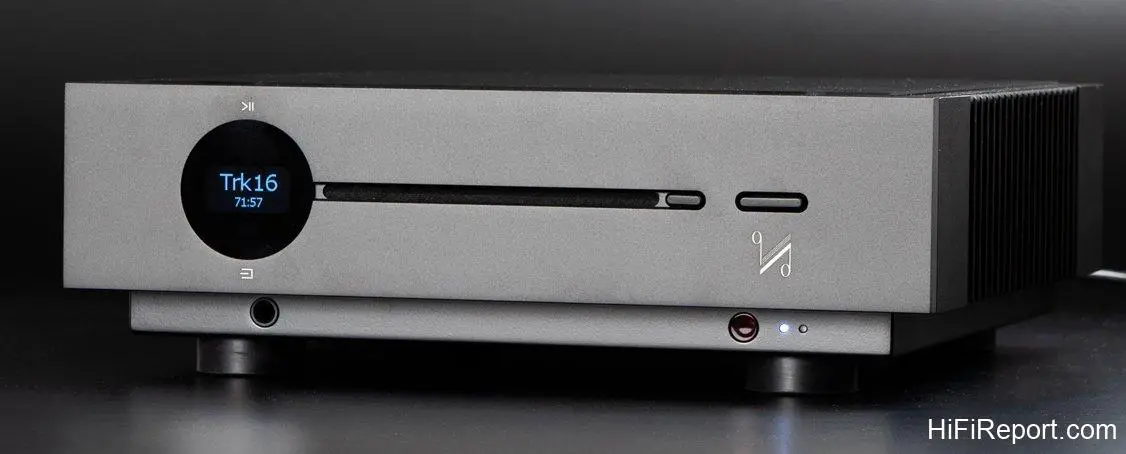
Aesthetically, I find the Artera Solus Play exceptionally appealing. In my opinion, it’s a paradigm of successful industrial design. It achieves a sense of quality through simplicity, with clean, crisp lines that seamlessly integrate into various interior styles. Moreover, its width of only 32cm, smaller than the typical 43cm of standard components, gives it a visually lighter and more streamlined presence.
Furthermore, the Artera Solus Play comes with a dedicated glass top plate. Placed atop the unit, it elevates the perceived quality without hindering heat dissipation and also helps prevent dust accumulation. With the glass plate in place, the appearance becomes even more refined and polished, allowing the Artera Solus Play to be showcased on open shelves, blending effortlessly into the overall home décor.
Instant Sonic Impression
Setting up the Artera Solus Play for auditioning is remarkably straightforward. Simply connect the power cord and speaker cables. Thanks to its Wi-Fi capability, a wired RJ45 network connection isn’t mandatory. In fact, Wi-Fi performance is on par with wired connections. If your home wireless router is capable and provides stable transmission, using Wi-Fi is recommended. Moreover, the Artera Solus Play utilizes the Play-Fi system, making Wi-Fi setup incredibly easy. Just open the app, follow the prompts, and the Artera Solus Play will be connected to your home Wi-Fi network in moments.
For the listening session, I paired the Artera Solus Play with Dynaudio Contour 60 floorstanding speakers, streaming music files from my NAS via Wi-Fi.
With a simple tap on my phone, music began to play, and I was immediately captivated. The Artera Solus Play’s sound is clean, fresh, transparent, and relaxed, exhibiting excellent definition and airiness. It evokes a sense of invigorating clarity.
It’s remarkable to consider that this sonic performance emanates from an all-in-one amplifier packed with such extensive functionality.
In my experience, cramming so many features into a compact chassis often leads to compromises in sound quality, such as increased noise, a coarser or more congested sound, or a lack of sonic spaciousness. However, the Artera Solus Play completely defies these expectations. It’s evident that Quad’s mature engineering and profound design expertise have effectively mitigated interference, allowing this all-in-one unit to rival the performance of separate component systems.
Layered and Articulate Soundstage
Listening to the Audio Physic 25th Anniversary CD, a compilation of classical recordings from Turtle Records, I was particularly drawn to track 5, “Gaude Virgo,” a motet by the 15th-century composer Pierre de la Rue. Through the Artera Solus Play, I immediately perceived the depth of the church acoustic. The soundstage depth and height were exceptional, with a black background and rich, lingering reverberation.
While I acknowledge that the impressive soundstage height is partly attributable to the tall stature of the Contour 60 speakers, I believe that if the Artera Solus Play’s high-frequency extension were lacking, or if the sound were not sufficiently open and detailed, such soundstage height would not be perceivable.
This male and female vocal recording also highlighted the Artera Solus Play’s excellent layering and separation. The sonic image of each voice was clearly delineated, with precise rendering of each vocal part, allowing for clear discernment of layers without any blurring.
Similarly, track 6, Hugo Distler’s “Variations on ‘Ei du feiner Reiter’,” a concerto for harpsichord and string orchestra, showcased the Artera Solus Play’s ability to reproduce harmonious and beautiful string ensemble playing. The sound was cohesive and rhythmic, yet not homogenized. Instead, individual instrumental lines were discernible, articulated clearly and precisely.
The harpsichord’s timbre was crisp and bright, effortlessly showcasing the system’s excellent high-frequency performance once again.
As the music unfolded with three distinct lines – the light and agile harpsichord carrying the high-register melody, the flowing mid-high range string section with audible bow-string texture, and the pizzicato bass providing the harmonic foundation – the Artera Solus Play revealed the clean texture and distinct articulation of each line. The thickness and pace were well-judged, resulting in a presentation that was both well-separated and cohesive.
Track 8, an excerpt from the finale of Mahler’s Symphony No. 1 “Titan,” further demonstrated the Artera Solus Play’s exceptional soundstage depth and clear front-to-back layering, underscoring its impressive sonic capabilities.
Performance with Musicality
Does good technical performance automatically translate to enjoyable sound? Not necessarily. However, I contend that audio equipment lacking in performance cannot truly sound good. Musical expression, vitality, musicality, and realism all rely on sufficient technical competence to be conveyed effectively.
For instance, listening to “Some Other Time,” an album featuring cellist Zuill Bailey and pianist Lara Downes performing works by American composers such as Bernstein, Barber, and Copland, track 4, Barber’s Cello Sonata, Op. 6, first movement, revealed the Artera Solus Play’s musicality. This piece features winding melodies, a wide frequency range, free tempo, and dramatic dynamic shifts, ranging from gentle introspection to intense urgency. Through the Artera Solus Play’s reproduction, I fully experienced the music’s dramatic tension.
This tension wasn’t derived from sheer volume, nor solely from timbre, but rather from contrast and dynamic range. Within a reasonable volume range, the Artera Solus Play fluidly and rapidly conveyed dynamic contrast, lending vivid expression to the music and creating palpable tension.
Furthermore, I noted the cello’s rich, resonant tone, often referred to as “rosin” or “bowed string resonance.” This was due to the Artera Solus Play’s ability to accurately reproduce resonance and its commendable tonal weight and density, resulting in a captivating sonic texture.
Similarly, track 3, Bernstein’s “In Our Time” for cello and piano, presented a slow, legato melody. The piece is generally tranquil and lyrical, a pleasant miniature. Through the Artera Solus Play’s clean and quiet sonic backdrop, I heard not only clear and pure musical tones, but also rich reverberation and a sense of airiness. The sound was ethereal and vibrant.
The string texture was not overtly smooth or sweet, but leaned towards analytical. The sonic lines were clear and defined, with good density. The bow-string texture was detailed yet refined, never harsh. The overall texture was excellent and refined.
More Than Just High Value
Finally, playing selections from Jonathan Lee’s “Rational & Sensual Works Concert” album, particularly “If You’re Leaving,” a track reinterpreted in a fusion jazz style, the opening kick drum and bass lines were immediately distinct, precisely positioned, and controlled in their quantity, leaning towards accuracy.
The kick drum had a defined impact, with clear shape, each beat hitting with immediacy, showcasing the Artera Solus Play’s excellent bass control and pace. For a 75-watt amplifier to drive the Contour 60s with such agility is truly impressive! This emphatically demonstrates the enduring merit of Quad’s “Current Dumping” technology, which has sustained the brand for decades.
At this point, it became abundantly clear that the Artera Solus Play is far more than just a high-value all-in-one system. It is a genuinely high-quality component with exceptional sound quality and comprehensive performance. Its sound is pure, clear, precise, balanced, and fluid, with ample driving power.
Its neutral sonic character also makes it easy to pair with various speakers and cables, allowing your existing equipment to perform optimally and enabling you to effortlessly enjoy the pleasure of music listening.
Moreover, the Artera Solus Play’s Play-Fi system provides convenient and stable streaming operation and control, while the extensive selection of music services ensures limitless listening possibilities.
In conclusion, don’t dismiss the Artera Solus Play as a compromise simply because it’s an all-in-one system. On the contrary, it will undoubtedly impress you.
Specifications
* Type: All-in-One Integrated Amplifier
* Output Power: 75 W / 8Ω
* Network: RJ45, Wi-Fi, Play-Fi, DLNA
* Supported Streaming Services: Spotify, TIDAL, Deezer, Qobuz, Napster, KKBox, TuneIn Radio, iHeartRadio, HDtracks, SiriusXM
* DAC Supported File Formats: ALAC, WAV, FLAC, AIFF, WMA, MP3, AAC, AAC-HE, AAC+, DSD64, DSD128, DSD256
* Digital Inputs: USB B, TOSlink, RCA
* Digital Outputs: TOSlink, RCA
* Analog Inputs: RCA × 2
* Analog Outputs: RCA × 2, XLR × 2, 6.3 mm Headphone Output
* DAC Maximum Sampling Rate (USB B): 384kHz, DSD256
* Frequency Response: 20Hz–20kHz / ± 0.5 dB
* THD: < 0.003 %
* S/N Ratio: > 108 dB
* Bluetooth aptX: Yes
* Dimensions: 320 × 320 × 105 mm (W×H×D)
* Weight: 11.5 kg