
REL Carbon Special Review
Editor-in-Chief Jerry at HiFiReport experienced the formidable power of the REL No. 32 paired with Elac Concentro speakers, and has since been captivated by the effectiveness of subwoofers in enhancing music reproduction.
Upon returning, he immediately borrowed a REL S/812, intending to start with a high-midrange 12-inch subwoofer and give it a thorough audition.
Actually, I have also had prior experience with REL, during my time at HiFiReport.
Xiao Weng from HiFiReport is also a devoted fan of REL subwoofers. Under his expert tuning, the Odeon horn speakers, also represented by HiFiReport, always delivered rich bass and a solid foundation.
However, adding a subwoofer still makes a world of difference.
Surprisingly, adding a subwoofer, while we expect it to augment the bass, elevates the entire frequency range. It also introduces a sense of envelopment and spaciousness that was previously absent.
Because of this, I made two trips to HiFiReport to learn from Xiao Weng.
Now that the Editor-in-Chief wants to explore the experience of “subwoofer upgrades,” what should follow the S/812? Naturally, it has to be the Carbon Special.
This time, however, the writing duties fall to me, and I will be documenting this listening experience.
The 2.2 Channel Hesitation: Wiring and Adjustment Concerns
This in-depth experience is also significantly meaningful for me personally.
For a long time, I used bookshelf speakers for music listening. Bookshelf speakers are compact, easy to place, and with less bass output, room mode issues are less pronounced, making them ideal for small urban spaces.
However, precisely because of this, sometimes I can’t help but think: wouldn’t it be wonderful if this double bass were deeper? If the bass chords of this piano were richer? If this drum sound were fuller?
If only…
Leaving aside the energy level, even just the slight lack of bass is an unspoken regret.
Would choosing a subwoofer to create a 2.1 or 2.2 channel system be a good solution? I believe so, but most subwoofers on the market are designed for home theater use. The connection methods for subwoofers mostly employ LFE or line-level inputs.
Connecting to surround receivers or surround preamps is certainly not a problem, but if you want to pair them with a two-channel system, you need to have “extra” preamp outputs.
Do I have to change amplifiers just to add a subwoofer? Consequently, I gave up on the idea of trying 2.1 or 2.2 channel systems.
REL’s Distinctive Approach: Music First, Synchronization with Main Speakers
When I started to encounter REL subwoofers, I seemed to see a glimmer of hope for traditional two-channel users like myself to build 2.1 or 2.2 channel systems.
REL’s uniqueness lies in two aspects: first, their subwoofers are designed “for music”; second, in practice, they possess the ability to synchronize with the main speakers.
Subwoofers intended for home theater pursue sufficient quantity, emphasizing performance in the 40Hz to 100Hz range.
However, for music reproduction, instruments like piano, double bass, contrabassoon, and pipe organ can all descend much lower.
If even the fundamental tones cannot be reproduced, let alone the downward harmonics.
Therefore, what REL aims to do is to compensate for the lower frequencies that the main speakers cannot produce, or can only achieve with difficulty, especially the ultra-low frequencies below 35Hz.
Beyond frequency range, there’s also the issue of speed.
A good car should not only be able to accelerate quickly but also brake effectively; both power and braking force are crucial.
The same applies to subwoofers. Not only should the bass go deep, but it must also stop when it should, without lingering sounds.
When watching movies, slightly sustained or prolonged bass might even enhance some low-frequency effects.
However, when listening to music, the timpani drum sound must stop when it’s supposed to; otherwise, the timpani’s sound becomes distorted.
For this purpose, REL has chosen a “less convenient” connection method: high-level input.
Synchronization with Main Speakers: High-Level Connection
The so-called high-level input means taking the signal from the amplifier’s “speaker terminals” and outputting it to the subwoofer using “speaker cables,” rather than using preamp outputs or LFE outputs and connecting to the subwoofer with “signal cables.”
REL believes that this high-level connection is the way to achieve synchronized response between the subwoofer and the main speakers.
REL subwoofers have built-in crossover circuits. Based on the crossover frequency set by the user, they extract the working frequency range.
Moreover, REL emphasizes that their subwoofers’ built-in crossover network has extremely fast response speed. This ensures seamless integration of the high-level input signal with the main speakers.

Although the amplifier provides the signal to the subwoofer, it does not need to bear the burden of driving it. The task of driving the subwoofer is handled by the subwoofer’s internal amplifier.
In this way, the subwoofer is effectively integrated into the main speaker system, becoming one unified system, while the amplifier is relieved of the power demand of driving the subwoofer.
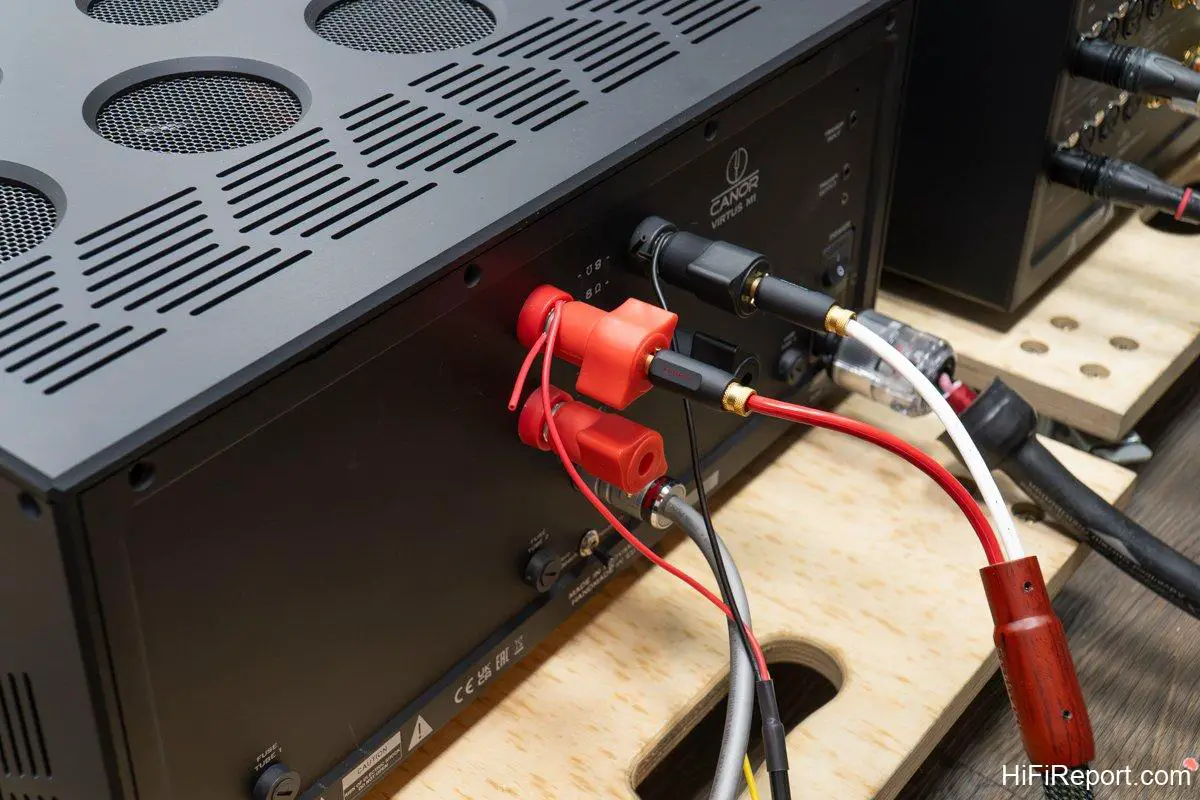
The rear panel of the Carbon Special provides RCA low-level input and output terminals. For their recommended high-level input speaker terminals, they have chosen professional-grade Neutrik SpeakOn connectors, ensuring robust and secure connections.
Each unit comes with a speaker cable equipped with a Neutrik SpeakOn connector. Inside, there are three cores, with the amplifier end pre-stripped, allowing users to directly lock the bare wires onto the amplifier terminals.
Why three cores? If only one subwoofer is used, the three cores are connected to the amplifier’s left positive, right positive, and negative terminals, respectively.
If two subwoofers are purchased, only the positive and negative terminals need to be connected, and the other wire can be wrapped with insulating tape.
The adjustment knobs for the crossover network are also located on the rear panel, including knobs for crossover frequency, high-level input volume, and LFE input volume.
The knobs do not have actual scales, but you can feel slight detents when turning them, which can serve as a rough reference.
0-degree and 180-degree phase adjustments are also essential settings to confirm when setting up a subwoofer.
Featuring the “Black Widow” 12-inch Carbon Fiber Woofer
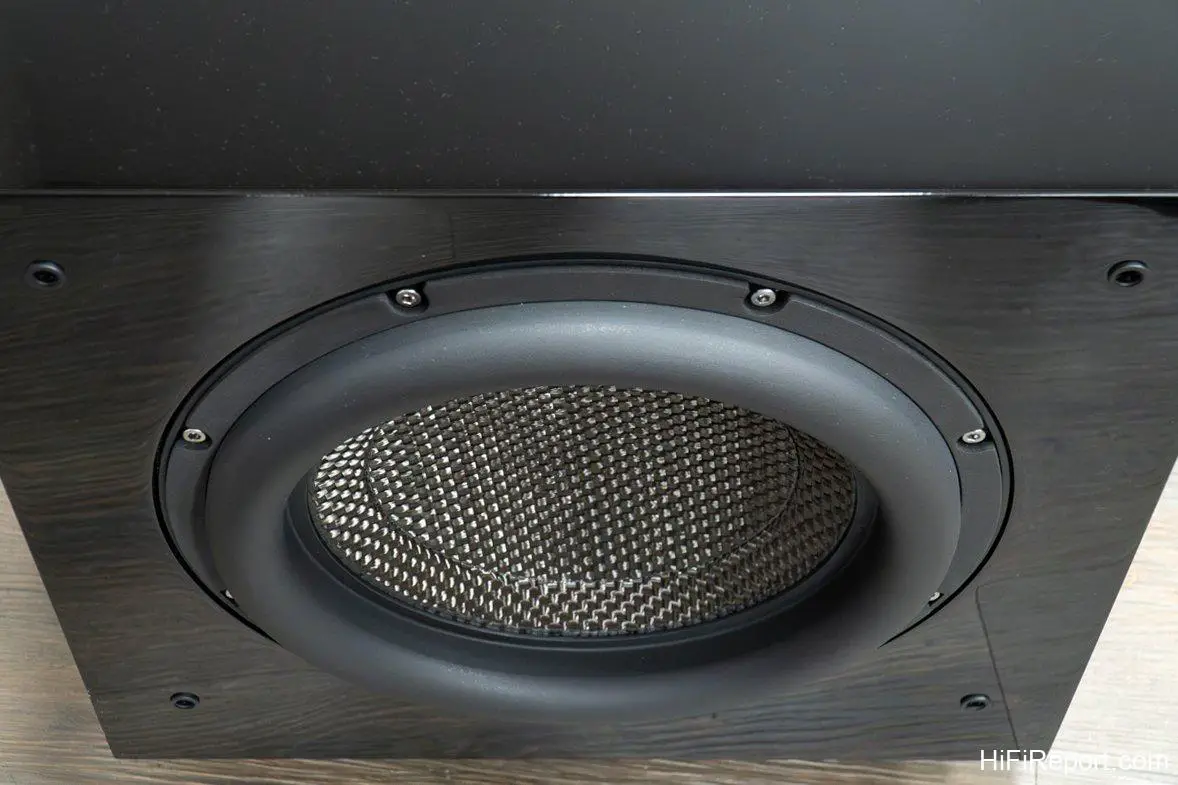
The name “Carbon Special” comes from its use of the latest Black Widow 12-inch carbon fiber diaphragm woofer, front-firing and in a sealed enclosure.
Carbon fiber diaphragms are characterized by ultra-light mass, high rigidity, and high restoring force. They can handle large dynamic ranges and are free from self-resonance coloration.
This 12-inch woofer is a third-generation design, with a thickened surround and a redesigned spider, boasting an impressive 100mm ultra-long excursion.
At the bottom, there is also a CSP passive radiator. A special design feature is the “feet” designed by REL for the Carbon Special.
Most subwoofers simply use four footpads to elevate the speaker.
However, REL believes that the sound from the bottom passive radiator should be guided out. Therefore, they designed special arc-shaped support plates, one on each side, to elevate the Carbon Special and guide the dispersion direction of the low frequencies.
This is another design aspect of REL subwoofers that is born for music.
Built-in 1000W NextGen5 Amplifier
A powerful amplification module is, of course, indispensable.
The Carbon Special incorporates REL’s latest NextGen 5 amplifier module, using Class D amplification and capable of outputting 1,000W of power.
The crossover circuit mentioned earlier is also REL’s proprietary CS PerfectFilter, which is a core technology that endows REL subwoofers with their distinctive bass performance and transparent low frequencies.
If you prefer not to have extra subwoofer cables running across your living room, you can also opt for the AirShip wireless connector, using 5.8GHz uncompressed transmission. REL assures that this will be a different experience from any unpleasant experiences you might have had with wireless transmission in the past.
Standard Installation and Setup Procedure
REL subwoofers can be daisy-chained and stacked, as seen in audio exhibitions in recent years. The output terminals on the rear panel are designed for this purpose.
However, my experience this time was with a single pair of Carbon Specials.
The setup process by the distributor’s personnel was the same as with the previous S/812. First, determine the correct phase, and then, using Clio measurements, identify the frequency dips in the room, followed by fine-tuning the crossover frequency, volume, and placement.
Q&A Session Begins
The main reference speakers were Wilson Audio Alexia 2, listened to with EAR Yoshino 868 preamp and 509 MK2 power amp, as well as Canor Hyperion P1 preamp and Virtus M1 power amp.
For this audition, I posed five questions: What will happen to the cello? What about the piano? What about drums? What about vocals? Finally, what about electronic bass? My reference music selections were chosen to address these five questions.
Double Bass is Fuller, and Instrument Lines are Enhanced
For cello music, I chose Jorg Baumann and Klaus Stoll’s performance of Rossini’s Duet for Cello and Double Bass in D major, first movement.
After adding a pair of Carbon Specials, the double bass certainly gained a clearer form, but even the cello’s sound became fuller, and pizzicato notes sounded more distinct.
Even when not playing bass notes, the cello’s melody in the higher register also showed improvement in its lines.
Adding Flavor and Charm to Music
For piano music, I selected “Adios Nonino” performed by the Belgian tango band Astoria, with music by Piazzolla.
This piece opens with an extended piano introduction, with the left-hand chords occasionally reaching down to the lowest octave, while the right hand handles the beautiful, elegant, and lyrical melody.
The Alexia 2’s low-frequency response is rated down to 19Hz by the manufacturer, which is already sufficient to meet full-range playback needs.
However, after adding the Carbon Special, the piano’s richness noticeably improved, the piano tone became more liquid and the timbre more beautiful.
While the subwoofer supplements the low frequencies, it adds flavor and charm to the music overall.
Vocals Become Clearer, Sound More Three-Dimensional, Drums More Solid and Powerful
I used one track to comprehensively illustrate drums and vocals, choosing Hanne Boel’s “After Midnight.” It begins with a steady drum rhythm, and the keyboard and electric bass subtly introduce the main melody.
With the assistance of the Carbon Special, this drum sound became more solid, fuller, and more powerful.
The difference is subtle, yet perceptible.
If the satisfaction of listening to Alexia 2 alone is 90 points, adding the Carbon Special might bring it to 92 points.
As for singer Hanne Boel’s vocals, the vocal lines are clear. If I were to say what improved, I would say the three-dimensionality is enhanced, and the sound is also more relaxed.
It’s remarkable. On one hand, the instrument forms and lines are more defined, and the three-dimensionality is better. On the other hand, the music sounds more effortless.
Expanded Soundstage, Even with a Sense of Envelopment
The last question is about electronic bass. I used Billie Eilish’s “Lo Vas A Olvidar” as an example. I must say that I didn’t perceive “lower” bass, at most, the bass was more defined.
However, I did experience a more expanded soundstage and clearer details emerging.
The expanded soundstage was something I had experienced before at Xiao Weng’s place at HiFiReport. This time in our own company’s listening room, I once again experienced that expanded and enveloping low-frequency atmosphere.
Additional Questions
After answering the five questions, I had more questions.
Our company has a pair of Capriccio Continuo Admonitor bookshelf speakers, paired with their own Submonitor MK3 subwoofer columns.
Before the Wilson Alexia 2 and Dynaudio Contour 60 arrived, this combination was our editorial department’s main reference speaker system.
The Submonitor MK3 uses three 165mm nano-carbon fiber diaphragm woofers. The top woofer slightly overlaps in frequency range with the Admonitor bookshelf speaker’s mid-bass driver, serving as an auxiliary bass unit.
The bottom two woofers are the true bass drivers, responsible for frequencies below 45Hz.
My question is: For bookshelf speakers like the Admonitor, is it better to pair them with the manufacturer’s own subwoofer columns or with REL subwoofers?
More Natural Low-Frequency Range, No Unnatural Boominess
In addition to the previous tracks, I added two more pieces, one a double bass performance, and the other a Hans Zimmer film score.
The double bass piece was Enzo Pietropaoli’s performance of “The Pink Panther Theme.”
The bass with the Carbon Special was cleaner than with the Submonitor MK3 subwoofer columns. In comparison, the Submonitor MK3’s bass sounded thick and full, but a bit boomy and less natural.
The Carbon Special’s bass was relatively relaxed, with more natural extension, and also had better definition and texture. If I had to choose, it would undoubtedly be the Carbon Special.
Performance Exceeds Even the Speaker Manufacturer’s Own Subwoofer Columns
The other piece was “Dream of Arrakis” from the “Dune” soundtrack. Sharp and powerful percussion, and electronic drums resembling heartbeats. Hans Zimmer’s forte is weaving together real instruments and electronic music, creating a deep and expansive soundstage.
Listening to this piece with just the Admonitor bookshelf speakers, the imaging of sound sources is very precise. Adding the Submonitor MK3 subwoofer columns significantly increased the scale and expanded the soundstage, enhancing the power.
However, switching to the Carbon Special brought a different perspective.
The solidity of the sound, the clarity of the lines, and the expansiveness of the soundstage were even better than Capriccio Continuo’s own subwoofer columns, and it also added an enveloping quality that the subwoofer columns lacked.
No Best, Only Better? To Be Continued
This comparison with the Capriccio Continuo speakers was not in the optimal condition, as I only relied on listening to adjust the subwoofer’s crossover frequency and volume, and fine-tuned the positions of the speakers and subwoofer. I haven’t yet mastered the distributor’s SOP.
Even so, using the Carbon Special as a 2.2 channel setup, whether paired with large full-range floorstanding speakers like the Wilson Audio Alexia 2, or bookshelf speakers like the Capriccio Continuo Admonitor, it can bring about an overall improvement in sound performance.
Even compared to Capriccio Continuo’s own subwoofer columns, it seems that external subwoofers provide even greater benefits.
This second round of REL subwoofer auditions in the HiFiReport listening room has concluded, and we are preparing for the next round.
Coming up, we hear, is REL’s near-flagship Reference No. 31. How much better can it be? I’m all ears and eagerly anticipating it.
Specifications
* Type: Active Subwoofer
* Driver: 12 inch (300 mm) Long-Throw Carbon Fibre Cone x 1
* Low Frequency Extension: -6 dB at 19 Hz
* Built-in Amplifier: 1,000 Watts NextGen5 Class D
* Inputs: High Level Input Neutrik Speakon, Low Level Stereo RCA, LFE XLR & LFE RCA, Optional Airship Wireless Receiver
* Dimensions: 430 × 455 × 539 mm (W × H × D)
* Weight: 38.7 kg