
Sampo Quantum Dot 4K TV Review
For years, Sampo TV has been dedicated to the development and design of televisions. In the past, Sampo TVs were known less for pursuing the absolute latest display technologies and more for their durability and accessible pricing – a focus on practicality and value. Their product launches each year typically highlighted new series that delivered solid picture quality and color, while also emphasizing impressive home theater audio performance.
With powerful built-in speakers as a key feature, consumers could enjoy excellent visuals and impactful sound without needing a large budget for equipment.
Shift in Philosophy
However, starting in 2020, Sampo TV shifted its design philosophy. The focus on “Thunder Sound” technology took a backseat as the company moved towards a more refined, practical, and smart design direction. This means striving to produce high-quality 4K TVs that rival Japanese and Korean brands but offer better value. For instance, the Sampo QA series 4K LED TV I reviewed previously was a budget-friendly model that delivered excellent picture quality, color, and smart features.
Combined with Sampo TV’s long-honed, proprietary audio processing capabilities, a single TV could serve as a capable home theater system encompassing both AV functions and networking capabilities.
Introducing the WA Series
In January 2020, Sampo officially launched its flagship WA series of 4K TVs. This series utilizes more advanced image and sound processing technologies than the QA series. Crucially, it moves away from traditional LED backlighting, adopting QLED quantum dot technology as its core illumination method.
Features such as HDR compatibility, color display performance, motion handling, audio processing technology, and integrated streaming platforms are now on par with comparable models from Japanese and Korean competitors. The design approach clearly indicates Sampo’s strategic direction for future product development.
QLED Technology, Color, and HDR
QLED technology differs from traditional LED backlighting by adding a quantum dot film over the LED panel. This film, when excited by blue light from the backlight, produces the three primary colors (RGB). This not only creates a wider color gamut than standard LED TVs but also improves brightness. Sampo’s WA series leverages this core QLED technology to elevate Sampo TVs’ picture quality to an unprecedented high standard.
What are these high standards for the WA series? The first point to highlight is color performance. In Taiwan, most people primarily watch programs or online videos in SDR format, so image colors are predominantly based on the Rec.709 standard. QLED TVs are specifically noted for having higher color purity than LED TVs. When measured using Rec.709, the Sampo WA series achieves a maximum color gamut coverage of approximately 120% of the standard.
This means viewers watching various types of content, including 4K and Full HD videos, will experience saturated, pure colors and distinct color gradation. During my color display testing, I also found that Sampo’s calibration of complementary color chromaticity coordinates and the RGB white balance curve is quite precise. The CMY chromaticity coordinates are adjusted very close to the standard base points, and the RGB curve maintains excellent flatness.
The warm color temperature is also very close to the D65 standard. Essentially, consumers can simply turn on the TV and start watching without needing to delve into menu settings.
Currently, the main sources for 4K content are UHD BDs, Netflix, and YouTube. Most 4K TVs on the market are capable of playing these three sources, and higher-end models often offer comprehensive HDR format support. The WA series provides robust HDR compatibility, supporting HDR10 commonly used for 4K Blu-rays, HLG for 4K content on YouTube, and the latest Dolby Vision.
This means that when watching 4K content on Netflix that supports this standard, you will experience the benefits of 4K HDR, including enhanced contrast, richer detail in bright areas, and more complete color gradations.
Picture Performance
With its wide color gamut and comprehensive HDR support, the WA series also delivers excellent contrast performance. It employs a direct-lit panel with 100 local dimming zones. When playing video, the video processing circuitry independently adjusts the backlight in these finely divided zones, resulting in impressive contrast ratios and natural grayscale transitions.
More importantly, the black levels can approach the effect of a turned-off screen, and this outstanding dark area performance gives the WA series’ 4K picture a more realistic visual feel. Furthermore, the WA series panel features 120Hz motion interpolation technology, which performs frame insertion for fast-moving images. This ensures that moving objects not only maintain clarity but also display smooth, non-stuttering motion trails.
Sound & Smart Features
Since the WA series is a Sampo TV, it naturally offers a certain level of audio performance. The built-in two 18W speakers have a unique cabinet design with internal acoustic pathways, allowing them to produce substantial low-frequency energy. More significantly, the WA series supports Dolby Atmos decoding. When playing 4K content with Dolby Atmos audio, you can clearly experience the immersive effect of 3D sound. For smart features, the WA series uses the Linux operating system.
While not the Android system found in the QA series, it offers a range of streaming platforms and downloadable applications that align with current user habits. Popular services like Netflix, YouTube, and LiTV are standard features. Via wireless connection, you can access all content, including 4K videos, on these platforms.

Reviewing the 65-inch
Sampo provided the 65-inch QM-65WA500 for review. 4K TVs 65 inches and larger are often display devices where performance is immediately apparent; due to the large screen size, playing test patterns or movie content reveals the picture quality at the optimal viewing distance. When I began examining the QM-65WA500’s picture quality, I quickly identified its strengths.
It faithfully presented the color advantages of QLED technology, displaying saturated, dense colors with distinct, layered gradations that vividly captured the three-dimensionality and realism of 4K images.
Sampo TVs in the past couple of years have tended towards a more pronounced color tuning. The QM-65WA500’s 4K picture also displays a rather strong color tonality. This approach to heavily tuning colors can be a double-edged sword; if the color gamut is wide and the image processor is capable, it can enhance the viewing quality of 4K content. Conversely, if the color rendering is mediocre, the picture can appear garish and lack refinement.
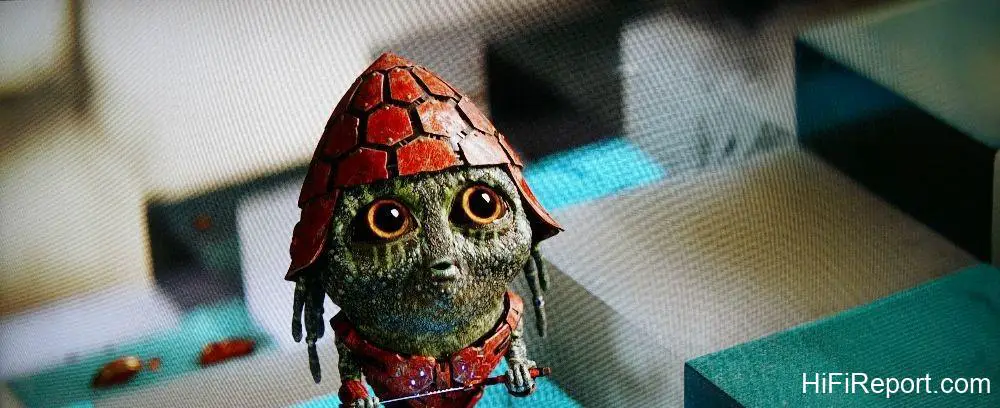
It is clear that the QM-65WA500 falls into the former category. Its 4K picture quality is quite refined, whether in the sharp outlines of images or its excellent detail rendering capabilities. For example, when watching test patterns in 4K, the patterns on a chameleon’s back and its tiny scales on a tree branch were clearly visible. When saturated green draped the chameleon, I could see extremely fine gradations of color without any color smudging or discontinuous transitions.
Performance Deep Dive
Following the test patterns, I moved on to playing 4K movies, and the QM-65WA500’s overall performance shone through entirely! The backlight adjustment allowed dark scenes to sink convincingly, capturing image details in dimly lit environments with ease. The overall contrast performance closely mirrored the feeling of watching in a cinema. Regarding HDR performance, as the unit supports Dolby Vision, it was able to render details in bright areas of the picture with greater precision.
Solar halos, the filaments of light bulbs, and the retained detail in clothing illuminated by light were all effortlessly displayed. If the 4K movie you’re watching supports Dolby Atmos audio, the TV can not only decode it directly but the built-in speakers can also produce surprising results. When watching movies in a listening room with three walls, I felt the audio envelope extend to the sides of my seating area, and I could distinctly hear the effects from the upper sound field.
While the QM-65WA500 does not feature dedicated upward-firing speakers like high-end Japanese OLED 4K TVs, the actual sound quality is arguably just as good, if not better, which is highly commendable!
Value Proposition
The WA series successfully harnesses the advantages of QLED technology, fully showcasing the inherent brightness and color capabilities of the panel. Simultaneously, it strikes a good balance in picture color calibration technology, delivers impressive audio processing performance, and offers smart features that cater to contemporary viewer trends. It can be considered a 4K QLED smart TV currently offering exceptional value for money on the market.
If you don’t have a large budget for imported products, the Sampo WA series is definitely your premier choice for owning a QLED TV right now.
Specifications
* Type: QLED Quantum Dot 4K TV
* Resolution: 3840×2160
* Contrast Ratio: 5000:1
* Response Time: 6ms
* Viewing Angle: 178°/178°
* Key Picture Technologies: 4K Upscaling, Ultra Wide Color Gamut Display, Dolby Vision/HDR10/HLG, Local Dimming, 120Hz Motion Rate
* Audio Technologies: 18W+18W Speakers, Dolby Atmos Compatible
* Operating System: Linux
* Built-in Streaming Platforms: Netflix, YouTube, LiTV
* Wireless Connectivity: WiFi(2.4G/5G), Bluetooth 4.2
* Input Terminals: 4x HDMI 2.0, 2x USB 2.0, AV Input, 3.5mm Jack Input, Digital Optical, Headphone Jack
* Dimensions: 1451×73×837mm (without stand), 1451×283×907mm (with stand)
* Weight: 20.8kg (with stand)