
Sennheiser AMBEO Soundbar Review
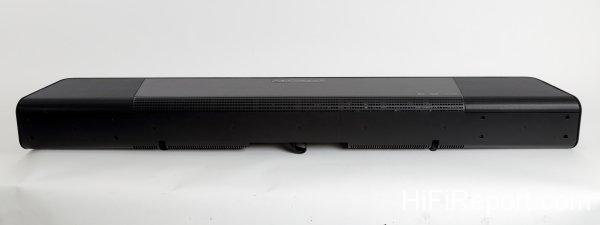
The AMBEO Soundbar is a single-unit home theater audio system built upon Sennheiser’s proprietary AMBEO audio technology.
But what exactly is AMBEO audio technology? Simply put, AMBEO is a solution developed specifically to deliver “immersive” audio – that is, a listening experience with a 3D spatial feel. AMBEO has a wide range of applications, extending beyond home theaters to include AR (Augmented Reality), MR (Mixed Reality), VR (Virtual Reality) related products, as well as binaural recording, headphones, and even car audio systems. The AMBEO Soundbar is designed for home entertainment, aiming to simulate a 5.1.4 channel surround sound system from a single soundbar. The effect is truly remarkable, and in no way inferior to traditional multi-speaker surround systems.
Immersive Audio and Format Support
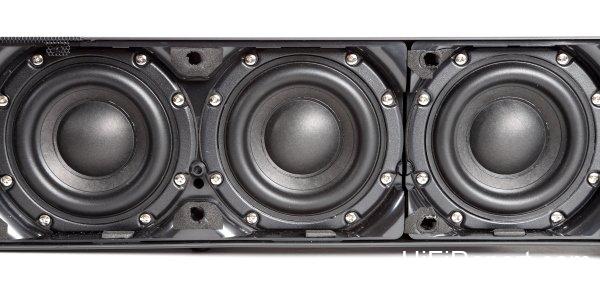
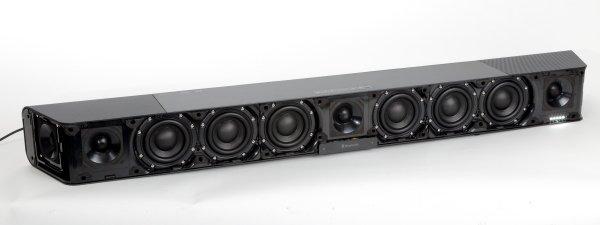
The AMBEO Soundbar achieves its 5.1.4-like surround sound through a sophisticated array of 13 drivers.
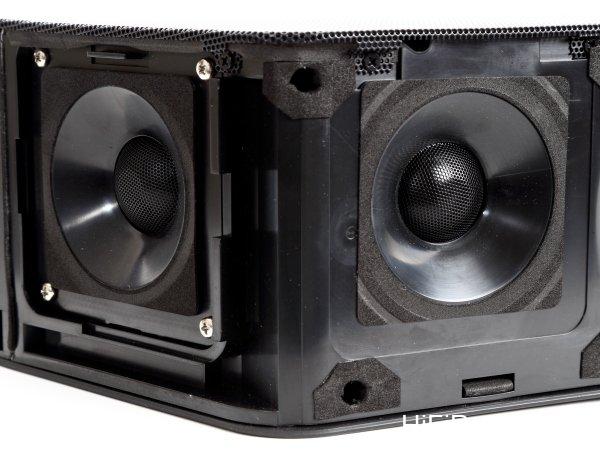
These include 5 one-inch aluminum dome tweeters, 6 four-inch long-throw sandwich cone woofers, and 2 three-and-a-half-inch full-range drivers.
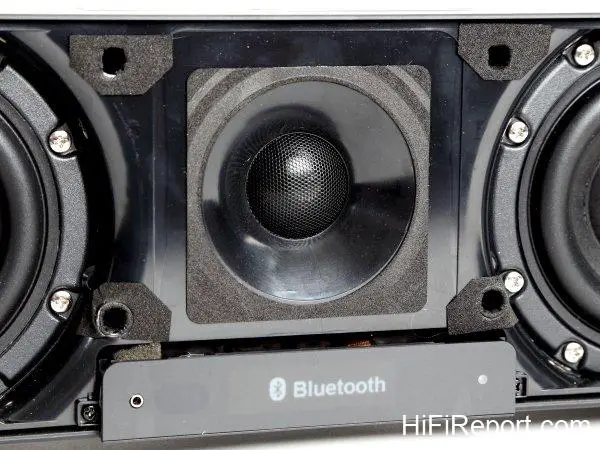
Among the 5 tweeters, 3 are positioned centrally on the front panel and to the left and right, functioning as the center and left/right main channels. The other 2 tweeters are located on the left and right sides of the cabinet, angled to project sound diagonally forward, utilizing side and rear wall reflections to create planar surround sound effects.
In addition to the 3 tweeters, the front panel also houses 6 woofers to bolster the mid-low frequency presence.
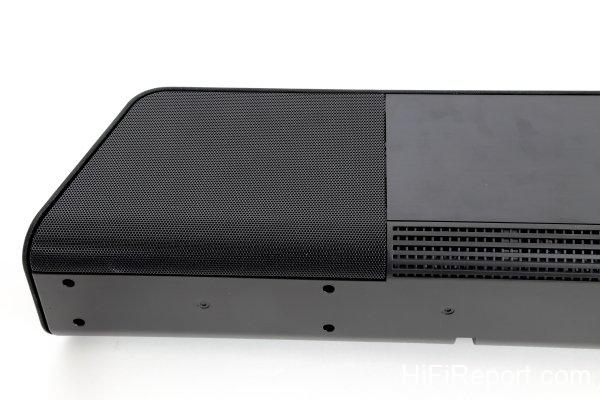
For the overhead soundstage, 2 full-range drivers are positioned on the top of the soundbar, towards the left and right ends, and angled upwards to project sound towards the ceiling. Reflections from the ceiling then create the vertical dimension of the sound field, simulating height channels.
Sound “projection” is crucial for the AMBEO Soundbar’s performance. To this end, the tweeters and full-range drivers are surrounded by shallow waveguides, enhancing energy and enabling sound to travel further.
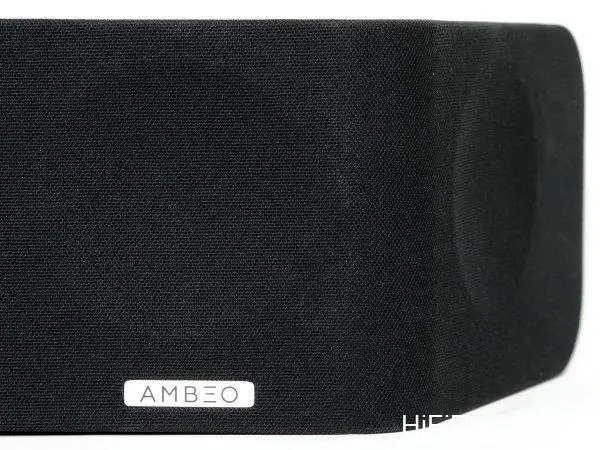
The AMBEO Soundbar supports the latest surround sound formats, including Dolby Atmos and DTS:X natively.
Even standard 5.1 channel encoded audio can be upmixed to AMBEO 3D audio, expanding the soundstage vertically.
Connectivity is well catered for with ample HDMI interfaces, including 3 HDMI inputs and 1 HDMI output. It supports 4K video, and the HDMI output is ARC-enabled, allowing audio from your TV to be sent back to the AMBEO Soundbar, eliminating the need to endure thin TV audio.
The AMBEO Soundbar also features built-in Chromecast functionality, enabling direct streaming of online video and audio content.
For network connection, both RJ45 Ethernet and Wi-Fi wireless are supported.
Furthermore, Bluetooth reception, optical digital input, and analog audio input are all included, making it a very feature-rich device.
Effortless Room Calibration
Beyond its features, the AMBEO Soundbar also boasts automatic room calibration. It’s essential to perform this spatial measurement and correction before you start listening.
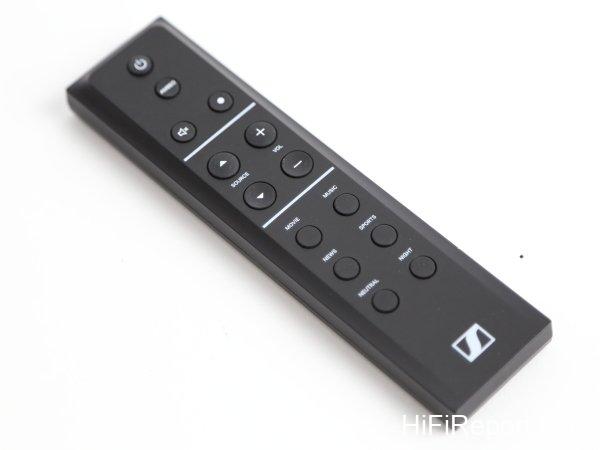
The AMBEO Soundbar comes with a microphone stand, with an omnidirectional microphone at its tip. Simply connect the microphone to the AMBEO Soundbar to initiate room calibration.
The measurement process is quite straightforward. Place the microphone at your listening position, and follow the instructions on the display panel and in the manual. The calibration process completes within minutes.
The AMBEO Soundbar relies on wall reflections to create its 3D surround effect. Therefore, the sound quality is significantly influenced by the room environment.
According to the manual, the ideal room for the AMBEO Soundbar is a rectangular space with symmetrical left and right side walls. The soundbar should be placed centrally on the front wall, with side walls within a range of 1 to 5 meters.
This indicates that the AMBEO Soundbar is suitable for rooms with widths ranging from 1 to 10 meters, offering considerable flexibility.
Additionally, the AMBEO Soundbar should be placed below the TV. It can be wall-mounted, but must maintain a minimum distance of 10 cm from the TV for ventilation.
In terms of height, the distance between the AMBEO Soundbar and the ceiling should also be between 1 and 5 meters. It’s important to note that the ceiling must be flat, not sloped or domed.
The distance to the rear wall behind the listening position is not specifically critical. If the rear wall is closer, the AMBEO Soundbar can utilize its reflection to create a sense of envelopment from behind. If the rear wall is far away, and reflections are minimal, the surround effect will be primarily focused in front and to the sides.
Furthermore, the materials of the walls, wall hangings, and furniture in the room can also affect the 3D sound field presentation.
Room-Filling Soundstage
The listening test was conducted in the HiFiReport listening room.
Our listening room is rectangular, approximately 7 meters wide, with balanced proportions and consistent wall materials, which should be ideal for the AMBEO Soundbar to perform optimally.
Unsurprisingly, playing the Dolby Atmos demo disc “Amaze,” the initial sound immediately astonished me: the soundstage was enormous! How large? As large as the room itself. The rain sounds in the clip seemed to blanket the entire front wall, filling the listening space in front of me. Even more impressively, I could discern the changes in raindrop size, indicating that the AMBEO Soundbar not only produced a vast and full soundstage but also presented details with remarkable precision.
Another key element in this clip is the sound of birds flapping their wings. Through the AMBEO Soundbar, I clearly heard the wingbeats move from left to right, and then from right to center, with a very smooth sense of motion.
Similar impressions emerged from the “Horizon” clip. A large spaceship appeared from above the screen, flew forward and then passed overhead. Following it, two smaller spacecraft flew in from the right and left sides respectively. I distinctly heard the sound effects originate from above and the sides, then move towards the center of the screen. The movement was seamless, and the scale of the sound matched the visual size of the objects perfectly.
Frankly, achieving this level of performance, even with a multi-channel speaker-based home theater system, is not easy. It requires meticulous adjustment of each channel’s volume and balance to attain such clear and smooth movement, and such excellent envelopment. Yet, the AMBEO Soundbar seemed to achieve it effortlessly.
This made me extremely curious: in such a large space, how could the AMBEO Soundbar, with just a single unit, create such a massive “wall of sound”? How could the movement, scale, and size variations of sounds be so distinct? Well, Sennheiser’s AMBEO technology certainly possesses unique capabilities.
Let me offer another example using the 2017 DTS demo disc.
When you insert the Blu-ray disc and before the video menu appears, there’s a DTS logo that explodes outwards from the center of the screen in the opening sequence. At this moment, the sound effect I heard radiated from the center point of the front wall towards all four corners, expanding from small to large, ultimately filling the soundstage like a front wall. It was incredibly satisfying to hear.
Excellent Sound Quality
The AMBEO Soundbar not only delivers vivid and rich sound effects but, crucially, also possesses clean sound quality, bright and lively timbre, excellent fullness, and remarkable smoothness. The sound is never harsh or aggressive, and never fatiguing. This means it’s not just great for movies, but also fully capable of handling everyday music listening.
For example, in the Dolby Atmos demo disc, there’s a segment called “Audiosphere.” The visuals show two concentric arcs with different colored blocks lighting up around them. As each block illuminates, a “ding-dong” musical note sounds, forming a melody.
Through the AMBEO Soundbar, each “ding-dong” sound is very clear and bright, with excellent moisture, indicating effortless and natural high-frequency extension.
Furthermore, after each “ding,” a distinct “humming” tail can be heard, with clear and extended reverberation, further demonstrating its exceptional detail reproduction.
Next, let’s test the AMBEO Soundbar’s low-frequency performance.
The AMBEO Soundbar claims a low-frequency extension down to 30Hz (-3dB), and that sufficient bass can be achieved without an external subwoofer under normal circumstances. Is this truly the case? Based on my listening experience, I believe it is. Otherwise, the overall soundstage wouldn’t be so expansive, the frequency range wouldn’t be so balanced, the extension at both ends wouldn’t be so natural, and the bass layering wouldn’t be so clear.
However, the adequacy of bass also depends on the content being played, room size, and personal preference. For instance, when playing the “Everest” clip from the Dolby Atmos demo disc, which depicts climbers descending the mountain and encountering a sudden storm with strong winds and flying snow, the low-frequency rumble is intense.
At normal listening volumes, the AMBEO Soundbar vividly portrays the positions, distances, intensities, and movements of various sound effects. However, when I increased the volume, seeking a more visceral sensation, I could sense that the AMBEO Soundbar was somewhat strained with sustained, powerful low-frequency output. It couldn’t fully reproduce the deep fullness and clear layering at those demanding levels.
This isn’t necessarily a flaw of the AMBEO Soundbar itself, but rather a reflection of how challenging movie (special effects) low frequencies are, especially in a large listening room. Expecting a single soundbar to handle everything is perhaps unrealistic. Fortunately, the AMBEO Soundbar does provide a subwoofer output, allowing it to be paired with an active subwoofer to enhance bass output and extension, catering to the needs of larger spaces.
Superior to Many Multi-Channel Systems
Continuing to listen to various materials from multi-channel demo discs, I found it increasingly engaging. I began to feel that the AMBEO Soundbar is not only the best 3D surround sound soundbar I’ve ever heard, but also the best-sounding soundbar overall, even surpassing many multi-channel home theater systems I’ve experienced.
This isn’t to say that those multi-channel systems are inadequate, but rather that the more speakers there are, the more demanding the calibration process becomes. Furthermore, the placement and mounting positions of numerous speakers are often constrained by room limitations, further complicating setup and optimization.
The AMBEO Soundbar, leveraging Sennheiser’s years of AMBEO technology development, only requires a single unit. After simple measurement and automatic calibration, it can deliver such captivating and rich 3D sound and surround effects. It’s incredibly convenient.
However, it’s important to note that the AMBEO Soundbar’s performance is also influenced by room conditions. It’s not suitable for all environments. Assess your room before making a purchase.
If you’re still undecided about what to spend your year-end bonus on, the answer is quite obvious now, isn’t it?
Specifications
* **Form:** Single-unit Home Theater Soundbar
* **Channels:** 5.1.4
* **Drivers:** 4-inch Long-throw Woofers × 6, 1-inch Aluminum Dome Tweeters × 5, 3.5-inch Full-range Top-firing Drivers × 2
* **Supported Decoding Formats:** LPCM 2Ch, LPCM 5.1Ch, LPCM 7.1Ch, Dolby Digital, Dolby Digital Plus, Dolby True HD, Dolby Atmos – Dolby TrueHD, Dolby Atmos – Dolby Digital Plus, DTS, DTS-ES Discrete 6.1, DTS-ES Matrix 6.1, DTS 96/24, DTS-HD LBR, DTS:X, DSD, MPEG-H
* **Outputs:** HDMI (ARC) × 1, Subwoofer RCA × 1
* **Inputs:** HDMI × 3, Optical × 1, AUX × 1, Ethernet (RJ45) × 1
* **Output Power:** Maximum 500 Watts
* **Frequency Response:** 30Hz – 20kHz +/-3dB
* **Dimensions:** Approx. 126.5 × 13.5 × 17.1 mm (with feet), Approx. 126.5 × 12.5 × 17.1 mm (without feet)
* **Weight:** Approx. 18.5kg