
Shure AONIC 215 Wired Sound Isolating Earbuds Review
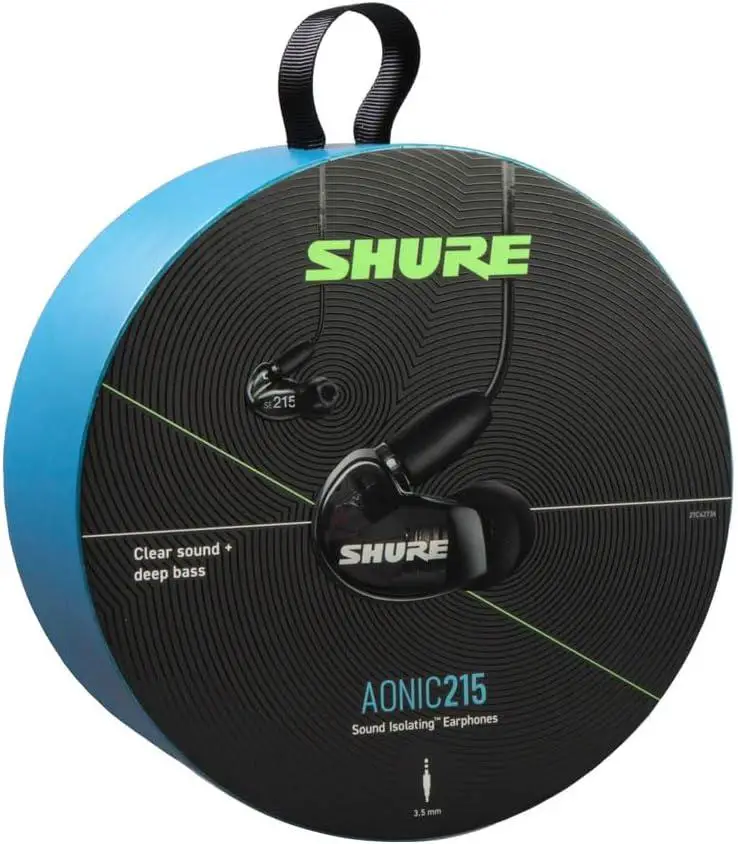
You slip a pair of earbuds in on the morning commute, hit play, and the city noise fades to a dull hum behind you. That moment of quiet is what the Shure AONIC 215 is built for. As the smallest earphone in Shure’s AONIC line, it packs a single vented balanced armature driver into a low-profile housing that sits flush in the ear canal, paired with a passive sound-isolating seal that blocks up to 37 dB of ambient noise. No battery to charge, no pairing screen to wrestle with. You plug a 3.5 mm cable into your phone, laptop, or in-flight entertainment system, and you are listening. For anyone who wants clean, detailed wired audio without the complexity of active noise cancellation, the AONIC 215 carries Shure’s in-ear monitoring heritage into a compact, everyday package.
This is an original work from hifireport.com. Unauthorized copying is not allowed.
Design, Materials and Feel
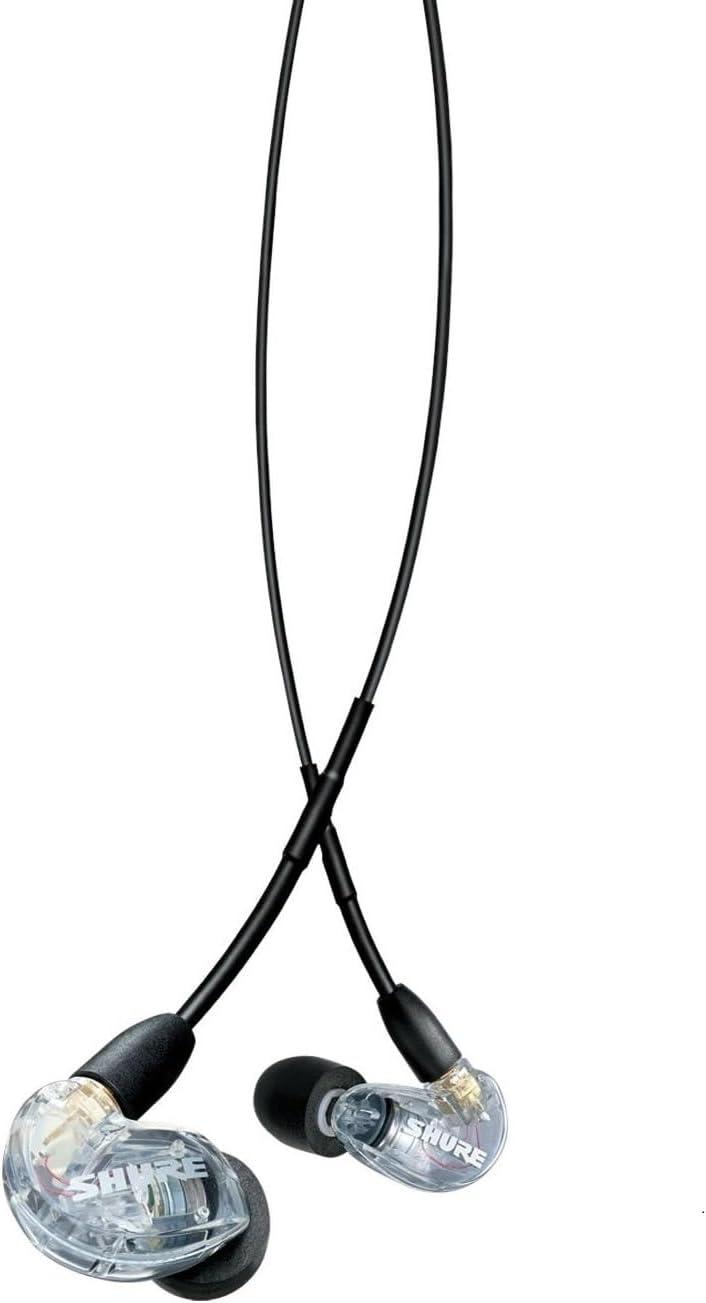
Shure has spent more than a century building audio equipment, from radio parts kits in 1925 to the professional microphones and wireless systems that fill concert stages and broadcast studios. The AONIC 215 carries that lineage into a consumer earphone, and the design reads as a deliberate step down in size while keeping the hardware professional. The housing is the smallest in the AONIC family, with a low-profile shape that sits flush against the ear canal rather than bulging outward. The over-ear wireform holds the cable behind the ear, keeping it out of the way during movement and reducing the tangle that plagues conventional straight-down earbuds.
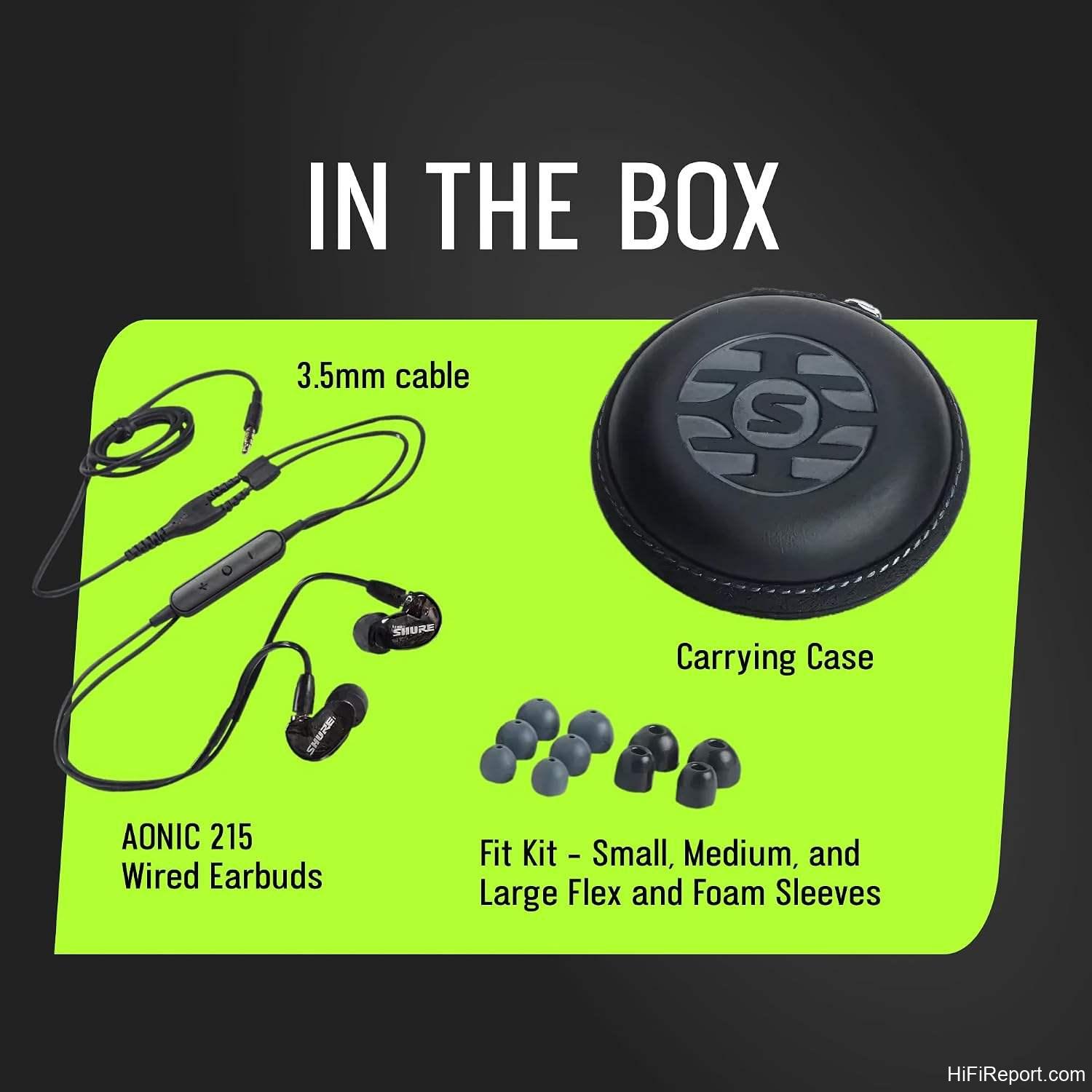
The cable system is where the build gets interesting. A 3.5 mm communication cable plugs into MMCX connectors on each earpiece, so the cable detaches and can be swapped. Shure sells replacement and specialty cables through that same MMCX port, including options for wireless conversion. The included cable has an inline remote with a microphone for phone calls and controls for volume, playback, and voice commands. The remote sits fairly high on the wire, close to the ear, and one long-time owner noted that volume adjustments become a matter of locating the small module by feel. The finish throughout is matte black, and the earpieces accept either the included memory-foam tips or the grey silicone tips also in the box.
Fit and Everyday Comfort
Insertion is the part of the AONIC 215 that demands a learning curve. The wireform loop needs to wrap behind the ear, and the small, rounded housing is not easy to grip. Multiple owners reported spending two to three minutes fiddling with placement, often in front of a mirror, before the earpiece seats correctly in both the canal and the outer-ear curve. One user described the first attempts in dim light as nearly impossible until the motion became muscle memory. Once properly seated, though, the flush profile means there is almost no outward pressure on the pinna, and the weight is light enough that most owners forget they are wearing them.
Long-session comfort is the product’s strongest selling point. The compact size distributes pressure evenly along the canal wall, and the memory-foam tips conform to the individual ear shape over a few seconds, locking in a seal that stays put for hours. Owners who commute, work out, or travel report all-day wear without the fatigue that larger earbuds can cause. The caveats come from specific scenarios. One owner who wears them for live stage work found the fit stayed secure through full sets. Another noted that the wire movement makes the AONIC 215 a poor match for heavy gym work, where pulling on the cable causes audible pops. A separate user tested the earbuds for sleeping on their side and found the canal tip deforms under pillow pressure, deadening the sound in the compressed ear until the head lifts.
How They Sound
The AONIC 215 uses a single vented balanced armature driver per side, a transducer type Shure has refined across decades of in-ear monitor systems. The result is a tuning that owners consistently describe as honest, clean, and detail-rich rather than bass-heavy or artificially colored. If you want a flat, reference-style presentation that reproduces what the artist recorded without adding or subtracting character, this is the sound you will hear.
Bass
Bass on the AONIC 215 is present but controlled. Owners who came from wired Apple Earpods or other consumer earbuds notice the difference immediately: the low end hits with a tight, drum-like transient rather than a slow, rolling boom. One long-time listener compared it to sitting next to a drum and hearing the real skin crack without the extra sub-bass that many consumer earbuds pump in. Those who prefer heavy, boosted bass will find the AONIC 215 underwhelming; the driver reproduces low frequencies accurately but does not inflate them.
This is an original work from hifireport.com. Unauthorized copying is not allowed.
Midrange and Treble
The mids and upper register are where the AONIC 215 earns its reputation for clarity. Vocals, acoustic instruments, and cymbal detail come through with a level of separation that owners describe in terms like “crisp” and “brilliant.” One reviewer, a lifelong headphone buyer since the 1970s, called the midrange and treble reproduction outstanding for audiophile listening. A separate owner noted that when the mid and high frequencies are allowed to stand out, the perceived soundstage widens noticeably, giving the impression of a larger, more open room behind the music. The treble can read as forward if the earpiece is not seated fully, so the fit matters to the tonal balance.
Soundstage and Detail
For a single-driver, wired earphone, the AONIC 215 opens up more space than most owners expect. The vented design in the driver housing helps with pressure relief and gives the presentation a sense of air. When the foam tips seal properly, the background behind the music drops and individual instruments gain their own position in the field. Owners who used them on stage for live performance reported that the isolation and detail combined made it easy to hear exactly what they needed without the mix turning to mush. The caveat is that the soundstage depends on the seal; a loose tip collapses the high-frequency extension and the sense of width shrinks.

Keeping the World Out
The AONIC 215 relies entirely on passive isolation. There is no active noise cancellation, no processing chip, and no battery-powered anti-noise system. The mechanism is physical: the memory-foam tip expands in the canal, the over-ear wireform pulls the housing deep, and the combined seal blocks up to 37 dB of ambient noise as Shure rates it. In practice, owners in open offices, on planes, or in a room with a running air conditioner report that the world goes very quiet the moment the tips seal. One user who swapped from wireless noise-cancelling headphones said the passive isolation on the AONIC 215 was close to the ANC performance of a higher-end wireless set, with the added benefit of no battery anxiety.
The flip side is that the isolation is only as good as the tip seal. If the foam is slightly rotated or the wireform is not fully wrapped behind the ear, the high frequencies leak in and the noise reduction drops. Owners who switch to the included grey silicone tips for everyday listening get a lighter seal, which trades some isolation for easier tip changes. For the noisiest environments, the foam tips are the clear choice; for a quiet home or office, the silicone tips keep the ear canal from feeling stuffed.

Battery Life
The AONIC 215 has no battery. It is a wired earphone, and power comes directly from whatever 3.5 mm source you plug into the cable: a phone, a laptop, an in-flight entertainment jack, or a dedicated audio player. There is nothing to charge, no charge cycle to track, and no battery swelling after a few years. The MMCX connector means that if the included cable eventually wears out, you replace the cable, not the earpieces. Shure sells individual replacement cables through the same MMCX port, so the driver housings can last well beyond the life of any single cable.
The tradeoff is that you are tethered to whatever device you are playing. No wireless freedom, no Bluetooth pairing, no multipoint connection. For listeners who want zero maintenance and do not mind the wire, that is a feature. The absence of a battery also means the earbuds do not degrade in sound quality over time the way wireless earbuds can when the charging contacts corrode or the cell loses capacity.

Taking Calls
The AONIC 215 cable includes a microphone and a remote module that handles call audio on both Apple and Android devices. Owners who use them for phone calls on mobile report clear voice pickup and a natural transmission that the person on the other end notices. One long-term user pointed out that friends on a call remarked on the voice clarity compared to the built-in phone microphone. The experience is less uniform on desktop or laptop use. One owner found the inline remote and mic did not register correctly on a PC, making the earbuds effectively music-only in a desktop setup. Another reported that on Android the mic simply did not function for calls, and on iPhone, using a 3.5 mm-to-Lightning adapter, call audio was equally unreliable. For mobile-first use the mic works; for PC or adapter-dependent use, expect inconsistent results.
Customer Feedback Highlights
The aggregate rating sits at 4.2 out of 5 across 963 reviews, a strong mark that reflects broad satisfaction with sound quality and fit. The most common praise centers on the clarity of the audio. Owners who used the AONIC 215 on stage for live performance called the balanced, distortion-free output a major upgrade over consumer earbuds they had used for monitoring. Multiple reviewers described the mids and treble as crisp and well-separated, with no harshness or muddiness. The passive isolation earned consistent mentions, with several owners saying the foam tips made loud office or commute noise disappear. Build quality drew its own thread: the MMCX cable system, the sturdy housing, and the fact that the foam tips grip firmly all appeared in positive reviews.
The complaints cluster around specific, fixable issues. The cable length is the most repeated gripe. At roughly one meter, it works fine for a phone in a pocket but falls short for a desktop or in-flight setup, and at least two owners wished they had bought the longer replacement cable upfront. The insertion process remains a friction point; the small housing shape and the wireform loop make first-time use fiddly, and a few reviewers gave the product a lower rating purely because they found it hard to seat without a mirror. A vocal minority reported that the mic or remote module failed on their particular device or adapter combination. And a small group found the tuning too bright for their taste, with treble leading and bass retreating, a direct consequence of the reference-style driver.
This is an original work from hifireport.com. Unauthorized copying is not allowed.
What We Like / What We Don’t
What We Like:
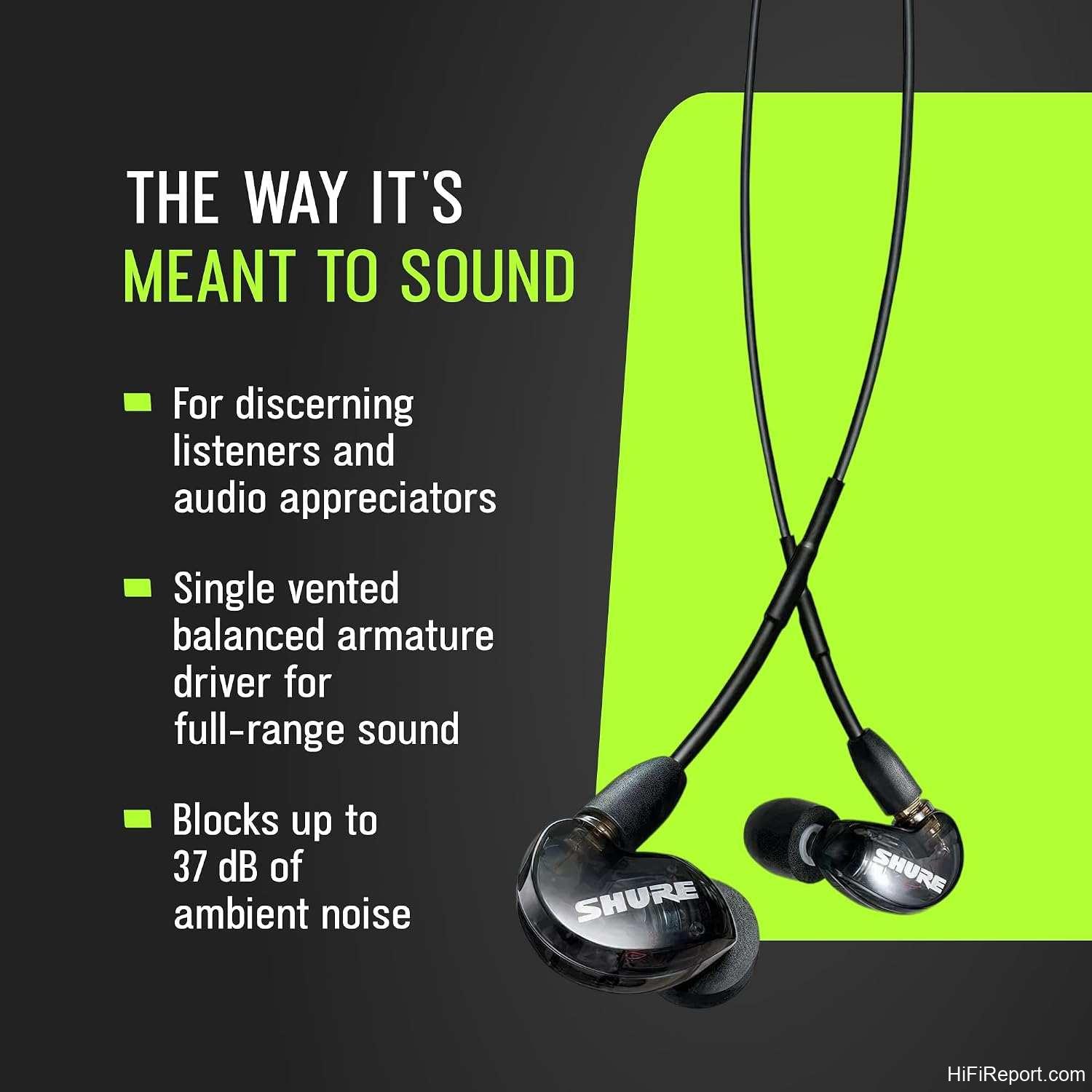
- Single vented balanced armature driver delivers clear, detailed, reference-style sound across the full frequency range
- Passive isolation blocks up to 37 dB of ambient noise without any active electronics
- Over-ear wireform and flush housing keep the earbuds secure and out of the way during movement
- MMCX cable system lets you swap or replace the cable without replacing the entire earphone
- Compact, low-profile design suited to long listening sessions
What We Don’t:
- Roughly one-meter cable length is too short for desktop or in-flight use without a longer replacement
- Insertion takes practice; the small housing and wireform loop are harder to seat than standard earbuds
- Inline remote and mic do not register reliably on all PC or adapter combinations
- Reference tuning will not satisfy listeners who want boosted, sub-bass-heavy output
- Side-lying sleepers may find the canal tip deforms under pillow pressure, muffling the affected ear
The Verdict
The Shure AONIC 215 is a wired earphone for listeners who value clarity over coloration and who are comfortable with a cable running from their ear to a phone or laptop. If you want a reference-style sound that reproduces recordings without artificial bass inflation, and you work in environments where 37 dB of passive isolation is enough to block the commute, the office hum, or the airplane cabin, this is a well-matched tool. The MMCX cable system gives the earpieces a long useful life, and the compact housing disappears in the ear during long sessions.

If your priority is wireless freedom, heavy gym use where wire movement becomes a problem, or a bass-forward sound signature, the AONIC 215 will not be the right fit. The cable length limits where you can comfortably use the earbuds, and the insertion process requires a minute of deliberate placement each time. For desktop or laptop users, the mic and remote reliability is inconsistent, so treat the earphone as a music-first, mobile-second product unless you test the cable on your specific setup before committing.
Specifications
- Driver: Single vented balanced armature, per side
- Isolation type: Passive, up to 37 dB ambient noise blocking
- Connector: 3.5 mm plug with MMCX earpiece interface
- Cable: Detachable, over-ear wireform, integrated remote and mic
- Ear tips included: Memory-foam and grey silicone
- Compatibility: Apple and Android devices via 3.5 mm (adapter required where needed)
- Color: Black
- Rating: 4.2 out of 5 (963 reviews)
Questions Buyers Ask
Do the AONIC 215 need a battery or charging?
No. The AONIC 215 is a fully wired earphone with no battery, no charging port, and no wireless pairing. Power comes directly from the 3.5 mm source you connect it to. The MMCX connector lets you swap the cable without replacing the earpiece housings.
Can I use the included cable with a desktop PC?
The cable connects via a standard 3.5 mm plug, but owners report that the inline remote and mic do not usually register on desktop systems. Music playback works fine; the remote controls and call microphone are unreliable on PC. For a desktop setup, treat the earphone as music-only unless you test the specific adapter and software combination first.
Are the foam tips necessary for full isolation?
Yes. Shure rates the passive isolation at up to 37 dB, and owners consistently report that the figure holds only when the memory-foam tips create a full canal seal. The included grey silicone tips provide a lighter seal and are comfortable for quieter environments, but the high-frequency extension and noise blocking drop noticeably without the foam.
What happens if the cable breaks?
The MMCX connector on each earpiece allows you to detach the cable and plug in a replacement or a Shure specialty cable, including wireless-conversion options. The driver housings stay in the ear; only the cable segment changes. This makes the earpieces far more durable in the long run than a permanently bonded cable design.

- STRIKING FULL-RANGE SOUND: Single vented balanced armature driver delivers clear, detailed audio across the entire frequency spectrum. Hear music the way it was meant to be heard with accurate reproduction that reveals every nuance in your favorite tracks
- COMPACT LOW-PROFILE DESIGN: The smallest earphone in the AONIC line provides all-day comfort without fatigue. Sleek, discreet shape fits securely for extended listening sessions whether you're commuting, working out, or relaxing at home
- SOUND ISOLATING TECHNOLOGY: Blocks up to 37 dB of ambient noise to eliminate distractions and create an immersive listening environment. Perfect seal keeps earphones secure and outside noise out during travel, exercise, or focused work sessions