
SINE MC40 Aluminum Dual Magnetic Conduit Power Processor Review
Power is the foundation of any audio system, yet because it is readily available, it is also the most easily overlooked. Many enthusiasts only realize the critical importance of clean power at the end of their upgrade journey—but it is never too late. SINE is a Hong Kong-based brand specializing in the design and manufacture of audiophile-grade power products, cables, and accessories.
Leveraging their deep understanding of audio reproduction, they deliver products with tangible sonic benefits at reasonable prices. The SINE MC40 is their latest power processor, utilizing magnetic conduit purification, natural mineral vibration damping, and power compensation circuitry to achieve a final sonic result defined by purity and silence.
The MC40 is a new release but does not sit at the top of the brand’s hierarchy; its technology essentially trickles down from the larger S-60A. The S-60A offers higher continuous and peak power handling capabilities, while the MC40 is tailored for mid-sized audio systems. The flagship remains the Gateway 3 power processor, which employs even more layers of purification technology. The MC40’s exterior and structural design balance aesthetics with function.
Its high-rigidity chassis features a specially thick 10mm aluminum alloy front panel paired with a thickened steel base (total unit weight reaches 10 kg), effectively shielding against external radio frequency interference (RFI) and mechanical vibration. All internal conductive components—including the 13 AWG single-core copper internal wiring and high-grade outlets—undergo -196°C cryogenic treatment to optimize the metal’s crystalline structure.
Outlet Configuration & Power Compensation
As a mid-sized power processor, the MC40 provides eight outlets divided into three distinct zones based on the connected equipment’s power characteristics, with internal circuitry optimized for each type. The factory default orientation positions the outlets facing rearward or forward, but the manufacturer specifically notes they can also face upward for convenience; consequently, the front aluminum panel is machined flat to allow stable placement in this orientation.
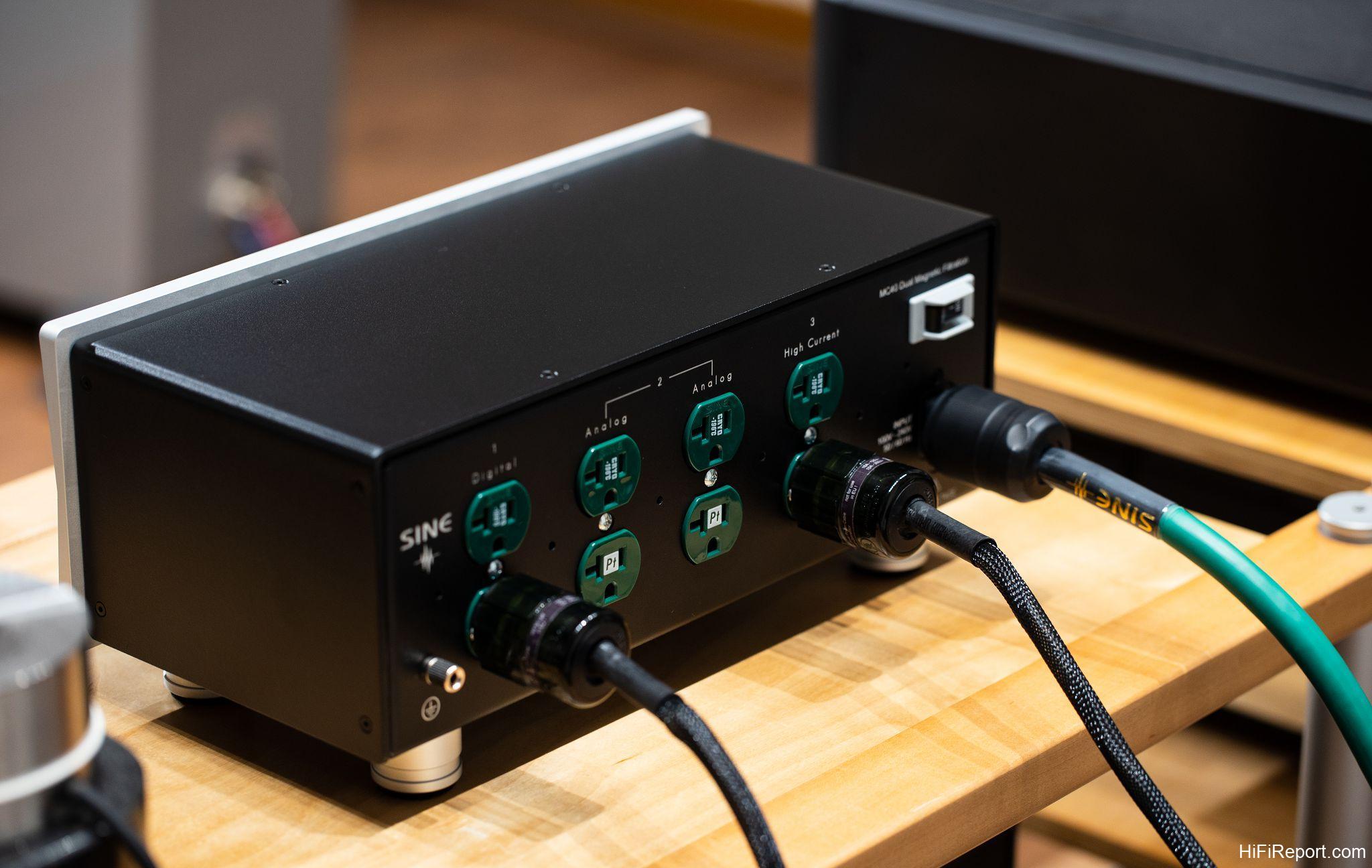
When the master power switch on the rear is engaged, the front panel illuminates, providing clear visual confirmation of operational status.
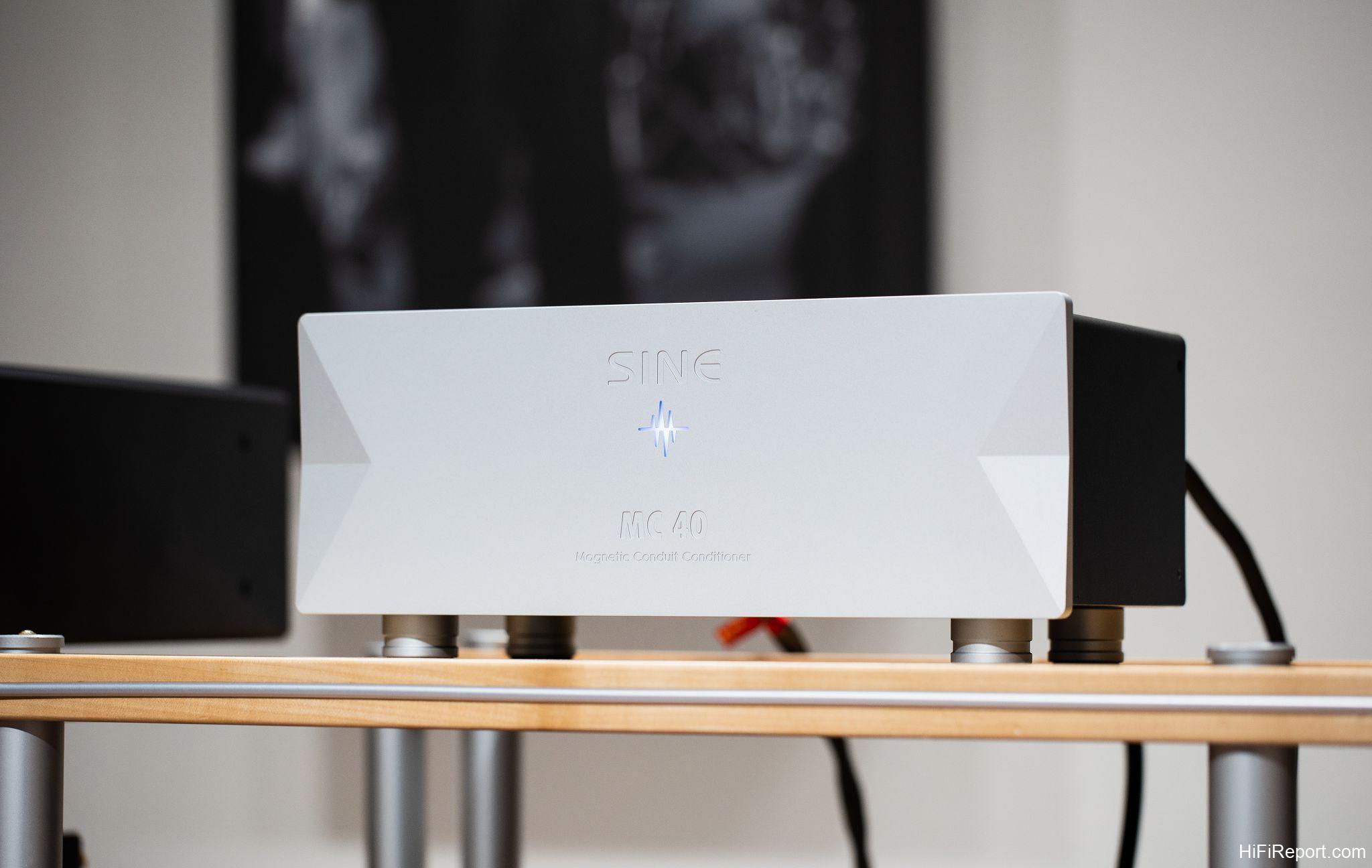
**The MC40 features 8 outlets divided into 3 zones with 3 independent power compensation circuits:**
* **Analog Zone:** Dedicated to analog components. Independent filtration prevents mutual interference between devices.
* **High Current Zone:** Designed specifically for power amplifiers and integrated amps, ensuring smooth high-current transient response and a blacker background.
* **Digital Zone:** Dedicated to digital components. Independent filtration prevents mutual interference between devices.
The outlets themselves are premium US-made, rhodium-plated, cryogenically treated units. The high-current 20A cryo-treated power switch incorporates surge/lightning protection. The chassis interior is filled with natural mineral granules, utilizing physical damping to absorb internal resonances and further absorb residual EMI.
Internal wiring employs 13 AWG single-core copper, terminated via a unique spiral wiring method / four-wire hook-up configuration, ensuring secure contacts and effectively mitigating high-current inrush impact.
Because the internals are not easily accessible for disassembly, we refer directly to official materials and photos for the core technology: the **Aluminum Dual Magnetic Conduits**—a triple-processing architecture that maximizes noise removal. The MC40 is equipped with an upgraded 40A Aluminum Dual Magnetic Conduit system.
Unlike traditional filters that rely on inductor coils, Magnetic Conduit technology utilizes specific magnetic fields to absorb high-frequency noise and EMI pollution within the current path. This fundamentally solves the “magnetic saturation” and “current limiting” issues inherent in conventional circuits. Dual conduits operate synchronously to filter both the live and neutral paths simultaneously, achieving true balanced, clean power delivery.
This yields a quieter musical background with uncompressed dynamic extension. The balanced circuitry filters the power on the positive cycle first, then processes the return path a second time, thoroughly cleansing the output power.
Upgraded from previous PVC conduits to 230mm aluminum alloy conduits, the exclusive 3-stage power compensation design enhances high-current transient response.
The manufacturer also provided their own **SINE NIDAS HC+** power cable for the audition. Designed specifically for high-power audio equipment, the entire cable undergoes SINE’s proprietary -196°C cryogenic treatment. It features 10 AWG conductors with a 5.26 mm² cross-sectional area, capable of handling up to 30A (300V).
Greater Nuance and Emotional Expression
For the listening sessions, I cued up Eva Cassidy’s *Live At Blues Alley*. With the SINE MC40 in the chain, the system’s agility was immediately striking. Vocal and instrumental details seemed to leap off the soundstage plane, presenting a vivid, tangible three-dimensionality. Cassidy’s delivery was rich with emotion and nuance—whether in her diction or the dynamic ebb and flow of her phrasing, everything emerged naturally and effortlessly.
The system conveyed her interpretation and expressive intent with uncanny realism, drawing me into the performance as if I were present at the venue. The music truly captured the atmosphere and emotion of that moment, preserving fragments of a lost time and space. The MC40 added richness, body, and weight to the mid-bass, which serves emotional expression exceptionally well, while simultaneously revealing transparency and extension in the upper midrange and treble.
The three frequency bands integrated into a more complete whole, with overall coherence and envelopment rendered in a balanced, harmonious manner.
Unshackled Sound: Freer and More Natural
During the evaluation, I first connected only the source component to the SINE MC40, playing Hanne Boel’s “Chance of a Lifetime.” The sound became noticeably more alive, with a cleaner, more transparent background and an overall lighter, more see-through quality. Instrumental separation from the background improved significantly; notes shook off a previously slight sense of stickiness and stagnation. Both vocals and instruments sounded more natural and free.
While maintaining weight and fullness, they gained a distinct sense of agility—like shedding shackles and breaking free from constraints. Notes rose and fell with greater elasticity, and string tones shimmered with more color and sparkle.
Vocals stood out particularly in terms of dynamics and agility, similarly freed from a sense of being pasted onto the backdrop. The interplay of phrases became more vivid; at moments of exertion, there was a commanding tension. A slight rasp in the voice was rendered with remarkable naturalness. As notes tapered off into long decays, the sound remained silky and pure. As the melody wound up and down, lines flowed with elegant smoothness.
The overall impression was one of a clearer, purer background that naturally brought vocals and instruments forward, presenting their character more prominently and vividly.
Well-Judged Balance, Seamless Vocal/Instrumental Blend
Next, I connected only the amplifier to the MC40, referencing Rachael Yamagata’s “Duet.” The overall presentation felt more cohesive, allowing the music to be lighter where it should be light and heavier where it should be heavy—better contrast and superior control. Right from the opening delicate strings and soft humming, the proportional weight between elements was crystal clear. The vocals were more prominent—focused and full—while the strings were rich yet appropriately lighter.
Though the singing was gentle, it possessed remarkable cohesion; decays didn’t just dissipate but remained poised and emotionally charged.
In the middle section, the male vocal originally seemed ambiguous in weight relative to the strings, occasionally sounding as if the strings were slightly stealing the spotlight. With the amplifier on the MC40, the presentation became more comfortable. The balance between male vocal and strings was just right: the strings retained their fullness and stability, but the vocal projected with greater clarity and presence, unmasked by the strings yet never aggressively overriding them.
During the duet with the female vocal, the interplay between voices and instruments was remarkably harmonious. There was zero sense of competition among the three elements—only a seamless, serene collaboration.
Restoring Musical Luster, A More Coherent Presentation
Finally, I listened to Ed Sheeran’s “Photograph,” this time with both source and amplifier connected to the MC40. Compared to the baseline, every passage of the song seemed to possess greater luster and tonal color. The opening strings were rich in timbre—full yet retaining a light-footed agility, with ample dynamic rise and fall.
The subsequent vocals sounded equally focused; despite the gentle melody, there was a sense of a more solid foundation beneath the voice, lending the sound greater substance.
As the track progressed, the drums swelled in intensity. Originally, the drums sounded imposing and impactful, but perhaps a touch overblown, causing cymbals and vocals to pale in comparison. The MC40 reined the drums in: they remained authoritative and dynamic, yet stable and controlled. While preserving their full momentum, the processor allowed vocals and other instruments to shine with greater clarity.
The proportional balance was even—delivering the full visceral impact of the drums while presenting the whole in a more coherent, integrated fashion.
SINE MC40 Aluminum Dual Magnetic Conduit Power Processor — Specifications
* Proprietary upgraded 40A Aluminum Magnetic Conduits filter power line contamination
* One output zone upgraded to High Current, processed by Dual Magnetic Conduits, providing a quieter background for high-current components
* Upgraded to premium US-made rhodium-plated cryogenic outlets, enhancing system dynamics and resolution
* Balanced circuitry: filters power on the positive cycle first, then performs secondary processing on the return cycle for thoroughly cleansed output
* 10mm extra-thick silver aluminum front panel & black aluminum chassis — minimizes RF interference to the absolute minimum
* Full-unit -196°C cryogenic treatment
* Spiral wiring method effectively mitigates current inrush shock
* Exclusive 3-stage power compensation design
* Chassis infused with natural mineral granules to dampen internal vibration and resonance, ensuring a quieter background
* High-current 20A cryogenic circuit breaker ensures smooth current flow; breaker provides lightning/surge protection
* 13 AWG single-core wiring, four-wire hook-up termination
* Maximum continuous power: 6000W (220V)
* Maximum peak current handling: 10600W (220V)
* Dimensions: (W) 372mm × (D) 180mm × (H) 160mm
* Net weight: 10 kg; Shipping weight: 11 kg