
Sonus Faber Lumina III Floorstanding Speaker Review
Have you, like me, ever dreamt of owning a pair of Sonus Faber speakers? When writing the review of the Guarneri Tradition (Homage to a Dream Goddess – HiFiReport Audio Reviews Guarneri Tradition), I mentioned my past aspirations.
Back when I was a student, dreaming was all I could do; Sonus Faber’s classic speakers were simply beyond my reach.
The Reference and Tradition series from Sonus Faber are indeed captivating, but their high prices make them inaccessible to most.
Are there more approachable options? Looking through Sonus Faber’s lineup, they do offer more affordable speakers, such as the Toy series from a decade ago, and the later Chameleon series. These models pushed prices down into a range that put pressure on mainstream speaker brands, making them attainable for young people willing to save up.
Now, Sonus Faber has once again presented a brand new, more accessible series: Lumina.
Entry-Level Price, High-End DNA
“I predict these will be a bestseller.” That’s what one audio store owner told me.
His prediction is not without reason. Sonus Faber has clearly invested significant effort in the Lumina series, striving to incorporate the brand’s signature elements while controlling costs.
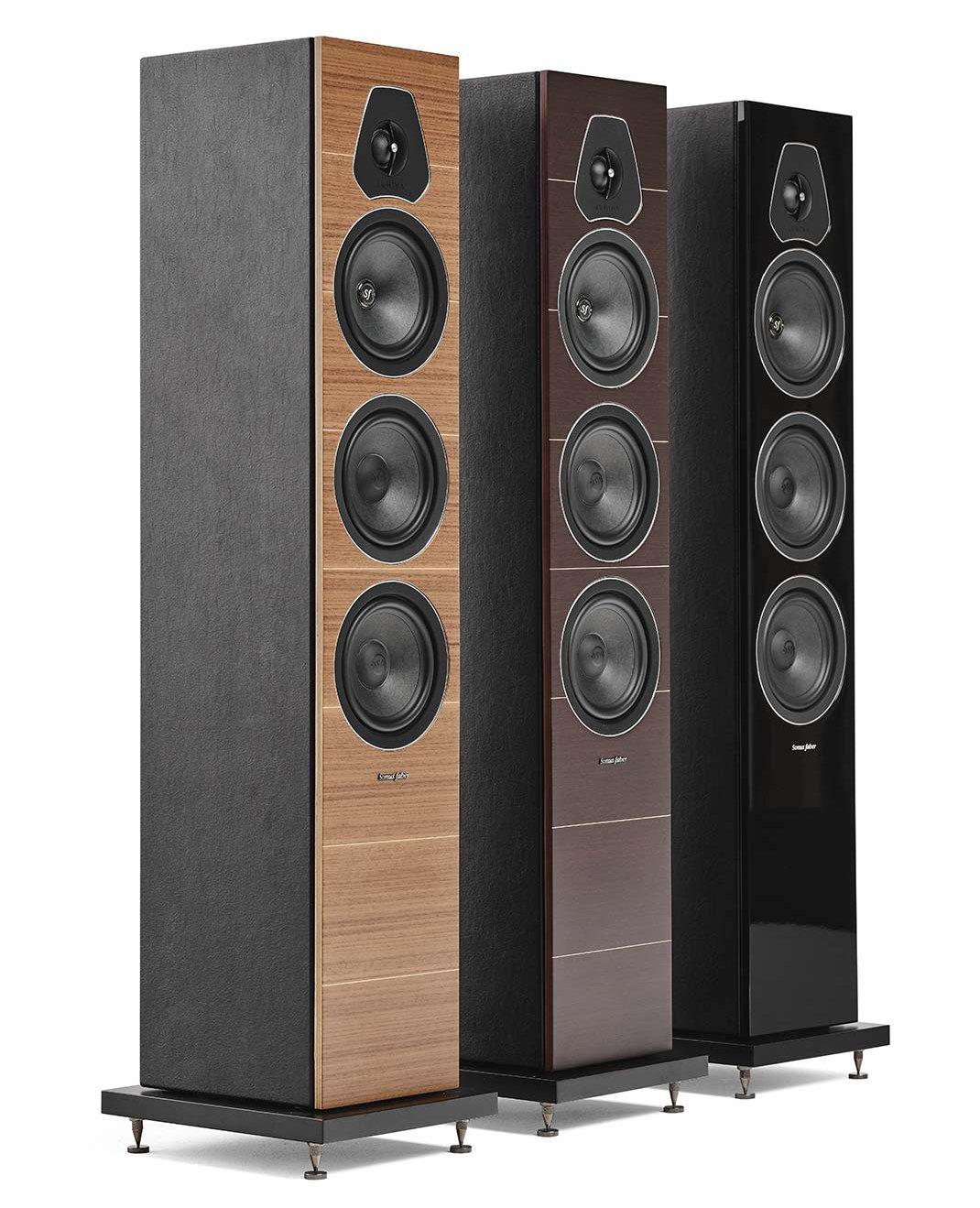
The cabinet is wrapped in leather, a classic Sonus Faber design cue. The tweeter features the patented Damped Apex Dome waveguide, framed by a tulip-shaped faceplate. The SF logo adorns the dust caps of the midrange and bass drivers, and horizontal metal strips grace the front baffle. These are all consistent brand hallmarks. What’s even more surprising is that the Lumina series, as an entry-level offering, is still manufactured in Italy.
Such sincere craftsmanship is hard not to be excited about. (Image source: Sonus Faber official website)
Sonetto Series Drivers
As the most affordable entry-level series, Lumina comprises three models: the floorstanding Lumina III, the bookshelf Lumina I, and the center channel Lumina CI.
According to the manufacturer, this series is equally suited for both music and home theater applications. The flagship Lumina III is a 4-driver, 3-way, bass-reflex design.
The tweeter is a slightly larger 29mm silk soft dome unit, manufactured by German driver specialist Dr. Kurt Mueller. Sonus Faber calls this tweeter D.A.D. (Damped Apex Dome), noting its diaphragm surface has a special coating. It also features the signature Damped Apex Dome waveguide. This tweeter is identical to the one used in the step-up Sonetto series (Falling in Love with the Sound of Sonus Faber – Sonus Faber Sonetto V Floorstanding Speakers), and boasts excellent extension, reaching up to 24kHz according to factory specifications.
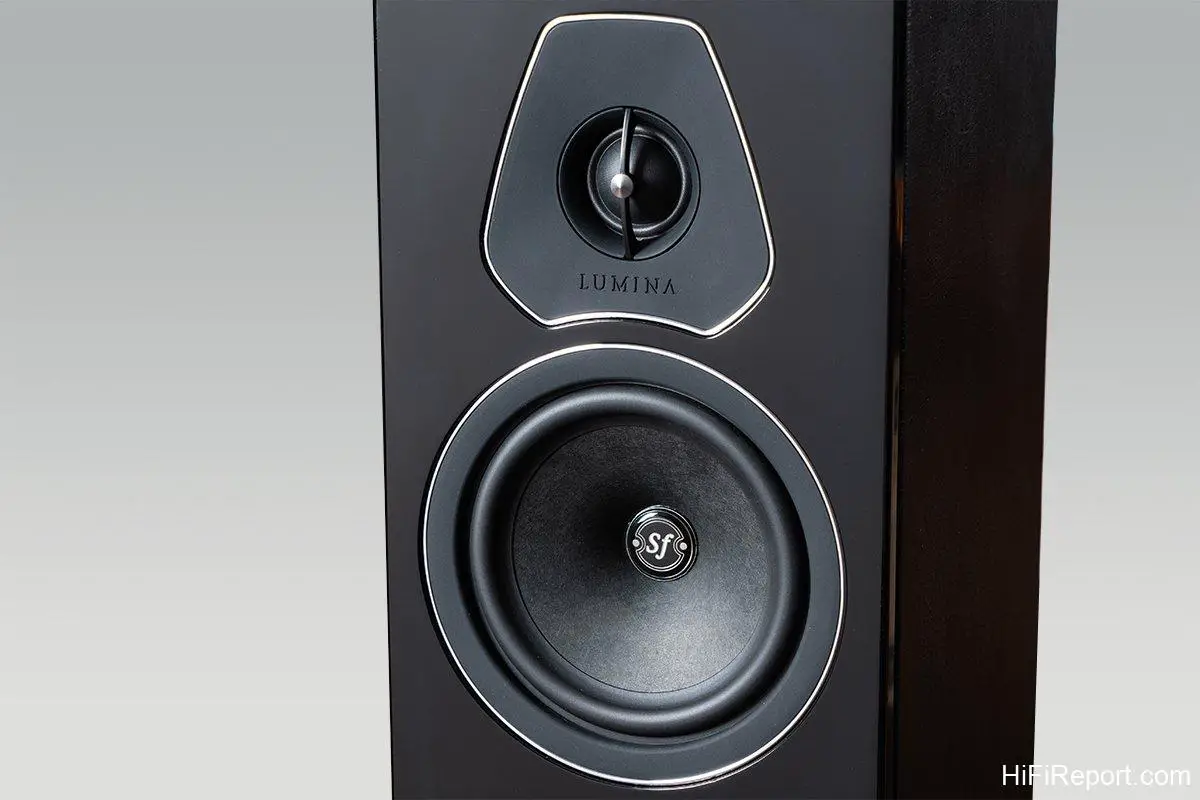
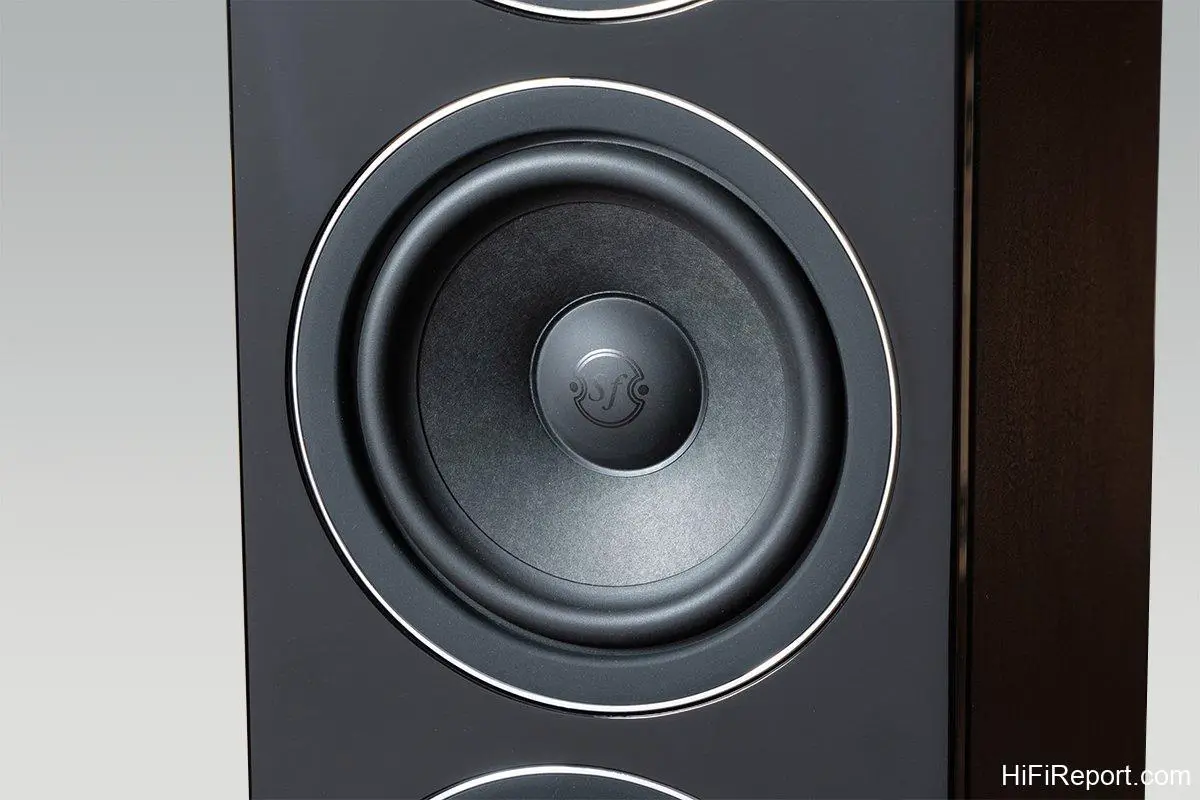
The midrange driver is a 150mm paper cone unit. Paper cone diaphragms made of natural fibers are a long-standing Sonus Faber tradition. The rigid dust cap, imprinted with the SF logo, mirrors those found on higher-end models. The manufacturer also states that this midrange driver is also sourced from the Sonetto series.
From this, it’s clear that the Lumina series inherits significant DNA from the Sonetto series, employing trickle-down technology in its entry-level range. It’s no wonder dealers are impressed.
Two 150mm paper cone woofers are positioned below the midrange driver, paired with a bottom-ported bass reflex design. This allows the Lumina III to achieve a low-frequency response down to 40Hz, quite remarkable for such a compact floorstanding speaker.
Para-Cross Topology Crossover
The crossover network utilizes meticulously selected capacitors, resistors, and inductors, implemented in a “semi-balanced” circuit design that the company calls Para-Cross Topology.
The crossover point between the tweeter and midrange is set at 3,500Hz, while the crossover between the midrange and woofers is at 350Hz. Sonus Faber further emphasizes that the crossover optimizes the time-domain phase response across all frequency bands.
Layered Wood Baffle
To manage costs, the Lumina series cabinets forgo the lute-shaped or teardrop curves found in other Sonus Faber speakers, opting for a more rectangular form. However, the sides and top of the cabinet are still wrapped in leather, and the front baffle utilizes a layered wood construction with lower resonance and higher rigidity.
A wide plinth is added to the base of the speaker, with height-adjustable spikes beneath, ensuring the Lumina III stands firmly.
Despite being an entry-level speaker, the Lumina III features two pairs of speaker binding posts, accommodating bi-wiring or bi-amping configurations. The terminals are nickel-plated to prevent oxidation.
The Lumina III sent for review is the black high-gloss version. The piano black finish on the front baffle certainly gives the speaker a more modern and understated appearance. However, I personally prefer the wood veneer versions, which showcase the layered wood edges. The walnut and wenge finishes resonate with the look of higher-end Sonus Faber speakers. (Image source: Sonus Faber official website)
Ideal Amplifier Pairing
An entry-level speaker like this is best paired with a simple integrated amplifier. If the amplifier includes source capabilities, even better—a simple three-piece system of an integrated amp and two speakers is all you need.
The editorial department happened to have the Quad Artera Solus Play on hand. This integrated amplifier, priced under $3,333 USD (assuming 30 NTD to 1 USD for 100,000 NTD), includes a built-in DAC, digital streaming, and CD playback. With 75W of output power per channel, its sonic foundation is clean, and its driving performance is satisfying.
Other suitable and convenient pairings would include the Naim Uniti Atom, NAD M10, and Lyngdorf TDAI-1120.
Elegant Midrange and Treble
Pairing the Quad Artera Solus Play with the Lumina III for listening, the sound is refined and elegant, with a pristine quality that is very pleasing. Take, for example, He Wanzhen’s performance of Tchaikovsky’s “The Seasons” piano cycle. When the music magazine was newly launched, Tchaikovsky was invited to compose piano pieces for each month of the inaugural year, based on a poem. Over a year, 12 exquisite miniatures were born.
The Lumina III, being compact, isn’t suited for high volume levels, but at a slightly reduced normal piano volume, the transparent and clear soundstage unfolds crystalline notes before you, like poetry and song. He Wanzhen’s playing is full of expression and color, and recording engineer Wang Zhaohui meticulously captured every moment of brilliance.
“March: Song of the Lark” opens with a slightly melancholic melody, reflecting not the lark’s song, but the human heart and consciousness. Listening to the right hand play the theme in the treble range, followed by the left hand restating it in the bass, the contrast in pitch draws emotions downward, evoking a sense of melancholy. The piece concludes with soft, lingering chords that carry the mood into the distance.
“April: Snowdrop” transitions from G minor in March to B major. The 6/8 time signature brings a dance-like elegance. The snowdrop, bravely stretching towards the spring breeze and sunshine, brings hope of the season. The steady rhythmic pattern in the left hand supports the graceful and beautiful melodic phrases in the right hand. When the pianist’s right hand reaches into the higher register, the brilliance that emerges is truly captivating.
Despite being an affordable speaker, the alluring midrange and treble of Sonus Faber are still captivating.
Smooth and Non-Fatiguing Sound
Having experienced the refined beauty of the Lumina III with Tchaikovsky’s “The Seasons,” I switched to orchestral pieces. The Lumina III adeptly expands the soundstage, and the full bass lends a certain weight and body to the music. While the treble is bright and the midrange is clear, there’s no harshness or fatigue. Violins sound smooth and pleasing.
Take Anne-Sophie Mutter’s “Across the Stars” album as an example. Although the selections are film scores, John Williams’ compositions differ from those of other contemporary film composers. His music can be very classical, with some pieces even possessing clear sonata-form structures. Even removed from the cinematic context, the music itself is rich with stories and imagery.
In “Hedwig’s Theme” from “Harry Potter and the Sorcerer’s Stone,” the opening celesta notes are beautifully resonant, with a rich and luminous quality. When the violin enters with the theme, the smooth tone is entirely free of roughness. The pizzicato violin is crisp and springy. The brass instruments playing the theme are warm and full-bodied, adding depth to the orchestra. When the violin reaches the higher positions, the delicate yet powerful bowing allows the Lumina III to clearly differentiate the timbral nuances between up-bow and down-bow strokes.
During the violin solos, without the distraction of the orchestra, the nuances of the violin’s phrasing are particularly clear. The texture of the bowing is not coarse, but rather tactile, with a sense of friction that is both rich and cohesive. Through the Lumina III, I heard the captivating qualities of Sonus Faber—round, warm, smooth, and lush, yet also clear, transparent, and lively.
Listening to “The Duel” scene music from “The Adventures of Tintin,” when the music swells, the low strings are full and rich. Don’t be fooled by the Lumina III’s small size; its bass output is substantial, enough to convey the tension of a sword fight. The growl of those low strings is truly satisfying! When the orchestra becomes assertive, the intensity, tempered by a hint of warmth, avoids becoming overly aggressive. It’s like a peaty Islay whisky, blended with sherry cask maturation—making it even more approachable.
Surprising Bass Performance
Listening to Jacques Loussier Trio’s jazz interpretations of Bach, the music becomes more playful and charming. The jazz trio reinterprets the melody and rhythm, two essential elements of music, giving Bach a fresh perspective.
Listening to Fugue No. 5 in D major, the piano notes are full and rounded, with a subtle warmth. The drum kit’s rhythm and dynamic variations are captivating. The cymbal shimmers like scattered water droplets, and the drum sounds are full, solid, and powerful. The bass is large and rich, with a slightly nasal character adding to the texture. As the music speeds up, the trio’s seamless collaboration becomes more apparent. Towards the end, the tempo suddenly slows down, and the bass plucks out a robust melodic line, culminating in a spirited and cohesive finish.
Listening to Pastorale in C minor, the piano and plucked bass duet restates the main melody, with delicate cymbal taps adding layers of color to the music. The cymbal sounds have a distinct timbre. The piano and bass duet gradually recede into the distance, developing independently. The Lumina III’s transparent and clean sonic character makes the Jacques Loussier Trio’s performance truly brilliant!
Detailed and Lively Vocals
How does the Lumina III perform with vocals? When has Sonus Faber ever disappointed in this regard? Listening to Eivør’s live performance album “Eivør Live,” the opening track “Mín Móðir” features powerful and deep percussion. Although limited by its physical size, the Lumina III’s reproduction of these drums is somewhat strained, but the low frequencies it manages to produce are still rounded and full, with substantial texture and a degree of weight.
The Lumina III’s open sound and soundstage capabilities are impressive. This track sounds wide and deep, and once the music starts, the speakers disappear, transforming the space in front of me into Eivør’s stage.
Eivør’s vocal style is versatile, her vocal lines are clear, and her vocal details are rich. The Lumina III upholds Sonus Faber’s legacy of vocal reproduction excellence. The vocal portrayal is still masterful.
The second track, “Where Are the Angels,” features nylon-string guitar accompaniment. The resonance of the guitar body is remarkably full. Even more captivating is Eivør’s singing. The vocals are focused and tangible, her enunciation is clear, and the rich details captured by close-miking are fully revealed. The shifts in resonance points and the breath sounds at the end of phrases bring the vocals to life. Indeed, the Angel is right here!
A Dream Come True
The Lumina III boasts a slender profile, with both gloss and veneer finishes offering unique appeal. The classic leather-wrapped design, combined with technology inherited from higher-end models, makes this entry-level flagship highly desirable.
Considering its “Made in Italy” origin, it demonstrates exceptional persuasiveness within its price range.
Young friends, if you dream of owning a pair of Sonus Faber speakers, but like me in my younger days, find them beyond your reach, the Lumina series offers a chance to realize that dream. Without extravagant expenditure, you can appreciate the exquisite Italian craftsmanship and sonic allure.
Specifications
* Type: 4-driver, 3-way bass-reflex floorstanding speaker
* Drivers: 29mm silk soft dome DAD tweeter x1; 150mm paper cone midrange x1; 150mm paper cone woofer x2
* Frequency Response: 40 – 24,000Hz
* Sensitivity: 89dB
* Impedance: 4 ohm
* Crossover Frequencies: 350Hz, 3,500Hz
* Recommended Amplifier Power: 50W – 250W
* Dimensions: 989 x 228 x 277.7 mm (HxWxD)
* Weight: 15.9 kg