
Swisscables Reference Power Bar Review
In the common perception of audiophiles, a power bar worthy of the name typically adheres to certain criteria. These often include a metal chassis, ideally the heavier the better, based on the belief that metal provides superior shielding against external radio frequency interference (RFI) and electromagnetic interference (EMI), thus reducing noise. Furthermore, the high density and structural rigidity of metal are thought to minimize unwanted resonance.
Additionally, it’s often considered essential for the metalpin (pins) to be generously gold-plated and designed for a tight grip, ensuring optimal contact and conductivity.
Internally, star grounding is frequently favored as the ideal wiring configuration. The inclusion of specialized noise-absorbing materials is often seen as the perfect finishing touch.
These fundamental attributes of a “good power bar” are likely familiar to many enthusiasts. However, does the absence of these features necessarily preclude excellent sound quality? Not necessarily. The Swisscables Reference Power Bar, for instance, seemingly disregards all of these conventional criteria yet still delivers remarkable sonic performance. This suggests that the true essence of superior sound may lie beyond our preconceived notions.
Tuning with Solid Wood: A Departure from the Norm
Swisscables’ design philosophy is rooted in several key principles. These include the exclusive use of UPOCC (Ultra-Pure Ohno Continuous Cast) single-crystal copper solid-core conductors, chosen for their exceptional conductivity. Insulation is primarily crafted from natural materials, emphasizing a “natural is best” approach. Conductors are separated by air dielectric, avoiding dense, suffocating insulation. Crucially, solid wood is strategically employed for tuning at key points, further aligning with the principle of utilizing natural materials. Finally, all Swisscables products are meticulously handcrafted in Switzerland.
These distinct choices collectively contribute to Swisscables’ unique aesthetic and, more importantly, their distinctive sonic signature, setting them apart from other cable brands.
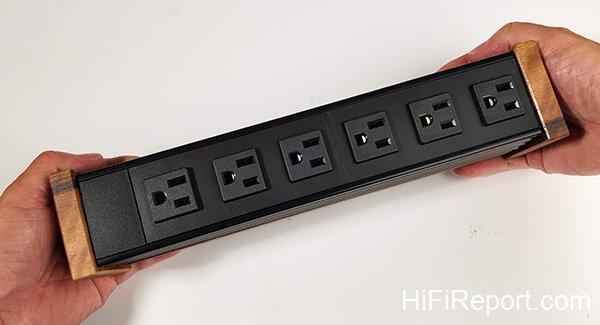
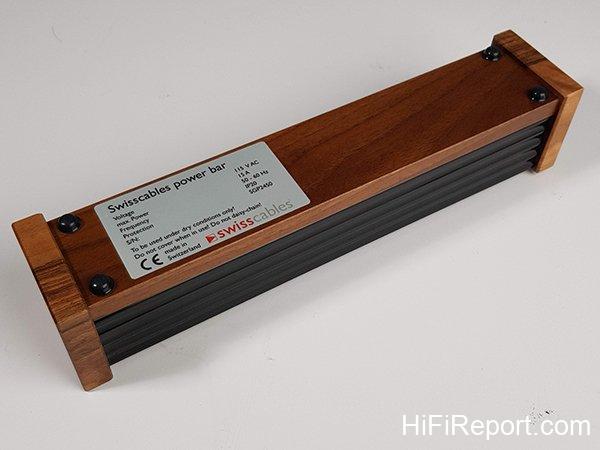
The Reference Power Bar is particularly unique. Its enclosure is constructed from three pieces of solid wood: a rectangular piece serving as the base plate, and two square pieces positioned at the front and rear as side panels.
My assessment is that these solid wood components are primarily for acoustic tuning rather than mere decoration—though aesthetically pleasing they certainly are. This arrangement appears to be a deliberate and holistic design consideration.
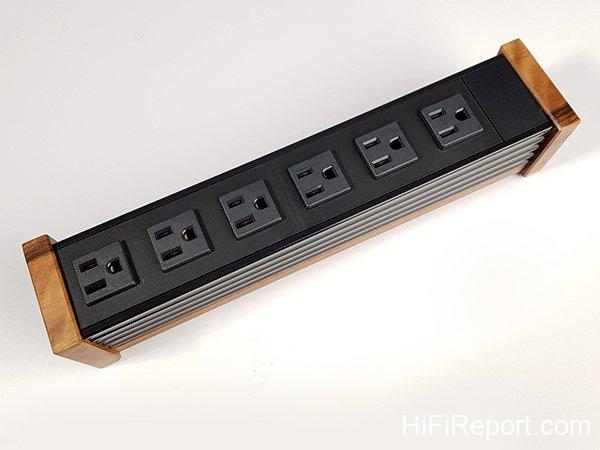
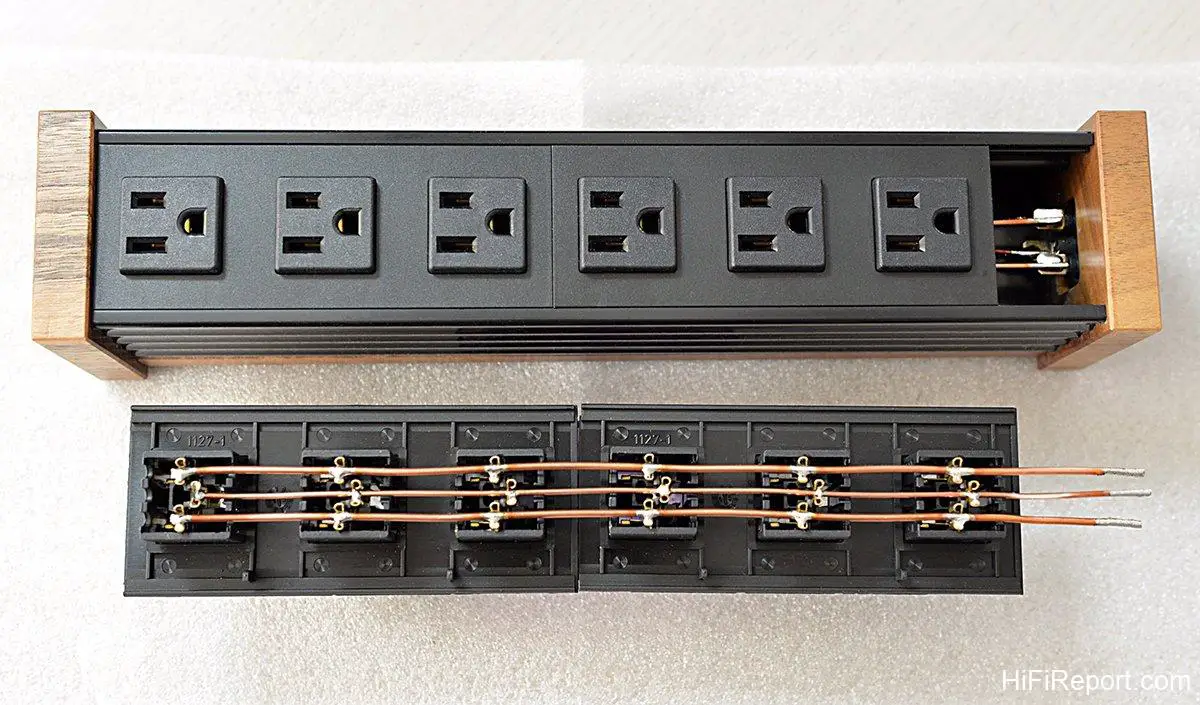
Why this assertion? The core housing of the Reference Power Bar is actually a U-shaped plastic enclosure. This plastic chassis accommodates two sets of three sockets each, totaling six outlets, inserted from the front or rear.
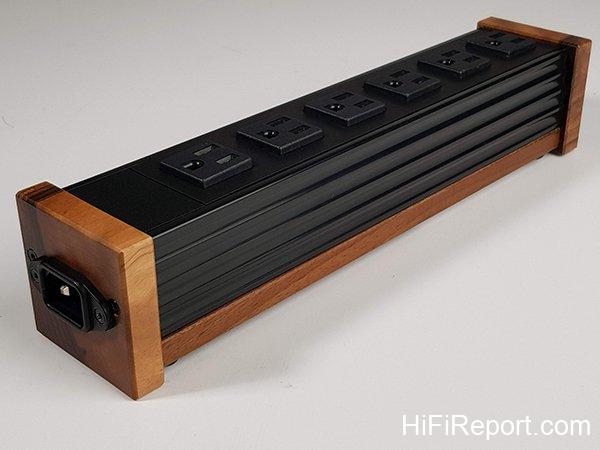
The wooden base and side panels are designed to manage and optimize the overall resonance characteristics of the unit.
But why such a seemingly basic plastic construction? Wouldn’t aluminum alloy, with its perceived superior qualities, be a better choice, even if slightly more costly? In reality, the Reference Power Bar is not large, and an extruded aluminum enclosure would likely not significantly increase production costs. The choice of plastic for the main housing, therefore, appears intentional rather than a cost-saving measure. The deliberate integration of solid wood for tuning suggests a calculated approach to achieve Swisscables’ desired sonic profile.
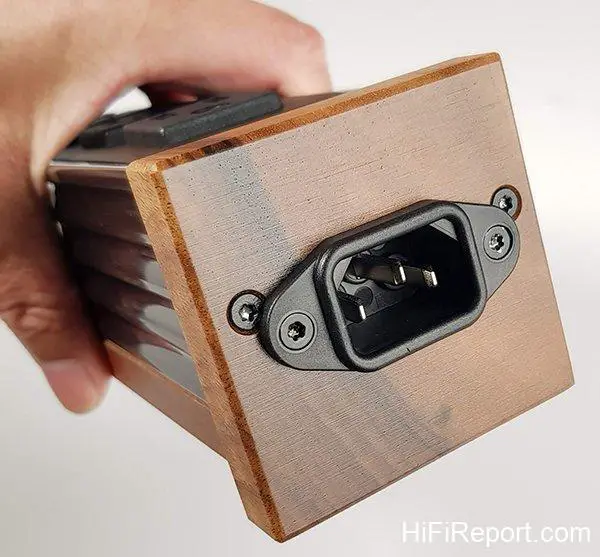
Internally, the Reference Power Bar maintains a similarly minimalist approach. It features just three UPOCC single-crystal copper solid-core wires internally. These are soldered directly to all sockets and then straightforwardly soldered to the input IEC inlet. There’s no pursuit of individual socket grounding or complex star grounding schemes; simplicity reigns supreme.
A Soundstage of Vivid Imagery
The listening evaluation was conducted in the HiFiReport listening room. The associated equipment included an Arriba P-2008 CD player as a transport, connected to a North Star Design USB DAC32 DAC, paired with a Linear Acoustic LAV-60 MKII integrated amplifier. Dynaudio Contour 60 loudspeakers completed the system.

An Opus Blue 8-outlet power bar served as the A/B comparison reference. The Opus Blue utilizes common American-style duplex outlets and an aluminum alloy enclosure, representing a fairly standard, widely used power bar design.
The first piece auditioned was the 2016 37th Audio & Art Grand Exhibition Commemorative CD, featuring a live recording of a National Symphony Orchestra (NSO) concert conducted by Lü Shao-Chia at the National Concert Hall.
Through repeated A/B comparisons, it became evident that the Reference Power Bar presented a more focused and centered soundstage, with a subtle elevation in perceived height. Furthermore, the soundstage imagery improved noticeably, clearly delineating a rectangular spatial perspective.
Beyond soundstage enhancements, the 3D (three-dimensional presence) of (sonic images) was remarkable. The outlines were more pronounced, distinct, and imbued with a palpable sense of physicality.
This resulted in a more direct and authentic listening experience. The depth and layering within the soundstage were subtly but perceptibly enhanced.
This transformation was truly quite remarkable. In my experience reviewing power conditioning products, superior power bars often primarily delivered improvements in perceived energy, tonal richness, and sonic density. The Reference Power Bar, however, offered a different kind of enhancement.
It didn’t present as an increase in raw power or a shift in the overall frequency spectrum. Therefore, I didn’t perceive a dramatically “louder” or “more forceful” sound. Instead, the musical picture became significantly clearer, with sharper outlines, greater precision, and a heightened sense of realism. This, in turn, translated to a more genuine and engaging listening experience.
Simply put, the sound was captivating, drawing the listener deeper into the music.
Even better, despite the enhanced clarity, the overall sonic coherence remained intact. The various sections of the NSO orchestra were both integrated and well-defined, exhibiting excellent separation and layered depth.
Moreover, the dynamic gradations and contrasts in musical intensity and shading were rendered with a rich spectrum of nuances, unfolding smoothly and linearly. I attribute this to the exceptional conductivity of the UPOCC conductors, coupled with the effective resonance control achieved by the solid wood base and side panels, culminating in a sound that is both balanced and dynamically vibrant.
Unassuming Excellence: Nothing Forcefully Emphasized
Next, I turned to the “Dragon Voice” CD, a compilation of audiophile recordings by renowned Chinese recording engineer Li Xiaopei, selected by Dr. Tsai Ke-Hsin.
Track 3, “Calling,” showcased remarkably palpable and distinct sonic images, making the lead vocalist feel almost lifelike. The dynamic impact was more pronounced, and the low-frequency layering, enhanced by the Reference Power Bar, became even more articulate, highlighting Li Xiaopei’s mastery in recording large-scale orchestral works.
Track 4, “Moon Harp,” revealed precise localization of different drum sounds, with clearly defined instrument bodies. The drum skin vibrations were clean and crisp, exhibiting a pristine texture and impressive transparency.
Track 6, “Drunken Flower Shade,” demonstrated another strength of the Reference Power Bar: its ability to delineate the structural layers of the soundstage across the frequency spectrum—high, mid, and low.
This track is rich in sonic elements, including the guzheng (Chinese zither), recorder, female vocals, string orchestra, and various percussion instruments, spanning a wide frequency range and creating a vibrant sonic tapestry. The Reference Power Bar provided ample space for each element to unfold naturally, preventing any sonic congestion or blending. The sonic architecture was clearly defined and meticulously organized.
Finally, I played Cassandra Wilson’s “Another Country” album, focusing on Track 2, “No More Blues.” The low-frequency performance was particularly satisfying.
In my experience, Cassandra Wilson’s music can be challenging to reproduce well. The bass is often recorded with considerable weight and fullness, bordering on excess. Few systems manage to deliver the intended low-end presence without sounding bloated or muddy.
The Reference Power Bar succeeded admirably. It rendered the bass with clear articulation of individual notes, defined lines, and palpable form, without artificially boosting the low-frequency quantity. This resulted in a harmonious and coherent overall musical presentation, with excellent clarity and organization. In contrast, the reference power bar exhibited less distinct bass lines.
Listening to the Reference Power Bar brought to mind the words of Barbara Suter, Swisscables’ Export Manager, during her visit to Taiwan for a product launch: Swisscables strives for natural sound reproduction.
Indeed, “natural” perfectly encapsulates the essence of the Reference Power Bar. I never felt that it was forcefully emphasizing any particular aspect of the audio spectrum. Yet, I was effortlessly drawn in by its rich musicality, lifelike presence, and overall realism.
Perhaps you too will be compelled to experience it firsthand.