
Swisscables Reference Ultra Power Cable Review
Upon receiving the Swisscables Reference Ultra power cable, I initially wondered if they had introduced a new series. However, upon checking, their product lineup still consists of four tiers, from entry to top-tier: Evolution, Reference, Reference Ultra, and Diamond. It seems the Reference Ultra likely replaces the previous Reference Plus, perhaps ‘Ultra’ just sounds more impressive.
Looking back at HiFiReport reviews, the last time I wrote about a Swisscables cable was the Diamond interconnect in 2020. Why such a long gap without being assigned a Swisscables review? The simple answer is that the other brand represented by their distributor, Bear Happy Audio, is Crystal Cable, which is even more expensive. The editorial team would prioritize assigning those to me, so Swisscables reviews came up less often.
So, how did I end up reviewing the Reference Ultra power cable this time? Last time, a full suite of Swisscables cables across different tiers was sent all at once. The other editors handled everything and were quite saturated with Swisscables reviews. They asked if someone else could take this one, and so I stepped in.
Writing audio reviews can be challenging when there’s nothing new to say. Reviewing multiple cables from the same brand, especially different tiers, is guaranteed to leave you feeling dizzy and overwhelmed. There are necessarily differences between each tier, but precisely describing those differences can be tricky. Comparing two cables isn’t hard, but three simultaneously starts to get confusing. If you’re comparing five different types – power, interconnect, speaker – it becomes a chaotic battle. Repeated comparisons, plugging and unplugging five cables for a single track, is guaranteed to make you dizzy and doubt your own hearing.
Design Philosophy
Taking on the Reference Ultra power cable review, the challenge landed squarely on my plate. The manufacturer doesn’t explicitly state the differences between the Reference Ultra and the Reference Plus. Curiously, when I read the editor-in-chief’s review of the Reference Plus and compared it to the Reference Ultra in my hands, I couldn’t spot many differences.
However, when it comes to Swisscables’ design philosophy, it’s a case of “the path is one and the same.” What does that mean? It means “they are all the same!” There are four key characteristics:
Conductor Technology
First, they use top-tier conductors, including a special copper alloy and UP-OCC single crystal copper.

Natural Materials
Second, they utilize natural materials for incredibly lightweight sheathing.
Air Insulation
Third, they employ air insulation to resolve MDI distortion caused by dielectric materials.
Wood Resonance Control
Fourth, they use wooden connectors to fine-tune resonance.
Swiss Manufacturing
If there were a fifth point, it would be the emphasis on being entirely manufactured in Switzerland. From this perspective, Swisscables’ pricing is relatively competitive compared to other Swiss brands.
To demonstrate their Swiss manufacturing, there’s a video embedded on their official website’s homepage. It shows the factory process of using natural materials to process conductors and create the cables, followed by a section on CNC machining the wooden connectors and the laser engraving process. This emphasis on Swiss manufacturing is crucial for those who value country of origin.
Five Design Aspects
However, whenever discussing cable design, I always tell the HiFiReport editors that we must examine five key aspects: impedance, capacitance, inductance, insulation, and structure. These are fundamental technical requirements for any audio cable, and they allow us to identify the unique design aspects of different manufacturers.

For Swisscables, the Reference Ultra uses UP-OCC single crystal copper. This conductor is produced slowly using the Ohno Continuous Casting process, which extends the length of the copper crystals as much as possible, eliminating grain boundaries. While still copper, UP-OCC requires re-melting and drawing. Aside from purification, the most important technical feature is the elimination of these crystal boundaries, allowing electrical conduction to be completely smooth and uninterrupted.
Natural Material Sheathing Emphasis
Furthermore, Swisscables emphasizes the use of solid-core wire. We can see this from the Swisscables factory winding machine video, where thick single-core UP-OCC wires are slowly wrapped with multiple strands of natural materials.
Swisscables believes that any artificial material close to the conductor, especially plastic, can cause MDI (Micro Discharge Interface) distortion, leading to spike noise during signal transmission. They contend that only natural materials can eliminate this type of interference distortion.
Unique Air Insulation
The air insulation that Swisscables emphasizes is related to capacitance and inductance. Take a power cable, for example: the best insulation between two conductors is air. However, placing two solid-core wires together means they could easily touch and short-circuit, which is absolutely unsafe. Therefore, insulation must be added around the conductors. But using PVC material in contact with the conductor creates capacitance and inductance. Moreover, soft insulation material itself can potentially vibrate due to current flow, causing microphonic effects. This needs to be addressed by the cable’s structure.
How does the Reference Ultra handle capacitance and inductance? It wraps the UP-OCC solid-core conductors with ultra-light natural materials. Within the thick body of the Reference Ultra, however, there are significant air pockets. This structure helps maintain a fixed geometric relationship between the three conductors (Live, Neutral, Ground) while simultaneously benefiting from air insulation.
Apart from Swisscables, German manufacturer In-Akustik also utilizes air for insulation. Their theoretical basis is similar, but their method of implementation differs. In-Akustik’s skeletal structure is more visually apparent, whereas the Reference Ultra’s structure is concealed within the cable body. My biggest curiosity lies in how they manage to maintain a consistent conductor geometry while also suppressing the effects of conductor vibration when the Reference Ultra’s body is appropriately bent. I suspect this is Swisscables’ true proprietary secret.
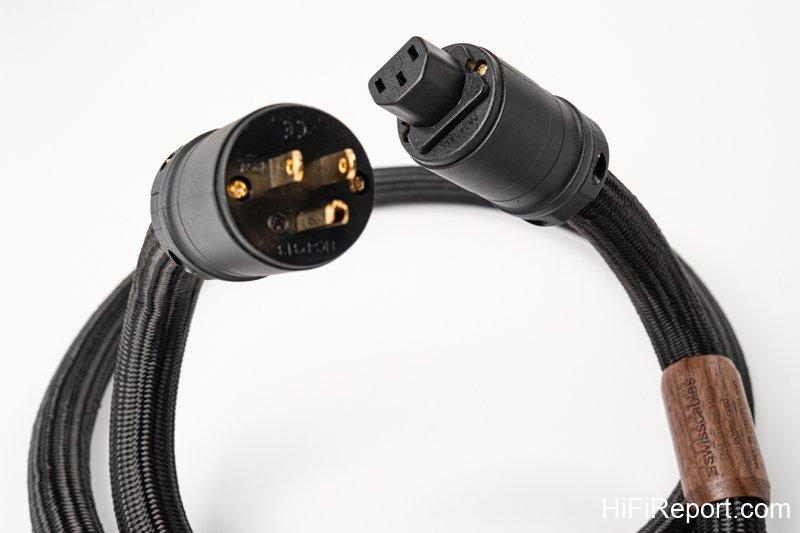
Flexible, But Avoid Sharp Bends
In terms of flexibility, the Reference Ultra power cable is not particularly rigid. It’s relatively easy to bend, making installation simpler.
However, due to Swisscables’ unique air-insulated structure and their emphasis on “field-balanced conductor geometry,” excessive bending might compromise this structure. Therefore, it’s best to route the cable following its natural lay rather than forcing sharp bends.
Optimal Placement: Upstream Components
During the listening sessions with the Reference Ultra power cable, I used two systems. The first was a Rega Saturn MK3 CD player and Elicit MK5 integrated amplifier driving Rega Aya speakers. Here, I used the Reference Ultra on the Saturn MK3 CD player. The second system featured a YBA CDT-450 transport feeding a Merging NADAC as the source, an EAR 868P preamplifier, and 509 MK II monoblock power amplifiers driving Wilson Audio Alexia V speakers. In this setup, I used the Reference Ultra on the EAR 868P preamplifier.
When I only have one power cable to review, my instinct is usually to try it on the upstream components, such as a digital source or preamplifier. This follows the “Garbage-in, Garbage-out” principle – the better the signal quality from the front end, the more noticeable the improvement will be downstream.
Appealing Transparency and Warmth
The sound signature of the Reference Ultra power cable is quite appealing. The midrange possesses ample body, supporting full and palpable musical forms. Extension at both ends is natural and unforced. The 3D soundstage portrayal is wide and transparent, and the overall presentation carries a pleasant degree of moisture. The high frequencies have a beautiful trailing edge but aren’t overly sharp; instead, they offer a comfortable luster.
I’d like to use “Dav’s True Story” as an example, specifically the track “Fever.” The Reference Ultra power cable makes the extension at both ends seem wider. The opening Hi-Hat percussion, the delicate tapping on the metal cymbal, and the contrast with the Tom-Toms are more clearly delineated. The drum kit sounds full and punchy, the cymbals are crisp, and vocalist Kelly Flint’s voice cuts through the powerful rhythm, sounding focused and vibrant.

I got lost in the music and continued listening to “Can’t Get You Out Of My System.” The soundstage opened up significantly, placing the vocalist further back, enhancing the sense of recording presence. I believe this is one of the sonic charms of the Reference Ultra power cable – a more energetic mid-bass coupled with effortlessly smooth high frequencies. The music comes alive, compelling you to keep listening.
Excellent Layering and Airiness
Let’s try an audiophile recording, “The Absolute Opus 3: Jazz & Blues.” I’ll listen to the sixth track, “Needed Time.” The light arpeggios on a steel-string guitar are paired with another guitar with metallic resonance, backed by a shaker. Eric Bibb’s singing is filled with sincere emotion.
The Reference Ultra power cable adds a touch of airiness to the listening experience, making it feel as though Eric Bibb is performing right in front of you. Subsequently, the double bass, drums, and blues harmonica join in, and the guitar ornamentation becomes richer, naturally incorporating slide effects to deepen the blues atmosphere.
Improved Sectional Layering
Let’s turn to some chamber music, selecting the Mozart Piano Trios performed by Pires, Dumay, and Wang Jian, specifically the first movement of K.496. This joyful Allegro starts with the piano leading, the cello providing the foundation, and the violin adding ornamentation. The transparency of the Reference Ultra power cable beautifully renders the instrument placement in the piano trio: the piano in the center, the cello slightly to the right, and the violin center-left. The vivid interplay between the three instruments leaps forth. Furthermore, the Reference Ultra enhances the dynamic contrast between notes, allowing the music’s ebb and flow to feel more fluid and natural.
Scaling up the music, let’s listen to Rubinstein’s recording of Chopin’s Piano Concerto No. 2, focusing on the second movement, Larghetto. The string section’s introductory passage, echoed by the woodwinds, leads to the piano solo. This is followed by the first theme, with the piano taking center stage, supported by the string section providing the foundation. The Reference Ultra power cable brings out the layering of the music; the underlying strings have body, while the piano is focused and vibrant. The Larghetto progresses steadily and gracefully.
When the piano repeats the theme, the melody rises an octave, pushing the atmosphere of the Larghetto to its peak. The piano’s high notes cascade like pearls on a jade plate. The Reference Ultra polishes this elevated melody beautifully, rendering each note distinct while drawing out exquisite melodic lines – a testament to Rubinstein’s meticulous legato playing!
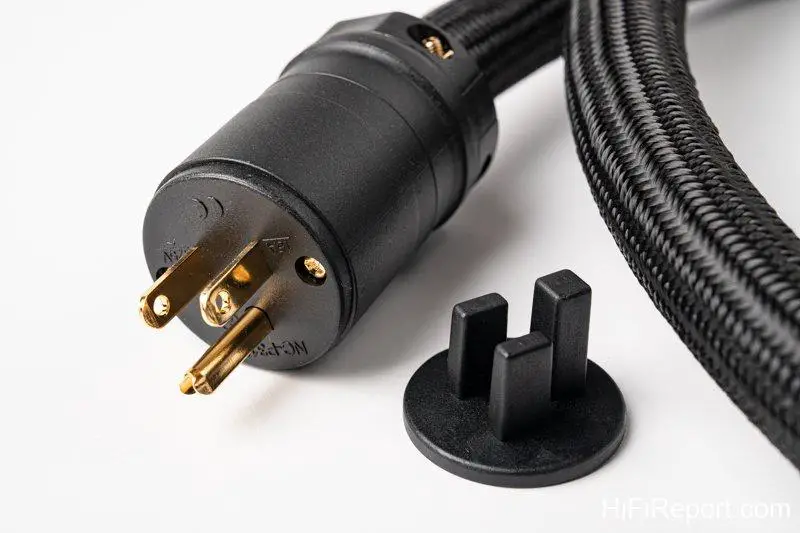
Capturing Brahms’ Dramatic Swings
Finally, I want to conclude the review of the Reference Ultra power cable using Bernstein’s recording of Brahms’ Symphony No. 2 with the Vienna Philharmonic, specifically the first movement, Allegro non troppo. Symphonies rarely begin the first movement at a slower pace, but Brahms offers an exception. The movement opens with a cello triplet melody, the brass section plays the theme robustly, echoed by the woodwinds, while the cellos in the background maintain the triplet motif. This is Brahms’ meticulously arranged orchestral layering, and the Reference Ultra power cable faithfully reproduces the clear sectional layers and their stacking, revealing the beauty of the orchestral synergy.
Is Brahms always this gentle? Of course not. As the theme develops, Brahms introduces powerful harmonies, then gradually recedes to build another romantic theme. From soft to loud, from relaxed to tense, the receding romantic notes subsequently give way to turbulent passages. The Reference Ultra power cable allows the dramatic tension within Brahms’ work to unfold with even greater clarity and layering.
I often say that Brahms isn’t the easiest composer for newcomers to classical music. His rhythms are quite complex. The first movement of the Second Symphony is not only slow but also written in triple time, yet he often multiplies the triple time by two, dividing six beats into three groups of two. Isn’t that just playing tricks on the listener?
Captivating Tension and Release
Brahms’ painstaking layering of the orchestra and intricate rhythmic variations are designed to satisfy the most discerning ears. You must listen attentively to appreciate the rich and ever-changing textures and rhythms of the symphony. When the theme returns, the feeling of relief as the music transitions from tension to relaxation is like a sudden sigh after a period of stress. Brahms then uses powerful rhythms and massive orchestral textures to stir the listener’s emotions. With the Reference Ultra power cable, all these complex orchestral textures, emotional shifts, and dramatic moments become even more intense and captivating.
Revisiting Swisscables with this Reference Ultra power cable reveals a product that balances stability with vibrancy. Stability lies in its appropriate musical weight and transparent soundstage, while vibrancy comes from its clear, layered musical reproduction. For critical listeners, the Reference Ultra power cable effortlessly reproduces fluid and natural melodies and harmonies, proving to be an excellent component for enhancing the liveliness of the listening experience.