
T+A Flagship Digital Source Review
Listening to the familiar strains of “Girl From Ipanema,” I found myself in HiFiReport Audio’s grand listening room, immersed in the sound of a complete T+A flagship Hi-Fi system.
DSD 1024 Upsampling Innovation
Just last July, I was at HiFiReport Audio, experiencing the full suite of German T+A HV flagship components. Unexpectedly, before mid-autumn had even arrived, I was back at HiFiReport, again listening to the T+A HV series. This time, however, the equipment configuration was slightly different. Previously, when paired with the Solitaire CWT 1000-40 flagship speakers for their 40th anniversary, the digital source was the all-in-one MP 3100 HV SACD player, complemented by the P 3100 HV preamplifier and M 40 HV power amplifier. Two months later, on this return visit, the pre and power amps remained the same, but the digital source had been swapped. This time, they brought out the two-piece “super” digital source: the PDT 3100 HV transport and the SD 3100 HV DAC.
Why “super”? Because the SD 3100 HV boasts PCM decoding up to an astonishing 32bit/768 kHz. Furthermore, its DSD capabilities are not just true T+A 1-bit Analogue decoding, but also feature native bitstream quadrupling upsampling. For instance, a DSD 256 signal can be upsampled fourfold to DSD 1024 (49.2MHz). Such an extreme DSD specification is unprecedented, with T+A leading the charge.
While the pursuit of higher digital specifications is a constant race, and SD 3100 HV takes an early lead, it’s not to say others won’t follow. However, at this moment, T+A has undeniably surged ahead, achieving DSD 1024 and claiming the top spot.
PDT 3100 HV: SACD Dedicated Transport
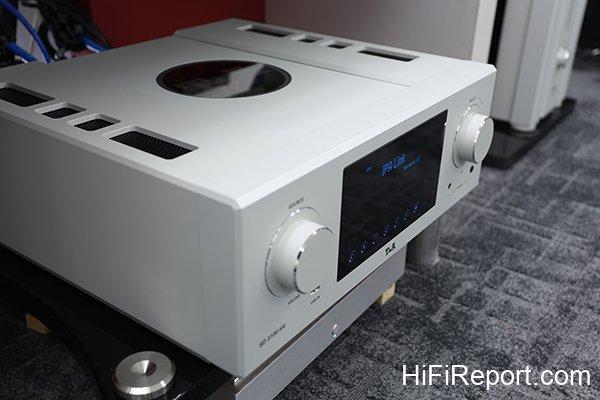
To fully leverage the DSD upsampling benefits and enjoy physical SACDs, the SD 3100 HV’s ideal partner is the PDT 3100 HV. When Sony introduced the DSD format, they deliberately “sealed” off DSD digital output functionality, preventing SACD from being easily ripped into DSD files. Therefore, to transmit DSD digital audio from an SACD transport, manufacturers must employ proprietary digital transmission methods. Brands like Accuphase and Esoteric, for example, require their own dedicated digital interfaces for DSD transmission from their SACD transports, compatible only with their own DACs. T+A is no exception, utilizing their IPA Link, exclusively compatible with their SD 3100 HV.
At every Munich High End Show, I consistently see T+A showcasing the internal construction of their HV series components. They are all exemplars of German over-engineering, and the PDT 3100 HV is no different.

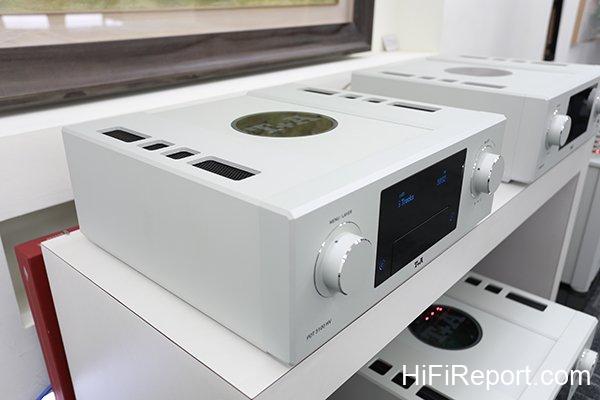
The silver-white aluminum alloy chassis and the clearly thicker front panel immediately convey a sense of robustness that surpasses others. This is what earns the moniker “Teutonic Armor.” As a dedicated SACD/CD transport, the PDT 3100 HV alone weighs a substantial 29 kilograms. Without proper preparation, attempting to lift it casually could easily strain your back – handle with care.
Elegant Disc Loading Mechanism
Beyond the solid and substantial chassis, the PDT 3100 HV’s internal design is equally robust.
If you have the opportunity to audition at HiFiReport Audio, be sure to operate the disc loading mechanism yourself. The SACD/CD tray ejects and retracts with a steady, deliberate pace, reminiscent of an elegant Adagio movement. Picking up the dedicated CD puck, placing it on the CD, and then replacing the puck, the magnet gently secures the metal puck. The SACD/CD tray then smoothly returns with the same Adagio grace, with barely a whisper of mechanical noise. This is a testament to the extremely high manufacturing precision.
During disc loading and unloading, take a moment to observe the PDT 3100 HV’s disc tray. It’s machined from a single 25mm thick block of solid aluminum, further encased in heavy-gauge aluminum, creating a veritable fortress to protect the SACD/CD drive mechanism.
Upon closer inspection, through the transparent glass top cover of the PDT 3100 HV, you’ll see the heavily shielded SACD/CD drive mechanism is supported by a total of three independent vibration isolation mounts, two at the front and one at the rear. Even with the tray already heavily armored, T+A adds three-point vibration isolation, employing both hard and soft measures to eliminate any resonance that might affect SACD/CD playback.
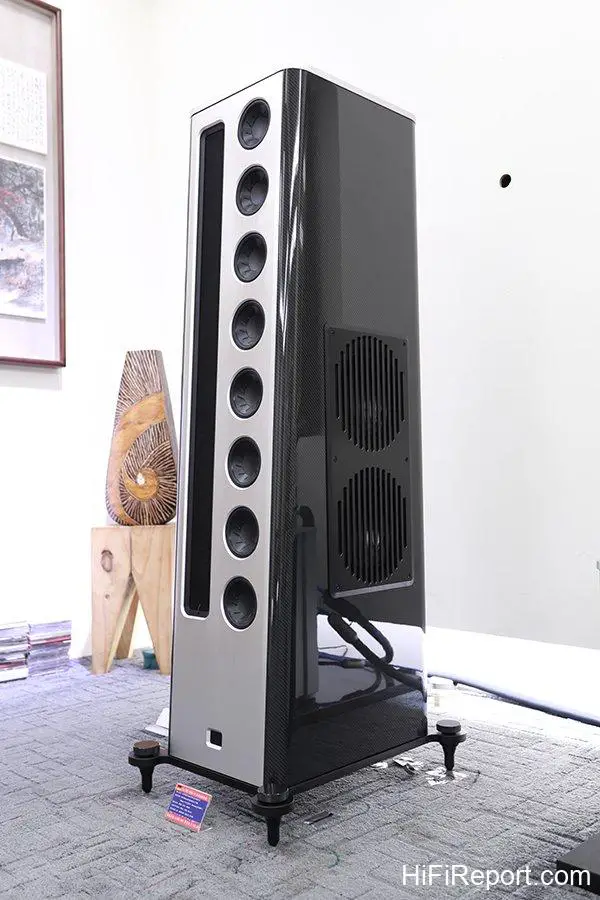
With comprehensive vibration countermeasures for the SACD/CD tray, the PDT 3100 HV further isolates all potential electrical interference. A thick aluminum alloy partition in the center of the chassis separates different circuit sections into independent compartments, completely eliminating any potential crosstalk.
In terms of digital output, traditional S/PDIF options are fully provided, including optical, coaxial, BNC, and AES/EBU. Additionally, there is the IPA Link. Crucially, only the IPA Link can output DSD signals; other digital outputs cannot. Furthermore, the IPA Link is exclusively compatible with T+A equipment, not interoperable with other brands.
Reference-Grade Streaming DAC
As for the SD 3100 HV, T+A designates it as “The Reference Streaming DAC.” It’s a DAC with built-in streaming capabilities. Beyond traditional S/PDIF digital inputs and T+A’s proprietary IPA Link, it also supports network connectivity, enabling direct streaming from services like Spotify, Apple Music, or Tidal. Bluetooth wireless input is also available, allowing for convenient music enjoyment directly from your smartphone. When paired with the PDT 3100 HV, the SD 3100 HV unlocks its special abilities, reaching today’s highest specifications of 32bit/768kHz PCM and DSD 1024.
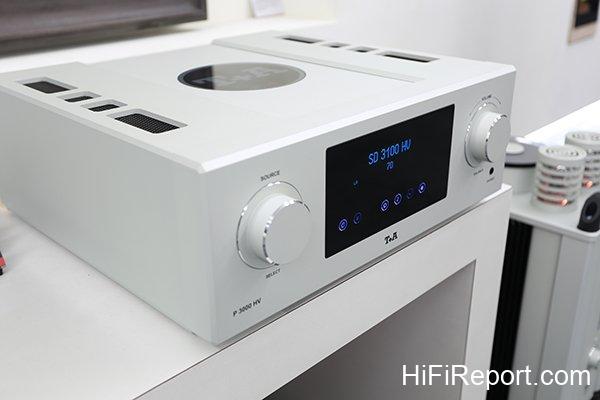
The SD 3100 HV has a sibling, the SDV 3100 HV. The key difference is that the SDV 3100 HV includes volume control, allowing it to function as a preamplifier. It has a single analog input, likely intended for a phono stage. All other digital sources can be controlled by the SDV 3100 HV. If you don’t have many analog sources, using the SDV 3100 HV to manage all digital inputs and reserve the analog input for a turntable could eliminate the need for a separate preamplifier. However, if you have numerous analog sources and aim for top-tier performance, adding the P 3000 HV preamplifier is still recommended. During my listening session at HiFiReport Audio, they employed the top-spec configuration, using the P 3000 HV preamplifier and M 40 power amplifiers.
When writing this review, my standard practice before putting pen to paper is to list the equipment specifications. It was then I realized the sheer volume of technical details for the SD 3100 HV. It’s rare to encounter a DAC with such an extensive specification sheet. The lengthy list at the end speaks for itself.
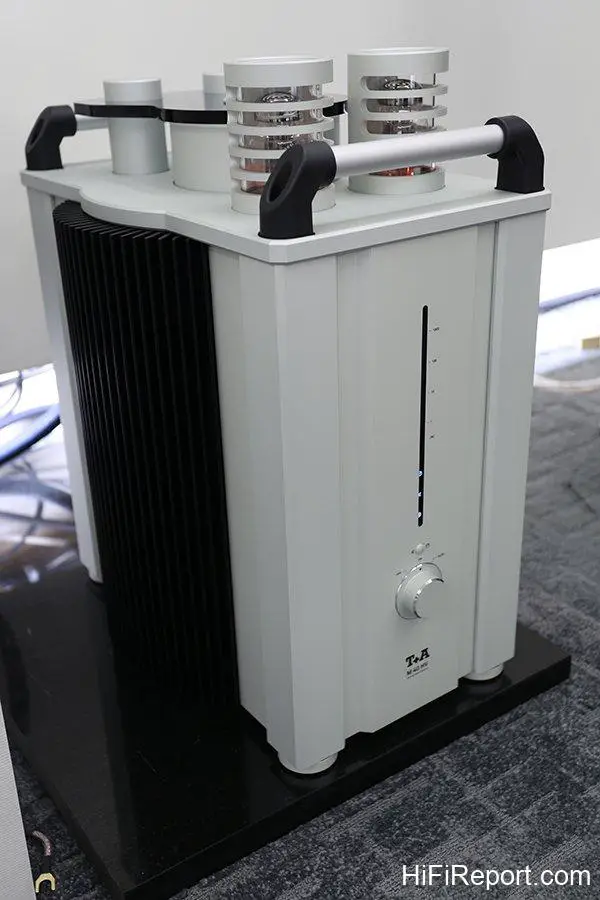
However, even if you don’t delve into the technical specifications, the sheer breadth of support speaks volumes. In short, the SD 3100 HV “accepts everything, supports everything.” It can handle virtually any digital music streaming format you might encounter. Moreover, with T+A’s exclusive digital upsampling technology, it can elevate music signals, improving upon the original format.
Effortless “Girl From Ipanema”
Listening to Joao Gilberto’s “Girl From Ipanema” again, just over two months after my previous visit to HiFiReport Audio and the T+A HV flagship system, with the only change being the two-piece digital source – PDT 3100 HV and SD 3100 HV – I needed to find a way to discern the differences. I recalled that during my last visit, manager Mr. Chu started with “Girl From Ipanema,” showcasing a wide soundstage and exceptional imaging, highlighting the sonic advantages of the Solitaire CWT 1000-40 line source speakers. I located the same SACD and began listening with “Girl From Ipanema” once again.
Hmm? Different. The P 3000 HV preamplifier’s volume was initially set at 50, which was too quiet. Increasing the volume to 66, the musical presentation broadened and expanded, yet remained remarkably relaxed. It also seemed that the volume could be pushed even higher than during my previous listening session.
I often say that in the same listening environment, using similar equipment, the ability to play louder while maintaining musical ease and naturalness indicates lower distortion and higher sonic purity.
I checked the M40 power amplifier settings, and it was still in HV high-current output mode, which offers lower output power but richer and fuller sound quality. This setting was identical to my previous HiFiReport visit. However, this time listening to “Girl From Ipanema,” I could turn up the volume higher. It seems the PDT 3100 HV and SD 3100 HV indeed have something special. The same “Girl From Ipanema” felt even more relaxed and effortless, fully capturing the joyful, swaying rhythm of Bossa Nova.
Bluetooth Convenience and Quality
After “Girl From Ipanema,” I paired my iPhone with the SD 3100 HV via Bluetooth and listened to Sting’s “Every Breath You Take.” The steady bassline and muted, arpeggiated electric guitar chords are hallmarks of my teenage years. Back then, we hauled cheap PA systems to university basements for underground dances, prioritizing loud rhythms over sonic nuance. Now, at HiFiReport Audio, with top-tier T+A equipment, listening to “Every Breath You Take” via Apple Music, every musical detail emerged. Sting’s voice retained its youthful energy. In the passionate sections, the electric guitar’s soaring chords and the crisp cymbal strikes from the drums created an immersive experience. I was enjoying not just the superb sound of T+A, but also a nostalgic trip back to my youth.
From youthful Sting to the Sting who has aged gracefully, I switched to his 2013 album “The Last Ship.” I particularly enjoy the second track, “Dead Man’s Boots.” This is often my go-to music on the subway, listened to through headphones. Each song tells a story, but headphones only deliver Sting’s vocals, lacking soundstage. On the well-configured T+A system, the soundstage immediately expanded.
“Dead Man’s Boots” opens with a harmonica, Sting’s voice centered, with crisp guitar chords subtly layered behind. Sting’s singing clearly carries the weariness of time. Even with Apple Music, a format often dismissed by audiophiles, the SD 3100 HV vividly conveyed the poignant emotion in his voice. “Dead Man’s Boots” is a story of generational inheritance, where the younger generation is unwilling to step into the shoes of the dead. Sting’s sincere delivery, amplified by the SD 3100 HV, conveyed the song’s heartfelt sentiment directly to the listener.
Customizable Input Volume Levels
Let’s compare Apple Music with CD. Playing Dire Straits’ “Brother In Arms” from my iPhone, listening to the classic “Money For Nothing” via the SD 3100 HV’s Bluetooth input, with the volume set at 66, it sounded excellent. It was hard to believe it was just standard Apple Music quality. However, switching to CD playback via the PDT 3100 HV, the volume was noticeably lower. I had to raise it to 76 to achieve a similar loudness. It felt as if Bluetooth had some hidden gain boost, making it sound subjectively fuller than CD. Could Bluetooth really be better than CD? Actually, the volume difference was deceiving. Louder Bluetooth playback can easily be perceived as better than a quieter CD. Once I matched the CD volume to the Bluetooth level, I could discern that the CD offered finer detail, greater dynamics, and clearer musical nuances. The Bluetooth, at the same volume, sounded comparatively coarser. But why was the Bluetooth input louder than CD by default? It turns out the SD 3100 HV has a dedicated app that allows adjustment of input volume levels. HiFiReport Audio, having used the SD 3100 HV extensively, likely had the Bluetooth setting turned up, unnoticed. By simply resetting the starting volume for each digital input, a fair comparison could be made.
I was initially surprised, thinking Bluetooth had surpassed CD, but it was all a matter of volume perception.
Bluetooth Performance Rivals CD
Knowing the volume difference, I continued listening to Dire Straits, now “So Far Away.” The CD presented a superior soundstage depth and width, offering a more relaxed overall listening experience. However, the SD 3100 HV playing Apple Music via Bluetooth still sounded very good. Compared to CD, the decays were slightly tighter, and the texture a bit harder. But without direct comparison, the differences were extremely subtle. This demonstrates that digital music streaming services have evolved significantly.
Considering the current trajectory and pace of digital streaming development, it’s not inconceivable that within a few years, streaming could rival CD quality. T+A’s early adoption of convenient Bluetooth and network streaming in the high-end SD 3100 HV signals the future listening trends, leaning towards this direction. Your investment today will remain relevant for years to come.
Enhanced Density and Soundstage?
Next, I revisited a CD I listened to during my previous visit to HiFiReport, Cecilia Bartoli’s “Live in Italy.” This is a live concert recording in Italy’s oldest opera house, the Teatro Olimpico, featuring harpsichord and period instruments. During my previous listening session, the entire T+A flagship system presented a wide soundstage and very natural sonic texture, with the speakers completely disappearing into the space. Listening again to track four, Handel’s “Lascia la Spina,” Bartoli’s voice floated in the center of the soundstage, which remained expansive and deep, complementing Bartoli’s rich voice. With the PDT 3100 HV and SD 3100 HV in the system, the sound density seemed to be higher.
However, I can only say “seemed slightly better,” as the perceived difference was subtle. I can confidently say the MP 3100 HV was already excellent, and the PDT 3100 HV and SD 3100 HV pairing is a step up, but both are outstanding. Listening to the same Bartoli track again, the PDT 3100 HV and SD 3100 HV seemed to offer improved realism and stronger musical energy. But could this be attributed to the slightly higher volume? Without an A/B comparison with two systems side-by-side, I can only say it “seemed” the two-piece source was marginally better than the previous all-in-one SACD player. However, both configurations are undoubtedly excellent.
DSD 1024 via Network with Fidata
At this point, the host, Mr. Chu, joined me and switched to network input, using a Fidata music server, to demonstrate the SD 3100 HV’s special capability: DSD 1024 music file streaming.
Impressive! This was my first time hearing DSD 1024. Since native recordings in this format are nonexistent, Mr. Chu played DSD 128 files, which the SD 3100 HV automatically upsampled to DSD 1024. For DSD 64 files, the upsampling is to DSD 512. Mr. Chu prepared “Summertime,” a jazz classic, in both DSD 64 and DSD 128 versions, for me to compare.
Intriguing. Essentially, I was comparing DSD 512 and DSD 1024, as both native DSD 64 and DSD 128 are upsampled. Listening to the same “Summertime,” the musical detail difference was minimal. The brass instruments’ shimmer was beautiful in both. Without direct comparison, both sounded excellent. However, this represents T+A’s current technological lead, with the SD 3100 HV being the only DAC achieving such high upsampling specifications. Repeatedly comparing DSD 512 and DSD 1024, the most significant difference was in smoothness. DSD 1024 exhibited a more analog-like quality, with a more natural, fluid, and refined musical presentation.
Capturing the Atmosphere of a Piano Competition
The final CD I listened to at HiFiReport Audio was Eric Lu’s live recording from the Leeds International Piano Competition. The final round performance was Beethoven’s Piano Concerto No. 4. Listening to the lively and spirited rondo of the third movement, the PDT 3100 HV and SD 3100 HV vividly recreated the atmosphere of the live recording. Especially in the passages where the cello echoes the piano solo, the piano was clear and transparent, with agile and distinct key strikes, while the cello was melodious and rich, creating a beautiful contrast.
This was the final round of the Leeds Piano Competition. The performer’s nerves must have been on edge, yet young Eric Lu’s fingers produced a composed theme, powerfully interacting with the orchestra. The third movement is the final section of the competition; all energy must be unleashed within these ten minutes to determine the outcome. Yet, the outcome must be set aside, focusing solely on the music, expressing one’s own Beethoven while remaining faithful to Beethoven’s notes.
The young pianist’s concentration during the final ten minutes of the competition, dedicated to the music, was conveyed through the notes played by the PDT 3100 HV and SD 3100 HV, and presented by the Solitaire CWT 1000-40 speakers. His ten fingers danced across the keys, while the orchestra responded with measured precision. The rapid piano passages in the latter part foreshadowed the finale. Young Eric Lu gracefully ascended to the climax, spiritedly racing towards the finish with the orchestra. Thunderous applause erupted – Bravo! The champion was crowned!
Immersive Musical Realism
In terms of specifications, T+A has achieved a leading position, being the first to offer DSD 1024 upsampling in a DAC. Paired with their PDT 3100 HV, they form a unique and superb digital source system, ready for audition at HiFiReport Audio. I had an early listen. The specifications are impressive, but even more impressive is the immersive musical realism they deliver. Visit HiFiReport Audio and experience it for yourself. They have prepared a rich musical feast, waiting for you to experience the power of DSD 1024!
Specifications
**T+A PDT 3100 HV**
* Type: CD/SACD Transport
* Frequency Response: 2Hz-44kHz/SACD, 2Hz-20kHz/CD
* Dynamic Range: 110dB/SACD, 100dB/CD
* Outputs: AES/EBU (24bit/192kHz), Coaxial (24bit/192kHz), BNC (24bit/192kHz), Toslink (24bit/192kHz), IPA
* Dimensions: 460×170×460 mm (W×H×D)
* Weight: 29 kg
* Reference Price: $24,031 (Converted from 769,000 NTD)
**T+A SD 3100 HV**
* Type: Network Streaming DAC
* Analog Outputs: RCA x 1; XLR x 1
* Digital Outputs: 1 x Coaxial, IEC 60958 S/P-DIF (LPCM)
* Digital Inputs:
* 1 x AES-EBU 32…192 kHz / 16-24 Bit
* 6 x S/P-DIF: 2 x Coaxial; 2 x BNC 32…192 kHz / 16-24 Bit; 2 x Optical 32…192 kHz / 16-24 Bit
* 2 x USB DAC (up to 768 kHz (PCM) and DSD 1024, supports asynchronous transfer, DSD512 and DSD1024 playback on Windows PC requires appropriate software)
* 2 x USB Storage (Stick or HDD)
* 2 x HDMI IN, 1 x HDMI OUT with ARC
* 1 x IPA (LVDS)
* LAN, Antenna input for WLAN and FM, 2 x H-Link
* DAC Section PCM: Double differential, quad-core, with four 32-bit Sigma-Delta D/A converters per channel, conversion rate 705.6 / 768 kHz.
* DAC Section DSD: T+A True-1Bit DSD D/A Converter, supports up to DSD 1024, native bitstream upsampling: T+A-Signal processor – synchronous upsampling, four adjustable upsampling algorithms (FIR short, FIR long, Bezier/IIR, Bezier)
* Analog Filter: Phase-linear third-order Bessel filter, 60 or 120 kHz crossover frequency
* Frequency Response:
* PCM 44.1 kSps: 2 Hz – 20 kHz
* PCM 48 kSps: 2 Hz – 22 kHz / DSD 64: 2 Hz – 44 kHz
* PCM 96 kSps: 2 Hz – 40 kHz / DSD 128: 2 Hz – 60 kHz
* PCM 192 kSps: 2 Hz – 80 kHz / DSD 256: 2 Hz – 80 kHz
* PCM 384 kSps: 2 Hz – 100 kHz / DSD 512: 2 Hz – 100 kHz
* PCM 768 kSps: 2 Hz – 120 kHz / DSD 1024: 2 Hz – 120 kHz
* THD: < 0.001 %
* Signal-to-Noise Ratio: > 117 dB
* Channel Separation: > 110 dB
* Streaming Player Section File Formats: MP3, WMA, AAC, OGG Vorbis, FLAC, WAV, AIFF, ALAC / UPnP AV, T+A Control
* Sampling Rate: PCM 32 to 192 kHz, 16/24 Bit; MP3 up to 320 kBit, variable or constant bit rate
* Supported Services: Tidal, Deezer, qobuz (Subscription required)
* Features: Gapless Playback for MP3 (Lame), WAV, FLAC, T+A Control App for iOS and Android
* Interfaces: LAN: Fast Ethernet 10/100 Base-T, WLAN: 802.11 b/g/n
* Radio Section Radio: Airable Internet Radio Service (> 11000 Stations worldwide), FM, FM-HD: 168 -240 MHz (Band III); sensitivity 2.0 µV, S/N > 96 dB, DAB, DAB+: 168 -240 MHz (Band III); sensitivity 2.0 µV, S/N > 96 dB
* Features: RDS/RDBS, Station name (PS), Program type (PTY), Radiotext (RT)
* Bluetooth Standard / Codec: A2DP (Audio), AVRCP 1.4 (Control) / aptX®, MP3, SBC
* Headphone Amplifier Section Headphone Outputs: 6.3 mm Jack (20 Ohms) and 4.4 mm Pentaconn (8 Ohms)
* Dimensions: 170 x 460 x 460 mm (HxWxD)
* Weight: 26 kg