
T+A Solitaire S 540 Review
Not long ago, HiFiReport Audio extended an invitation, mentioning they had set up a complete German T+A audio system in their second-floor listening room. Featuring the flagship Solitaire S 540 speakers paired with the top-tier HV series, they boasted exceptional sound performance. Naturally, I eagerly accepted the invitation.
Captivated by a Single CD
HiFiReport’s second-floor listening space has undergone years of refinement, and its acoustic performance is now quite mature. I’ve auditioned numerous components here. The open-plan space, created by combining the entire floor, is perfectly suited for large systems to breathe freely. This time, listening to the Solitaire S 540, I was immediately captivated from the very first CD – Mozart’s Piano Trios performed by Pires, Dumay, and Wang Jian. The pairing of the Solitaire S 540 with the full T+A HV series far exceeded my expectations. The sense of realism and intimacy, as if being in the recording venue itself, was truly remarkable.
It’s peculiar, hasn’t the editor-in-chief heard T+A flagship combinations before? Yes, but always focused on the electronics, never paired with T+A’s own high-end speakers. Could it be that T+A components perform best when matched with their own speakers? That might be part of the answer, but not my complete conclusion. I believe the astonishing nature of the Solitaire S 540 stems from its “line source” sound emission. This differs in auditory experience from “point source” speakers. Combined with the robust driving power of the HV series electronics, the Solitaire S 540 creates a wide, expansive, and realistic soundstage, while simultaneously preserving every nuance of musical detail.
Rare Line Source Loudspeaker
“Line source” is a key design feature of the Solitaire S 540. During the 2023 audio exhibition, founder Siegfried Amft and his son Conradin Amft, who succeeded him as COO, visited Taiwan. They took this opportunity to hold a meeting with distributors to introduce T+A’s product features. I served as the translator, and Siegfried specifically explained T+A’s rationale for choosing line source. He considers it the optimal loudspeaker design principle, and after years of dedicated effort, T+A has brought the Solitaire S 540 to its pinnacle.
During the distributor meeting, Siegfried let his son Conradin take the stage first to introduce T+A’s newly launched headphones. When it came to loudspeakers, Siegfried took over, stating that the foundation of loudspeaker design is acoustic physics. Regarding high-frequency drivers, theoretically, the best are electrostatic and ionic tweeters. However, both require power, making them less convenient to use. I recall T+A employing electrostatic tweeters for a period, which aligns with Siegfried’s statement.
Proprietary Magnetostatic Tweeter
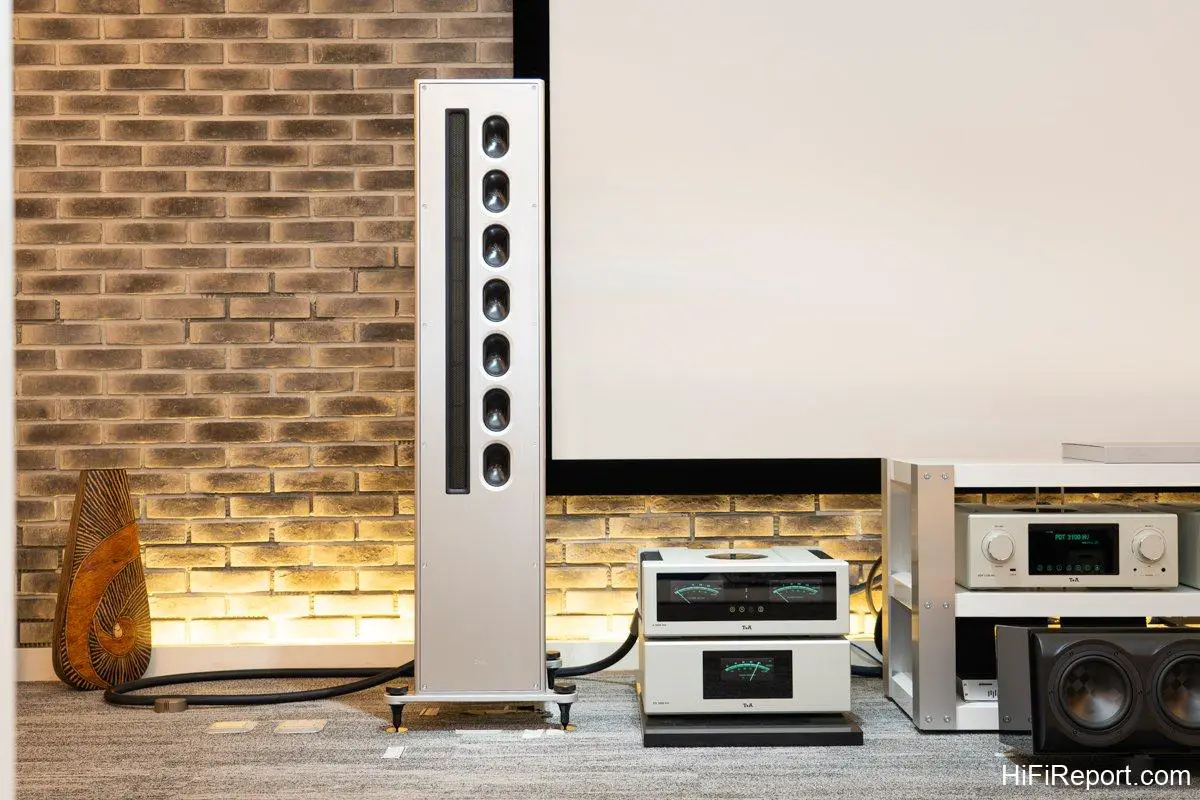
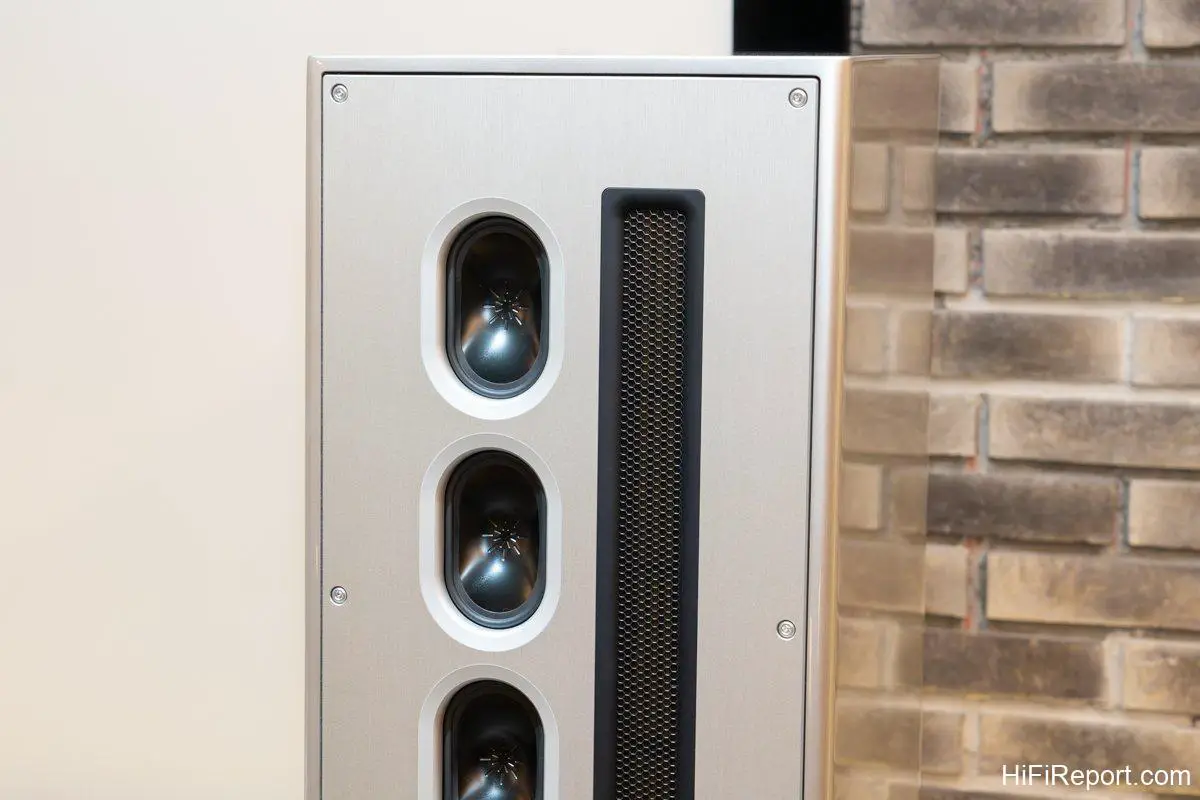
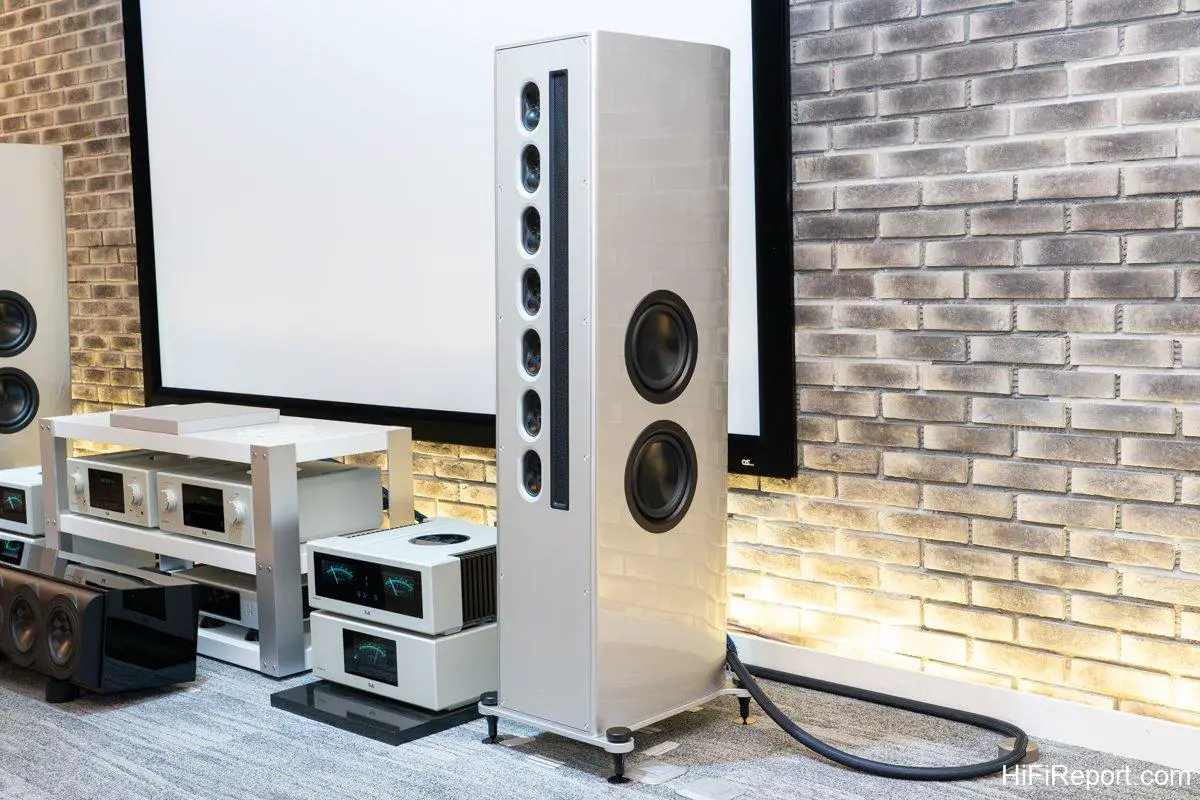
The newly introduced Solitaire S 540 utilizes T+A’s in-house designed magnetostatic tweeter, model Mag 850. It measures 85 centimeters in length with an exceptionally large diaphragm. This signifies abundant high-frequency energy capable of handling demanding dynamic challenges. Behind the driver are 64 magnetic engines arranged vertically.
This represents a significant technological breakthrough. The operational principle of the magnetostatic tweeter closely resembles that of an electrostatic tweeter, but without the latter’s drawbacks. Firstly, it does not require external power. Secondly, the diaphragm is not susceptible to humidity or dust.
Seven Midrange Drivers Forming a Line Source
Adjacent to the Mag 850, seven midrange drivers are vertically aligned. These feature oval diaphragms with a central indentation – T+A’s proprietary Star Stabilizer, designed to suppress cone breakup. The arrangement of seven drivers, with a length comparable to the tweeter, forms a “line source” for sound emission.
Here’s the crucial point: the “line source” principle causes sound to radiate cylindrically, dispersing in all directions. This allows for the reproduction of a vast and grand soundstage. Moreover, compared to point sources, line source sound wave dispersion experiences minimal attenuation. If you have a large listening space, the Solitaire S 540 can effortlessly fill the room with rich and full musical energy.
Given the advantages of line sources, why are they not more prevalent? Cost! Consider the Mag 850 used in the Solitaire S 540 – it alone employs 64 magnetic engines. Seven midrange drivers are incorporated at once. The component count is several times higher than that of point source designs. While purchasing audio equipment isn’t solely about the parts, the Solitaire S 540’s material cost is significantly higher. How does one make the economics work?
Four Woofers Cancel Vibrations
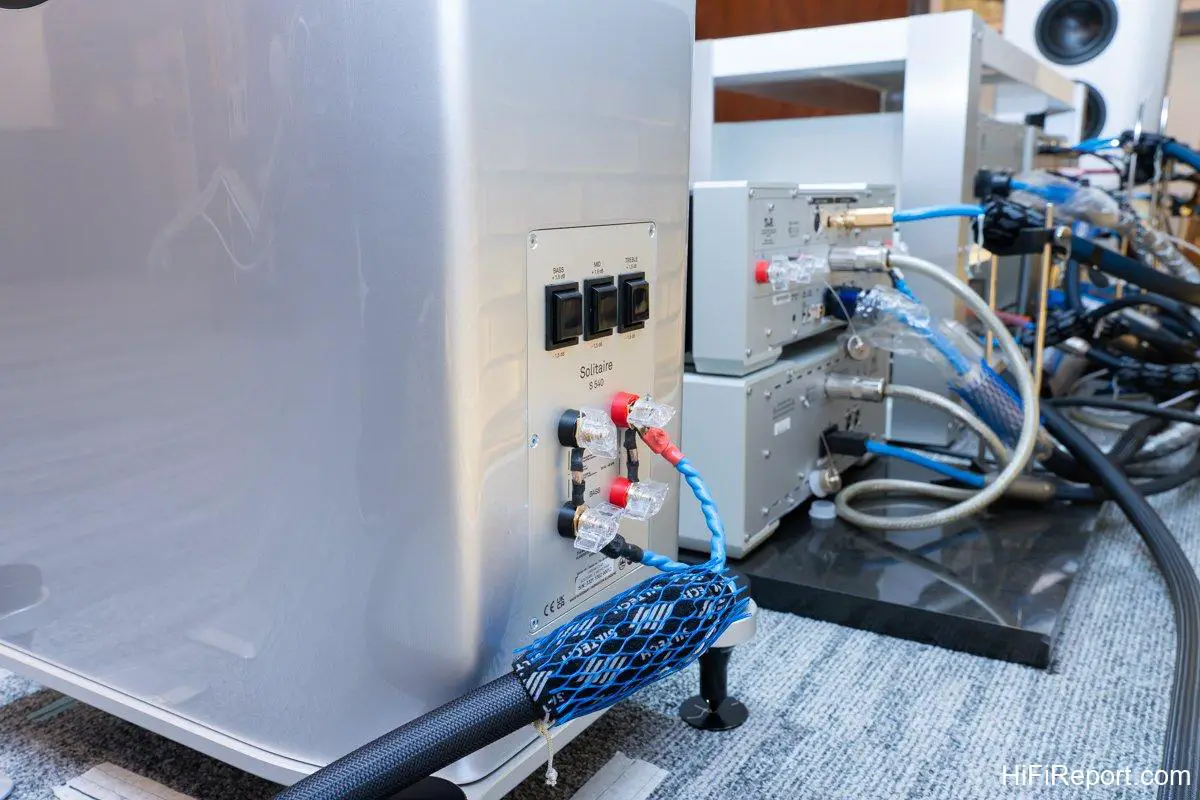
From the front, only the Solitaire S 540’s line source tweeter and midrange arrays are visible. The woofers are positioned on the speaker’s sides, totaling four units. Arranged in opposing pairs, their piston movements cancel each other’s vibrations, reducing coloration. This design is employed by various speaker manufacturers, not unique to T+A, but undeniably effective and grounded in acoustic physics principles.
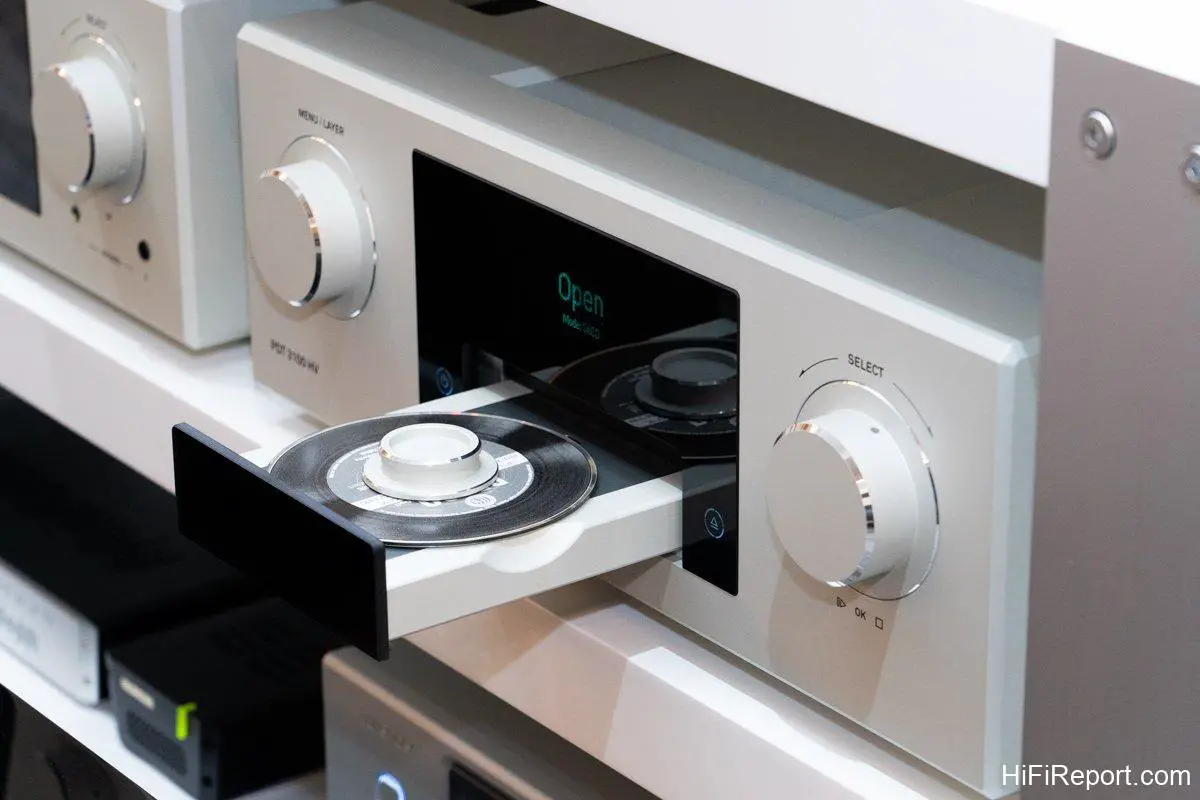
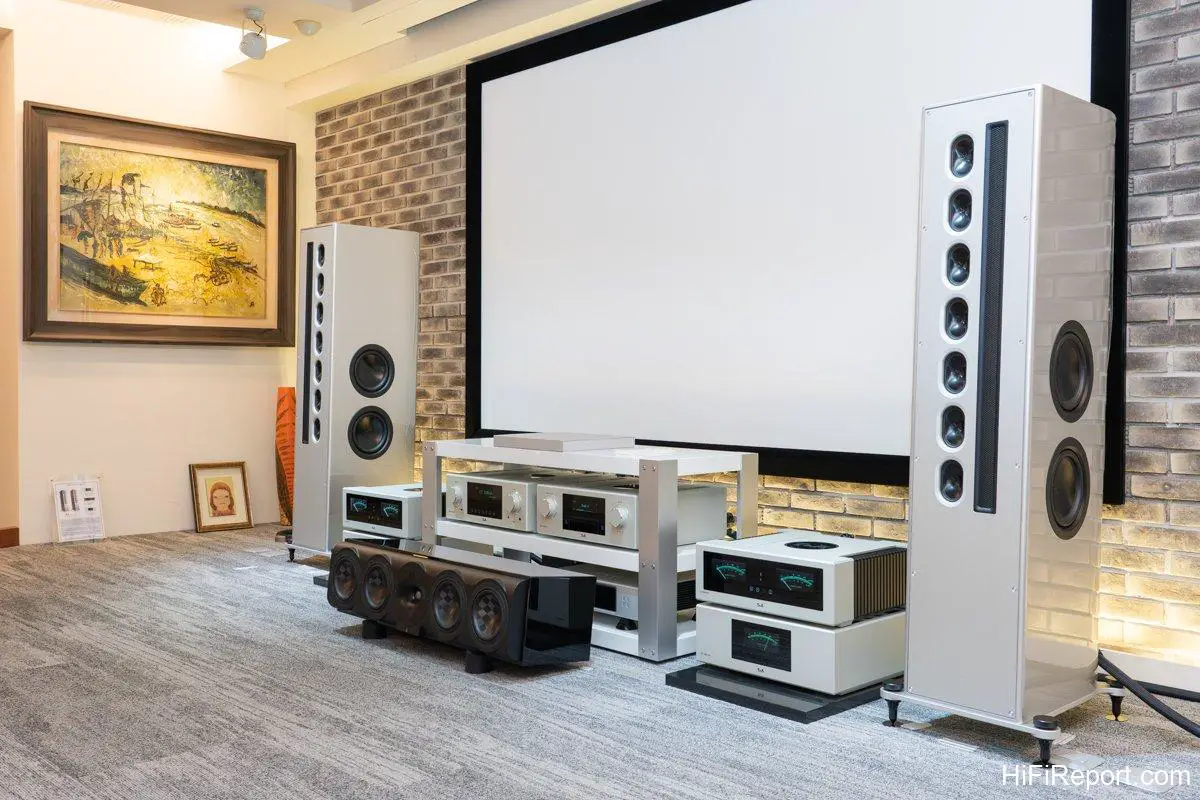
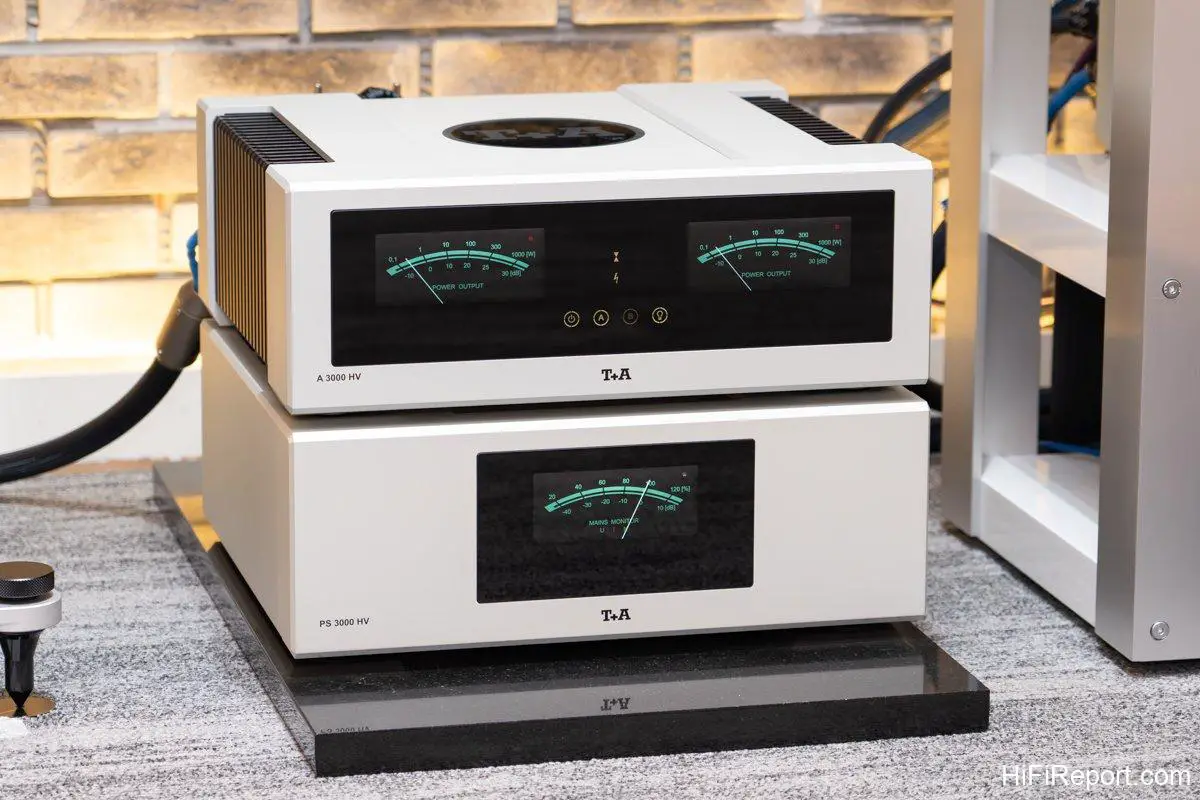
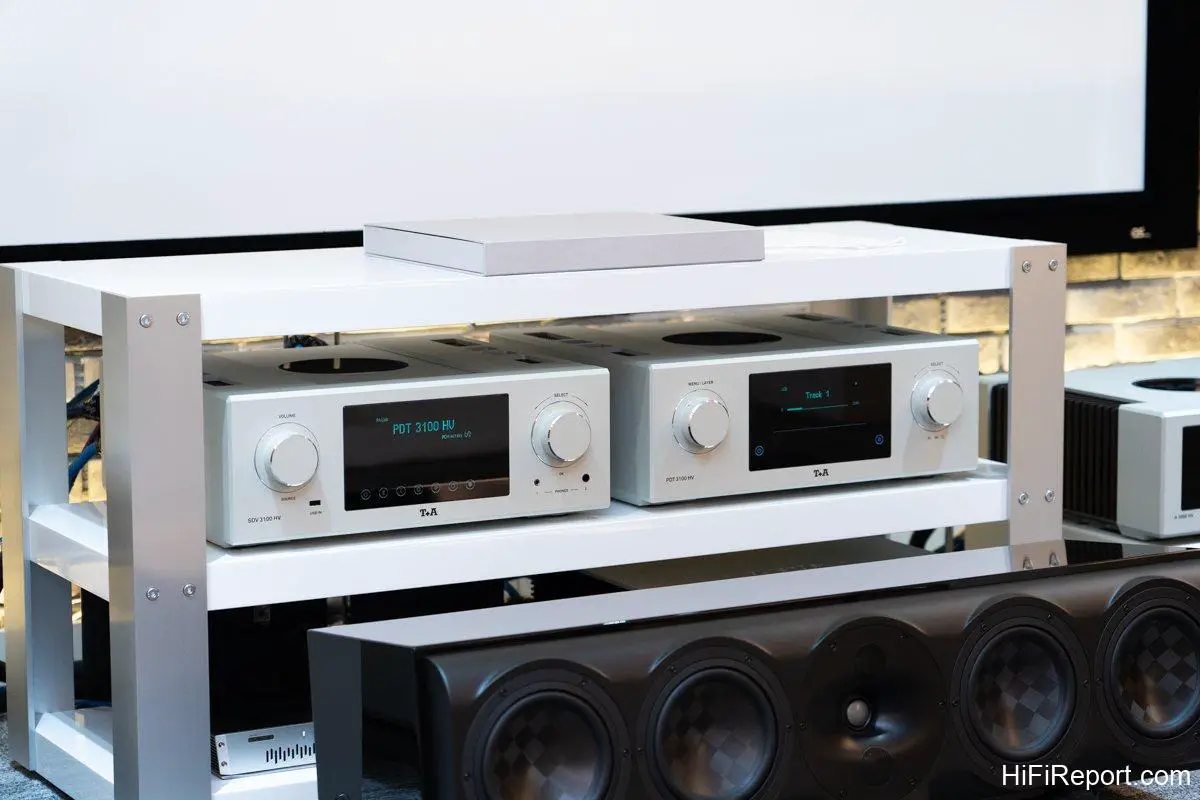
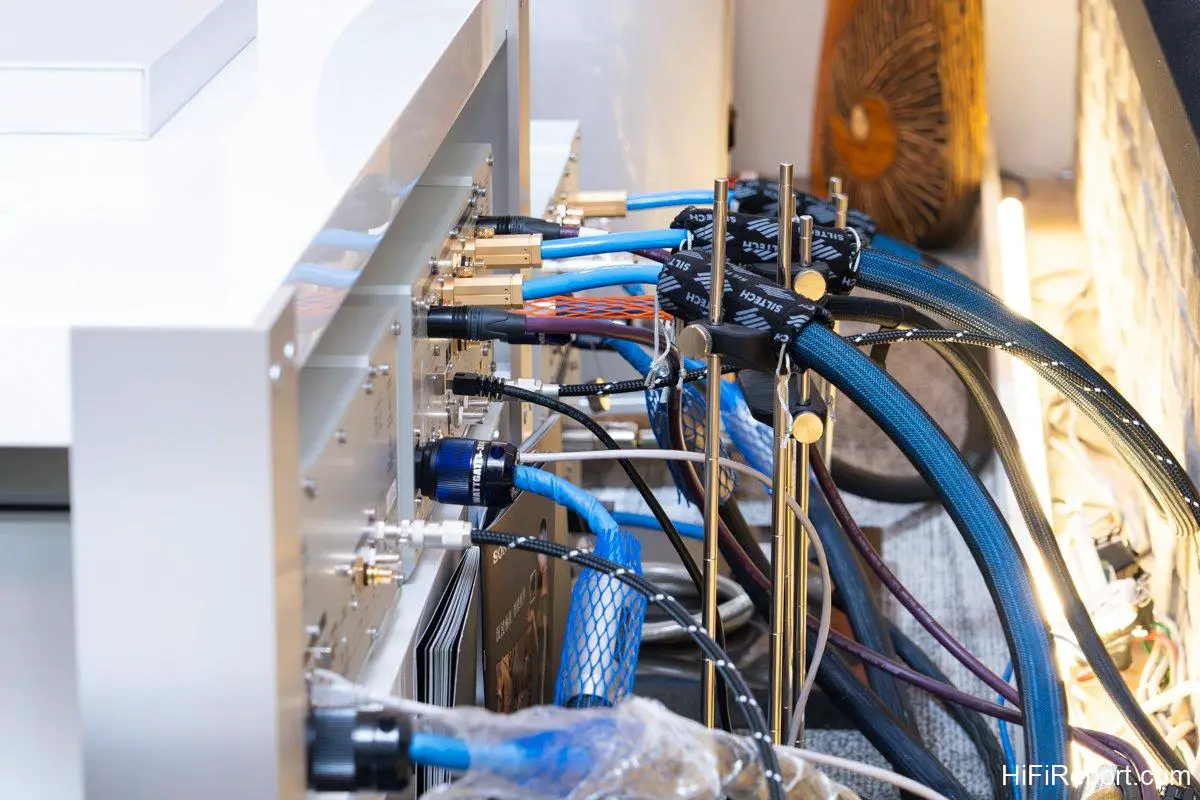
For the Solitaire S 540, HiFiReport Audio brought out a complete T+A HV series system. The front-end consisted of the PDT 3000 HV SACD/CD transport, connected to the SDV 3100 HV streaming DAC preamp. For amplification, they deployed two A3000 HV power amplifiers, each paired with a dedicated PS 3000 HV power supply. Truly luxurious!
Note that a single A3000 HV is capable of driving a pair of Solitaire S 540s. However, when switched to monaural mode, the A3000 HV’s output power increases from 300 watts to 380 watts into 8 ohms, and from 500 watts to 650 watts into 4 ohms. HiFiReport Audio intentionally used a pair of A3000 HVs to provide the Solitaire S 540 with even greater driving headroom.
Direct Comparison with B&W
It was time to properly savor the sound of the Solitaire S 540 and the complete T+A HV series. HiFiReport’s staff mentioned that the Solitaire S 540’s sonic performance had also amazed them. Mr. Chu, the manager at HiFiReport, even emphasized that with the Solitaire S 540 priced at $58,590 USD (1.89 million NTD), it directly surpasses B&W’s new 800 D series. While the 800 D series now retails for around $51,150 USD (1.65 million NTD), its sound performance is not in the same league as the Solitaire S 540. HiFiReport is highly confident that the Solitaire S 540 offers significantly superior sonic capabilities! Well, that’s Mr. Chu from HiFiReport’s opinion; I wouldn’t dare make such a claim, lest I get into trouble. But even without comparing which is better, the Solitaire S 540 paired with the full T+A HV series undeniably reaches a new height. Listening to it, I was filled with apprehension – could my own Wilson Audio Alexia 2 possibly compete? I believe the Solitaire S 540’s sonic allure stems from its line source design. The relaxed, open, natural, and expansive soundstage and imaging present a vibrant musical beauty.
Piano Trio: Realistic and Beautiful
In fact, from the moment I started listening to Mozart’s Piano Trios performed by Pires, Dumay, and Wang Jian, I was taken aback. The Solitaire S 540 presented a wide and natural soundstage for the piano trio. The piano was anchored in the center, with the violin nestled close to the piano and the cello positioned to the right of center. The Solitaire S 540 emanated a natural and effortless soundstage localization, and the timbre was both realistic and beautiful, immediately captivating the listener.
Mozart’s Piano Trio K. 502 features light and joyful melodies. The cello’s sustained notes and the piano’s playful dance above, embellished by the violin’s timely ornamentation – while the piano is the protagonist, the cello and violin accompaniment make the piano melody even more buoyant and cheerful. Pires’ piano tone is crystalline and transparent. Most surprisingly, in the first movement’s recording, the subtle sounds of musicians’ chairs shifting were audible. Such delicate details are not discernible on every audio system, indicating the HV series front-end’s ability to extract all recording nuances and present them through the Solitaire S 540.
Even Chair Noises Are Audible
Actually, whether or not chair noises are audible isn’t the most critical aspect of music listening. More important are musical flow and clarity. However, the presence of chair-moving details can enhance the listener’s sense of being present at the recording, experiencing the musicians’ expressions.
I suspect the recording studio, during post-production, likely heard this “non-musical” detail but chose not to eliminate it, aiming to allow listeners to experience the feeling of being there.
To be honest, just listening to Mozart’s Piano Trios, I was already quite satisfied with the Solitaire S 540. Repeatedly listening to the first movement’s theme at different volumes, the charm of the line source became even clearer. When listening at higher volumes, it felt like moving closer to the piano trio performance. At lower volumes, the sound didn’t become timid or constricted. The forms of the piano, violin, and cello remained clearly defined at the center of the speakers, only on a smaller scale, but without collapsing or losing shape. Listening at low volumes was relaxed and enjoyable, while at high volumes, it felt as if the musicians were performing right before my eyes, reproducing a clear sense of soundstage realism. The musical flow of the piano, violin, and cello melodies conveyed the musicians’ dedicated performance, captivating my attention without me realizing it.
Multitrack Recording Effects Clearly Rendered
Switching to “Dave’s True Story,” a multitrack studio recording, employs recording techniques different from naturally sounding instruments. Through the Solitaire S 540 and the complete HV series combination, numerous studio-added effects became audible. Listening to “Marisa,” the opening electric guitar, though a clean tone, still had reverb from the amplifier, resulting in a full tone. When vocalist Kelly Flint began singing, clear echo effects were discernible. As the electric bass joined, its full and prominent note definition underpinned the music, and the bouncy dynamics suggested compression effects were added. The Solitaire S 540 performed effortlessly, yet all the recording effects were rendered with clarity.
Moving on to a high-quality SACD, listening to German Stockfisch Records, David Roth’s “Meet You Where You Are” SACD. The opening features layered steel-string guitars, with the recording intentionally placing guitar sounds distinctly in the left and right channels, creating a sense of depth. David Roth’s voice is sincere and rich, feeling as if he’s singing right into the microphone. I know these images, soundstage, and layers are studio-created effects, but the Solitaire S 540 presented them with a “right in front of you” presence, a truly supreme listening pleasure.
Tango Violin: Passionate and Silky
Returning to natural instrument recordings, listening to Canadian ensemble Viveza’s “Tango Tango,” “Jalousie,” a passionate tango piece, opens with the violin’s sharp notes, followed by the piano layering in thick chords. The violin’s brilliant solos interplay with the cello and accordion.
I must say, the Solitaire S 540 conveyed the passion and fervor of tango, while maintaining the music’s natural and vibrant character. The new magnetostatic tweeter is indeed impressive, capable of unleashing the violin’s fiery notes without any harshness, radiating a silky high-frequency sheen, smooth and pleasing to the ear.
Clearly Differentiating Musical Interpretations
The Solitaire S 540 and complete HV combination not only offer smooth and pleasing sound, but also possess strong capability in differentiating versions. While listening to this system, Mr. Chu was also present. I suggested choosing a “less impressive” recording of Chopin’s Piano Concerto No. 2 for him to hear, featuring Barenboim. He recorded this piece relatively late in his career, and I found it somewhat disappointing. Listening to the second movement, Larghetto, the strings are beautiful, but when the piano enters, in this concerto that feels almost like a solo piece, the piano seems to be going through the motions, lacking the Chopin sentiment Barenboim intended to convey, simply playing the notes fluidly. However, even with this recording, the Solitaire S 540 still presented excellent realism.
After listening to the first theme, I told Mr. Chu, “Let’s switch discs,” and brought on Rubinstein. The older analog recording has more background noise, but it doesn’t detract from the strings’ softness. When Rubinstein’s piano emerged, Mr. Chu immediately understood what I meant. The same notes, in Rubinstein’s hands, were like speech, eloquently conveying ineffable emotions. According to musical history, this piece embodies Chopin’s longing for a female classmate, transformed into romantic notes. Rubinstein’s piano, of course, didn’t speak, but the emotions hidden within the notes were profoundly heartfelt.
Recommendation: Zimmerman’s Version
Mr. Chu asked me, “How can there be such a difference between two versions?” I replied, “That’s the power of the complete T+A system. It immediately reveals the inner meaning of the musicians’ interpretations.” “Come, another excellent version.” I didn’t bring CDs, so I searched in Roon and played Zimmerman’s version, conducting the Polish Festival Orchestra. This is probably the slowest Larghetto of Chopin’s Piano Concerto No. 2 I’ve ever heard. But how difficult is this “slow”? For the piano, extremely difficult! Why is a very slow tempo so challenging for the piano? Once a piano key is struck, the sound begins to decay. To maintain a very slow Larghetto, how do you connect the piano notes, how do you delineate a slow and sustained legato melodic line? It’s very difficult! Moreover, Zimmerman himself plays the piano while conducting the orchestra, yet he manages to draw out legato piano lines at such a slow tempo. Each note is meticulously placed. The Solitaire S 540 fully showcased the recording venue’s musical emotion. The piano, reaching high octaves, with pearlescent notes, strung together Chopin’s longing. This version is truly Chopin romance at its extreme.
After listening to Zimmerman, Mr. Chu asked me, “How is it possible to play the piano and conduct at the same time?” I said, “Conducting doesn’t necessarily require hands; eye contact can also suffice.” And listening to Zimmerman’s Chopin on the Solitaire S 540 and HV system, what I felt wasn’t just romantic sentimentality, but even more intense emotions. Different from Rubinstein, and certainly surpassing Barenboim, but the differences between these three recorded versions were clearly articulated in the Solitaire S 540 and HV series, allowing listeners to hear the nuances of the musicians’ interpretations.
In fact, just for “hearing the differences in musicians’ interpretations,” the Solitaire S 540 and HV series are already worth their price. And the line source’s vast and realistic soundstage presentation is distinctly different from point sources. I told Mr. Chu, “This system deserves to be heard by more people. It’s easy to get addicted because the line source’s spaciousness and expansiveness are immediately distinguishable from point sources. This difference alone is enough to attract discerning ears.”
“Enigma Variations”: Truly Satisfying
Huh? It seems we haven’t played any “torture test” tracks? We have. A few days after visiting HiFiReport, Mr. Chu invited friends to gather on the second floor to showcase the muscle of the Solitaire S 540 and the complete HV combination. I played Elgar’s “Enigma Variations,” listening to the ninth variation, “Nimrod,” in the version conducted by Barbirolli and the London Symphony Orchestra.
Many people say that when listening to Elgar, Barbirolli is indispensable because Barbirolli was in the orchestra playing cello during the premiere of Elgar’s Cello Concerto. And in Elgar’s later years, when his health was failing, he often asked Barbirolli to fill in as conductor. So, when listening to Elgar, Barbirolli is always a must-hear.
“Nimrod” is a crescendoing piece. The opening Adagio is so slow it almost feels like listening to the Adagio movement of Mahler’s Fifth Symphony, almost imperceptible in tempo. I pushed the Solitaire S 540 with a higher volume. As the crescendo built to its peak, the timpani pounded powerfully, and the organ filled in the foundation, presenting a grand orchestral sonic grandeur. When the orchestra reached its loudest point, it suddenly contracted, using a very soft volume to let the music dissipate into the space. The dramatic contrast, placing extreme loudness and softness side-by-side, and as the music naturally faded away, the listening emotion lingered. You see, the Solitaire S 540’s musical infectiousness is remarkable!
Experience It Yourself at HiFiReport
When writing about audio, I always prefer to talk about music. Audio equipment progresses, but the heart for listening to music is the core of enjoying audio. Listening to the Solitaire S 540 and HV was a moving experience. Listening to music while chatting with Mr. Chu about music. What about the equipment? If audio equipment can move you, what is that emotion worth? And the complete HV system fully unleashed the Solitaire S 540’s line source musical charm. Come to HiFiReport Audio and experience its prowess for yourself.
Specifications
* Type: 3-way 12-driver bass reflex floorstanding speaker
* Drivers: 850 mm magnetostatic tweeter × 1, 96 x 60 mm midrange × 7, 220 mm woofer × 4
* Crossover Frequencies: 180 Hz, 1.8 kHz
* Power Handling: 240 watts, peak 300 watts
* Impedance: 8 ohms
* Sensitivity: 88 dB
* Frequency Response: 20 Hz – 45 kHz
* Dimensions: 148 × 32 × 52 cm (Width × Height × Depth)
* Weight: 66 kg