
TAD GE-1 Speakers Review
Each new product from TAD feels like encountering the spirit of Japanese craftsmanship, evoking images of sparks flying as a master swordsmith hammers steel. This company’s creations are truly “tempered a thousand times,” unassuming and outwardly simple, yet in reality, they are like audiophile swords that can cut through anything. While perhaps not entirely invincible, they undeniably represent peak achievement within their price range.
The Grand Evolution One (GE-1) speakers and C-1000 preamplifier, unveiled at the 2023 TECA Yuanshan Hi-Fi Show, perfectly exemplify this philosophy.
A Legacy of Craftsmanship
As many know, TAD’s former parent company was Pioneer, founded in 1937. Pioneer’s very first product was the A-8 speaker developed by Nozomu Matsumoto, although the company wasn’t officially registered at that time. In 1938, Fukuin Shokai Denki Seisakusho was established in Tokyo, considered Pioneer’s predecessor. The company was renamed Pioneer Electronic Corporation in 1961, marking the formal beginning of the Pioneer era.
In 1975, Pioneer announced the TAD professional driver research project, opening a new chapter dedicated to developing professional drivers and horns. However, TAD-branded drivers weren’t officially launched until 1979. Many years passed, and TAD remained focused on professional driver development. It wasn’t until 2003 that the first TAD-branded finished speaker, the M-1, featuring the CST coaxial driver, was released.
This CST coaxial driver technology has continued to evolve and is still in use today. In 2007, Technical Audio Devices Laboratories, Inc. officially became an independent company. Therefore, TAD’s establishment date should properly be considered 2007, having operated under Pioneer’s umbrella until then.
In 2007, TAD also introduced the R1 speaker, the inaugural model in their Reference series. Why did the R-1 replace the M-1 back then? While these two pairs of speakers were similar, their cabinet construction differed entirely. The M-1’s cabinet was built by bonding multiple cross-sections, a non-traditional and very costly method. The R-1, with its more conventional cabinet construction, was introduced as a replacement to be more cost-effective.
In 2009, TAD unveiled their first amplifier, the M600 monoblock power amplifier. The CR-1 bookshelf speaker was also introduced that year. In 2010, the M4300 and TAD-2500 power amplifiers were released, marking the debut of their Evolution series. That same year, the D600 SACD player was also launched.

2011 saw the introduction of the E1 speaker, the first in the Evolution series. The C2000 preamplifier (Evolution series) and C600 preamplifier (Reference series) also followed that year. In 2012, the R-1 MKII and CR-1 MKII speakers were released. 2013 brought the D1000 (SACD/CD player) and DA1000 (DAC). The CE1 bookshelf speaker arrived in 2014. In 2015, the D1000MK II and TAD-M2500MK II power amplifiers were introduced.
The ME1 bookshelf speaker was released in 2016. 2018 saw the introduction of the M1000 power amplifier and the E1TX floorstanding speaker. In 2019, TAD launched their flagship R1TX speaker, the M700 monoblock, and M700S stereo power amplifiers. The CR1TX bookshelf speaker came in 2020. 2021 brought the E2 floorstanding speaker, D1000TX SACD/CD player, and DA1000TX DAC.
The CE1TX bookshelf speaker was released in 2022. 2023 marked the debut of the D700 SACD/CD player (though it was actually introduced in late 2022) and the ET-703a (a horn super tweeter). Of course, 2023 also saw the launch of the C1000 preamplifier and the Grand Evolution One floorstanding speaker.
TAD’s Product Lineup: Reference vs. Evolution
Looking at TAD’s product lineup, excluding professional gear, their home audio range consists of just two series: Reference and Evolution. The former is the flagship series, while the latter is more accessible in terms of price. The Reference speaker line includes one floorstanding and one bookshelf model. There’s one preamplifier, one monoblock and one stereo power amplifier, and one SACD/CD player, but no dedicated DAC.
The Evolution series, however, is more extensive, featuring three floorstanding speakers, two bookshelf models, one preamplifier, two power amplifiers, one SACD player, and one DAC.
Among the Evolution series speakers, the Evolution 2 is the most affordable, the Evolution One sits in the middle, and the most expensive is the newly released The Grand Evolution One. The suffix “WN” (Walnut) indicates the finish.
Inside the GE-1: Drivers and Key Technologies
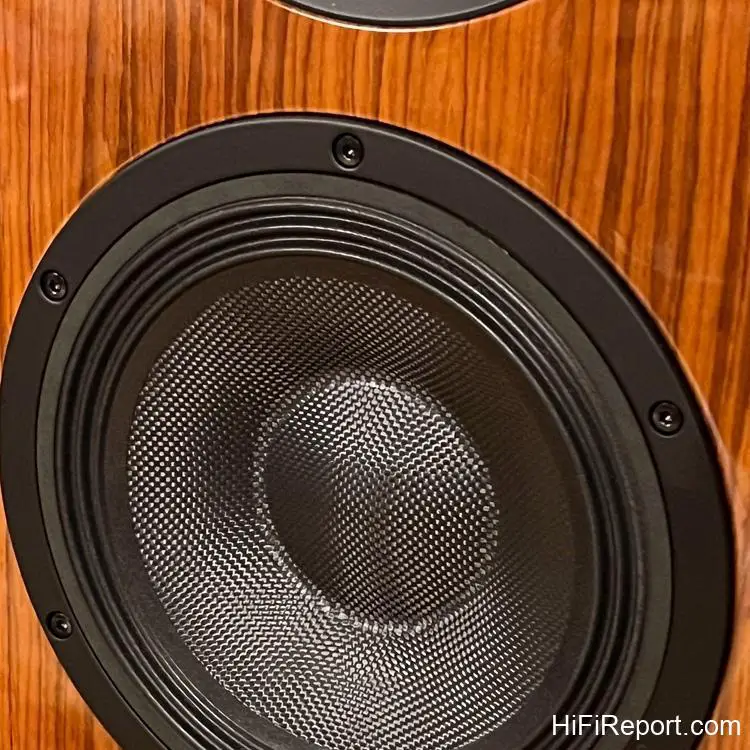
The GE1’s driver configuration remains consistent with TAD’s previous designs, featuring one CST (Coherent Source Transducer) coaxial driver and two 180mm Multi-layered Aramid Composite Shell (MACS) woofers, specifically the second generation.
The “multi-layer” construction involves five layers, including tough Aramid fiber cloth and foam materials. The outermost layer integrates the diaphragm and dust cap into a single piece, rather than two bonded components. The surround uses a triple-roll cloth design, similar to vintage speakers, with a special damping material applied to the back. This technique, also used in TAD’s professional drivers, helps reduce low-frequency distortion and minimize coloration in the mid-bass.
The driver frame is designed like a cradle; its massive structure can withstand the intense vibrations produced by the diaphragm’s forceful movement and allows back-waves to dissipate smoothly. The magnetic system employs powerful neodymium magnets, which are less common in woofers.
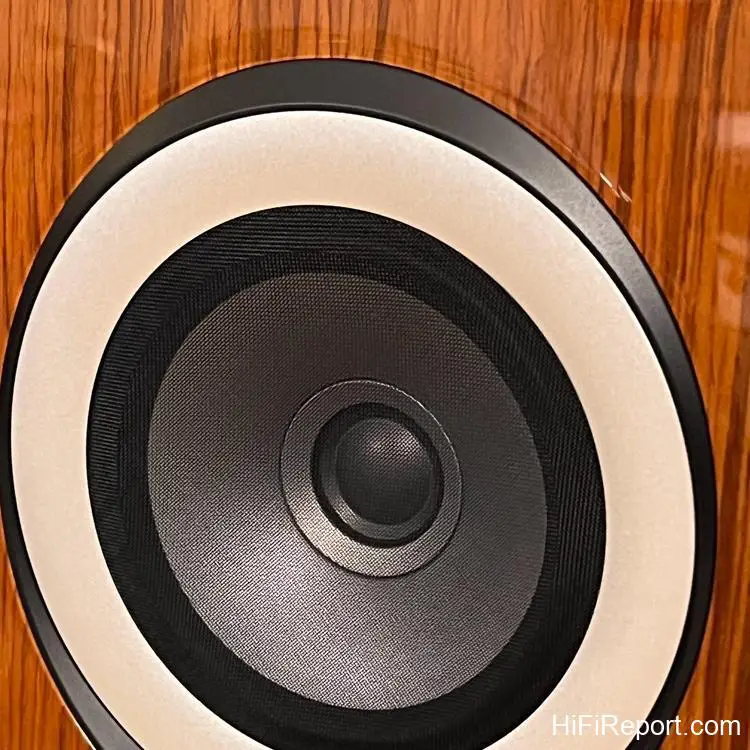
The CST driver comprises a 35mm tweeter and a 140mm midrange. The tweeter features a beryllium diaphragm formed using a vapor deposition technique derived from emerald rough ore (same as the flagship R1TX). The midrange diaphragm uses magnesium alloy with a surface coating called Hybrid Chemical Conversion Coating, which enhances hardness and creates greater internal loss.
While the midrange diaphragm’s surface appears unremarkable, it was designed by TAD using computer analysis and the Harmonized Synthetic Diaphragm Optimum Method (HSDOM) to achieve an optimal shape. This shape functions as a waveguide for the tweeter without affecting its dispersion pattern while also controlling unwanted diaphragm vibrations.
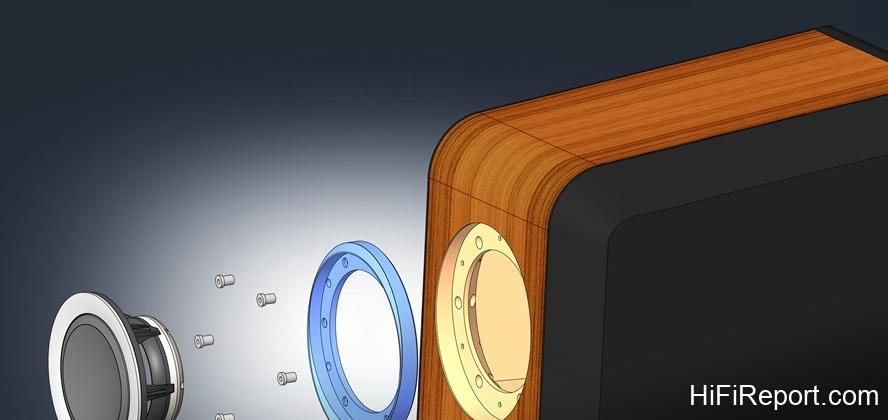
The CST coaxial driver boasts an extremely wide frequency range, from 250Hz up to 100kHz. This CST driver is not directly bolted to the cabinet but is instead isolated by a 25mm ring machined from aluminum alloy, which sits between the driver and the cabinet. The manufacturer refers to this as ISO (Isolation) technology. This isolation ring, borrowed from the flagship R1TX, fundamentally separates the CST driver from direct contact with the cabinet.
This prevents vibrations transmitted from the woofer section through the cabinet from affecting the CST driver, and also absorbs vibrations generated by the CST driver itself during its piston-like movement.
During the product launch at the hi-fi show, TAD’s president, Shinji Tarutani, specifically highlighted that while the external appearance of the GE1 drivers might seem unchanged, significant internal upgrades and refinements have been made, such as improvements to the CST coaxial driver’s magnetic system, even though they don’t publicly emphasize these details.
Cabinet Design and Construction
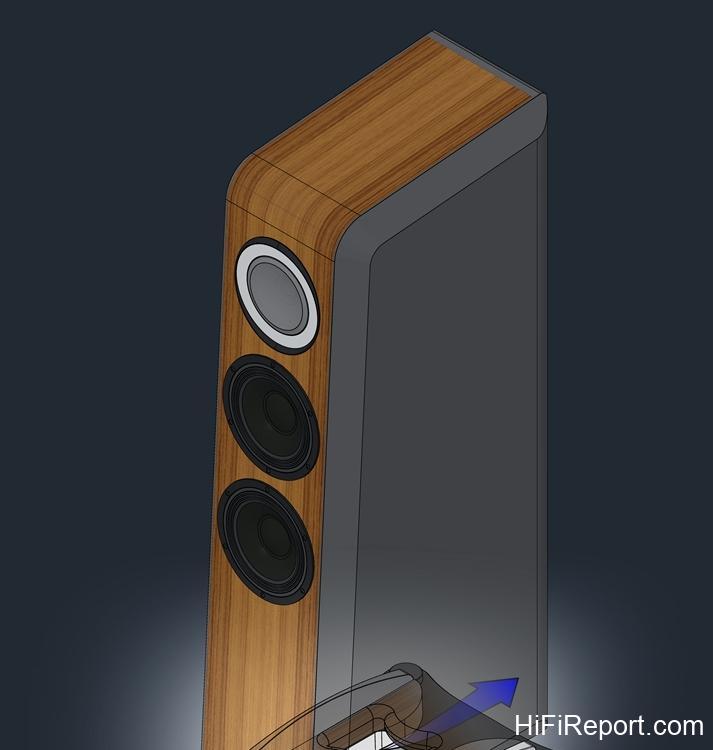
Looking from the side, you’ll notice that the entire GE1 cabinet is angled slightly backward (approximately 3 degrees). This design incorporates what’s known as Time Alignment, aiming to align the acoustic centers of the high, mid, and low-frequency drivers along a single vertical axis. This ensures that sound waves from all drivers reach the listener’s ears simultaneously, eliminating time disparities.
One might worry that this backward tilt would cause the CST coaxial driver’s sound waves to project upwards. TAD’s designers have considered this, and the CST coaxial driver is mounted with a slight downward angle to compensate.
The GE1’s cabinet eschews right angles. The top and bottom front edges are curved, the sides are beveled, and the rear sides are curved. This design is intended to reduce diffraction caused by sharp edges. The internal cabinet structure still utilizes TAD’s SILENT (Structurally Inert Laminated Enclosure Technology) method, now in its third generation. The main body is made of MDF, while the bracing frame is constructed from birch plywood. How is this internal reinforcement frame designed?
This is determined using TAD’s Acoustic Filter Assisted System Tuning (AFAST) technology, which applies reinforcement to areas of strongest vibration.
MDF is used for the main body because it can appropriately absorb vibrations, while the birch plywood bracing strengthens the cabinet. The cabinet is constructed by sandwiching the main body between the side panels, resulting in an exceptionally rigid structure. At the bottom of the cabinet is TAD’s renowned Bidirectional ADP (Aero-Dynamic Port) bass reflex design.
This port features flared openings at both the front and rear, cast from aluminum with a maximum thickness of 70mm and a minimum of 50mm. Seen from the side, they are curved, directing the powerful bass back-waves outwards from the front and rear simultaneously. This creates a balanced state that cancels vibrations and minimizes noise generated by airflow. The port openings are reinforced at the bottom by a 15mm aluminum plate, further solidifying the base of the entire speaker cabinet.
Naturally, the GE1 cabinet comes with sturdy spikes to provide stable support for the speaker.
Crossover, Placement, and Technical Details
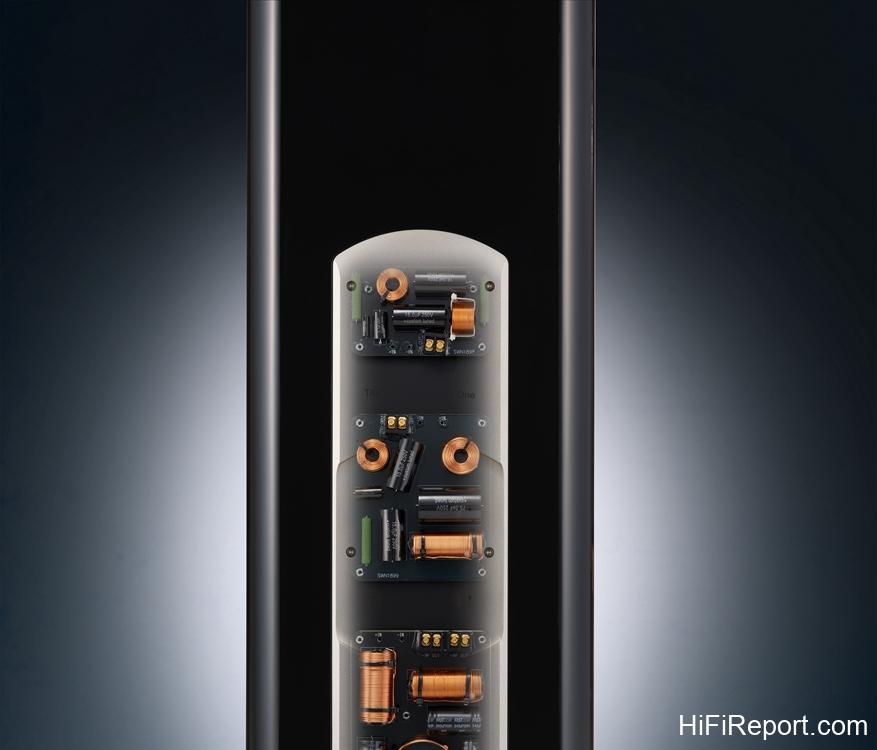
The GE1’s crossover network is divided into three independent boards: one for the tweeter, one for the midrange, and a shared board for the two woofers. This design aims to prevent mutual interference. These three crossover boards are not located inside the cabinet but are mounted on a metal plate on the cabinet’s rear, separated from the cabinet itself. This method also serves to prevent cabinet vibrations from affecting the crossover components.
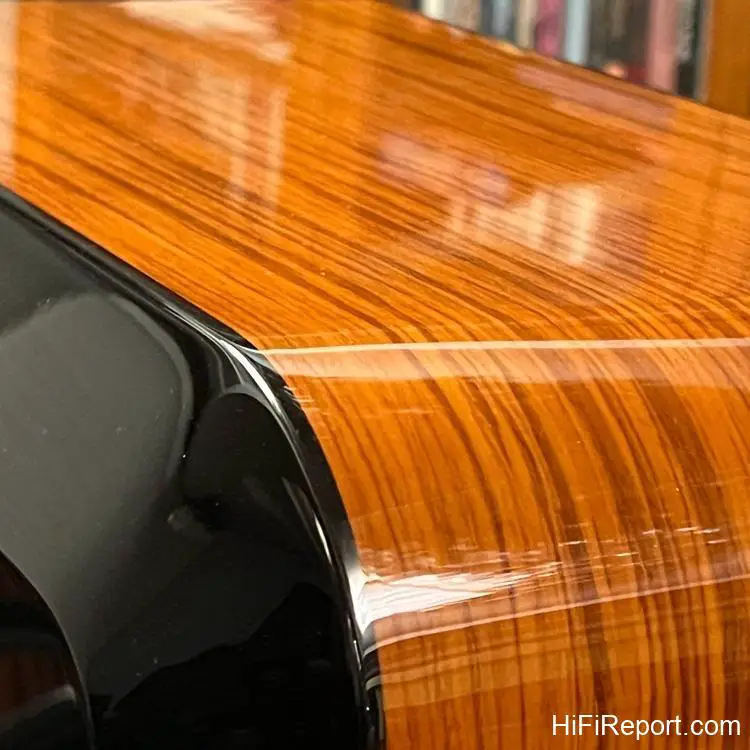
Although the crossover is divided into three independent boards, the GE1’s speaker terminals are not configured for tri-wiring; they remain a bi-wire design. The finish on the entire GE1 speaker is of extremely high quality. Whether it’s the walnut veneer or the black finish on the sides, they are polished to a mirror-like sheen, truly reaching the pinnacle of craftsmanship.
The GE1’s crossover points are set at 250Hz and 1.8kHz, with a frequency range of 27Hz to 100kHz. The nominal impedance is 4 ohms, and sensitivity is 88dB (2.83V). It is not a high-sensitivity speaker and requires a relatively high-power amplifier to drive it. I estimate at least 100 watts per channel is needed, and 200 watts would certainly be better.
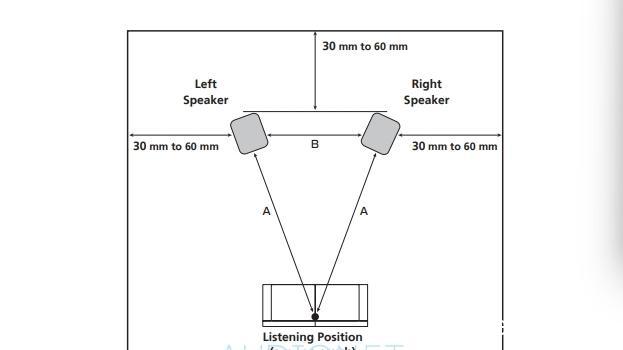
The GE1’s user manual provides detailed recommendations for speaker placement. Speakers should be at least 30-60 cm away from the rear and side walls. The distance between the listening position and each speaker should be greater than the distance between the two speakers. Finally, the two speakers must be angled inward (toe-in) so that the acoustic axes intersect at the listener’s ears, forming an isosceles triangle structure.
The Listening Experience
My listening space for the GE1 was my large open-plan living area. The distributor kindly provided the C1000 preamplifier for review, but a power amplifier was unavailable. I initially used the C1000 paired with my Pass X350.5 power amplifier (350 watts into 8 ohms) to drive the GE1. Then, I used my Spectral DMC 30SS preamplifier paired with a Pass X350.3 power amplifier. The sound performance differed slightly between the preamplifiers, but both pairings were excellent.
I can reveal that the sound was simply fantastic when using the C1000, but since I need to write a separate review for the C1000, this final review will focus on the pairing with the Spectral preamplifier. My digital sources included the emmLabs TSDX SE transport and DAC2 SE DAC, and a Weiss DAC 502 4ch for streaming. I also used an Esoteric K1X SE with the PS1 external power supply. With this digital source setup, the GE1’s performance capability elevated by several levels.
Ultimately, my final review of the GE1 incorporates the contributions of both the TAD C1000 and the Esoteric K1X SE.
Do you remember the TECA Yuanshan Hi-Fi Show in December? Many people must have listened to the GE1 speakers in the Yuncheng Audio room on the V floor. At the time, the C1000 preamplifier was used, but the power amplifier was an M700 (350 watts into 8 ohms). TAD President Shinji Tarutani was present at the show, but the actual demonstrations and music playback were handled by Nai-Yuan Hu, with the president providing supplementary remarks.
During that demonstration, Nai-Yuan Hu carefully selected several pieces of music suitable for the room conditions and controlled the volume appropriately. I believe everyone who heard it was left with a very good impression.
At my home, I didn’t have to carefully control the volume. Instead, I often let the GE1 roar to test its capabilities. Of course, I also played some of the same pieces Nai-Yuan Hu played at the show to hear how the GE1 sounded in my home compared to the exhibition hall.
First, I must say that the GE1 at the audio show sounded more refined, restrained, with beautiful tonal quality, excellent musical balance, and clear yet non-aggressive sound with very fast transients. However, the show environment didn’t allow for a full exploration of the GE1’s low-frequency performance. It seemed decent, but no demanding bass passages were played to push it.
Furthermore, the show environment didn’t allow me to fully appreciate the GE1’s sense of scale and dynamics, as playing at high volume might expose the venue’s acoustic shortcomings. Frankly, the GE1’s performance heard at the show already confirmed about 80% of its capabilities; the remaining 20% will be revealed in this review.
The GE1’s frequency response is specified as 27Hz-100kHz, but without specifying the attenuation at the extremes (e.g., -3dB). I wanted to know if the two woofers, responsible for frequencies below 250Hz, could truly extend down to 27Hz. So, I listened to the second track, “Adagio,” from Saint-Saëns’ Symphony No. 3, “Organ,” conducted by Myung-Whun Chung with the Orchestre de l’Opéra Bastille. Surprisingly, I could clearly hear the low-frequency pedal notes of the organ subtly emerging.
Clearly, the GE1’s 27Hz specification is not just a boast.
Next, I listened to the seventh track, “Pie Jesu,” from the RR recording of John Rutter’s “Requiem.” The subtle, ultra-low frequencies were still clearly audible and even produced that pleasant low-frequency “skin massage” sensation. Since the organ notes in these two pieces (around 31Hz) were easily reproduced, I moved on to a more challenging test: the soft tapping of a large drum.
I used the Icelandic band Sigur Rós’ album “Með suð í eyrum við spilum endalaust,” listening to the seventh track, “Ára bátur” (Row boat). This required closer attention, but indeed, I heard the gentle, ultra-low frequency of the large drum, like smoke rings exhaling. At this point, there’s no doubt about the GE1’s ability to delve deep into the bass; it truly goes low enough.
However, the bass in the aforementioned three recordings was subtle. What about impactful bass? Can the GE1’s two 180mm woofers handle it? I immediately listened to Malia and Boris Blank’s album “Convergence.” Picking a few tracks at random, the GE1 did not disappoint. Bass that felt like a water balloon popping, powerful yet low ultra-low frequencies, and those skin-massaging sensations were all present and accounted for. They were clearly rendered, full-bodied, and stable.
Finally, I listened to Eivor’s live album, “Eivor Live.” The first track, “Mín Móðir,” is fierce and complex. The GE1 was able to clearly resolve the bass, preventing it from becoming a jumbled mess where you couldn’t distinguish individual instruments within the low-frequency range. At this point, I was completely satisfied with the GE1’s bass performance. However, I unexpectedly encountered the GE1’s outstanding bass again while listening to Tsai Chin’s “Light Up the Neon Lights.”
I hadn’t intended to use this track to test the bass, but I again heard bass that was soft yet firm, elastic, deep, and clear. It seems the GE1’s deep bass capability is omnipresent.
As for kick drums, which occupy a higher frequency range around 100Hz, these were even easier for the GE1. You can hear them everywhere in popular music. For example, in Mayumi Itsuwa’s “Koibito yo,” Janis Ian’s “Breaking Silence,” James Blood Ulmer’s “Crying,” Eagles’ “One of These Nights,” Stevie Ray Vaughan’s “Tin Pan Alley,” and others. The “thump” of the kick drum in these tracks varies, but they were all full, solid, quick and punchy, and clean. Clearly, the GE1 has excellent bass control.
Because the bass performance I heard in my home was so good, I measured the frequency response. In my room conditions, I found peaks in the GE1’s bass spectrum around 63Hz and 150Hz, with ample energy between 31Hz and 63Hz. This appears to align well with the GE1’s 27Hz specification (although attenuation isn’t specified), explaining why the bass can extend so low and has such ample energy.

How about the GE1’s mid-range performance? From the vocals in the aforementioned pop songs, I could feel that the mid-range leans towards neutrality, without a particularly heavy coloration. However, vocal density is quite high, and the vocal timbre is very beautiful. Listening to Bocelli, Tsai Chin, Sandy Lam, and Yao Yingge, their voices sounded particularly pure.
In terms of piano reproduction, when I listened to Mitsuko Uchida playing Schumann’s “Davidsbündlertänze,” I immediately noticed the richness of the piano’s harmonics. The texture of the keystrokes felt incredibly real. The clang of the upper keys sparkled with a radiant quality and sweetness. The lower keys expanded downwards like water ripples, and the piano’s tone was exceptionally beautiful.
Listening to the Beaux Arts Trio playing Brahms’ “Piano Trios,” the piano notes were particularly full and forceful, with a solid and well-defined presence. Listening to Zlata Chochieva playing Liszt’s “Transcendental Etudes,” the rapidly played piano notes burst forth individually, clean and fast, without any sense of drag.
The GE1 also renders brass and wind instruments beautifully, and the instrumental timbres are very accurate. This was my feeling when listening to Beethoven’s Piano and Wind Quintet, Op. 16 (with Pascal Rogé on piano). Here, the GE1 was calm and composed, with rich harmonies and beautiful resonance, making for a very comfortable listening experience. The GE1 possesses the characteristic of never sounding harsh, no matter how you listen.
It is very tranquil, allowing you to listen to music in a relaxed and unburdened state. The sound is clearly defined, yet it’s never aggressive, allowing for long listening sessions without fatigue.
How does the GE1 perform in the high-frequency range? When various instruments play in the upper registers, they never sound piercing, as if caught by an invisible net, preventing any harshness. Violins sound warm, clear, and gracefully nuanced. The texture of cymbal crashes and the striking of delicate metal percussion instruments are particularly excellent. Even very subtle sounds feel solid. The rustle of snare drum brushes and the tap-tap sound of drumsticks also feel remarkably solid.
To test the GE1’s violin performance, I specifically chose Christian Ferras playing Brahms’ “Violin Concerto” (conducted by Herbert von Karajan with the Berlin Philharmonic). The recording of this album has quite sharp treble, almost reaching the threshold of good sound. By that, I mean if the high frequencies are too exaggerated, they can become aggressive and make the music unpleasant. Surprisingly, the GE1 reproduced it with complete ease and confidence.
Although the violin and the accompanying orchestra’s strings were sharp, they weren’t grating. Instead, there was a uniquely clear quality. After listening to this piece alone, I had 100% confidence in the GE1’s violin performance.
Next, I listened to Christoph Koncz’s performance of Mozart’s “Violin Concerto No. 5.” Here, the GE1 showcased an incredibly delicate violin sound. Even the accompanying strings sounded similarly soft and elastic. Listening to Mullova’s performance of Tchaikovsky’s “Violin Concerto,” her violin also sounded very delicate and full of woody character.
Perhaps you might think that since the GE1’s frequency response extends up to 100kHz, the high frequencies should be very prominent and sharp? This is not the case. The frequency range that ears typically perceive as sharp is around 2-4kHz. Above that, our hearing sensitivity begins to decline, and fundamental frequencies of instruments rarely exceed 4kHz. Above 10kHz, the sound is entirely composed of harmonics.
Harmonics don’t cause ear fatigue; instead, they make the timbre of instruments and voices more accurate and pleasant. Listening to Mullova’s violin performance now confirms this; as she plays in the higher registers, the tone becomes more refined, yet without losing its luster or sweetness.
Listen again to Hilary Hahn playing Vaughan Williams’ “The Lark Ascending.” When the GE1 reproduces this piece, the violin truly sounds like a lark soaring, twisting and turning in the air. The accompanying strings are like a gentle breeze, delicate, soft, and utterly comfortable. The GE1 is like someone with a wonderful temperament, not easily angered or awkward. Those interacting with it feel no aggression or pressure.
The GE1 offers excellent imaging. When listening to Mendelssohn’s String Quartet Op. 12 No. 1, the positions of the four string instruments are crystal clear, with distinct outlines. The plucked notes (pizzicato) are sharply defined and (three-dimensional). Listening to Yosi Horikawa’s “Bubbles,” the bouncing sounds are particularly solid and three-dimensional, with each landing point incredibly precise and never blurred.
This is a significant advantage of coaxial drivers, and the fact that the two woofers handle only frequencies below 250Hz means they cause minimal interference to the coaxial driver’s excellent imaging capabilities.
The GE1 has a strong capacity to handle musical impact. When I listened to the track “Weishen” from the album “Long Drum,” the impact of the Chinese drum is very strong and percussive. The GE1 did not collapse under the pressure. The speed of the drum strikes was very fast, and the power was intense. Listening to Myung-Whun Chung conducting the Philadelphia Orchestra in Shostakovich’s Symphony No.
4, the orchestral opening surges forward like a tidal wave, accompanied by powerful drumbeats, creating astonishing scale and high sound pressure. I heard no signs of weakness. Listening to “End of the War” from the “Curse of the Golden Flower” movie soundtrack, the large drums produced a very elastic flow of air, and the drum lines were clear. Listening to the track “Golden Armor,” the scale of the chorus and accompaniment was even more astonishing.
Drums, gongs, and voices converged into a massive wave of sound, constantly churning. I was genuinely a little concerned the GE1 might not hold up, but it did. The GE1’s cabinet and drivers aren’t large, yet they can produce such immense sound energy – truly impressive.
Every time TAD releases a new product, it’s met with anticipation because their products are packed with technical ingenuity, possess elegant and refined exteriors, and most importantly, their sound performance repeatedly resets the listening experience for audiophiles. The GE1 can handle explosive dynamics yet also resolve quiet passages. It renders violins with delicate elegance and gentleness, pianos with crystalline sparkle and luster, and voices with a rich, relaxed beauty.
It excels in soundstage layering, depth, and imaging. Buying the TAD GE1 is like finding a lifelong companion; you can listen to her a thousand times and never grow tired.
Specifications
* Product Type: Three-way, coaxial, floorstanding, bass reflex speaker
* Release Year: 2022
* Drivers: CST coaxial driver x 1, 180mm woofer x 2
* Frequency Range: 27 Hz – 100 kHz
* Nominal Impedance: 4 ohms
* Sensitivity: 88dB (2.83V)
* Crossover Frequencies: 250Hz, 1.8kHz
* Maximum Input Power: 250 watts
* Dimensions (WHD): 394 x 1,212 x 547 mm
* Weight: 64 kg