
TAequo Audio Adamantis Floorstanding Speakers Review
The Dutch speaker brand Aequo Audio, recently imported by the local distributor Fully Tune, has finally arrived at the MY-HiEND testing room. We were first intrigued by these speakers at an audio show, drawn to their ultra-modern yet acoustically justified design.
The Adamantis on display features sleek, fluid lines, a striking black-and-white lacquer finish, and top-tier, exquisite craftsmanship. Although Aequo Audio has a relatively short history, they apply rigorous scientific technology to every key component and structural element, striving for the perfect reproduction of original sound in both theory and practice.
“Aequo” means consistency and equality. This represents founder Ivo Sparidaens’ expectations and standards for his products. He aims to reproduce the exact musical content originally created by artists and producers, delivering an authentic playback without adding or subtracting anything from the faithful recording.
Ivo started as an avid music lover and audiophile. At one point, he upgraded his speakers to a higher-end model from the same brand. Despite spending significantly more money, he felt no improvement in performance. He experimented with different rooms, placement, and matching equipment, but still felt stuck. Having previously worked in an F1 racing team, conducting hands-on research and building prototypes came naturally to him.
When he finally completed his DIY project, the results exceeded his expectations.
Ivo later met marketing specialist Paul Rassin. After deep discussions, they decided to establish Aequo Audio. Collaborating with the legendary Skaaning family of Denmark (famed for driver design), they launched their first speaker, the Ensis, in late 2015, followed by the Stilla in 2018.
Aequo Audio subsequently achieved a major breakthrough by developing a brand-new enclosure material. Utilizing nanotechnology, their Diluvite™ technology can be molded into any shape a speaker designer desires while possessing exceptional acoustic properties. It is virtually vibration-free and rapidly converts micro-vibrations directly into thermal energy.
In 2025, Aequo Audio used this Diluvite technology to introduce two brand-new floorstanding speakers: the Adamantis and the Ensium, with plans to leverage this technology for more products in the future.
Diluvite Development
Aequo Audio currently has only two products in its lineup: the fully passive Adamantis and the assisted-bass Ensium. On their official website, the two speakers appear virtually identical in appearance, dimensions, and weight. The difference lies in the Ensium’s assisted bass, which increases the voltage of the low-frequency input signal to deliver more power to the driver. This results in slight differences in sensitivity and nominal impedance.
The Ensium also features an all-analog ARPEC™ low-frequency adjustment system. In addition to extending the low-end limit, this allows users to fine-tune the bass energy according to their room acoustics—something we hope to introduce in more detail in the future. Today, our focus is on the fully passive Adamantis: a 3-way, 3-driver floorstanding speaker standing 116 cm tall and weighing a substantial 129 kg, featuring a downward-firing, horn-loaded bass reflex port at the bottom.
Custom Colors
3D Octagonal Aesthetics
The “Octagon Philosophy” stems from the core design philosophy of Aequo Audio. While the Adamantis has a fluid exterior, a closer look at its facets and construction reveals a complex matrix of multi-angled, non-parallel surfaces. By eliminating right angles and parallel planes on all axes (top, bottom, left, right), this 3D organic, streamlined shape not only looks avant-garde but physically prevents the buildup of internal standing waves.
The smooth baffle edges also eliminate cabinet diffraction, allowing for ultra-clear imaging and rendering the speakers completely “invisible” within the room.
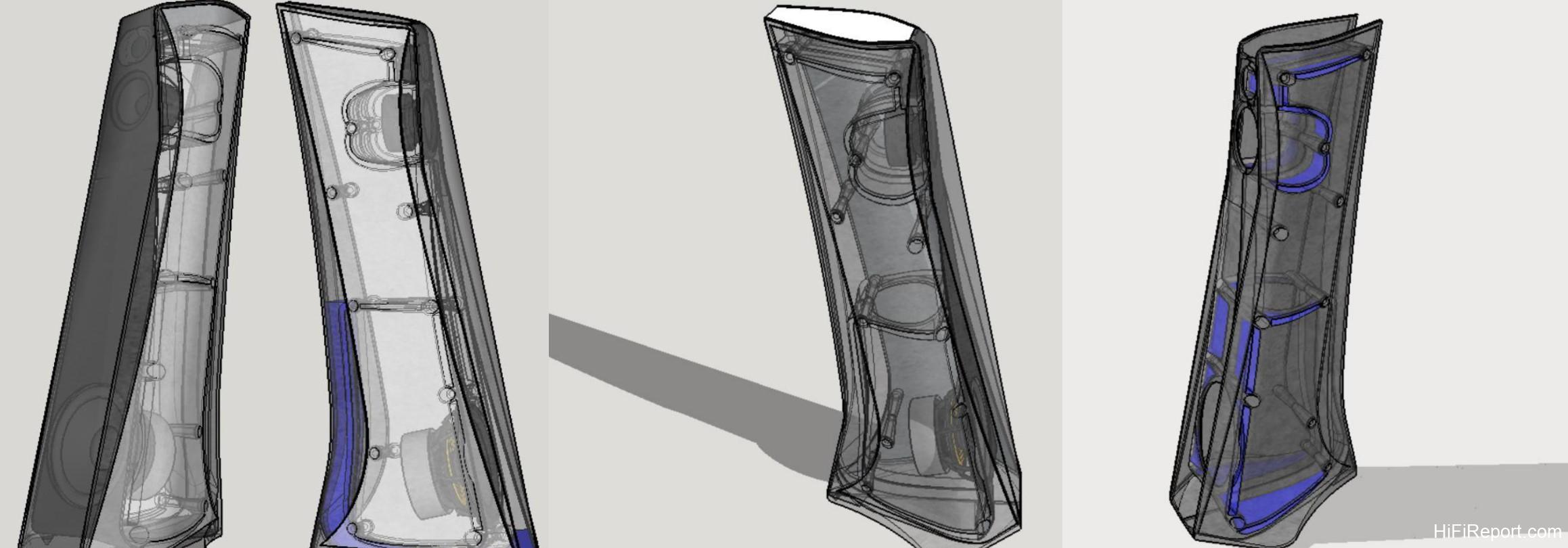
The Adamantis cabinet is not cast from a single material but employs a more complex “composite physical insert” architecture. The main Nanocast-MMC™ structure forms the large white side panels of the enclosure (which feel rock-solid and completely vibration-free to the touch). This metal-matrix composite provides twice the rigidity of pure aluminum and converts minute mechanical vibrations from 1 Hz to 100,000 Hz into micro-thermal energy.
At critical internal acoustic nodes, Nanocast-PMC™ inserts utilizing the polymer-matrix Diluvite composite are embedded. These two materials complement each other to comprehensively suppress resonances across different frequency bands. During assembly, the left and right halves of this complex nano-composite cabinet are joined under extreme pressure using 11 high-tension bolts, fusing the entire cabinet into an incredibly rigid, monolithic structure.
The Adamantis utilizes a bass-reflex design, with the port intentionally located at the very bottom of the front baffle, close to the floor. The internal port extends into a horn-loaded acoustic channel, precisely tuned to an ultra-low resonant frequency of 19 Hz to 20 Hz. This delivers an authoritative, noise-free low-end extension.
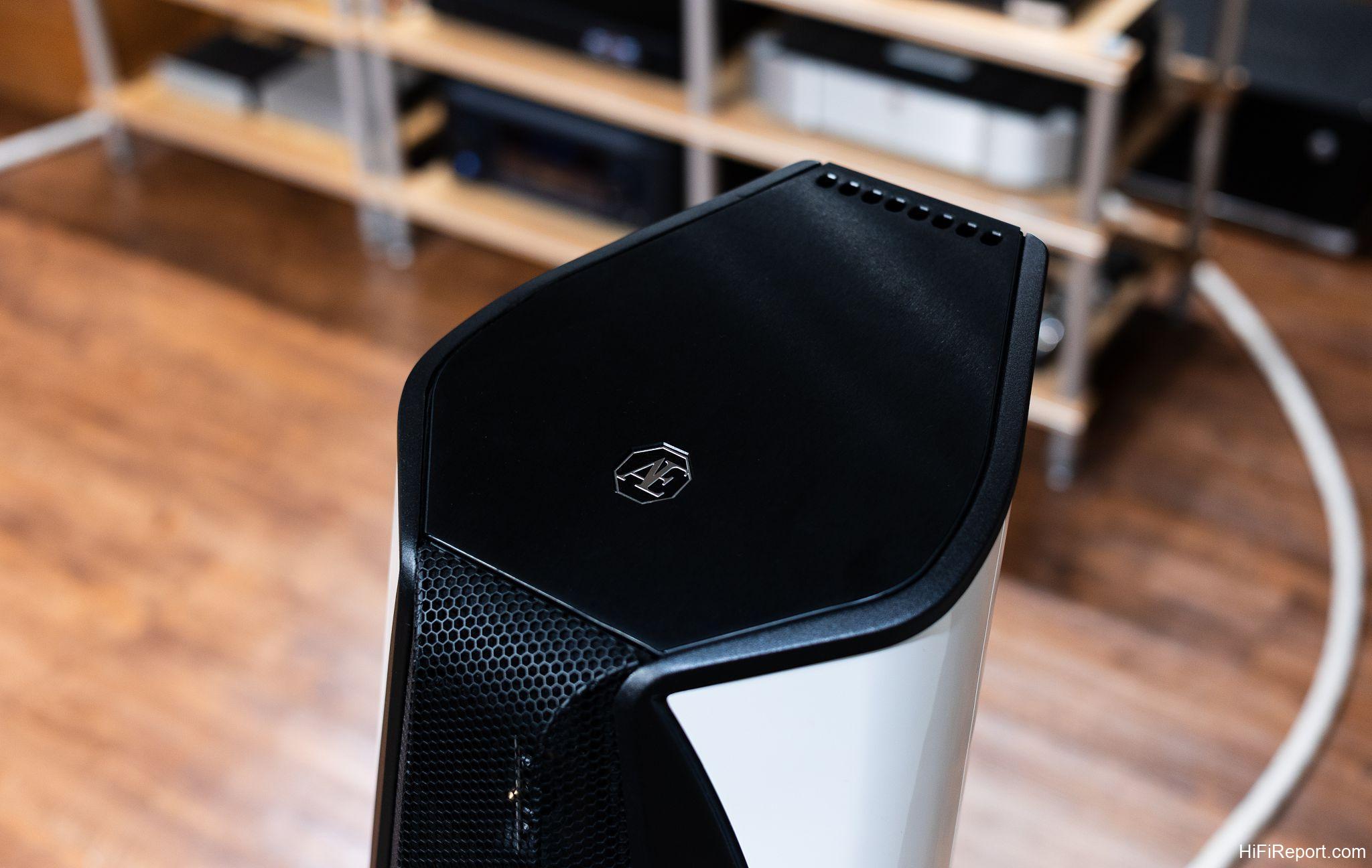
In contrast to the white Diluvite nano-materials on the sides, the top-to-back section of the Adamantis features a high-rigidity black metal structure. Eight precision-engineered apertures are carved into the upper back panel. Besides echoing the brand’s signature octagonal emblem, these openings serve crucial acoustic purposes: venting physical airflow from the internal crossover, releasing minute internal pressure differentials, and improving the cabinet’s overall tuning characteristics.
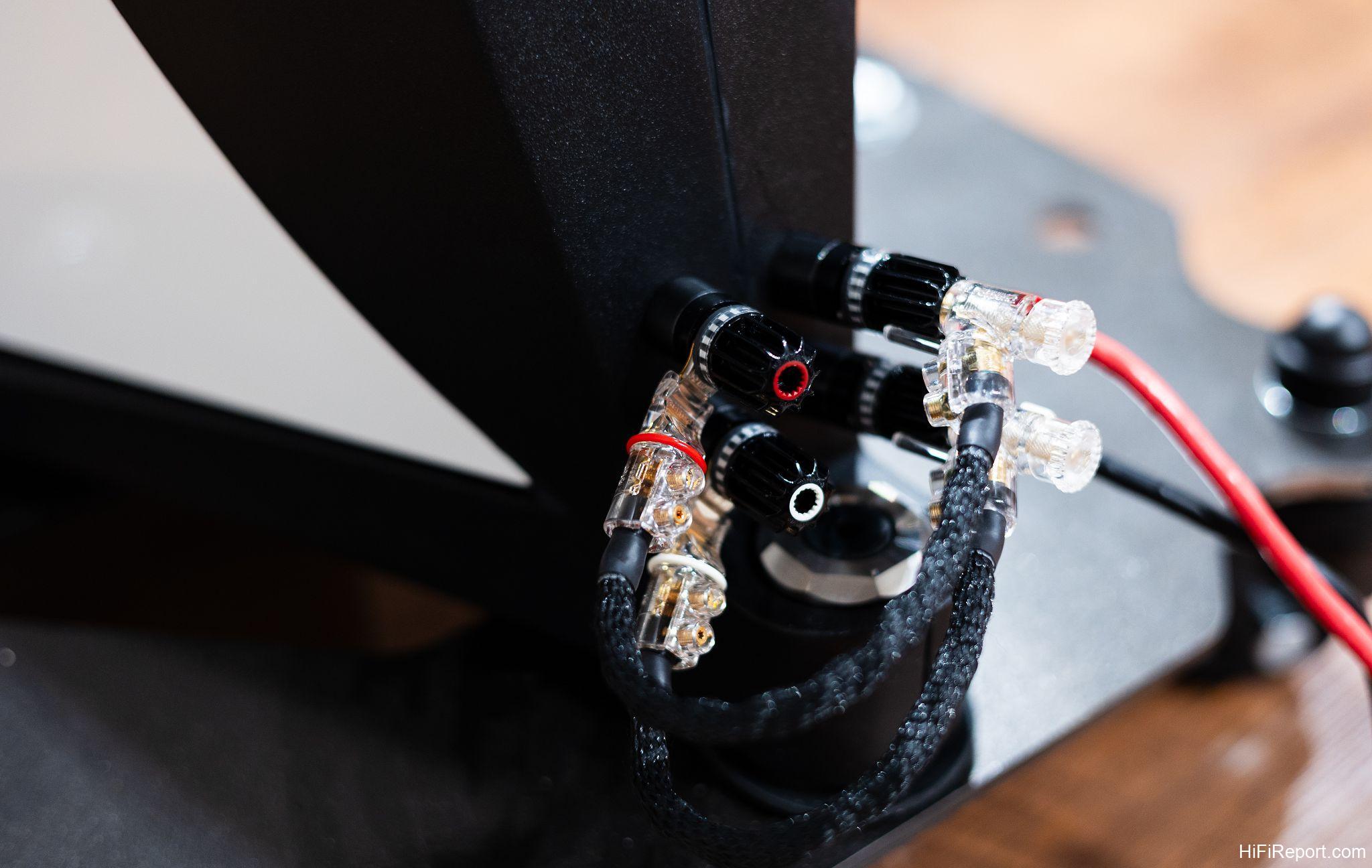
The base employs a “three-point grounding” metal stand design with two spikes at the front and one at the back, utilizing three heavy-duty M12 metal spikes. (For ease of positioning during this review, we left the transport casters on instead of swapping them for the spikes).
Viewed from the side, the entire speaker slopes elegantly backward. The single rear spike allows for fine height adjustment, enabling listeners to adjust the tilt angle based on their seating height and listening distance. This ensures microsecond-level time alignment of the high, mid, and low frequencies as they reach the listener’s ears.
Premium Driver Configuration
The Adamantis features a 3-way, 3-driver front-bottom horn-loaded bass reflex design. Its drivers are custom-built by top European manufacturers, with each driver meticulously engineered for lightning-fast transient response and ultra-low distortion.
The 1-inch fully symmetrical soft-dome tweeter (SF40 driver) uses a high-performance custom soft dome diaphragm paired with Aequo’s proprietary fully symmetrical motor structure. It delivers outstanding horizontal dispersion, exceptional resolution, and extremely low distortion, effectively solving the cone breakup distortion commonly associated with traditional soft dome tweeters.
The 5-inch custom ultra-fast midrange driver (featuring a Nomex-coated composite diaphragm) was co-developed by the Aequo team and the legendary Skaaning family of Denmark. Utilizing a 5-inch Nomex-coated paper pulp composite cone, its crossover point is set relatively high (above 170 Hz). This reduces the excursion required by the midrange driver during operation, maintaining ultra-low distortion and a highly pure, clean, and natural tonal character even at high volumes.
The 10-inch long-throw subwoofer features a high-rigidity aluminum alloy cone with a specialized mineral coating and a heat-resistant, anodized voice coil.
The patented EHDL™ (Enhanced Horizontal Dispersion Lens) is a specialized tweeter waveguide technology developed by Aequo to overcome the physical limitations of traditional tweeters in vertical and horizontal dispersion. It creates an exceptionally wide, highly holographic 3D soundstage, ensuring pinpoint instrumental imaging even as listeners move around the room.
Symmetric Topology Crossover
The internal crossover is housed in an isolated, vibration-damped compartment at the bottom of the cabinet, accessible only via a proprietary key. Within this fully passive architecture, Aequo utilizes top-tier custom audiophile components from Denmark and Germany. These include custom-spec symmetrical precision air-core coils, high-grade polypropylene (PP) audiophile capacitors, and ultra-low tolerance Danish super-resistors, ensuring seamless integration across all three frequency bands.
Exquisite Transparency and Detail
In the pantheon of high-end audio, speakers that can seamlessly translate “high-tech hardware strength” into “exquisite emotional beauty” are exceedingly rare. The Aequo Audio Adamantis is undeniably one of them. From the moment it began to play, its premium texture, a tonal balance as pure and transparent as distilled water, and almost microscopic levels of detail took our breath away.
To test its full-range reproduction capabilities, we selected violin virtuoso Hilary Hahn’s classic recording, *J.S. Bach: Violin Concertos*. This album is exceptionally well-recorded, rich in dynamics and fine detail, and filled with the rigor and vitality of Bach’s polyphonic music, making it the perfect litmus test for dynamic contrast and tonal purity.
As soon as Hilary Hahn’s bow touched the strings, the Adamantis displayed stunning agility and finesse. Thanks to the resonance-free Diluvite™ nano-cabinet, the lines of the music were incredibly clean, well-defined, and devoid of any harsh edges. The violin’s tone was far from dry or sterile; instead, it possessed just the right amount of body and an ultra-dense, exquisite texture—sounding like radiant, naturally hydrated skin.
The sound delivery was remarkably fluid, smooth, and effortless, completely free of the fatiguing glare common in lesser tweeters, while the instrument’s overtones were breathtakingly sophisticated. Across the frequency spectrum, this 129 kg behemoth integrated so seamlessly that it behaved like a single full-range driver.
The Skaaning-collaborated midrange and proprietary EHDL™ horizontal dispersion lens proved their immense worth. When the music transitioned into the full-throttle tuttis of the solo violin and orchestra, the Adamantis radiated the surging acoustic energy evenly throughout our listening room with a wide, majestic, and 3D geometric presence—just like the brilliant rays of a magnificent sunrise.
Serenity and Harmony
If Hilary Hahn’s Bach showcased the Adamantis’ lightning-fast dynamics and brilliance, then Leonard Cohen’s legendary 1967 debut album, *Songs of Leonard Cohen*, fully revealed the flagship speaker’s harmonious, peaceful, and profound “beauty of serenity.”
Under the Adamantis’ interpretation, Cohen’s voice was wonderfully refreshing. At just over thirty years old, his voice was remarkably clean, transparent, and carried an elegant, captivating, papery texture. It was entirely free of the gravelly, ultra-deep whisper of his later years; instead, this was a youthful, clear, and luminous voice.
Through these speakers, we were delighted to discover that the young Cohen was not only a vehicle for deep, introspective emotion, but also a true *bel canto* troubadour. The acoustic guitar plucks were full-bodied and warm, accompanying his clean diction so vividly that one could almost visualize the young poet in the recording studio, cradling his guitar and singing with absolute sincerity.
The greatest strength of the Adamantis is its complete absence of grain or artificial glare. As the music flows, a sacred sense of tranquility naturally settles over the room. This “quietness” is largely thanks to the 129 kg, resonance-free cabinet constructed from the Diluvite™ nano-cast metal-matrix composite, which nips all coloration and noise in the bud, carving out an ink-black, high-purity background reminiscent of a deep forest at midnight.
Furthermore, the speaker’s driver integration is exceptionally seamless. Whether reproducing Cohen’s baritone, the gentle instrumental accompaniment, or the subtle backing female vocals, the overall proportions of the sonic image are perfectly balanced. No single frequency band protrudes, and no musical lines feel forced or showy.
This overall balance and naturalness deliver a performance that is both vividly lifelike and incredibly non-fatiguing. Watching the warm, clearly defined form of the poet singing from the center of the soundstage, the listener cannot help but feel a deep sense of inner peace and comfort.
Technology and Emotion (Wacko Wong)
We kicked off the listening tests with OneRepublic’s “Rescue Me”. In terms of bass performance, the Aequo Audio Adamantis demonstrated outstanding control and crisp transient response. When the electronic beat and low-frequency bass drum kicked in during the intro, the impact was immediate—completely free of cabinet coloration or muddiness. Each bass hit felt full-bodied, clean, and punchy, with zero overhang.
At the same time, the lines of the acoustic and electronic instruments were highly three-dimensional. Instead of sounding like a flat wall of sound coming from the front, they were precisely mapped within a 3D space, enveloping the listener in a pulsating, rhythmic groove.
By the chorus, the lead vocals soared to an energetic peak. The speaker rendered the powerful, piercing voice with meticulous detail. The vocal image was solidly placed and highly dimensional, as if the singer were performing live right in the center of the room.
The track’s electronic instrumentation, strings, and tight handclaps were reproduced with exceptional detail, maintaining a vibrant, bright, and transparent timbre that never sounded dry or harsh. The presentation was fluid, well-layered, and densely saturated, providing a smooth yet impactful delivery that effortlessly immersed us in the high-energy melody—a perfect fusion of technological prowess and musical emotion.
Dissolving Speaker Boundaries
Next, we played “Poison & Wine” by The Civil Wars. From the opening notes, an airy, highly dimensional acoustic space unfolded before us. The male and female vocals, positioned left and right, intertwined beautifully. Every micro-detail—from the breath to the subtle physical shifts in their diction—was vividly captured and suspended in the air, allowing us to almost feel the intimate emotional dialogue taking place right in front of us.
The subsequent acoustic guitar plucks were lively and bright, preserving every nuance of the fingers sliding on strings. The warm piano keys were struck with exquisite tone, sounding pure, transparent, and entirely free of artifacts, delivering the song’s pent-up, dense emotions directly to the heart.
As the track progressed, the low-end piano notes and subtle bass elements began to swell. The low frequencies were tightly controlled and highly elastic, reaching deep without a hint of bloat, laying down a solid, warm foundation that enhanced the sense of immersion.
The instruments and vocals maintained a perfect sense of distance. Even during the dense vocal harmonies in the intense chorus, the high frequencies remained silky smooth. The dynamics of the entire song were organized and orderly, preserving the sophisticated, delicate texture of the instruments. The speakers completely disappeared from the room, leaving behind only the purest and most authentic performance of music and voice.
Brass and Dynamic Power
Finally, we listened to “High Hopes” by Panic! At The Disco. The song opens with an array of brass instruments, where the high-frequency performance was stellar—vivid, energetic, and full of luster. The complex overlapping instruments never smeared; instead, they sustained a clean decay with a refined, controlled edge. The brass sounded brilliant and soaring but never fatiguing, retaining a warm, metallic texture.
The following drum beats and handclaps had a crisp, snappy rhythm. Every single bass drum impact and stick strike was tightly defined and lightning-fast, hitting with pinpoint precision and setting a thrilling, engaging pace right from the start.
When the vocals entered, the lead singer seemed spotlights-focused within the expansive soundstage. The voice was densely textured, highly focused, and precisely positioned. Even as the instrumentation swelled and waned, the vocals remained rock-solid and clear.
In the latter half of the song, the complex strings, piano, and electronic backing tracks were beautifully layered without any congestion. Even with such an explosive, high-energy track, the Aequo Audio Adamantis managed to preserve micro-dynamics and delicate contrasts, allowing us to fully enjoy the drive of modern pop while maintaining top-tier tonal beauty and resolution.
Aequo Audio Adamantis Specifications
* Design: 3-way, 3-driver passive floorstanding speaker with front-firing bass reflex port
* Sensitivity: 89 dB @ 4 Ω
* Frequency Response: 20 Hz – 45 kHz (-3 dB)
* Impedance: 8 Ω (minimum impedance 3 Ω)
* Dynamic Output: Maximum full-frequency linear SPL >116 dB @ 500 W (250 W per channel)
* Recommended Amplifier Power:
* Minimum recommended: 20 W @ 4 Ω
* Recommended: >50 W
* Long-term maximum power handling: 350 W (higher peak power allowed)
* Drivers:
* Tweeter: 1-inch fully symmetrical soft-dome (SF40 driver) with EHDL™ (Enhanced Horizontal Dispersion Lens)
* Midrange: 5-inch Nomex-coated paper pulp composite
* Woofer: 10-inch aluminum cone
* Crossover: Low-order filter slopes with ultra-wideband phase alignment technology
* Dimensions: 116 x 52 x 42 cm
* Weight: 129 kg per speaker