
Tannoy SGM-15 Floorstanding Coaxial Speaker Review
Tannoy strikes again.
Two weeks ago, HiFiReport extended an invitation to audition a pair of Tannoy speakers named SGM-15.
I searched online for information and saw their simple, retro appearance, similar to the previous Legacy series. I initially assumed it was Tannoy updating the Legacy series with a new name.
Upon arriving at HiFiReport and inquiring, I learned that this is a brand new Tannoy series, positioned even higher than the Legacy range.
This isn’t just a facelift; it’s a fresh move from Tannoy.
Super Gold Monitor Series: A Glorious History
SGM stands for Super Gold Monitor, a tribute to their classic Monitor Gold series.
Launched in the 1980s, the Tannoy Monitor Gold series became a staple in numerous professional recording studios. During the golden age of popular music, it assisted recording and mixing engineers in creating countless beloved records.
However, this time, Tannoy intends for the Super Gold Monitor to reside at home, for domestic use.
The SGM series comprises three models, ranging from smallest to largest: the SGM-10 with a 10-inch coaxial driver, the SGM-12 with a 12-inch driver, and the flagship SGM-15.
Products in the Prestige GR series and Legacy series are all given specific names, without any numbers in their model designations.
The SGM series, on the other hand, directly uses numbers to indicate the speaker driver size, making it simple, clear, and easily understandable.
Dual Concentric Design: 70 Years of Dedication
Tannoy refers to their coaxial driver design as Dual Concentric.
The origin of coaxial drivers in audio history can be traced back to Tannoy’s pioneering Dual Concentric design in 1947. Even the Cambridge English Dictionary includes “Tannoy” as a word. Being referenced by audiophiles and reported in audio magazines is one thing, but being listed in a dictionary is quite another! The greatest advantage of coaxial drivers is their ability to achieve natural “point source” sound reproduction.
Because the tweeter and woofer are located on the same central axis, it ensures that the sound emitted by both drivers disperses evenly in both horizontal and vertical planes, more closely resembling the natural sound radiation of real-world sound sources.
Even when you’re not in the “sweet spot,” the perceived frequency response remains uniform, unlike typical non-coaxial speakers where the frequency response noticeably changes in off-axis listening positions.
This advantage has become Tannoy’s unwavering commitment, upheld for over 70 years.
Through continuous refinement of manufacturing processes, structures, and materials, coupled with modern acoustic research, Tannoy has enabled their coaxial drivers to achieve even more outstanding performance.
Aluminum-Magnesium Alloy Tweeter with 15-inch Paper Cone Woofer
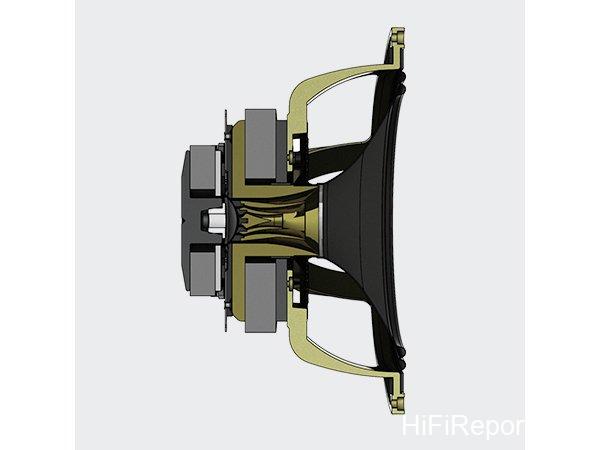
The 15-inch coaxial driver in the SGM-15 features a 1.3-inch (33mm) aluminum-magnesium alloy dome tweeter at its center, handling all frequencies above 1.1kHz.
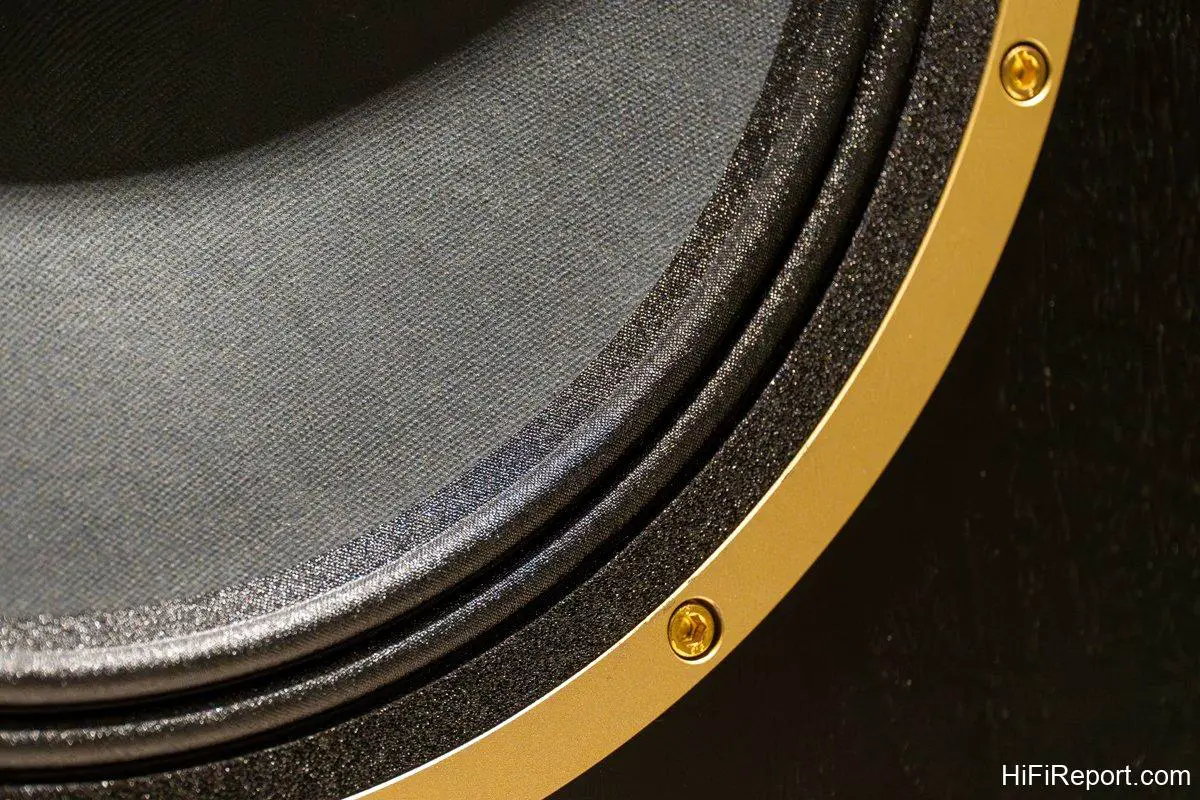
The mid-bass driver, sharing the same center axis, is a 15-inch (380mm) paper cone woofer with a W-type fabric surround. The overall design philosophy clearly aligns with the Prestige GR series.
Unassuming Appearance, Exquisite Craftsmanship
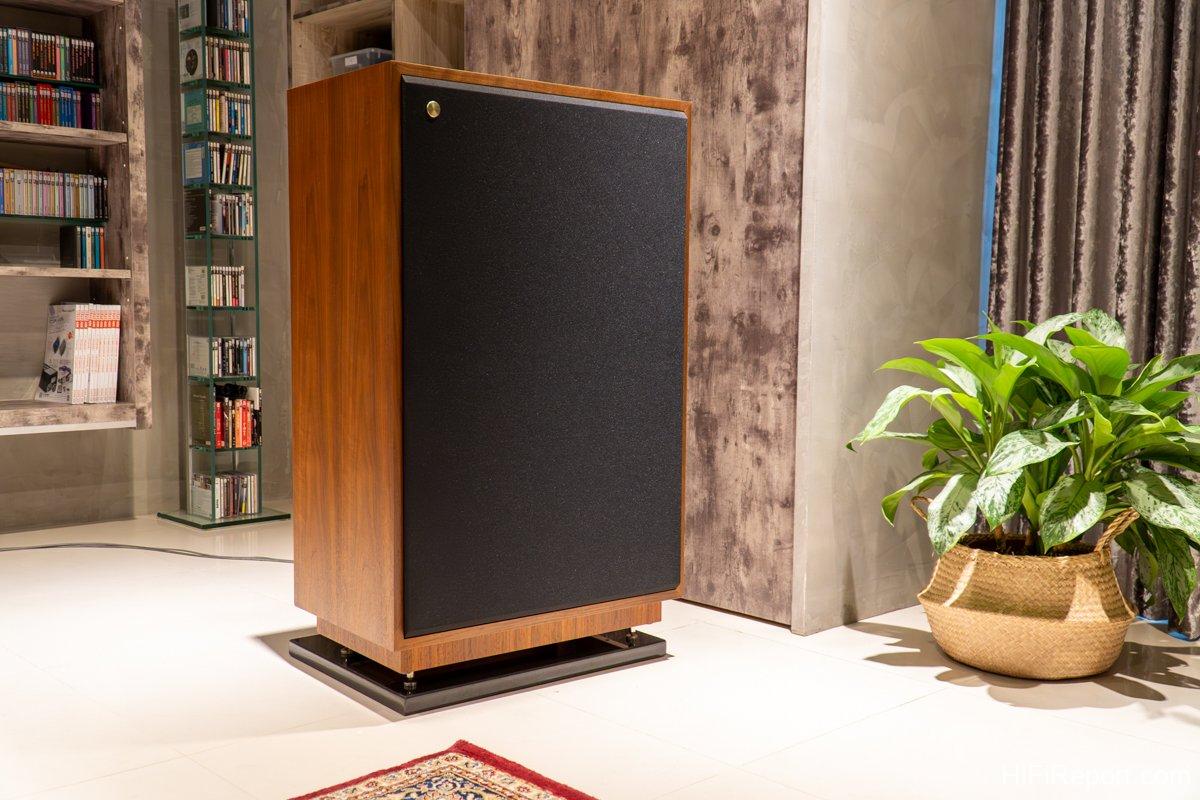
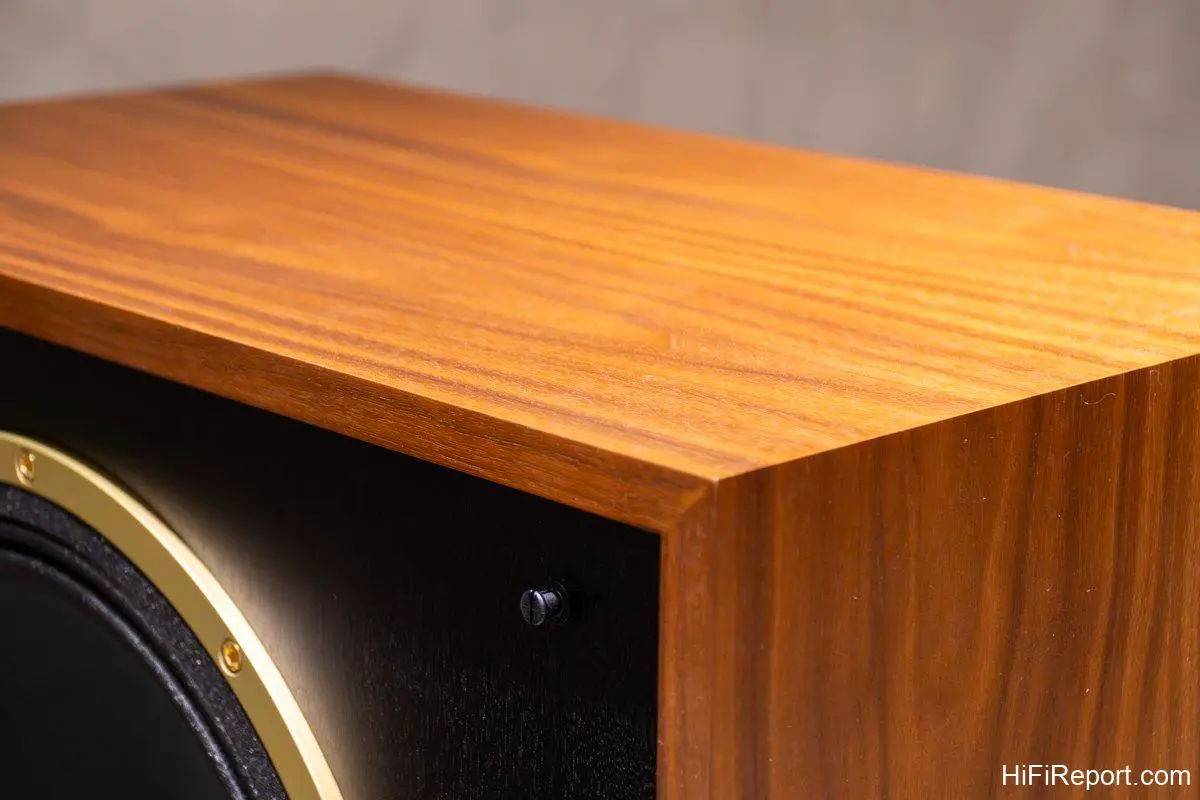
While the cabinet may not be as elaborately ornamented as the Prestige GR series, the craftsmanship remains exquisite. The walnut veneer finish and edges are beautifully executed, especially the corner joints, showcasing meticulous technique.
Will such a large cabinet resonate? You might ask. Tannoy has certainly considered this.
They construct the main cabinet body from 19mm thick particleboard, with internal MDF and plywood bracing at specific points to reinforce the overall structure and enhance cabinet damping.
The bass reflex ports are located at the front, and the SGM-15 boasts three openings, giving it a commanding presence.
The speaker grille is pin-mounted, similar to the Prestige GR series, featuring a full-face grille rather than the two-piece design of the Legacy series.
Three Adjustable Responses: Adding Tonal Playfulness
The speaker’s rear panel features two sets of binding posts, allowing for Bi-Wire connection. The tweeter’s high-pass filter is a first-order crossover, while the woofer’s low-pass filter is a second-order crossover.
For those who are meticulous, grounding is also an option.
Tannoy speakers are equipped with a fifth binding post specifically for grounding. Users can experiment with shielded speaker cables connected to the amplifier’s ground terminal.
However, HiFiReport informed me that whether grounding improves the sound is not guaranteed and depends on the system pairing. It requires listening to determine.
Furthermore, consistent with Tannoy’s classic design, the SGM-15 offers three sets of frequency response adjustments (the SGM-12 and SGM-10 have two sets).
These three adjustments are “Treble Roll Off,” “Treble Energy,” and “Presence Energy.”
“Treble Roll Off” provides fine-tuning of high frequencies above 5kHz in a range of -6dB to +2dB. “Treble Energy” adjusts the frequency range above 1kHz by +/-3dB, and “Presence Energy” operates within the 1kHz to 5kHz range, also with +/-3dB adjustment.
Operation is slightly less convenient, requiring manual unscrewing of the gold-plated bolts, inserting them into the desired adjustment holes, and then tightening the bolts again.
It’s not as convenient as switches or knobs, but the process has a ritualistic feel, arguably a piece of historical heritage that Tannoy preserves for its users.
Bonus Feature: The Brand New Esoteric F-02 Integrated Amplifier
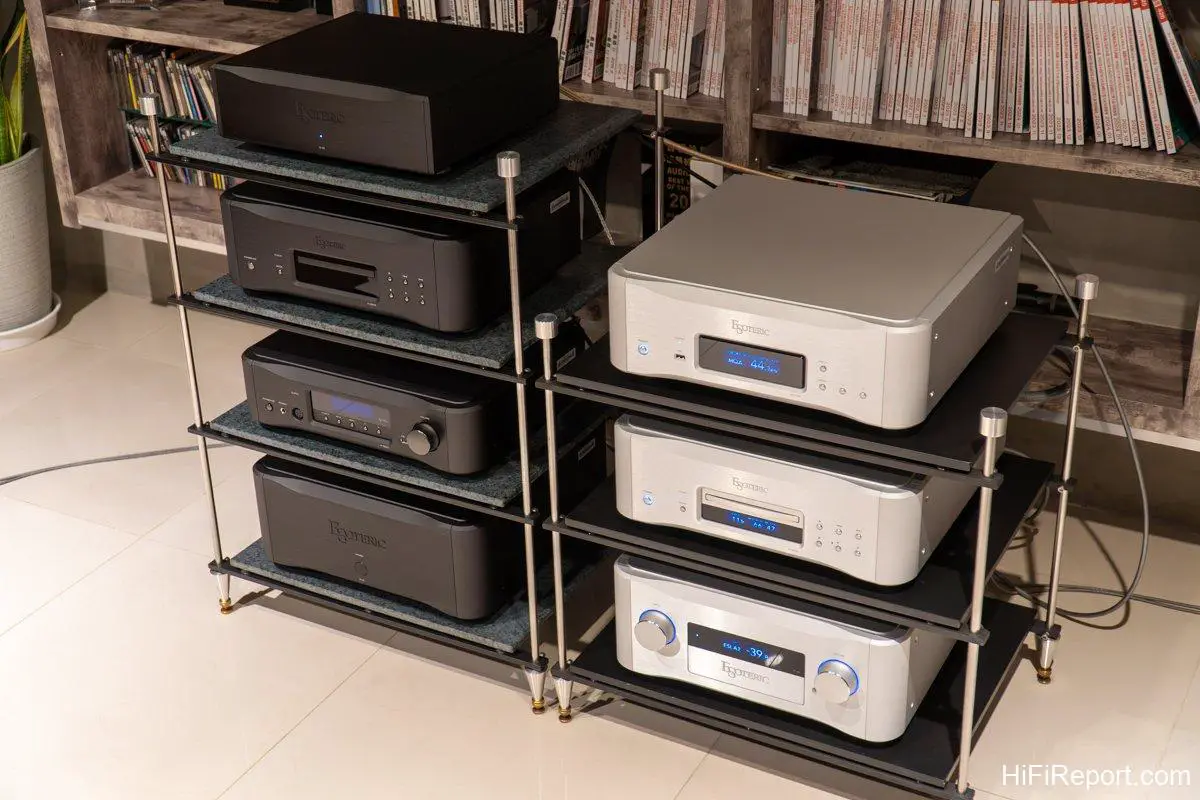
HiFiReport paired the SGM-15 with a complete Esoteric system.
The sources included Esoteric’s flagship streaming player N-01XD and the K-01XD, the second-in-line integrated SACD/CD player. Both were connected to the G-05 clock generator.
The amplifier was even more noteworthy: the newly released Esoteric F-02 integrated amplifier.
I had just auditioned the F-01 integrated amplifier two months prior. The F-02 is a sibling model launched at the same time. Until a new integrated amplifier is introduced in the Grandioso series, these two represent Esoteric’s highest-end integrated amplifiers.
They are of equivalent grade, without one being superior to the other, differing only in their operating class. The F-01 is a pure Class A amplifier with a maximum output of 30W, while the F-02 is a Class AB amplifier, delivering up to 120W. Both can be connected to the PS-01F external power supply for independent power to the amplifier’s preamp stage.
Low Frequencies Looser Than a Top Sergeant
Movies and novels can have supporting characters, but my review can only have one protagonist.
Despite the presence of the latest Esoteric F-02, I must refocus on the Tannoy SGM-15.
To conclude upfront, its only drawback is its size. Otherwise, considering its price and performance, I genuinely believe the SGM-15 offers arguably the best value in the Tannoy lineup.
Last time I was at HiFiReport to listen to the F-01, they were paired with the higher-tier Tannoy Kensington GR. Two months later, revisiting HiFiReport, this SGM-15 truly doesn’t lose out to its superiors.
Where does it excel? It’s in the loose, rich, and elastic low frequencies, unfolding without any strain.
The warm, supple texture, combined with the detail richness from the compression driver and the precise focus and imaging benefited from the coaxial driver, make the SGM-15 adept at playing any genre of music.
Clear, Solid, Full, Warm, and Rounded Vocals
Usually, I start with classical music, but this time I’ll begin with other genres.
The SGM-15’s sound is warm and rounded, with clear and full mid-frequencies. The vocals are clearly focused and solidly formed, making it sound excellent with vocal-centric music.
For instance, listening to Dire Straits’ “So Far Away,” the drums are crisp and energetic. Mark Knopfler’s mellow voice, carrying a hint of deep melancholy, sings and plays guitar like a storyteller narrating a tale.
“Money for Nothing,” after an extended opening prelude woven with electric guitar, vocals, and ethereal synthesizers, truly begins with powerful, weighty drums.
This drum sound is grand, robust, and full, with ample impact, yet the sound is not tight, maintaining good spaciousness.
The electric guitar enters alongside Knopfler’s vocals, providing just the right amount of tension, neither aggressive nor subdued, with the drums offering strong support.
Knopfler’s vocals are clearly and precisely focused, with discernible vocal timbre and texture.
The SGM-15 truly understands Dire Straits.
Rich Guitar Body Resonance, Authentic Live Performance Ambiance
Listening to Eric Clapton’s “Eric Clapton Unplugged” album, the Dual Concentric coaxial speaker also showcased its exceptional qualities.
Not only did the aluminum-magnesium alloy tweeter reveal every detail, but the 15-inch woofer also provided a rich sonic texture.
The guitar’s body resonance imbued the instrument’s mid-bass range with fullness. The SGM-15, when playing Eric Clapton’s guitar, not only reproduced the crisp and clean fingerpicking but also rendered these guitar performances with fullness, three-dimensionality, and a moist, non-dry character.

When listening to this album, the more full-range the system, the larger the system, the richer and fuller the reproduced music becomes.
This is what I experienced with the SGM-15.
Moreover, unlike many speakers that sacrifice woofer size for narrow front baffles, the 15-inch woofer’s spaciousness paired with the metal dome coaxial tweeter not only clearly reproduces the brilliance of the live performance but also delivers a rich, lush, and hydrated sonic texture.
Eric Clapton’s vocals are weathered and nuanced, with vivid and three-dimensional imaging. Even the ambient noises from the live performance are faithfully reproduced.
I believe the Esoteric N-01XD and F-02 also played a crucial role here. At least, such clean, clear, smooth, non-harsh, full, and solid sound is precisely the result of Esoteric’s continuous evolution over the years.
From another perspective, it also relies on Tannoy’s Dual Concentric coaxial driver to fully showcase these strengths of Esoteric.
Drum Rhythm Full Enough to Make You Crank Up the Volume
The manufacturer states that many of Michael Jackson’s albums were produced using Gold Monitor monitors.
So, let’s listen to a few of Michael’s songs! Listening to the sustained bass rhythm in “Billie Jean,” the bass is truly rich.
Although Tannoy speaker specifications don’t typically indicate particularly deep bass response, the SGM-15 is also only rated down to 35Hz/-6dB.
However, listening to “Billie Jean,” the sustained bass rhythm in the background creates a psychedelic feeling that not just any speaker can provide.
In “Black or White,” the opening scene of father and son dialogue, the sound of the father knocking on the door is weighty, and the sound effect of changing cassettes is even more realistic.
The song then unfolds with a powerful and full rhythm, accompanied by Michael’s vocals.

The SGM-15’s warm and full sound makes you want to crank up the volume when listening to this song.
“D.S.” is also a rhythmically powerful song. Underneath the strong and steady drum rhythm, the electric guitar emits mechanical-sounding sounds in a fixed rhythm. Michael’s vocals emerge from these layers of rich accompaniment, yet remain unobstructed.
In “Stranger in Moscow,” we again encounter full electronic drums.
Electronic rhythms don’t have the tangible texture of real drums, but they can produce powerful, full, deep, and varied sounds. These rich sonic elements are all presented solidly and concretely on the SGM-15.
“They Don’t Care About Us” showcases even crisper and more forceful electronic rhythms, which the SGM-15 presents in a relatively gentle yet solid manner.
In the latter half, the explosive electric guitar solo, while interpreted somewhat gently by the SGM-15, still possesses ample energy and vivid colors, like a plate of spicy fish head with red peppers – looks spicy, but tastes just right.
Violin’s Delicate Expressions Audible, Grand Orchestral Scale Achieved
When playing classical music, the SGM-15 exhibits full expressive power and handles large orchestral pieces with ease, readily conveying the scale of the orchestra.
Take Anne-Sophie Mutter’s performance of Sarasate’s “Zigeunerweisen” (Gypsy Airs) as an example. The piece opens with a powerful orchestral tutti, grand in scale, followed by the violin entering with an equally decisive and forceful presence.
There are many paths to conveying the timbre of a played instrument, and dynamics is one of them.
In this piece, the extended violin solo begins with a powerful opening, then tells a story in varying tones, revealing all the tonal variations and technical nuances in between.
The SGM-15’s texture is dense, soft yet resilient. Its musicality in expressing the richly nuanced violin here is quite captivating.
Various sonic elements during the performance, such as glissandos, pizzicatos, and bow-on-string textures, are clearly presented.

At this point, I tried adjusting the “Presence Energy” in the 1K-5kHz range, increasing it by 1.5dB.
I didn’t perceive any imbalance in the music at this point; instead, I enjoyed the more forward, more vivid, and livelier violin even more.
In the final section of the third movement, a breath-like sustained pianissimo is followed by an explosive fortissimo from the orchestra and violin, leading into the brilliant final allegro, passionate and exuberant, dazzling and eye-catching.
This “Presence Energy” adjustment really works. With a slight tweak, the piece sounds even more passionate.
Clear Timbre and Tone Reproduction
Listening to Bruno Walter conducting the Columbia Symphony Orchestra in Beethoven’s Symphony No. 5, the unfolded soundstage layers were very lifelike.
However, at this point, the slightly enhanced high frequencies made the overall music seem slightly unbalanced, and the string section also appeared somewhat prominent.
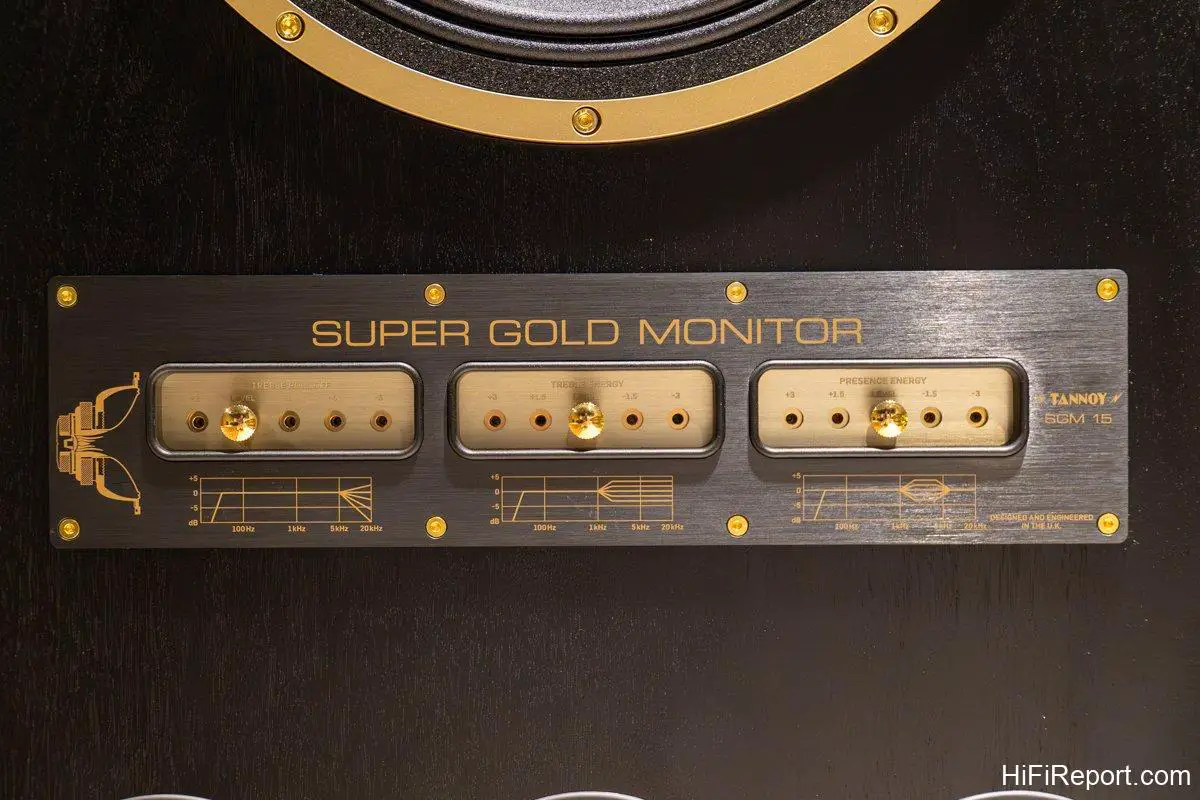
I returned the “Presence Energy” adjustment bolt to the 0dB position, and the balance was restored.
The second movement, depicting a brook, featured silky strings and sweet woodwinds echoing each other. Walter’s deployment of balanced sonics is evident in these ensembles.
In the village dance of the third movement, the string density is excellent. When the woodwinds sing, not only are their timbres and textures clear and distinct, but their specific locations are also concrete and well-defined, with truly clear positioning.
When the country dance tune begins, the rich string ensemble sounds truly exhilarating in this rhythm.
Joy is often followed by impending change. The storm of the fourth movement is full of drama, with the string section under fortissimo exhibiting full tension, and the low strings rumbling like distant thunder in the sky.
This is Beethoven’s most visually evocative music, and listening to it through the Tannoy SGM-15 is rich with the imagery of an orchestral performance.
The fifth movement showcases Beethoven’s “struggle through darkness, towards light” character.
Silky and lustrous strings unfold here, accompanied by the brass section, like sunlight piercing through the clouds, bringing hope.
Does the metal tweeter make the brass sound harsh? Not at all. To my ears, it doesn’t sound harsh at all. The metallic texture is warm yet not aggressive, just right.
Unrivaled Vocal Performance: Tannoy Still Reigns Supreme
If you frequently listen to opera, the SGM-15 will surely capture your heart.
This 15-inch coaxial driver not only clearly resolves the texture of vocal timbres but also imparts a touch of warmth and charm to the natural sound.
Vocal images are clearly delineated, with well-defined outlines, conveying the singer’s expressions in full.
Take Anna Netrebko’s “Sempre Libera” album as an example. It opens with the “E strano! e strano!” to “Sempre libera” sections from “La Traviata.” Violetta’s emotional shifts are dramatic, initially delicate with doubt, seemingly finding love yet still uncertain, then shifting her resolve, appearing to have found freedom, only to become uneasy again when Alfredo’s voice rises from the background.
Anna Netrebko’s voice in her prime was truly unparalleled, full of power, rich in color, and her coloratura is convincingly sung.
Through the SGM-15’s playback, the abundant detail, confident power, and smooth dynamics make Netrebko’s singing particularly captivating.
Your Only Consideration: Will It Fit in Your Living Room?
If you prioritize a more Hi-Fi, faster, more powerful, airier, brighter, and sharper sound, Tannoy might not be your cup of tea.
If your preference leans towards a warmer, more supple, spacious low-frequency, non-fatiguing high-frequency, and full mid-frequency sound, seeking comfortable and extended listening rather than immediate adrenaline-pumping excitement, Tannoy is undoubtedly an excellent choice.
The SGM-15’s price point falls in the fiercely competitive mid-range price bracket of around $13,200 USD. For the same money, you could buy bookshelf speakers from a high-end brand, or a classic design from a venerable British manufacturer, and this is the flagship model of a sub-flagship series. Do the math yourself.
If you have the budget and appreciate the sound, your only remaining consideration is whether it will fit in your living room.
Specifications
* Type: 2-way coaxial floorstanding speaker
* Driver: Dual Concentric coaxial driver, 1.3-inch (33mm) aluminum-magnesium alloy tweeter, 15-inch (380mm) paper cone woofer
* Frequency Response: 35Hz~30kHz (+/-6dB)
* Crossover Frequency: 1.1kHz
* Sensitivity: 93dB
* Nominal Impedance: 8 ohms
* Recommended Amplifier Power: 20~300 watts
* Maximum Power Handling: 150W continuous input, 600W peak input
* Dimensions: 650.2 x 424.9 x 1033.5 mm (HxWxD)
* Weight: 50kg