
Telos GNR V5.1 Review
Since writing my review of the Telos GNR Active Grounding Noise Reducer over three years ago, this GNR unit has remained a permanent fixture in my home system. Once you experience its benefits, there’s no going back; the only option is to happily pay Mr. Lin for the upgrade.
Later, Mr. Lin discovered the directional nature of current flow in circuit components and developed V3.1 technology. My GNR was subsequently upgraded to the V3.1 version, which elevated my system to a new level of performance.
Now, Telos has introduced V5.1 technology, and as always, it’s applicable to existing Telos products, allowing long-time users to enjoy the benefits of technological advancements. Naturally, I had to upgrade! I eagerly “leveraged my position” to have Mr. Lin personally perform the upgrade, equipping my GNR with the innovative V5.1 technology derived from their flagship power supply, the QRC.
Schumann Resonance Infusion
V5.1 technology was discovered by Mr. Lin during the development of the flagship QRC power supply. Its principle involves directly applying extremely low-frequency sound waves to certain critical components, influencing their operating state to achieve sonic tuning.
Mr. Lin found the effect of this technique to be astonishing. Driven by a desire to share this advancement with loyal customers and celebrate Telos’s 15th anniversary, he modularized the V5.1 technology onto a circuit board. This module can be directly installed into existing Telos products, including the QNR Quantum Noise Reducer, GNR Active Grounding Noise Reducer, and GNR Mini, enabling upgrades for all three.
Simply put, V5.1 utilizes the 7.83Hz Schumann resonance ultra-low frequency to treat six key capacitors on the QNR circuit board. Since the GNR and GNR Mini also incorporate the QNR circuit, this single technology benefits all three product lines.
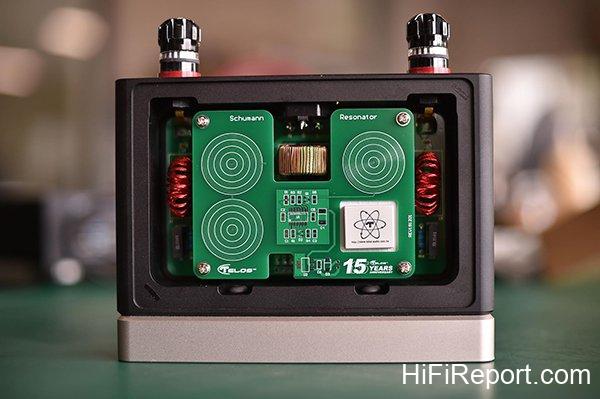
The module board is essentially an H-shaped circuit board, designed to be “stacked” directly above the original QNR circuit board using copper standoffs. Because the original QNR circuit board is black, the module board for the QNR is also black. Conversely, the original circuit boards in the GNR and GNR Mini are green, so their upgrade modules are green as well.
Furthermore, while the QNR and GNR Mini upgrade modules are single boards, a GNR unit incorporates two sets of QNR circuits. Consequently, the GNR upgrade kit includes two module boards, resulting in a higher upgrade price.
Simple Installation Process
As I use the GNR, Mr. Lin brought two module boards, along with a soldering iron and solder for the installation. The entire process took only about ten minutes to complete at my home.
The installation process is quite straightforward, and I’ll illustrate it with photos and captions below.
This is my GNR 3.1. The two H-shaped circuit boards pictured above are the V5.1 upgrade modules, along with eight copper standoffs. The tools needed include a soldering iron, solder, screwdriver, etc.
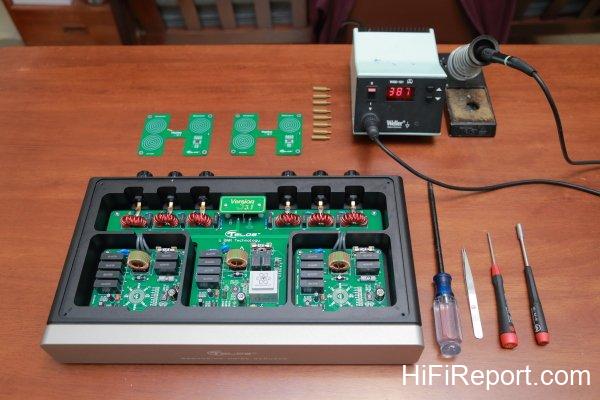
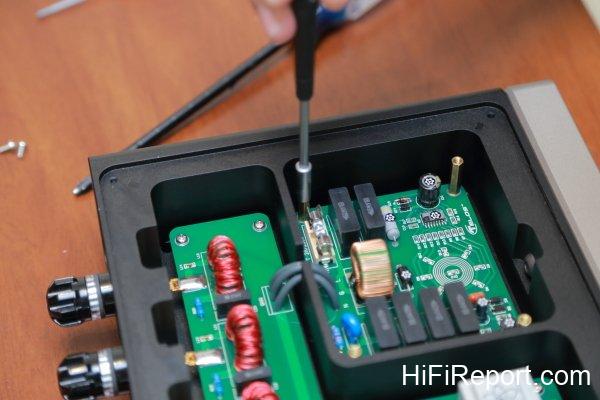
Where do they go? They are installed in these two rectangular areas on the left and right sides.
Each of these rectangular areas houses a QNR Quantum Noise Reducer circuit.
The module board clearly displays “Version 5.1” in the center, indicating the incorporation of Telos V5.1 technology.
There are three coils on the circuit board, each a Schumann resonance generator, using extremely low frequencies to treat the key capacitors on the QNR circuit board below.
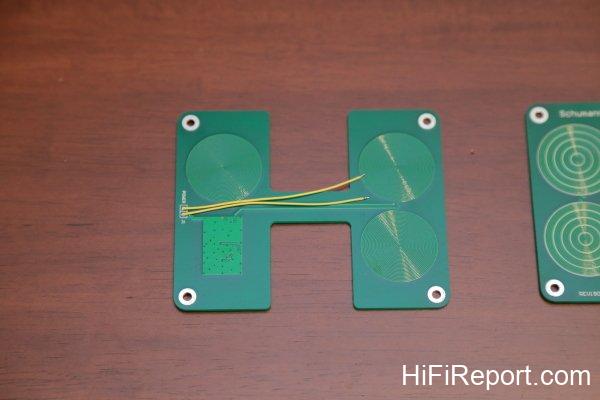
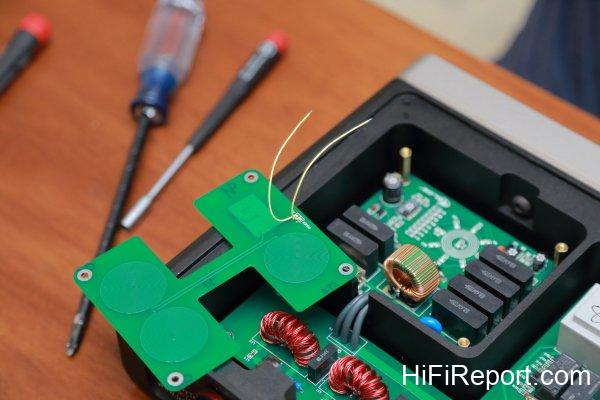
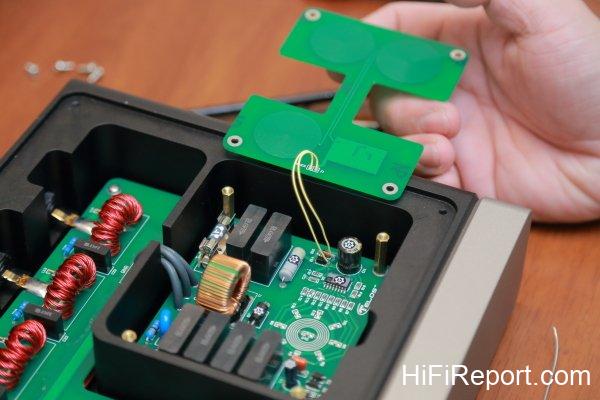
Flipping the module board over reveals two small wires already soldered on; these are the power supply wires.
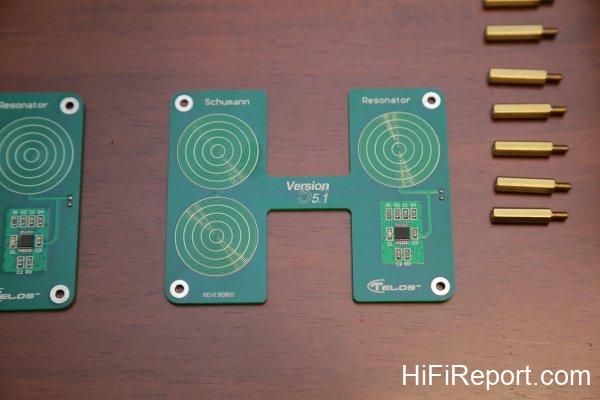
The module board is stacked directly above the QNR circuit board, so first, four copper standoffs are screwed into place.
Preparing to solder the power supply wires.
Because the distance between the module board and the capacitors is extremely small, only a very low-power Schumann resonance is needed. Therefore, drawing power directly from the circuit board is sufficient to supply the module.
There are only two solder points. Anyone with basic DIY skills and familiarity with a soldering iron should be able to complete this easily. Detailed installation instructions are available for download online.
If you’re not confident, you can ask your dealer for assistance, or directly request Mr. Lin’s service; he is very happy to help.
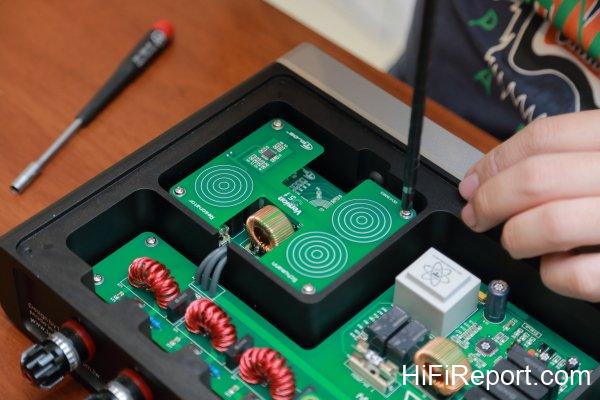
After soldering the power wires, flip the module board back over and secure it with screws.
Repeat the process on the other side. Done!
The completed installation is so seamless that it looks like the modules were originally part of the design.
Using Schumann resonance to tune room acoustics is old news for audiophiles, but using Schumann resonance to tune audio equipment? Telos is undoubtedly the pioneer.
You must be curious about what the Schumann resonance is actually treating. The answer is capacitors.
Mr. Lin explained that each QNR circuit board has six critical non-polar capacitors, each with different functions. Some are used for power supply noise filtering, and others for power phase compensation. Applying Schumann resonance to these six capacitors yields the most significant effect. More importantly, this intermittent tuning method doesn’t add any new components to the original circuit, doesn’t alter the circuit design, and doesn’t affect the signal path. This minimizes the possibility of any negative side effects.
However, Schumann resonance isn’t applied indiscriminately; its power must be precisely controlled to emit the appropriate intensity. Too much or too little is detrimental.
Mr. Lin spent a long time repeatedly listening and adjusting to find the optimal intensity.
System Gains Richness and Density
Once Mr. Lin finished the installation, I couldn’t wait to install the GNR 5.1 (yes, my GNR 3.1 instantly transformed into a GNR 5.1!) and give it a listen.
The immediate impression upon playback was: my system had gained a sense of richness and density.
Before installing the module boards, we listened to tracks 4 and 5 of “Tutti!”, Stravinsky’s “Firebird” – “Berceuse” and “Finale.” After the upgrade, listening again, the background noise floor was noticeably lower, the blackness of the soundstage deepened, and the soundstage itself became more profound.
These two pieces begin very quietly and slowly. With the V5.1 upgrade, the decay of sounds became longer, and the reverberation in the space more lingering, creating a more resonant and immersive experience.
Furthermore, due to the lower noise floor, the lower registers of the soundstage seemed to become deeper and more solid, lending a more solemn atmosphere to the music.
In fact, the GNR itself already provides such improvements, but with the Schumann resonance “assist,” these changes were further enhanced.
Beyond that, V5.1 also makes the sound more focused, with an improved sense of image solidity. For example, in “Berceuse,” from the middle section onwards, a woodwind instrument takes the lead melody. The timbre at this point has a richer resonance, sounding with a more fragrant and sweet woody texture. The sound is melodious and sustained, both detailed and gentle, compelling me to hold my breath and listen with greater concentration.
Clearly, V5.1 has a very charming quality: it thickens and slightly pushes forward the midrange without sacrificing the natural extension of the highs and lows. It even improves the transparency and cleanliness of the texture, making the sonic background purer and more tranquil. It’s truly remarkable! Simply put, isn’t this the beloved “vinyl sound”? This kind of improvement is most noticeable with vocals. Listening to Jeff Chang’s “Between Half-Dream and Half-Awake,” not only is the vocal thickness improved, but the density and weight of the guitar notes, and the richness of the instrument’s body resonance, are also enhanced, all while maintaining a clearer texture.
Another example is Jiang Yu-heng’s “Look Back Again.” His singing originally has more throat sound and less chest resonance. After the V5.1 upgrade, the feeling of life’s vicissitudes remains, but the warmth in his voice increases, making it sound less melancholic.
Timbre Becomes More Ethereal and Beautiful
After experiencing the GNR upgraded to V5.1, I understand why Mr. Lin is so willing to extend the research and development (résults) of the flagship QRC power supply to other products. It represents a unique sonic aesthetic, what Mr. Lin believes distinguishes Telos most from other brands, and he wants existing Telos customers to experience this beauty.
When designing the QRC, Mr. Lin experimented with adding some “color” to the power supply, imbuing the QRC with a richer, softer, and warmer sonic flavor that I immediately became addicted to. Now, this sonic texture has been passed down to the GNR.
Previously, the GNR’s function was to enhance musical liveliness, including dynamic contrasts, subtle variations, low-frequency detail and layering, timbre and texture expression, and sonic vibrancy – all of which were significantly improved. Now, V5.1 brings midrange richness to the GNR, making the music sound warmer.
For example, when playing acoustic instruments like piano and strings, V5.1 adds a touch of thickness, moisture, richness, and sweetness to the timbre. The sound images have better focus and density, yet without sacrificing the original brilliance and transparency. In fact, there’s even a brighter sensation. Simply put, it enhances the musicality while making the timbre more ethereal and beautiful. It sounds too good to be true, but the GNR 5.1 achieves it.
V5.1 is a non-invasive upgrade. Through Schumann resonance generators mounted above the original circuit board, low-frequency waves are applied to the key capacitors below, promoting smoother and more stable operation, thereby achieving sonic tuning.
Even better, the upgradeable models are not limited to V3.1 versions. Even V1.1 or V2.1 products can install the V5.1 kit.
If GNR V3.1 made music richer, more realistic, and more natural, upgrading to V5.1 adds beauty to the sound, making music sound even better and more wonderful.
Crucially, beauty often comes at a high price. V5.1 allows you to obtain this beauty within a reasonable budget, without any negative side effects. This is an investment worth considering.
This is the GNR Mini after the V5.1 upgrade.