
Telos Macro G Active Grounding Device Review
It’s said that Telos’s head honcho, Mr. Lin, was an audiophile even before entering the Hi-Fi industry. His deep passion for audio drove him to switch careers and immerse himself in the world of sound. As his interest and expertise grew, he established his own brand, starting with cables and then venturing into the research and development of active tuning devices. Telos carved a unique path in audio power processing, developing distinctive products that have led to their current respected position in the market.
Despite becoming the boss, Mr. Lin remains an audiophile at heart, deeply understanding the mindset of audio enthusiasts. This insight allows him to create products that truly meet their needs and garner excellent reviews. However, Telos has always been known for its pursuit of ultimate quality, which often places their products at a higher price point, making them less accessible to newcomers or younger audiophiles. This product positioning is set to evolve, starting with the Macro G.
The Macro G is a product specifically designed to meet the needs of younger and budget-conscious audiophiles. It offers a more accessible price point, significant performance benefits, and a user-friendly approach tailored to modern streaming setups.
Lowering the Entry Barrier
Telos’s first active grounding device, the GNR (Grounding Noise Reducer), was launched in 2015. At the time, it was the largest grounding device in their lineup, capable of grounding six components simultaneously.
In 2018, responding to the needs of users with smaller systems, the GNR Mini was introduced. Approximately one-quarter to one-third the size of the GNR, it offered the same functionality, grounding two components at a significantly more accessible price – about one-third of the GNR’s cost.
At the 2019 Munich High End Show, Telos unveiled the “Godzilla Grounding Monster,” capable of grounding a staggering twelve components at once. No matter how extensive your system, the Godzilla should have you covered.
While these three grounding devices varied in scale, they all featured the same output interface: WBT speaker binding posts. These are well-suited for connecting to the RCA input jacks of typical audio equipment or directly to chassis. However, they aren’t always convenient for purely digital streaming devices.
Recognizing the prevalence of USB ports on modern streaming sources, headphone amplifiers, portable players, music servers, and more, Telos strategically launched the Macro G active grounding device. It features two USB Type-A output ports, allowing for easy grounding of two devices using standard USB cables. This greatly simplifies setup and, with a price point half that of the GNR Mini, lowers the barrier to entry even further. Telos’s initial foray into active grounding began with the GNR in 2015.
Small Size, Macro Effect
Intriguingly, Telos chose the name Macro G, rather than using the more commonly understood term “Micro” to reflect its compact size. “Macro” signifies large or grand. This name was chosen to emphasize that despite its small form factor, the Macro G delivers a substantial, “macro” effect. Don’t let its size fool you into underestimating its capabilities.
The technology within the Macro G is directly derived from the larger GNR models, ensuring no compromise in functionality.
What exactly does the Macro G do? First and foremost, it provides active grounding.
Through CPU-based measurement and calculation, the Macro G actively provides a near-zero ground reference potential to the secondary side of connected equipment. It also rapidly balances dynamic ground potential variations between components, facilitating smoother audio signal transmission.
The CPU within the Macro G is identical to that in the larger GNR models, demonstrating no skimping on core components.
Secondly, the Macro G reduces noise. It actively detects distortion in the power sine wave, providing real-time phase compensation. This corrects phase distortion and drift, smoothing the waveform and effectively reducing noise.
Furthermore, the Macro G incorporates Telos’s V5.1 technology, developed for their 15th anniversary. This includes a Schumann resonance ultra-low frequency generator, which enhances the density and fullness of the mid and low frequencies while adding a touch of sweetness. This benefits tonal quality and texture.
This feature is particularly beneficial for entry-level equipment. Smaller desktop playback devices, budget-friendly DACs, streaming players, or computer sources often exhibit weaker mid and low frequencies and a somewhat sterile tonal character. The Schumann resonance enhancement in the Macro G effectively addresses this, without any negative side effects.
The New X Series is Born
The introduction of the Macro G also marks the birth of Telos’s brand new X series.
The X series is specifically designed by Telos to cater to the demands of a younger generation of audiophiles.
To appeal to a younger audience, product design must align with the needs of younger listeners, and aesthetics are crucial. Telos has broken away from their traditional rectangular designs, boldly adopting an unconventional X-shaped chassis to create a striking first impression.
Functionality is integrated into the form. The Macro G’s X-shaped chassis offers additional benefits beyond visual appeal.
The X-shape provides high structural rigidity, and being precision CNC-machined from a single block of aluminum alloy, it effectively minimizes unwanted resonance, ensuring the chassis itself remains sonically neutral.
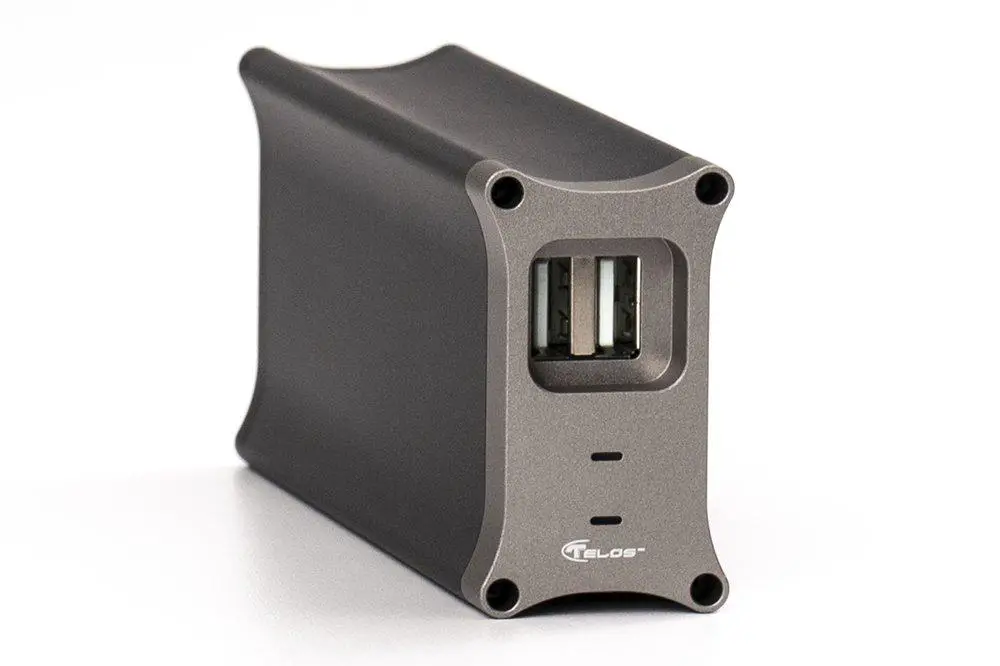
Additionally, the X-shaped chassis minimizes the contact area with the surface it rests on, further aiding in vibration isolation.
The Macro G leads the charge for the X series, with plans to introduce power conditioners, linear power supplies, and even network streaming-related products in the future, likely all featuring the distinctive X-shaped chassis design.
The Macro G’s front panel features two USB Type-A ports. The included USB cables allow for simultaneous grounding of two devices, such as streaming players, music servers, computers, NAS devices, Wi-Fi routers, portable players, and DAC/headphone amplifiers – all devices commonly equipped with USB interfaces, making the Macro G broadly applicable.
Pay attention to connection directionality.
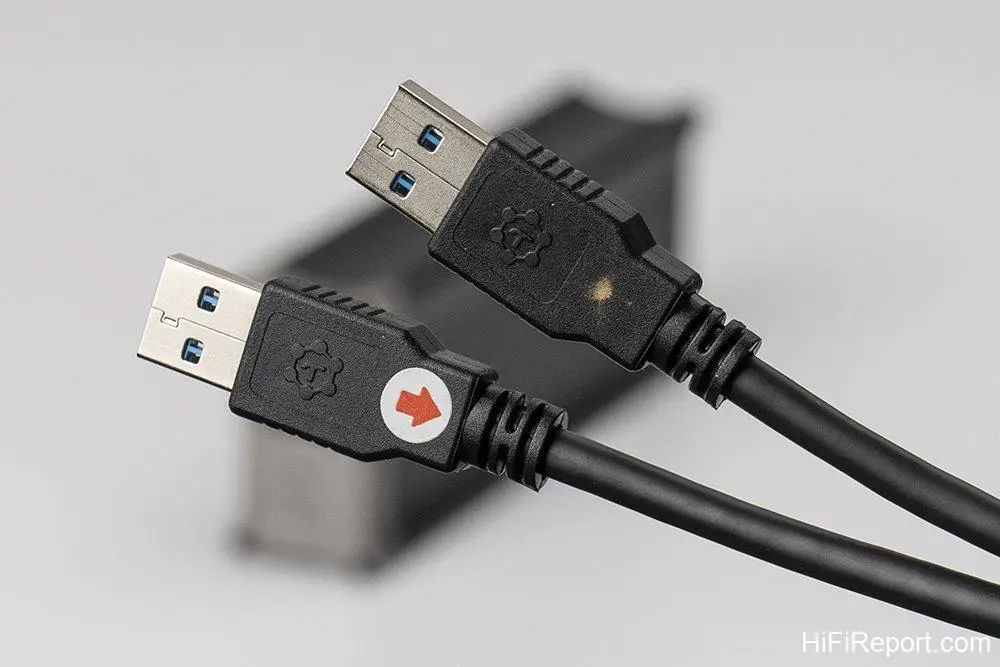
The included USB cables are USB Type-A to Type-A on both ends. While they will connect and function regardless of orientation, Telos emphasizes conductor directionality principles, even in USB cables. Telos has pre-determined the correct direction and marked it on the cable. Simply connect the end with the arrow sticker to the Macro G.
To maximize the Macro G’s versatility, Telos may introduce adapter cables with other interfaces in the future, such as USB to HDMI or USB to RJ45, enabling grounding for projectors, Blu-ray players, televisions, or network switches.
For power, the Macro G utilizes a custom-designed, high-efficiency switching power supply, accepting input voltages from 100V to 240V for global compatibility. Due to the limited rear panel space, it uses an IEC C8 inlet (figure-8), which is a two-prong connector for live and neutral only, so proper polarity is important when connecting the power cable.
How to ensure correct polarity? The Macro G’s rear panel C8 inlet has an “L” marked on one side, indicating the live (hot) pin. The included figure-8 power cable is also marked at both ends to indicate the live conductor. Simply match the markings when connecting.
If you are unsure which socket in your wall outlet is live, please search online for instructions.
At this point, some might wonder: if the Macro G itself isn’t grounded, how can it ground other devices? It doesn’t rely on the mains ground. Instead, it actively provides a ground reference potential. Therefore, rest assured, the Macro G is effective.
Flagship-Level Build Quality
As a long-term, loyal user of the Telos GNR V5.1 myself, I am intimately familiar with the benefits of Telos active grounding. Immediately, I recognized that the Macro G offers the same direction of improvement as the GNR V5.1. However, the Macro G adds an element of “playfulness.”
The GNR V5.1 is not something you’d casually handle – you’d be lucky not to break a toe! But I can hold the Macro G in my palm, admiring its clean, crisp lines and precise, finely cut edges. Running my fingers over it, I can feel the incredibly smooth and refined surface finish. This level of quality is only achievable through very high-level metal machining. All of this comes from […].
The Macro G finally allows me to ground my computer.
My streaming player is a PC running Roon Bridge, effectively making it a Roon Ready endpoint. It’s connected to an Audiobyte Blackdragon DAC for music playback. Previously, due to interface differences, grounding my computer with the GNR V5.1 was difficult. Now, using the motherboard’s USB port, grounding my computer with the Macro G is effortless.
My listening tests were conducted at home, step by step. Initially, I grounded only my computer with the Macro G.
Playing track 1 of “The Dali CD Vol. 5” test disc, “Up to the Mountain” performed by Danish singer Dorthe Gerlach, a 3/4 time ballad with folk guitar accompanying her clear vocals. Strings join in after the B section. The song’s frequency range is primarily in the mid and high frequencies.
Without the Macro G connected, I clearly noticed the steel guitar’s plucked texture sounded duller, the sense of air in the recording background felt more stagnant, and the soundstage wasn’t as open. The height seemed reduced, like the ceiling had suddenly lowered.
In simple terms, the music felt “muffled” without the Macro G grounding the computer.
Atmospheric changes are readily apparent in my system. My Aurum Cantus Grand Harmony speakers feature ribbon tweeters and aluminum ribbon super-tweeters, with an additional rear ribbon tweeter to enhance airiness. They are highly sensitive to changes in atmosphere. The Macro G noticeably improved the listening atmosphere.
Letting Music Bloom
Furthermore, without the Macro G, Dorthe Gerlach’s vocals initially seemed thicker, warmer in tone, and perhaps denser. However, when she reached higher notes, her voice became strained and constricted. With the Macro G connected, her voice immediately became lighter and more agile, with greater dynamic ease. The performance sounded more relaxed and effortless.
In reality, the Macro G doesn’t thin out the sound; rather, it makes it more transparent, agile, and layered. My system is already well-tuned and not lacking in thickness or density. For me, the increased lightness and agility are more important. This is where the Macro G’s benefits became immediately apparent. Especially when the strings entered, the difference was even more pronounced. Not only was the flow and smoothness of the instrumental lines improved, but when the music became more impassioned, the sound was no longer restrained, but rather felt like it blossomed and expanded. This indicated improved dynamics as well.
Another example, Sinne Eeg’s “The Beauty of Sadness,” begins with a brilliant cymbal crash in the upper left of the soundstage. From the outset, it was clear that without the Macro G, the cymbal’s height and the overall soundstage height were lower, and the background transparency was diminished. With the Macro G connected, the high frequencies soared upwards vividly, the entire musical presentation lifted, and the vocal image positioned higher, with greater solidity and focus.
Simply put, vocals were muddier and more lifeless without the Macro G, and more natural and live-sounding with it.
The Macro G also provides similar improvements in the low frequencies. Without it, the bass sounded dull and heavy, almost like it was lying down, muddy and indistinct. With the Macro G, the bass guitar’s plucked string articulation and melodic lines became clearer, sounding more lively and agile.
Grounding the Wi-Fi Router Too
After the first phase of testing grounding the computer, I wanted to try grounding my home Wi-Fi router, or wireless base station. I’ve always been curious whether this would benefit audio. The Wi-Fi router is the gateway for internet access in my home, and since my computer connects via Wi-Fi, directly from the router without any intervening switches, I suspected grounding the router might improve sound quality. Previously, I lacked a suitable grounding cable to try this. Now, with the Macro G, I finally could.
Where to connect? Most Wi-Fi routers have a USB Type-A port on the back, typically intended for connecting peripherals like printers or external hard drives. I don’t use these functions, so it was perfect for connecting the Macro G.
After connecting, I listened to track 2 of the “HDCD Sampler” compilation, Ron Nelson’s “Behold Man” performed by the Turtle Creek Chorale.
This piece is a cappella, recorded with ample room ambiance and reverberation, creating a spacious and deep soundstage.
After grounding the Wi-Fi router with the Macro G, the most significant changes were in soundstage depth and image focus. The soundstage width seemed to narrow slightly, but the sense of scale became clearer and the depth extended significantly, improving front-to-back separation and layering.
Furthermore, the sense of spaciousness increased vertically, making the reverberation more sustained and emotionally resonant.
Increased depth also enhanced image solidity, and the separation between different vocal sections improved.
Effective with Portable Players as Well
Both previous grounding tests yielded positive improvements, which was somewhat expected. After all, grounding addresses power quality, and improved power quality generally leads to more detail and enhanced sound. However, Mr. Lin from Telos mentioned that the Macro G’s benefits extended beyond this, even improving the performance of battery-powered portable players. He encouraged me to try it.
To verify this, I borrowed an iBasso flagship DX200 Max portable player from HiFiReport editor, Mr. Tsai Cheng-Rong. It has a USB Type-C port, so a USB Type-A to Type-C cable was all that was needed to connect to the Macro G.
Listening with Philips Fidelio X1 headphones, I found the direction of improvement mirrored that of grounding the computer with the Macro G. The soundstage lifted and expanded vertically, the sound became more transparent, images more focused and solid, and the atmosphere richer and more natural, making the music sound more vibrant.
Additionally, I found the Macro G made the tonality more appealing. For example, listening to Cheer Chen’s “Cheer Collection,” featuring her classic tracks from 1998 to 2005. Her voice is highly distinctive – clear, delicate, soft, with a touch of youthful shyness, even a hint of coquettishness. With the Macro G, the midrange gained more richness, making her already delicate voice sweeter, more tender, and fuller. Crucially, the overall vibrancy of the music also improved, making it more comfortable and naturally more enjoyable to listen to for extended periods.
I believe this is attributable to the Macro G’s Schumann resonance implementation, integrating tuning aesthetics into power processing. While enhancing detail, precision, resolution, and layering, it also enriches the tonal quality, achieving the best of both worlds.
If you enjoy female vocals through headphones, the Macro G should provide a finishing touch of magic.
Unimpeded Signal Path from Source to Output
The Macro G active grounding device is designed by Telos specifically for younger audiophiles, budget-conscious enthusiasts, and the popular streaming and desktop listening communities. It incorporates patented technology derived from the flagship GNR V5.1, but with a significantly lower barrier to entry, allowing more music lovers to experience the sonic improvements from enhanced power quality.
If you’ve never experienced the benefits of Telos active grounding, now is the perfect opportunity. If you are already a GNR or GNR Mini user, you can further utilize the Macro G to ground additional devices, ensuring an unimpeded signal path from source to output.
Specifications
* Type: Active Grounding Device
* Output Terminals: USB Type-A × 2
* Input Voltage: 100-240V