
Thorens TD 403 DD Direct Drive Turntable Review
The debate over music media seems to have reached a relatively clear consensus: CDs are in decline, cloud-based digital streaming dominates, and analog vinyl records, once relics of the past, have made a comeback, securing a niche. While vinyl may not challenge digital streaming for supremacy, the allure of pure analog music persists, imbued with a nostalgic and sophisticated charm.
The Effortless Direct Drive
Listening to the Thorens TD 403 DD, the vibrant energy of a direct drive turntable showcases the essence of pure analog sound. Moreover, direct drive turntables are remarkably hassle-free. In contrast to belt-drive models, where belts degrade and require replacement every few years, necessitating maintenance to restore performance, direct drive systems eliminate this concern. The DC motors in direct drive turntables boast extended lifespans, virtually eliminating the risk of failure, making them a truly low-maintenance choice for vinyl enthusiasts.
Thorens is a brand steeped in history, founded in Switzerland in 1883 by Hermann Thorens. In 1930, it transitioned into a German company. The 1960s saw a Swiss acquisition by Paillard, marking Thorens’ entry into the realm of vinyl turntables and a return to Swiss roots. In 2000, Heinz Rohrer took the helm, maintaining Thorens as a Swiss entity and continuing its focus on turntable production.
Finally, in 2018, Gunter Kurten, the current CEO, acquired the company, bringing Thorens back to German ownership. This historical journey, while intricate, reveals a clear trajectory post-World War II: Thorens solidified its position as a specialist in vinyl turntables. I first encountered Gunter during his tenure as General Manager at Elac Germany. His acquisition of Thorens in 2018 marked a shift from employee to owner. Initially, the direction seemed somewhat ambiguous as he navigated managing existing Thorens products while simultaneously developing new ones. Prior to 2018, Thorens had explored diverse materials and aesthetics in an attempt to appeal to younger demographics. While these designs exhibited creativity, they failed to resonate with the market, ultimately paving the way for Gunter to acquire the company and embark on a revitalization.
Five Years of Reorganization: A New Era for Thorens
From 2018 to 2023, within a mere five years, a visit to the Thorens official website reveals a clearly defined product strategy. The unconventional and quirky turntable designs have vanished, replaced by a cohesive lineup of traditionally styled vinyl turntables. The entry-level models utilize direct drive, while the more advanced options employ belt drive. Notably, the iconic TD 124 DD, a reimagining of the classic 1957 model, has been reintroduced, now featuring direct drive.
At the 2023 Munich High End Show, coinciding with Thorens’ 140th anniversary, the brand unveiled the New Reference and TD 124 DD 140th Anniversary models. These flagship turntables elevate Thorens’ brand stature even further, underscoring their ambition for the future of vinyl playback.
Vinyl turntables occupy a niche market, not a mass-market segment. However, Thorens’ transformation over the past five years has firmly established them in both the entry-level and advanced markets. The resurrected TD 124, a niche within a niche, was instantly sold out. The newly launched TD 124 Anniversary is likely to follow suit. Meanwhile, the New Reference serves as a “muscle-flexing” flagship, incorporating semiconductor-based active vibration isolation technology and numerous innovative designs, unequivocally declaring Thorens as the vinyl turntable expert.
Thorens’ Top-Tier Direct Drive Turntable
Returning to the TD 403 DD, it embodies the essence of a straightforward vinyl turntable. The world of entry-level vinyl is most easily accessed through direct drive models, eliminating concerns about speed accuracy, as the turntable self-calibrates. Thorens’ product naming convention is clear: three-digit models signify direct drive. The entry-level range includes the TD 101A and TD 102A, followed by the more advanced TD 201, TD 202, and TD 204. The TD 402 DD and TD 403 DD represent the higher-end direct drive offerings. Within this structure, the TD 403 DD stands as Thorens’ most sophisticated direct drive turntable. Stepping up from there leads to their belt-drive models.
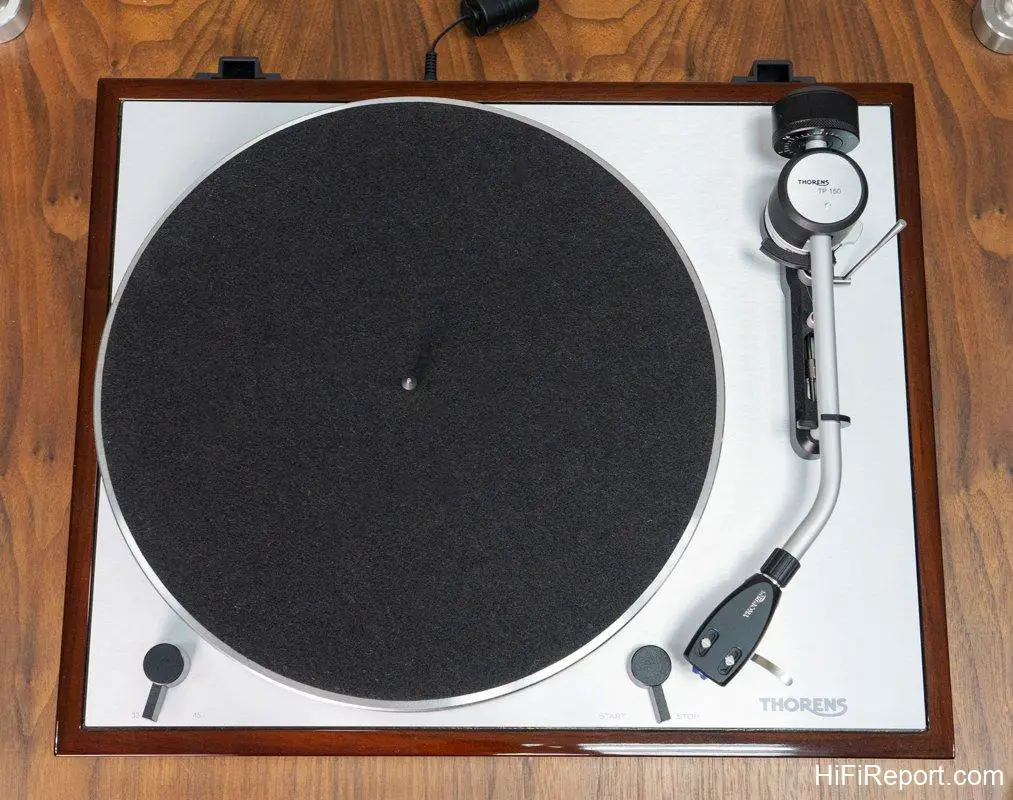
Why do direct drive turntables often occupy a perceived lower position compared to belt-drive counterparts? Vinyl enthusiasts are aware that belt drive, by isolating the motor from direct contact with the platter, minimizes motor vibration from influencing the sound, thereby reducing coloration. Independent power supplies can further mitigate interference, enhancing sonic purity and customization possibilities. However, direct drive retains its own allure. While the minute vibrations from the motor might introduce a subtle sonic signature, some listeners find this coloration appealing, perceiving it as injecting a sense of musical vitality.
The Sonic Charm of Direct Drive: An Echo of Radio Broadcasting
Where does this preference originate? I believe it stems from radio broadcasting. Before the advent of the internet, radio was the most accessible and affordable way to experience music. Radio stations predominantly relied on idler-wheel and direct drive turntables for music playback. These types of turntables could rapidly achieve correct speeds, enabling radio hosts to cue up tracks while speaking, ready to play music instantly after finishing their announcements. Occasionally, if not cued precisely to the beginning of a track, the music would start with a “whoosh” sound, a rising pitch caused by the platter accelerating from a standstill to the correct speed.
If this description resonates with you, you likely experienced the era of tuning into the radio. For those born in the 1980s or later, radio stations had long transitioned to CDs, and the distinctive sound of a vinyl record starting up is likely unfamiliar. However, because radio stations predominantly used direct drive turntables (idler-wheel turntables being more expensive), the sonic character of direct drive became ingrained in the auditory memory of many. This historical association perhaps explains why the resurrected TD 124, originally an idler-wheel design, was reimagined as a direct drive model.
Upgraded Platter, Tonearm, and Cartridge
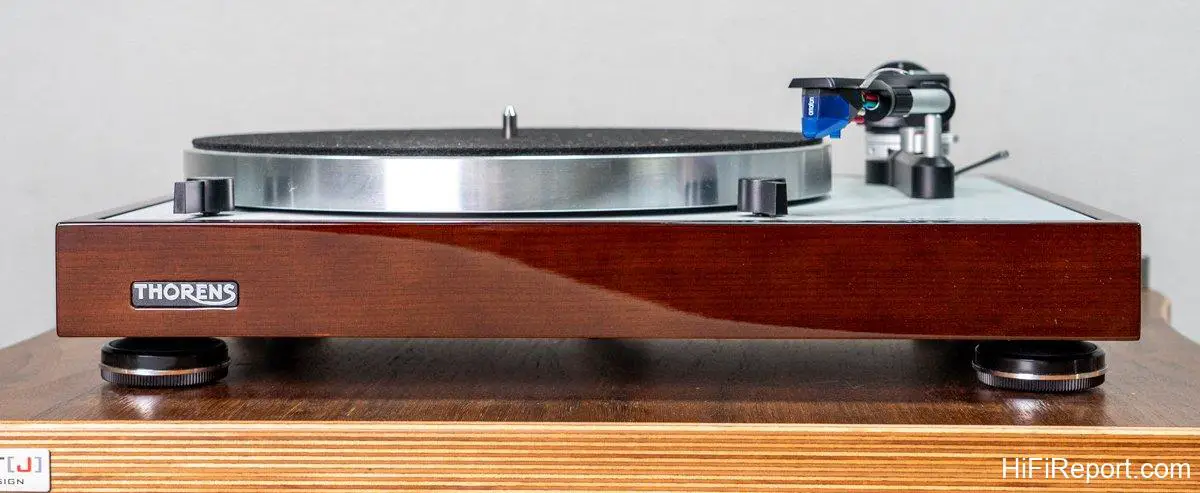
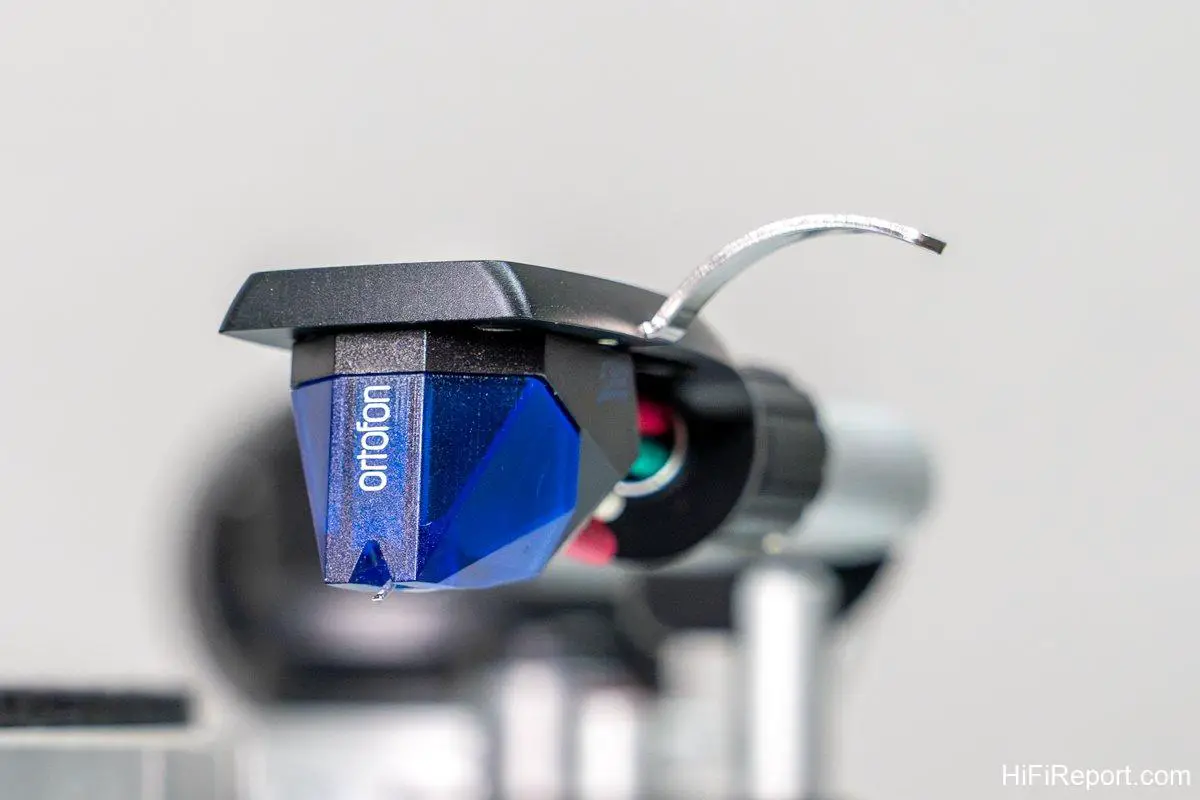
As Thorens’ top-tier direct drive turntable, the TD 403 DD boasts three key upgrades. Firstly, it features enhanced mass. While not comparable to the TD 124, the TD 403 DD is 1.4 kg heavier than the TD 402 DD, with the aluminum platter thickness increased to 22mm. Secondly, the TD 403 DD is equipped with the TP 150 tonearm, the same model found on the TD 1500. This J-shaped arm features a standard SME headshell mount, allowing for easy cartridge swapping. Thirdly, the TD 403 DD comes pre-fitted with an Ortofon 2M Blue MM cartridge, an upgrade from the Audio Technica AT-VM95 found on the TD 402 DD, representing a higher cost component.

During my audition of the TD 403 DD, I utilized the McIntosh MA12000 integrated amplifier and the EAR 886P preamplifier/509 MK II power amplifier, driving Wilson Audio Alexia 2 loudspeakers. I also experimented with the preamplifier output paired with PSI A14-M Studio active monitor speakers.
High-Output Cartridge for Easy Matching
The 2M Blue MM cartridge, with its 5.5 mV output, presents no challenge for phono stages. Whether using the 868P preamplifier or the MA12000’s MM phono stage, the volume level was not noticeably lower than that of a CD, indicating a good match between cartridge output and phono stage gain. In terms of sonic character, the MA12000 delivered more forceful bass, while the 868P presented a gentler low-frequency response. Regarding mid-high frequency performance, the 2M Blue exhibited commendable detail retrieval. While it might not reach the ultimate refinement of a top-tier MC cartridge, the overall musical energy is excellent. For listeners who favor jazz and rock, the fuller midrange of an MM cartridge might be particularly appealing and well-suited to their taste.
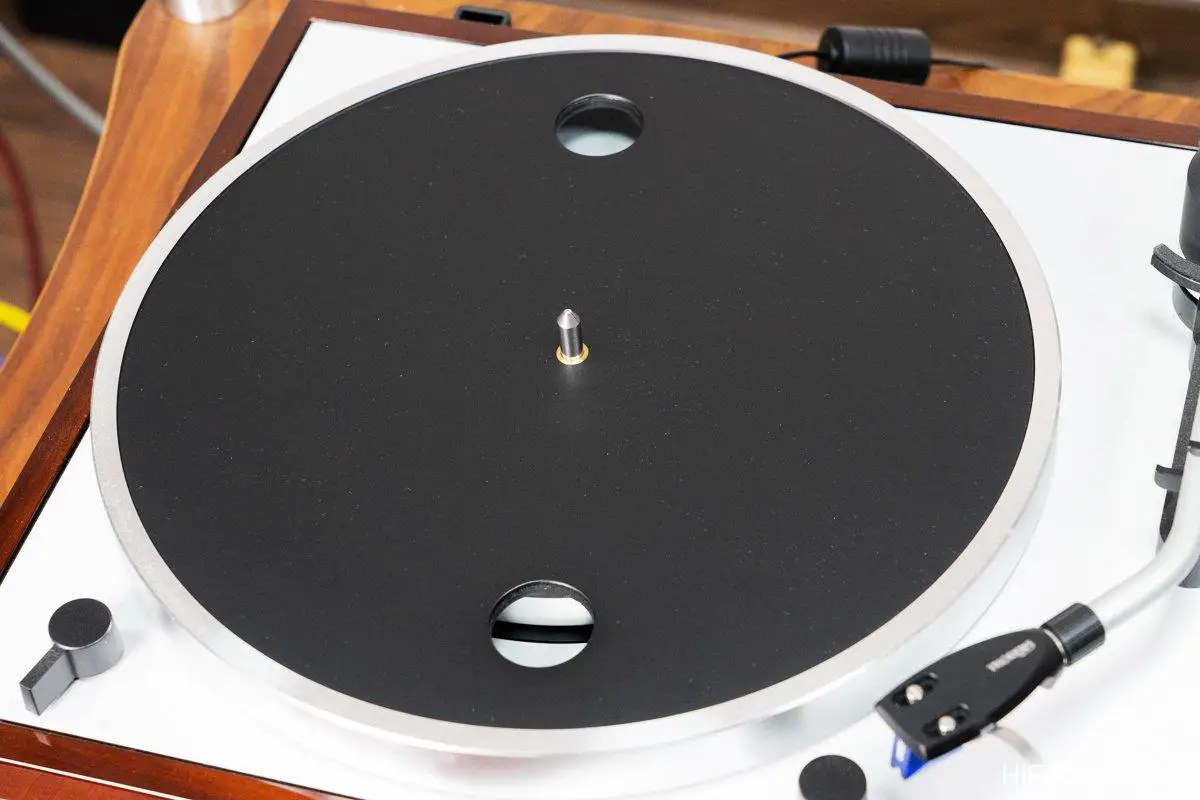
When setting up the TD 403 DD, three key points should be noted. Firstly, ensure the turntable is level. Place the TD 403 DD on your equipment rack and use a smartphone app to measure the platter’s level. Be sure to measure directly on the platter, not the turntable base.
Secondly, remove the dust cover during playback! The dust cover is designed to protect against dust accumulation. However, it should never be left in place while listening, as it will dampen the sound. Simply detach the dust cover along with its hinges from the rear of the turntable before playing records.
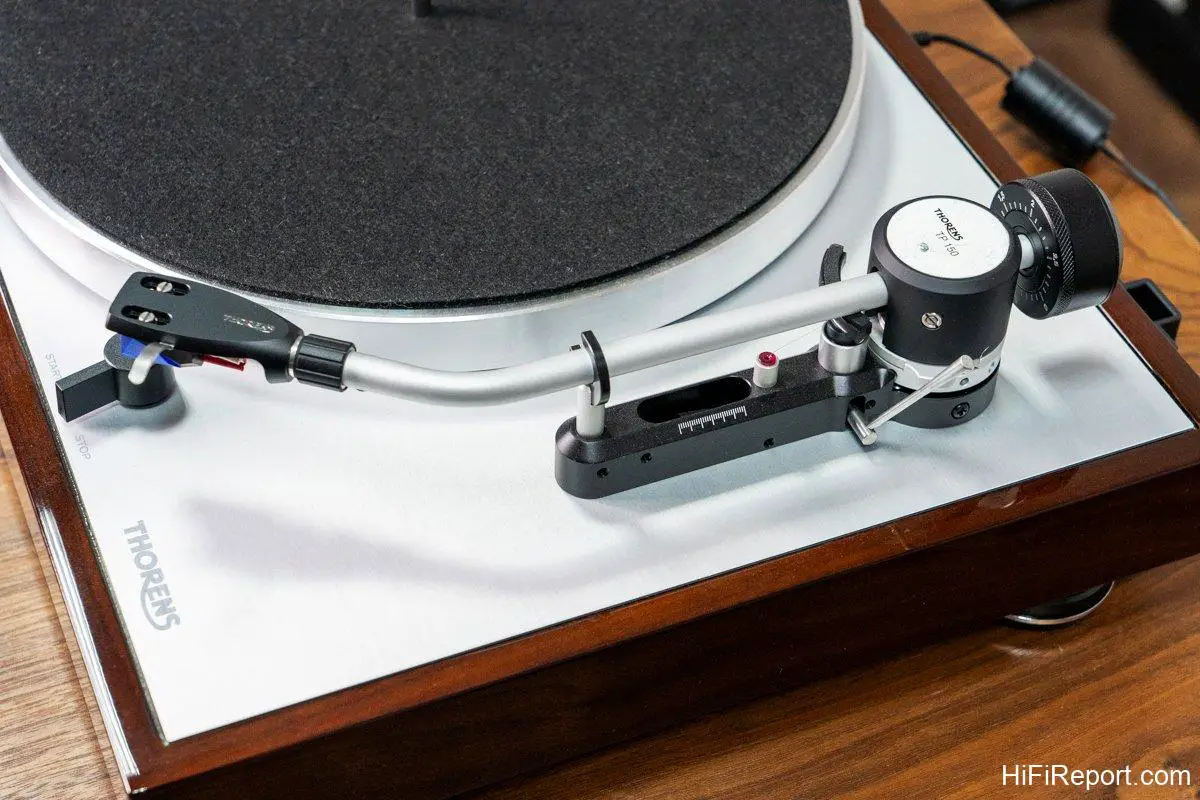
Thirdly, adjust the stylus pressure accurately. For the 2M Blue, the recommended tracking force range is 1.6-1.8 g, with the manufacturer suggesting 1.8 g. While a stylus pressure gauge provides the most precise measurement, the TD 403 DD’s counterweight can serve as a reference point, with an error margin of no more than 0.5 g compared to a gauge. I initially set it to 1.8 g but noticed slightly increased surface noise. Gradually reducing the pressure, I found 1.6 g to be optimal.
The TD 403 DD is a very user-friendly turntable. Once leveled, with stylus pressure and anti-skate (adjusted using the fishing line and weight on the tonearm) roughly calibrated, it’s ready to play music. The turntable features two levers on the top panel: the right lever for start/stop and the left for 33/45 RPM speed selection. A power switch is located on the rear panel; ensure it’s turned on for the front panel controls to function.
Robust Mid-Low Frequencies Ideal for Rock
The dynamism of direct drive turntables stems from their potent mid-low frequency energy, offering a more vigorous and direct sound compared to belt-drive designs, making them particularly well-suited for pop, rock, and jazz genres.
Listening to Katja Werker’s album “Contact Myself 2.0,” a live recording from the Stockfisch Records studio, the guitar tone felt remarkably immediate. The articulation was full-bodied and impactful, with each note jumping out with presence. While the soundstage depth seemed slightly compressed, the imaging remained precise. Katja Werker’s guitar and vocals were positioned slightly to the left, while another guitar was placed center-right, with the bass guitar in the center. Even with a simple female vocal and guitar arrangement, the TD 403 DD conveyed a clear sense of the recording space, with the midrange exhibiting enhanced vibrancy.
Switching to something grittier, Nirvana’s “Nevermind” and “Smells Like Teen Spirit”. The opening electric guitar riff initially sounds innocuous, but as soon as the drums kick in, the raw power of rock is unleashed. The TD 403 DD captured the punch and elasticity of the kick drum, with the distorted electric guitar playing grunge-laden chord progressions in the background. Kurt Cobain’s distinctive vocals, delivering rebellious lyrics – this is certainly not an audiophile recording, perhaps even a poorly recorded one. Soundstage is virtually nonexistent, and compression is applied liberally to maximize the chaotic energy of the music, even bordering on noise to amplify the anti-establishment sentiment.
However, this was the music I loved during my school days. Listening to it on the TD 403 DD, it sounded absolutely right! For rock music, how can one overlook Guns N’ Roses? Playing “Appetite for Destruction” and “Welcome to the Jungle,” the exaggerated delay on the electric guitar cues the drum response. Slash’s guitar solo layers in, and power chords build hard rock momentum. Axl Rose’s voice is still the quintessential Guns N’ Roses sound – how can someone possess such vocal range and depth, delivering such raw, hard-rock screams with such intensity?
The TD 403 DD’s midrange thickness and density propel a rich, powerful sound. This is a multi-track recording where soundstage is irrelevant – it’s a fabricated effect of the recording process. Do you really think Slash can play four guitar parts simultaneously with just two hands? But listening to rock on a direct drive turntable, the raw energy is fantastic! Especially the mid and mid-low frequency power – truly exhilarating.
Laid-back Jazz Swings to Life
Transitioning to jazz, Bill Evans’ classic “Waltz for Debby.” The opening track, the jazz standard “My Foolish Heart,” embodies a relaxed, swinging jazz mood. The TD 403 DD’s mid-low frequency range is smooth and elastic, presenting a comfortable double bass line. Bill Evans’ piano solo drives the melody, while the drummer’s brushes provide a continuous, subtle rhythmic texture alongside the piano. The TD 403 DD excels at conveying the and rich atmosphere of jazz music.
If one were to nitpick, the brushwork on the drums might sound slightly forward. The upward-reaching harmonics might be rendered with greater delicacy and airiness by an MC cartridge. However, this is the characteristic sound of an MM cartridge. Alternatively, when listening to live jazz drumming with brushes, the slightly coarser texture of the TD 403 DD might actually be closer to the live experience. How about classical music? When listening to Bach’s Cello Suites or purely instrumental pieces like piano solos, the TD 403 DD doesn’t reveal significant flaws. Especially with cello solos, the MM cartridge’s midrange fullness makes the cello’s timbre captivating. Similarly, with piano solos, the weight of the keys is well-represented. However, as the melody ascends into the higher registers of the piano, the extended harmonic shimmer cannot quite match that of a high-quality MC cartridge.
Alas, such is the nature of audio – MM cartridges offer rich, full midranges and mid-low frequencies, but their high-frequency extension and airiness fall short of MC cartridges. What to do? If resources allow, have both! After all, the TD 403 DD utilizes a standard SME headshell, making cartridge swapping straightforward. Prepare both an MM and an MC cartridge!
For Classical Music, MC Cartridges Still Reign
Switching the TD 403 DD to 45 RPM and listening to Anne-Sophie Mutter and John Williams’ “Across the Stars,” specifically the “Star Wars: Attack of the Clones” theme, adapted for orchestra. The TD 403 DD delivers a rich violin melody, and the orchestra’s breadth is commendable, with good mid-low frequency fullness. However, when I typically listen to this 45 RPM record, I often use a Linn LP12 Klimax or Elac Miracord 90, both equipped with high-end MC cartridges.
The high-frequency extension of the strings is undeniably more refined with MC cartridges, and the 3D spatiality of the soundstage is also superior. The TD 403 DD only approaches comparable performance in terms of sonic richness. It’s admittedly an unfair comparison, given the significantly higher cost of the other two turntables and their cartridges. Yet, the TD 403 DD’s violin, while not reaching the ultimate heights, remains smooth, non-fatiguing, and possesses a pleasing violin resonance, offering a compellingly pure analog sound.
The Best of Both Worlds
For those seeking to enter the world of vinyl without unnecessary complications, the TD 403 DD is an excellent choice. Direct drive turntables are inherently less demanding, eliminating belt aging concerns. The Thorens TP150 tonearm included with the TD 403 DD offers adjustable stylus pressure, anti-skate, and vertical tracking angle (VTA), providing comprehensive adjustment capabilities.
Should you choose belt drive or direct drive? I would say that the sonic differences are subtle. For rock and jazz enthusiasts, direct drive offers more mid-low frequency energy and immediacy. For classical music, belt drive paired with an MC cartridge may be preferable.
Which to choose? The answer is simple: “Why choose?” Have both types of turntables, and your audiophile journey will be complete!
Specifications
* Type: Vinyl Turntable
* Drive System: Direct Drive
* Tonearm: Thorens TP 150
* Cartridge: Ortofon 2M Blue