
Titan Audio Eros Power Cable Review
Upon receiving the brand-new, unopened Titan Audio Eros power cable, my routine was to plug it into my amplifier for run-in, letting it burn-in for a while before critical listening.
After the initial burn-in and first listen, I was impressed by its refinement, transparent and clean sonic background, and beautiful tonality. However, the sound felt a bit constrained, lacking liveliness, as if it couldn’t fully express itself.
I thought it might need more burn-in time, so I continued to let it run.
After another extended burn-in period, I listened again, but the situation remained largely unchanged. Could it be that this cable only excelled in tonal beauty? I quickly checked the manufacturer’s website for information and discovered that the Eros power cable was designed for source components, while the Eros Signature model in the same series was intended for amplifiers. I then switched the Eros to my DAC, and instantly, the sound was right. It possessed finesse, transparency, richness, liveliness, and vivid dynamics – truly a remarkable cable.
This was the first time I’d encountered such a significant difference in performance when using a power cable with source components versus amplifiers. It seems Titan Audio is onto something special!
Power Experts
Titan Audio hails from Northern Ireland, UK, and was founded in 2013. Although relatively young, the company has dedicated itself to the field of power, establishing itself as power specialists. Their primary products are power-related equipment, including power distributors, power cables, fuses, contact cleaners, and more. Currently, they offer 3 power distributors, 10 power cables, and a patented FFT module. With no other types of cables in their product line, calling them power experts is certainly fitting.
Titan Audio’s ten power cables are categorized into five series, ranging from entry-level Nyx to flagship Nemesis. Each series includes two models, one tailored for source components and the other for amplifiers. The amplifier-specific models are designated with the “Signature” suffix and are priced slightly higher.
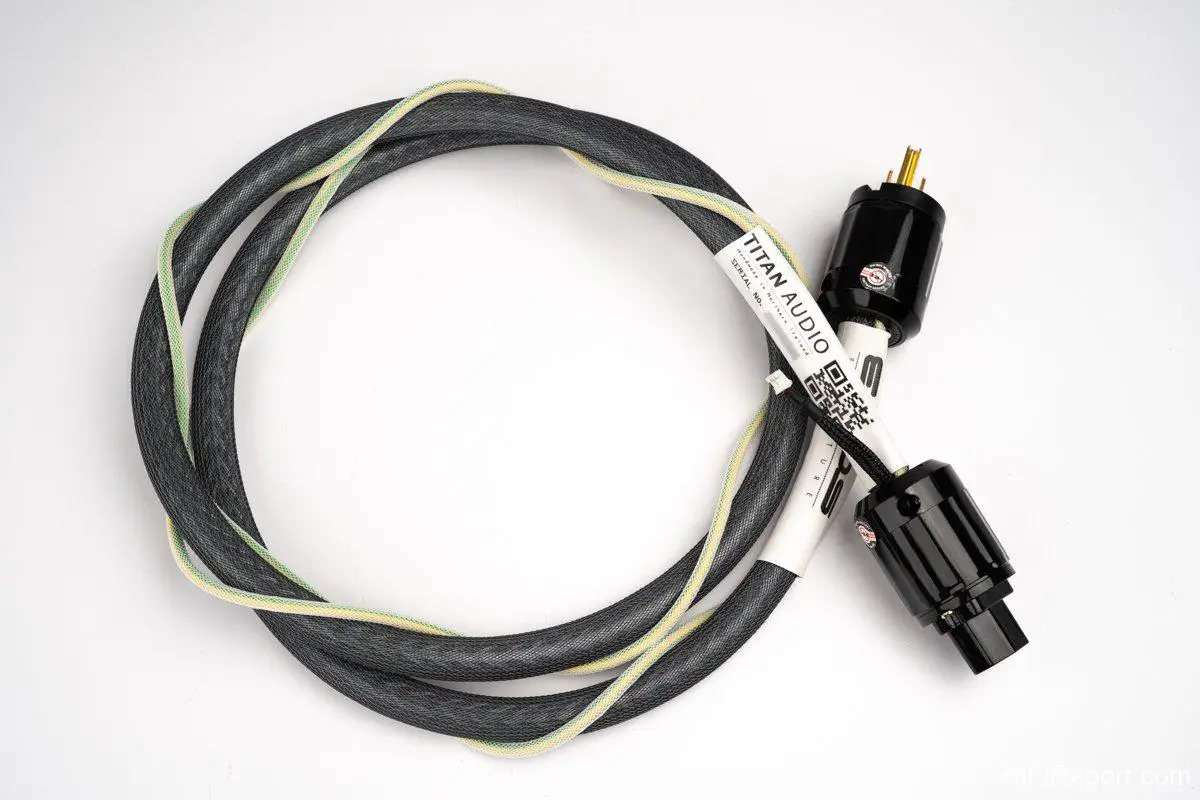
This demonstrates Titan Audio’s emphasis on the suitability of power cables for different applications. They believe that power cables for low-current devices and high-current devices should be distinct. It’s not about making higher-end, more expensive cables thicker to handle high current demands. Instead, it’s about a “horses for courses” approach.
So, what are the differences between the standard and Signature versions? According to Titan Audio’s website, the design distinctions lie in current transmission speed, impedance, and shielding.
For power amplifiers or integrated amplifiers that require substantial current, power cables must deliver current as quickly as possible to accommodate large dynamic swings. In contrast, for source components that only need minimal current, the focus of power cable design shifts away from current transmission speed and towards shielding, aiming to minimize interference with the delicate signal.
Clear Price Tiering
Titan Audio’s power cables are clearly segmented by price. From the entry-level Nyx to the flagship Nemesis Signature, prices range from £100 to £2,500, catering to a wide spectrum of budgets.
While their tiers and prices vary, the underlying technology and design principles remain consistent. The differences lie in the grade of conductors, insulation, and shielding materials, as well as the complexity of the construction. For instance, Nyx and Helios use OFC conductors, while Eros steps up to OCC copper. Chimera further refines this by extruding a layer of silver over OCC copper, bringing its performance closer to the OCC silver used in the flagship Nemesis.
The Eros cable features three 5mm diameter conductors made of OCC single-crystal copper, insulated with extruded PTFE (polytetrafluoroethylene, i.e., Teflon).
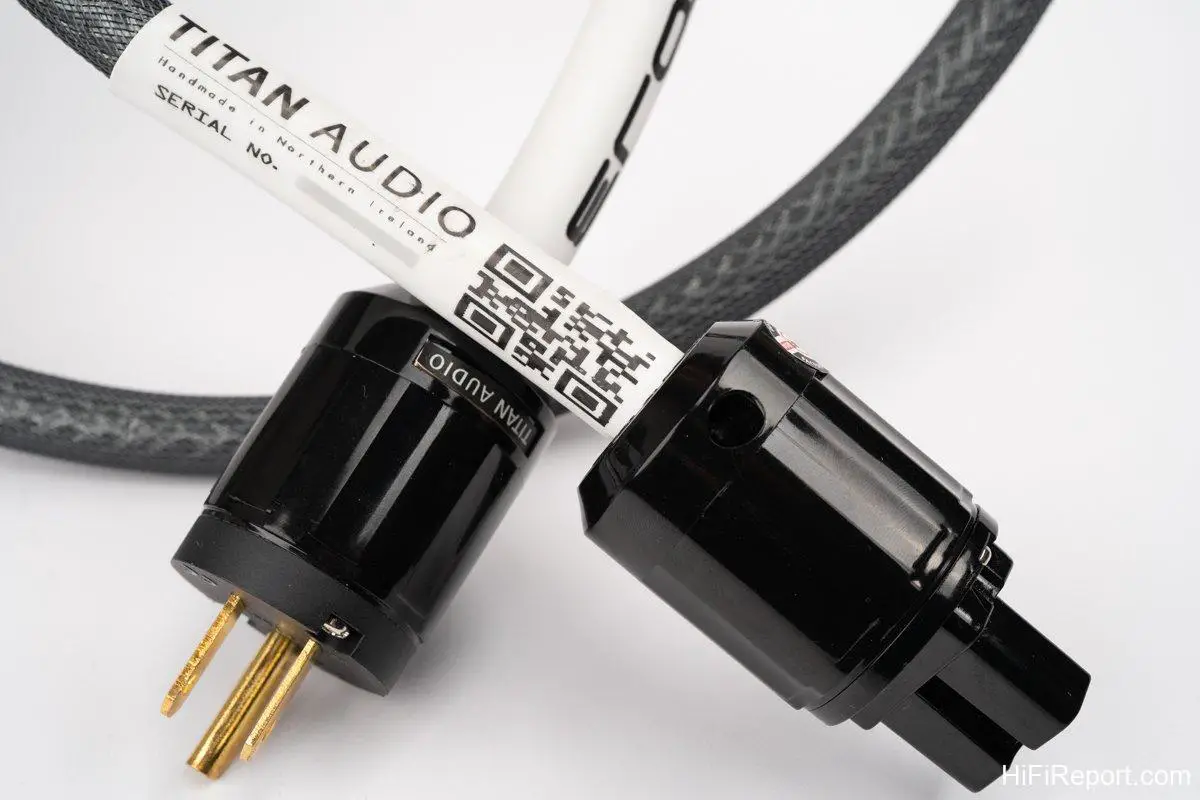
The combination of OCC and Teflon is immediately impressive, a formula commonly adopted in many high-end audio cables.
The benefits of OCC are well-known; its conductivity surpasses OFC, making it ideal for audio cable conductors.
What about Teflon? Teflon boasts an extremely low dielectric constant, resulting in low capacitance and minimal signal impact. Furthermore, Teflon is less susceptible to high-frequency airborne interference such as EMI (electromagnetic interference) or RFI (radio frequency interference), offering EMI/RFI resistance and maintaining power purity.
For the connectors, Eros employs Japanese-made Oyaide plugs, ensuring reliable quality.
Proactive EMI/RFI Elimination
The Eros power cable places significant emphasis on shielding. Beyond the aforementioned Teflon insulation for EMI/RFI resistance, it incorporates a layer of metal braided shielding for enhanced protection.
Moreover, Eros features the proprietary FFT (Force Field Technology), which proactively eliminates EMI and RFI interference.

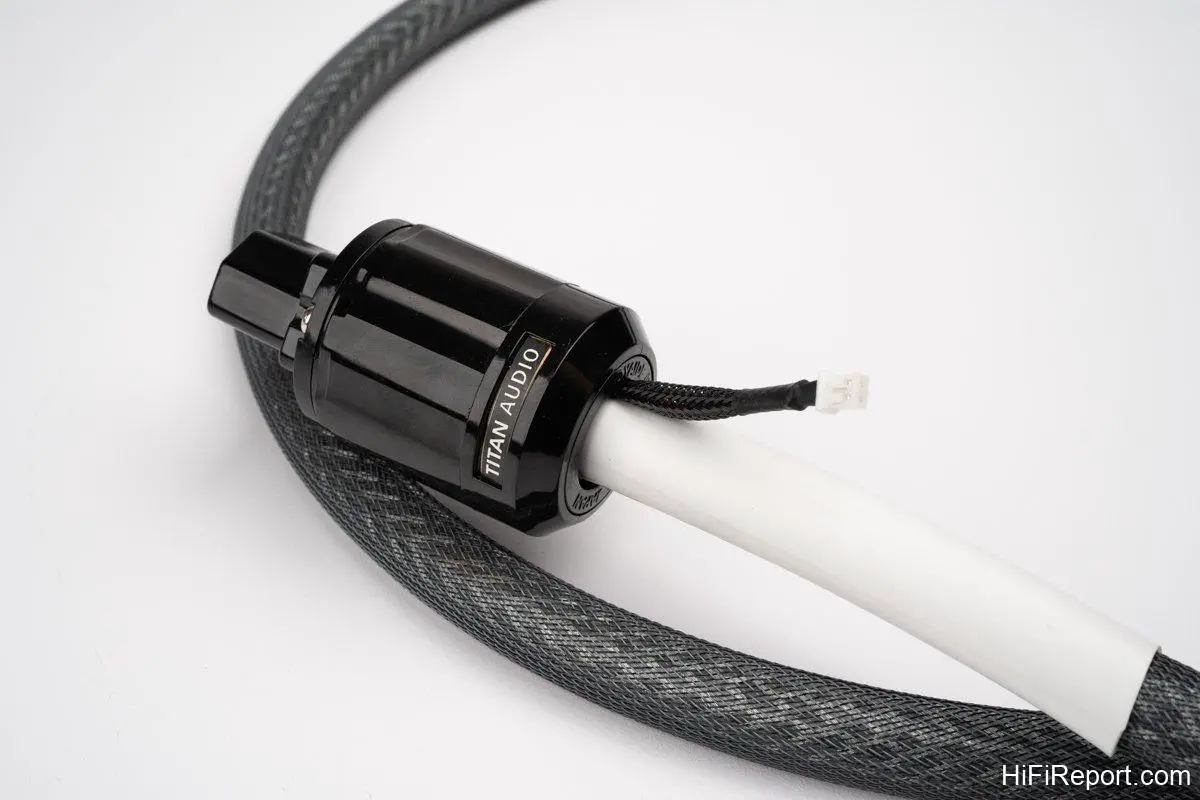
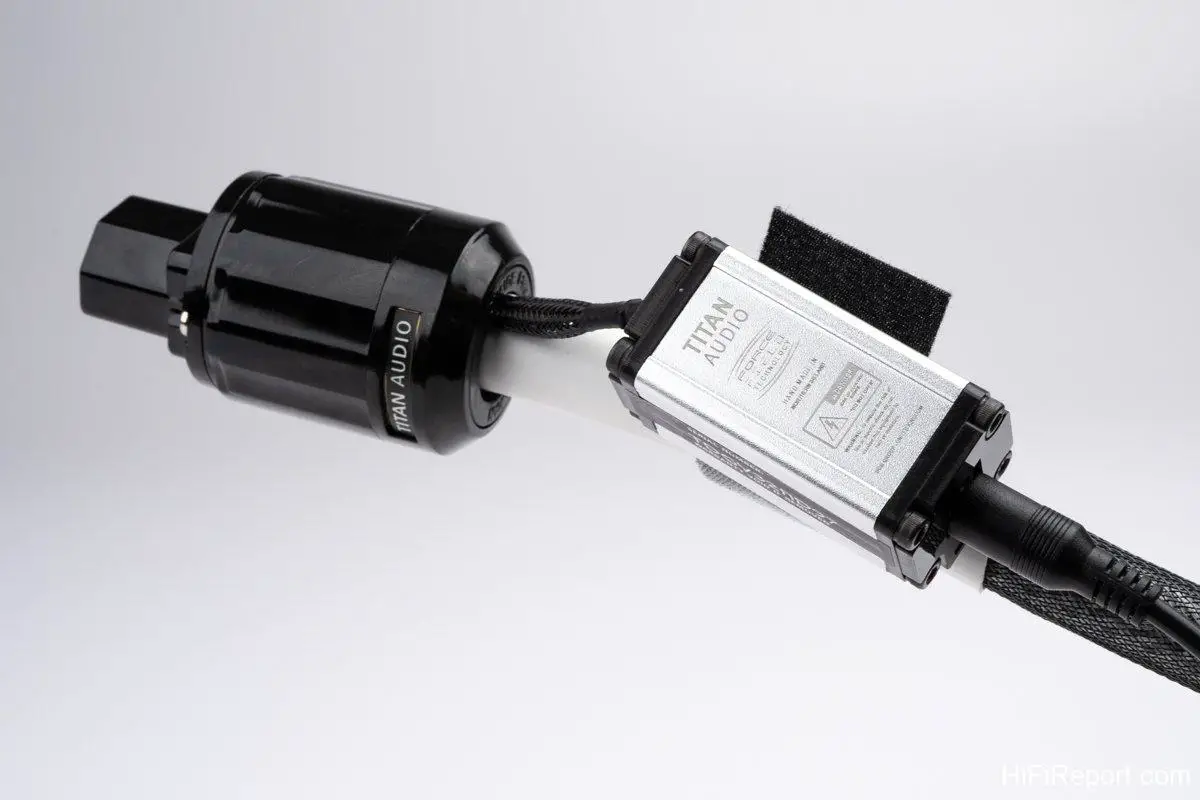
What is FFT? Observe the female connector end of the Eros cable; a small lead extends from the junction of the cable and connector, terminating in a tiny connector for attaching the FFT module.
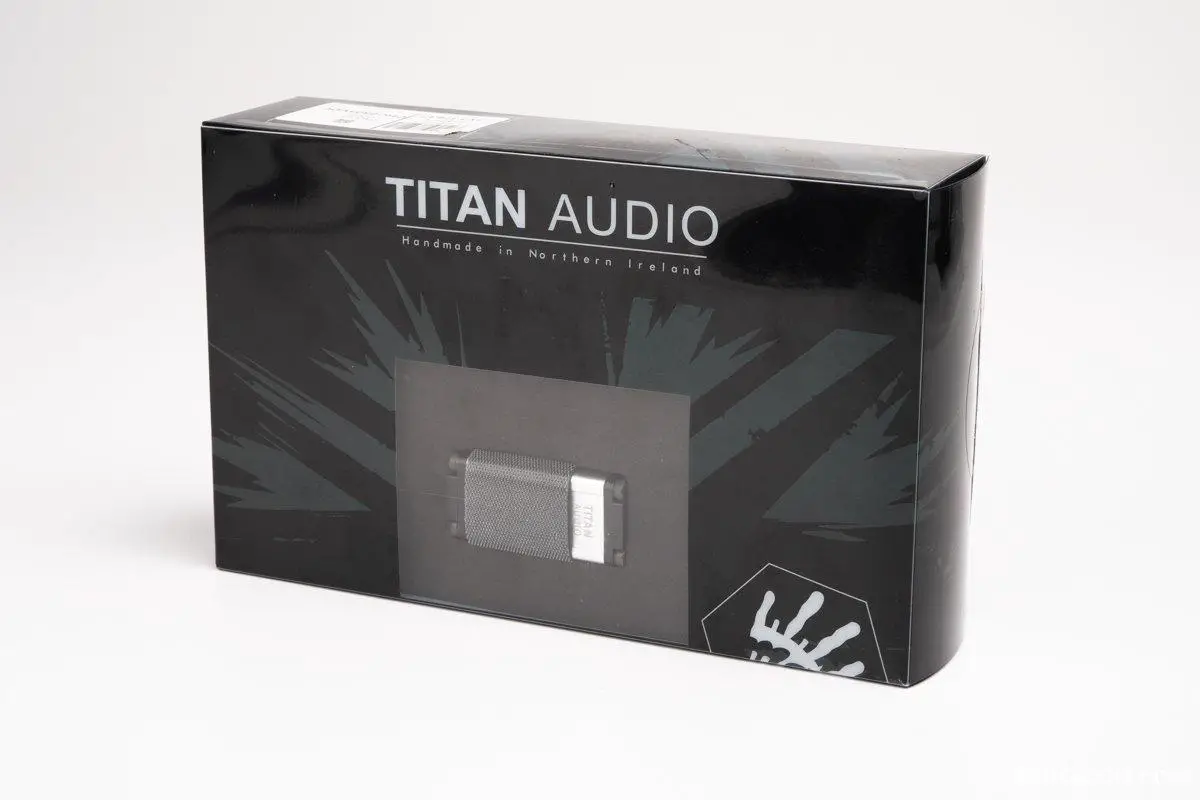
The FFT module has an aluminum alloy housing with acrylic top and bottom plates, housing sophisticated circuitry inside.
Using the included nylon straps, the FFT module can be directly attached to the power cable, ideally close to the female connector for easy connection of the small lead.
Each FFT module comes with its own power supply. Once powered, it generates an invisible shielding layer around the Eros power cable, further eliminating EMI and RFI interference.
The FFT module is an optional accessory, sold separately. Currently, only Helios and Eros power cables are compatible with the FFT module, but the FFT technology will soon be extended to other series, eventually encompassing the entire Titan Audio power cable range.
Refined and Lively Performance
Having previously run-in the Eros with my amplifier, I now connected it to my Audiobyte Black Dragon DAC for proper auditioning.

Along with the Eros, I also received the FFT module and the amplifier-specific Eros Signature cable, which I would test one by one later, starting with the Eros.
The rest of my system comprised an Auralic Aries G1 wireless streaming transport, EC 4.8 preamplifier, NuPrime Evolution One power amplifier, and Aurum Cantus Grand Harmony loudspeakers.
What immediately captivated me about the Eros was its clean, transparent sonic foundation and refined musical expression, rather than the powerful, solid, energetic, or sharply dynamic characteristics often prioritized by many power cables in the same class.
Take “Audio Physic 25,” the twenty-fifth-anniversary commemorative CD, for example. Track 5 features “Gaude Virgo,” a motet by the 15th-century Renaissance composer Pierre de la Rue, performed a cappella.
Played through the Eros, the already dark and clean background and transparent tonal texture of the recording were further accentuated. The presence and fullness of the vocals became clearer and more substantial. In other words, the singing was purer, more distinct, and more fleshed out.
Due to the enhanced clarity and presence, the different vocal sections also exhibited better layering and separation.
In contrast, a standard black power cable used for comparison sounded drier, thinner, and leaner. The soundstage was looser, less focused, and flatter, lacking vibrancy.
Another example is track 6, “Ei du feiner Reiter” Variations, a piece by German organist Hugo Distler, featuring a harpsichord and string orchestra concerto. I perceived the strings becoming fuller, denser, and smoother. The layering between different string sections became richer, and the timbre more pleasing. Not only did the overall liveliness increase, but the tonal balance also improved.
Simply put, the Eros noticeably elevated the sonic texture.
Enhanced Emotional Engagement
Another track that deeply impressed me was “Immediately Blessed” from the “Blue Coast Collection” sampler, track 7, a slow, lyrical piece featuring a male vocalist accompanied by guitar.
Here, the Eros conveyed the spatial characteristics of the recording with greater clarity, evidently due to the retrieval of more detail.
This was accompanied by clearer and more prominent image outlines, improved textural density resulting in better dynamics, and a sweeter guitar tone. The sound was captivating.
I also noticed that the Eros amplified the subtle fluctuations in very quiet musical phrases, enriching the dynamic range and improving the continuity of each note. This made the song seem slower, and the emotional impact more profound.
It was time to introduce the FFT module.
I attached it to the Eros female connector, connected the lead and power supply, and the setup took less than a minute.
Replaying “Immediately Blessed,” I immediately noticed another sonic uplift, a clearly discernible improvement! What improved? The micro-dynamic variations in quiet passages. They were already excellent, but unbelievably, they got even better. This enhanced the contrast in micro-dynamics, enriched the musical expression, and amplified the emotional intensity, almost giving me goosebumps.
In fact, for everyday music listening, I believe micro-dynamic variations are more crucial than macro-dynamics. Musical climaxes are fleeting, while most musical passages are played at low to medium volumes. If we experience better nuance at these volumes, it is most beneficial. The Eros with the FFT module precisely strengthens this aspect, significantly enhancing musical appreciation.
Furthermore, adding the FFT module deepened the blackness of the background, improved clarity and airiness, enhanced sonic weight and impact, sharpened image outlines, and added dimensionality to the soundstage.
In essence, the FFT module takes the original strengths of the Eros and amplifies them, making the music sound even more vivid and engaging.
Texture Elevated
Next, I decided to integrate the Eros Signature into my system. However, my NuPrime Evolution One power amplifiers are monoblocks, requiring two power cables, but I only had one Eros Signature. Therefore, I used it on my EC 4.8 preamplifier, which was previously using a standard black power cable.
The sound now gained a touch of warmth, with improved overall fullness, solidity, and textural richness. Transparency and clarity remained undiminished, and the tonality became even purer, without becoming thick or dull.
Like the Eros, the Eros Signature also rendered images more concrete and focused the soundstage more centrally, enhancing spatial clarity and depth.
Revisiting track 6, “Ei du feiner Reiter” Variations, from the “Audio Physic 25” CD, the Eros Signature made the string timbre brighter and the lines smoother and more fluid. The texture became even more velvety, and the layering of the string sections became clearer. The overall structure was balanced and stable, with everything well-organized.
In terms of soundstage, it continued to become more focused and centered, while also expanding in height and depth, and moving closer, resulting in a more realistic and live-like presentation.
Essentially, the Eros Signature possesses a healthy constitution, with well-judged pacing, a clean and bright sonic character, a dense and solid texture, and it adds moisture and richness, elevating the overall sonic quality. It is undoubtedly an excellent cable.
Unleashing Source Component Potential
This audition has highlighted the importance of having a dedicated power cable for source components.
Most power cables on the market are either general-purpose for both sources and amplifiers, or more suited for amplifiers than sources. Very few are specifically designed for source components, and the Eros is one of those rare exceptions.
Furthermore, in terms of price, the Eros offers exceptional value. At its price point, finding a power cable with OCC single-crystal copper conductors, Teflon insulation, metal braided shielding, Japanese Oyaide connectors, and handcrafted in the UK is likely to be challenging.
Moreover, the Eros, leveraging Titan Audio’s unique technology, can be further enhanced by the patented FFT module, representing not just icing on the cake, but a tangible improvement. In terms of value, the FFT is in no way inferior to the Eros itself. I would even recommend purchasing the FFT module alongside the Eros from the outset to fully unleash the potential of your source components from the start.
Specifications
* Type: Power Cable
* Conductor: 5 mm OCC copper stranded wire × 3
* Insulation: Extruded PTFE
* Shielding: Metal braid + Force Field Technology
* Connectors: Oyaide plugs