
Vestlyd V15C Coaxial Speaker Review
If you love rock music, if you adore the blues, if pop is your jam, if fusion jazz gets you moving, if you listen to music with clear, heavy beats and powerful rhythms – music that features not just drums but electric guitars – and if you crave large, full-bodied vocals, then you absolutely must lend an ear to Vestlyd speakers.
They are, without exaggeration, the biggest surprise I’ve encountered this year.
When I label a piece of audio equipment a “surprise” in my reviews, it always carries a crucial prerequisite: affordability. It must be something within reach for the average enthusiast.
If, under that condition, the equipment also delivers outstanding sonic performance, or excels remarkably in its specific domain, then it earns the title of “Captain Surprise” in my book.
The Vestlyd V15C I auditioned is precisely the kind of speaker that warrants such an exclamation.
Nordic Hi-Fi Lineage
Founded in 2021, Vestlyd hails from Denmark and operates under the Nordic Hi-Fi umbrella. Its parent company is none other than Hi-Fi Klubben, Northern Europe’s largest audio retailer, established by audio industry veteran Peter Lyndorf.
Considering this lineage, one could even say Vestlyd functions as Hi-Fi Klubben’s house brand. While the brand itself is young, its origins boast significant clout.
Coaxial Design Addresses Frequency Response Issues
Currently, Vestlyd’s primary offerings consist of just two models: the V15C, a 15-inch coaxial speaker, and the V12C, a 12-inch coaxial speaker.
Their design principles are identical, differing only in size. The V15C employs a 15-inch driver within a larger cabinet, while the V12C uses a 12-inch driver in a smaller enclosure.
Traditional two-way speakers separate the tweeter and woofer, assigning specific frequency ranges to each. However, the acoustic centers of these drivers are distinct.
Moreover, the larger the woofer, the greater the separation between these centers. This spatial disparity can lead to noticeable time and phase differences, potentially causing frequency response dips, particularly off-axis. This is precisely why the concept of the “sweet spot” is so frequently emphasized.
Vestlyd believes the optimal solution to this challenge is a coaxial design, which is why all their speakers feature this configuration.
15-inch Paper Cone Woofer for Dynamics and Detail
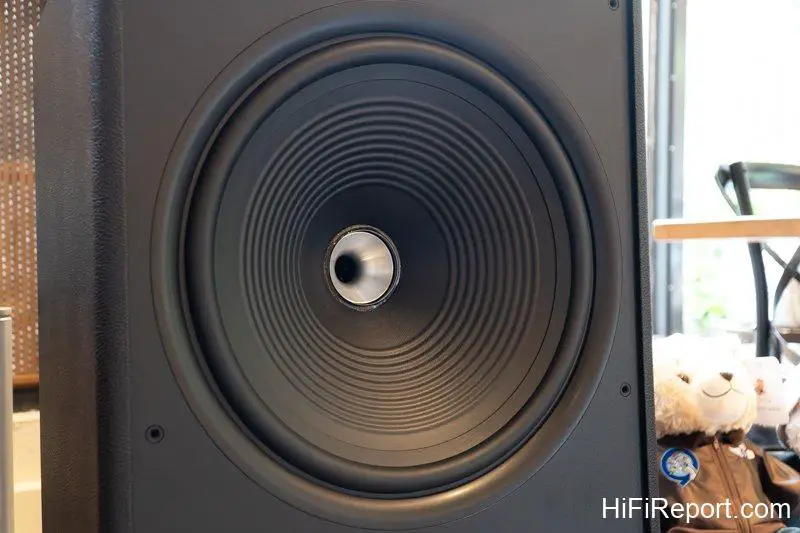
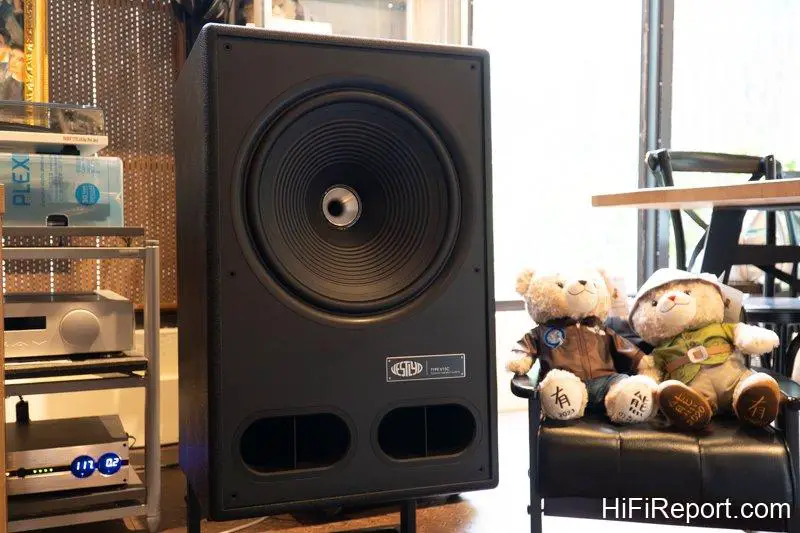
The coaxial driver in the V15C incorporates a 15-inch woofer. Its diaphragm is a paper cone featuring concentric, three-dimensional ribs.
These ribs aren’t merely for aesthetics; they are designed to enhance the cone’s rigidity, minimizing cone breakup – a common source of distortion at higher volumes or frequencies.
The woofer’s magnetic system includes an aluminum Faraday ring. This component compensates for non-linear excursions in the mid-frequency response caused by magnetic field variations. Put simply, this design ensures that the driver maintains clarity in the mid-range, even under high sound pressure levels or when simultaneously reproducing complex low and mid-frequency content.
Central Compression Driver Tweeter with Low Compression Ratio
Mounted at the center of the coaxial driver is a 1-inch compression driver tweeter. Unlike conventional dome tweeters, a compression driver incorporates a narrow throat or chamber in front of the diaphragm. Sound energy is squeezed through this constricted passage, enabling it to project further and with greater efficiency.
It’s akin to pinching a garden hose nozzle to make the water spray farther – the compression driver works on a similar principle. However, a very narrow throat results in high compression, which can make the sound feel aggressive or sharp.
Vestlyd employs a relatively low 2:1 compression ratio, specifically chosen to mitigate the distortion often associated with high-compression drivers in the upper mid-range and treble.
The compression driver is powered by a neodymium magnet. In front of the compression driver, where it meets the base of the woofer cone, is a solid aluminum waveguide machined from a single piece. This waveguide, coupled with the horn-like flare of the woofer cone, facilitates a natural physical crossover.
The manufacturer also shared that Vestlyd’s coaxial drivers undergo rigorous simulation using Finite Element Analysis (FEA), followed by extensive measurements, to ensure optimal design at every stage.
Reinforced Cabinet with Distinctive Faux Leather Finish
The Vestlyd speaker cabinets feature robust internal bracing, both horizontally and vertically, to effectively suppress cabinet resonances. This prevents unwanted coloration of the sound caused by cabinet vibration.
Engineers also specifically left space behind the driver to ensure adequate heat dissipation. The front baffle is substantial, measuring a full 3 cm thick, providing a stable platform for the driver.
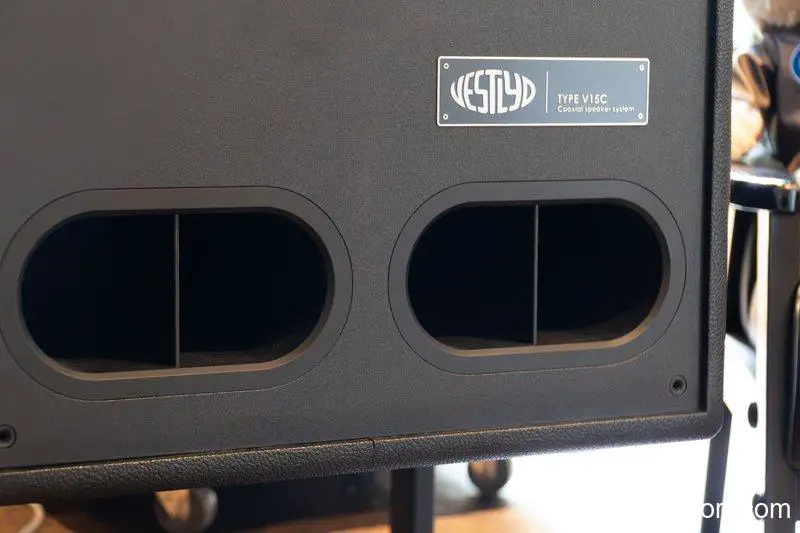
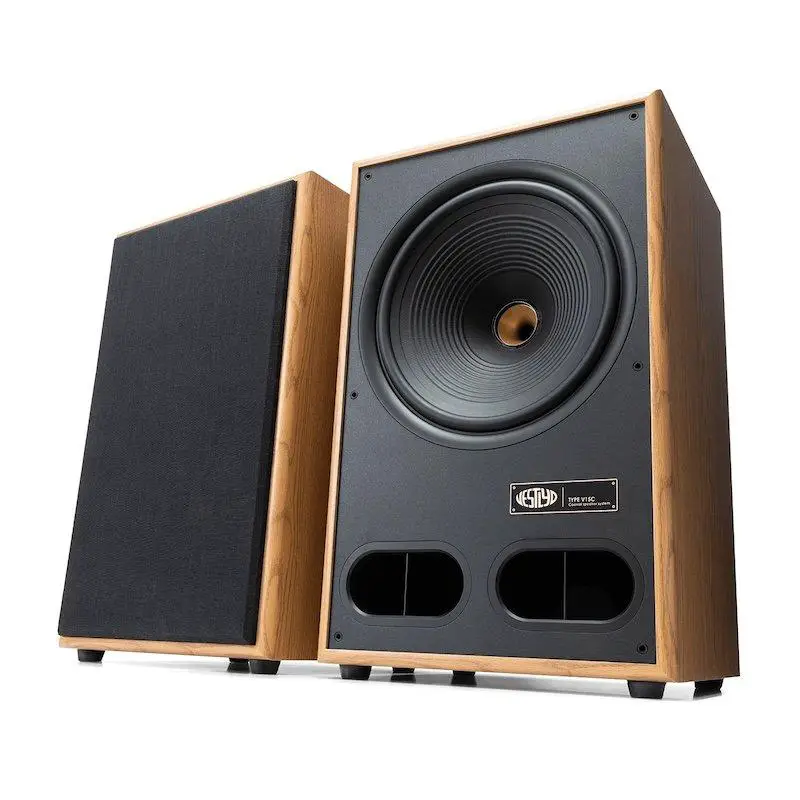
The bass reflex ports are located on the front baffle. Two elliptical ports, carefully sized and tuned for length, allow the low frequencies to extend naturally without compressing the dynamics.
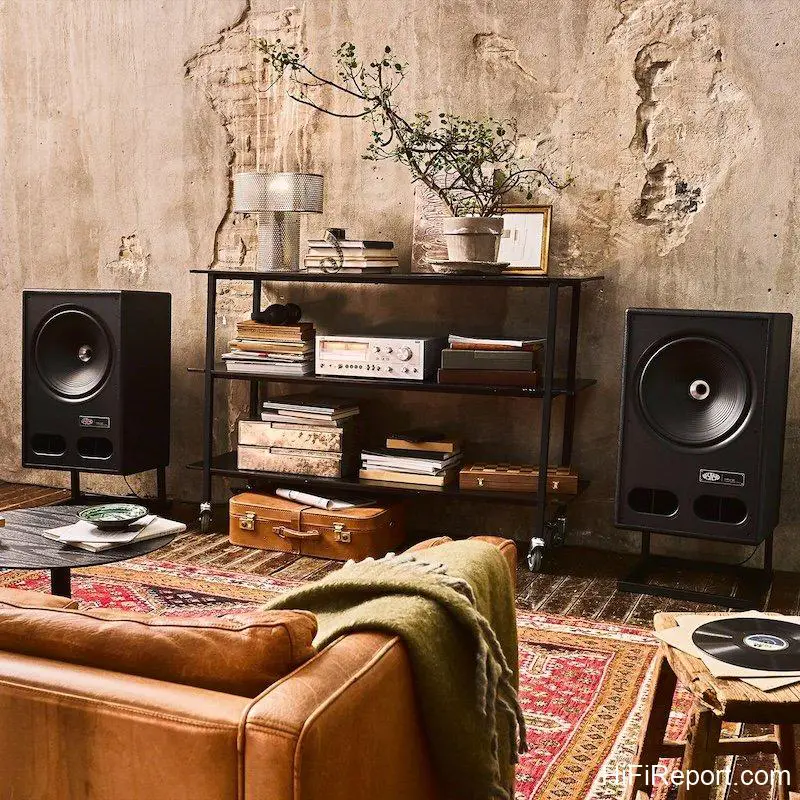
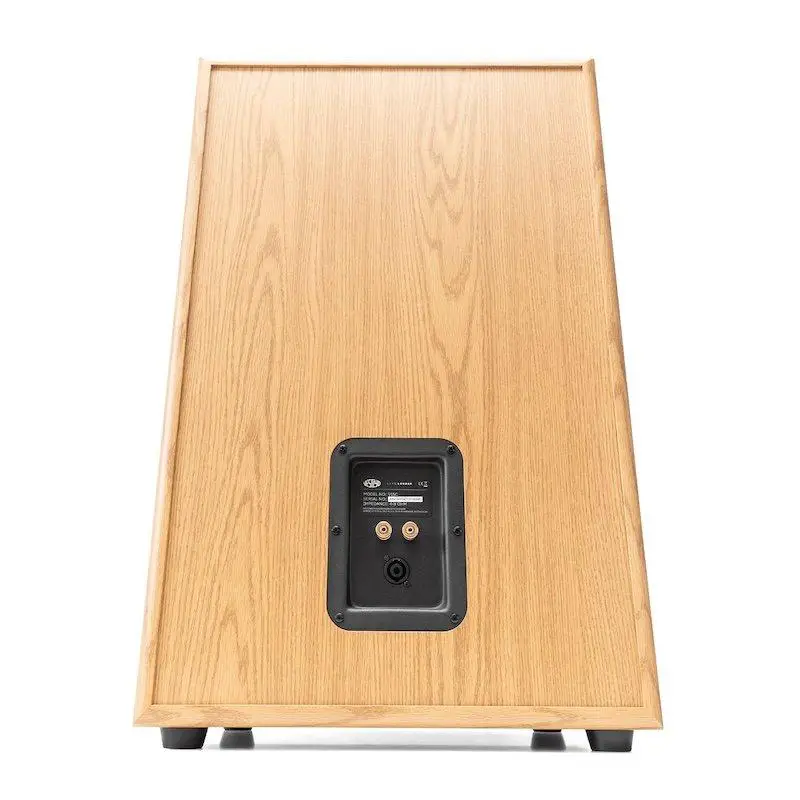
What makes Vestlyd’s cabinet truly striking is its unpretentious appearance. The exterior is wrapped in black synthetic leather with a textured surface, giving it a distinct look reminiscent of guitar amplifiers or professional public address speakers. Even the rear speaker terminals include both standard binding posts and a professional Neutrik Speakon connector. This unique visual identity reflects Vestlyd’s design philosophy from the outset.
Indeed, the Vestlyd V15C boasts remarkable durability and output capability. The manufacturer proudly states it can achieve an astonishing 130dB sound pressure level with very low distortion. Their official website even includes a cautionary note to users about protecting their hearing!
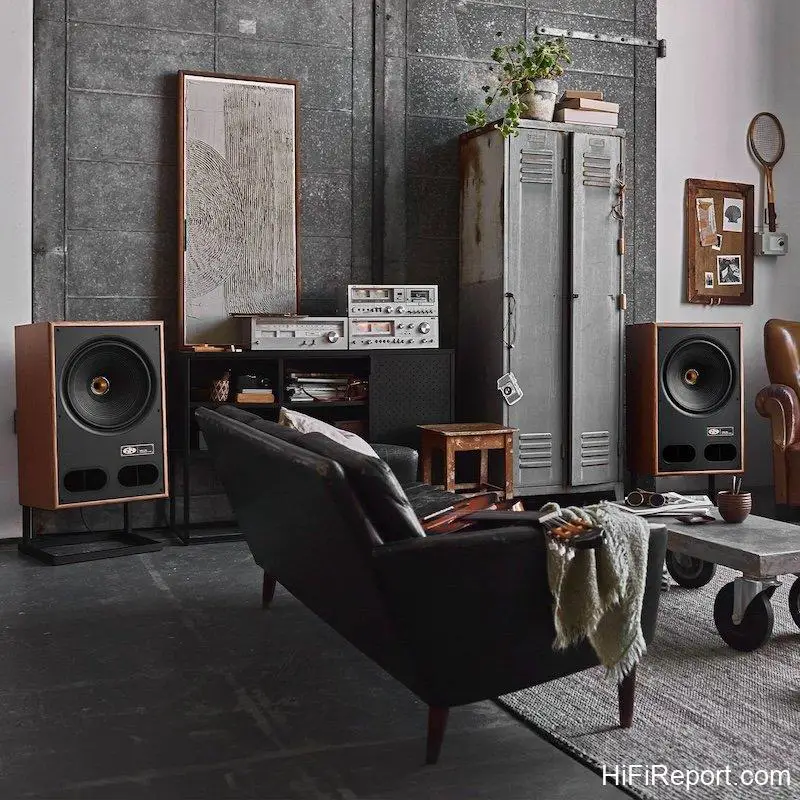
The speakers’ dark, understated exterior lends the Vestlyd V15C a professional aura. If the look feels too much like a guitar amp for your taste, Vestlyd also offers an oak veneer version, which presents a much more refined aesthetic.
The Sound of the “West”
Breaking down the name “Vestlyd,” we get “Vest” and “Lyd.” In Danish, “Vest” means West, and “Lyd” means Voice or Sound. Vestlyd’s speakers are designed at the company’s headquarters in western Denmark, where engineers listen to the sound of the North Sea waves crashing on the shore while finalizing the designs.
However, to my ears, Vestlyd’s sound seems to reach across the Atlantic to North America, embodying a “West Coast Sound” vibe. The moment they started playing, I was reminded of American giants like JBL. The Vestlyd V15C delivers a warm, full, and expansive soundstage with powerful, robust imaging.
Spinning rock music? Excellent! Blues? Superb! Fusion jazz? Fantastic! Pop songs? Brilliant! Electronic music? Outstanding! The more a track features prominent beats and strong rhythms, the better these speakers perform.
Another crucial point: they need to be played loud. In fact, the louder they play, the better they sound. My audition at HiFiReport used an Arcam A15 integrated amplifier rated at 80W. HiFiReport’s listening room is spacious – a roughly 200-300 square foot area with a high ceiling – large enough for many high-end speakers to truly sing. For the Vestlyd V15C, this space felt just right; they could easily handle an even larger room.
Drum Sound: Beyond Good, It’s Phenomenal!
Listening to Donald Fagen’s album “Nightfly,” a classic 80s recording that perfectly captures the musical style of that era, the drums were full, powerful, and incredibly dynamic, with a round, tactile feel. Just listening to that stable yet subtly laid-back lounge rhythm from the drums revealed the Vestlyd V15C’s prowess. And as the volume increased, the drums became even more spectacular.
It wasn’t just the drums; the brass and saxophone, mixed warmly in the recording, still exhaled their notes steadily with the rhythm. The metallic texture and sheen were beautifully rendered. I’ve always enjoyed listening to brass instruments played through compression driver speakers. Perhaps it’s the metal diaphragm, the metal throat, or the projecting effect of the compression driver – or a combination of these factors – but these types of speakers seem uniquely capable of conveying the metallic luster and texture of brass instruments. The V15C performs similarly. While the brass on this track isn’t inherently harsh, through the V15C, it sounded exceptionally bright yet warm. This song, heard through the Vestlyd, was simply delightful.
A Scale of Relaxation Only Large Drivers Can Achieve
Thanks to the substantial woofer and cabinet size, the V15C exhibits the effortless spaciousness typical of large speakers. Many bookshelf speakers can play loudly, and some are even intentionally displayed next to floorstanders to create a misleading impression. However, these so-called “loudmouths” or “pocket rockets” are ultimately still bookshelf speakers. Even if they can achieve high volume (setting aside bass extension for a moment), the sheer scale and ease of the sound are inherent limitations that bookshelf speakers struggle to overcome.
The V15C is a *true* loudmouth. It can play louder than many floorstanding speakers while maintaining excellent composure and spaciousness. Yet, beneath that relaxed presentation lies a sound that is full, solid, and packed with energy – a muscular quality. This is arguably its most captivating trait.
Powerful Drums, Authoritative Vocals, and Plenty of Texture and Detail
Take the album “Outtakes” by veteran Danish singer Hanne Boel. The drums on “After Midnight” are strong, full, and impactful. This 2014 recording boasts even greater dynamics and fidelity than Donald Fagen’s 80s work. Beyond the sheer power, the drums are rich in detail. The taut impact of the drumsticks hitting the toms is incredibly convincing – a sound with real tactile force and ample detail, making the percussion sound remarkably realistic. The weight and impact of the kick drum are also undeniable; truly, a large woofer delivers here.
The electric bass providing the foundation is deep and textured, and the acoustic and electric guitars are not overshadowed by the rich, full bass. Instead, they have a distinct clarity, almost seeming to leap out – a strength of the compression driver tweeter. Hanne Boel’s relatively low but incredibly steady voice is showcased beautifully in the slow track “How Can You Mend a Broken Heart.” The V15C effortlessly presents a full-bodied, solid, and well-defined vocal image. Every nuance – diction, breathing, vocal runs, sustained notes – decades of Hanne Boel’s artistry are laid bare. The Vestlyd V15C puts it on a big screen for you; nothing is missed.
Excellent Guitar Tone, Diverse Textures
Dan Patlansky’s music further illustrates the Vestlyd V15C’s strengths. Listening to “Big Things Going Down,” the opening guitar solo features simple arpeggios. Later, the arpeggios are joined by bass and drums, creating a heavier rhythm and a more intense mood. Patlansky’s gritty voice enters with the lines: “I left my hometown, baby. There be big things going down…” evoking a palpable sense of homesickness and wandering. Driven by powerful guitar strumming, the emotion unfolds without reservation.
Compression drivers aren’t just good with brass; they render guitars with a unique flavor. Being blues electric guitar, the sound isn’t from the resonance of a hollow body or soundboard but primarily captured by pickups. The texture of the strings is less woody, feeling more direct. These subtle distinctions are clearly audible through the Vestlyd V15C. As for Patlansky’s voice, it’s rich and warm, infused with a grainy weariness that perfectly captures the essence of the blues. Whether it’s Hanne Boel or Dan Patlansky, the distinct characteristics of their voices are clearly audible on the Vestlyd V15C, even from several meters away.
Lively, Comfortable Sound, Jazz Bliss!
Given their “West” moniker, it’s no surprise they handle jazz with flavor (though perhaps a different “West” than initially imagined). Listening to the soundtrack of “Alfie,” the track “Alfie Theme” features Sonny Rollins on saxophone and Kenny Burrell on guitar. The piece opens with the saxophone playing the main melody, followed by the guitar developing the theme with an improvised solo before handing it back to the tenor saxophone.
The warm saxophone and guitar sound wonderfully comfortable. Despite being a 1966 recording, the saxophone retains a lively quality beneath its vintage patina. I suspect the compression driver tweeter contributes significantly to this sense of liveliness, while the warmth, ease, and softness of the music are undoubtedly linked to that 15-inch driver.
Warm, Smooth Tone Appeals to a Wider Audience
Oscar Peterson’s “We Get Requests” is an evergreen audition album. It’s hard for any system or component to sound bad with this record, but there are degrees of ‘good’. The V15C faithfully reproduces Ray Brown’s well-defined bass notes, Peterson’s round, warm piano playing, and Ed Thigpen’s lively, detailed drumming. The track “Quiet Nights of Quiet Stars” beautifully showcases the balanced interplay between the three instruments.
The V15C presents the piano with a smooth, gentle sheen, rich in woody timbre and stable in its notes. This character differs from other coaxial speakers like Tannoy, which tend to sound more refined. It’s also distinct from Fyne Audio, which often features a more elaborate treble. As a 15-inch coaxial speaker with a compression driver, the Vestlyd V15C is not only one of the most affordable options available but also targets a broader audience with its appealingly warm, full, rich, and powerful sound signature.
Overcome the “Size” Hurdle, and It’s an Unbeatable Captain Surprise
Does the Vestlyd V15C have any drawbacks? Yes, it does. Unquestionably, it’s big. This is an obvious “flaw” visible to everyone. While the V15C’s price is remarkably accessible, its sheer size means it requires a sufficiently large living space. Even if you can accommodate the speakers, you must consider whether you can let them truly sing.
The Vestlyd V15C’s energy isn’t merely ample; it’s exceptionally abundant. And the louder you play them, the better they sound. In fact, I’d argue that you need to reach a certain volume level to fully appreciate its qualities. And once you hit that threshold, you’ll realize there’s virtually no competition at this price point. It’s like buying a V8 performance car at the price of a standard sedan. Its true brilliance is best experienced on an open, straight road; navigating tight city streets wouldn’t highlight its remarkable capabilities.
Specifications
* **Type:** 2-way bass reflex coaxial speaker
* **Drivers:** 1-inch neodymium compression driver tweeter + 15-inch paper cone woofer (coaxial)
* **Frequency Response:** 36Hz ~ 22kHz
* **Sensitivity:** 95dB
* **Impedance:** 4 ohms
* **Crossover Point:** 1.1kHz
* **Max Power Handling:** 500W
* **Dimensions (HxWxD):** 742 x 468 x 417mm
* **Weight:** 34kg