
Vivid Audio Kaya 25 Floorstanding Speaker Review
Are you familiar with Vivid Audio? They are, in fact, South Africa’s premier Hi-End audio brand.
Even if you’re not intimately acquainted with the brand, if you’ve attended the TAA audio show in the last decade, you’ve undoubtedly encountered them. Their presence is, to put it mildly, unforgettable.
The ‘special’ quality I’m referring to primarily lies in their aesthetics.
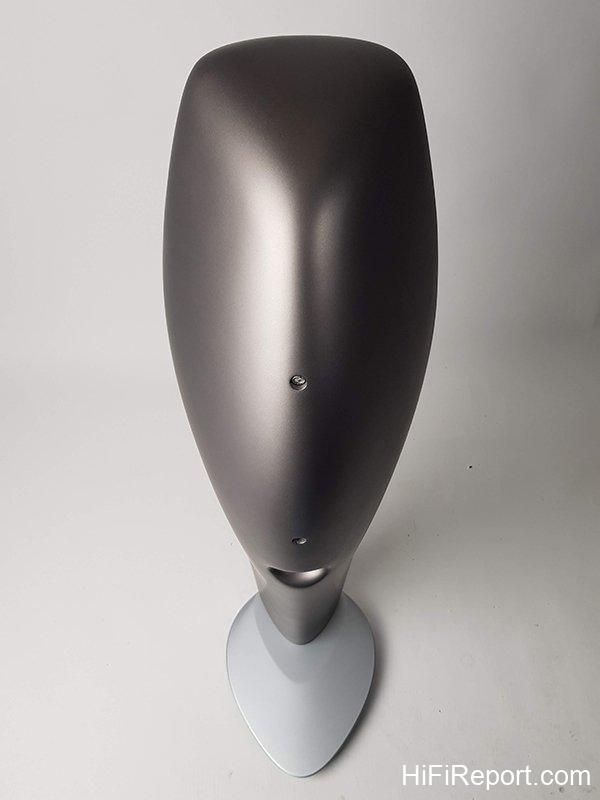
Their current flagship Giya series boasts a truly unique form, unlike anything else in the audio world. You won’t find a single visible screw, a parallel surface, or even a flat plane anywhere on these speakers.
Sonically, they deliver undeniably Hi-End performance – rich, powerful, and exceptionally articulate. They delve into the subtle nuances of music, connecting you directly to the emotional core of the performance.
Vivid Giya series speakers possess a captivating allure: they entice you with their sound and challenge your preconceptions with their appearance, much like the sirens of mythology.
Nautilus Designer’s Refined Creation
If you possess even a touch of imagination, seeing Vivid Giya might evoke another speaker in your mind – the Bowers & Wilkins (B&W) Nautilus.
Back in 1993, B&W introduced the Nautilus, showcasing two significant technological achievements. The first was the tapered tube design behind each driver. These meticulously calculated tubes, filled with specific sound-absorbing materials, effectively absorb the driver’s back wave. This results in more precise driver movement and cleaner sound.
Those “spikes” behind the tweeter and midrange drivers aren’t just for show; they are acoustically functional tubes.
For the bass driver, effective back wave absorption would require a tube exceeding 3 meters in length. To address this, the bass driver’s tube is coiled into a spiral shape, resembling a nautilus shell, hence the name.
The second major innovation was the cabinet itself.
Abandoning conventional wood, they collaborated with a factory specializing in racing car bodies, utilizing fiber composite materials cured with resin to construct the enclosure. The manufacturing process demanded hand-shaping and polishing by skilled artisans, making it a labor-intensive endeavor.
Why bring up the Nautilus? Beyond the visual resemblance, these two speaker families share a common lineage.
Laurence Dickie, the engineer who spearheaded the Nautilus design, later left B&W to pursue research in professional audio (PA) loudspeakers. However, his passion for Hi-End speakers remained, and he harbored further refinements for his Nautilus design.
At this juncture, Philip Guttentag of B&W South Africa, with aspirations to establish his own audio brand, connected with Dickie through Robert Trunz, former president of B&W. In 2002, Guttentag successfully founded Vivid Audio, enlisting Dickie to lead the design efforts.
Vivid’s initial flagship series, Giya, emerged, featuring that distinctive droplet shape—not for mere aesthetics, but for the back-wave guide. The aluminum alloy drivers and fiberglass composite cabinets echoed the Nautilus, yet represented Laurence Dickie’s more evolved vision.
If the Nautilus was the most revolutionary speaker design of the 1990s, then Vivid Audio embodies Laurence Dickie’s more mature and realized design philosophy.
Kaya: Vivid Audio for More Homes
As I mentioned earlier, Vivid Audio’s earlier Giya and Oval series, with their distinctive appearances, were born from acoustic principles, not arbitrary styling.
However, undeniably, such avant-garde aesthetics aren’t universally embraced, and the Giya series, targeting the Hi-End market, carried a high price tag, making them less accessible.
The company recognized this.
How could they broaden Vivid’s appeal? How could Vivid speakers grace more homes? These were the questions Vivid posed, and the impetus behind the Kaya series.
They partnered with a London-based product design firm, aiming to create a new series more palatable to a wider audience, while upholding Vivid Audio’s acoustic ideals and achieving a more approachable price point.
The Kaya series was born from this ambition.
Currently, the Kaya series comprises three floorstanding models: Kaya 90, Kaya 45, and Kaya 25. Future additions will include the Kaya S15 bookshelf speaker and the C25 center channel speaker. This expansion will soon enable consumers to assemble a Vivid Kaya multi-channel system – a first for Vivid, venturing beyond the realm of two-channel audio.
The Kaya 90 and 45, with their side-firing woofers concealed in the lower cabinet, exhibit a more substantial presence, both visually and sonically, delivering a richer, fuller sound.
In contrast, the Kaya 25, lacking the lower woofer section, presents a slimmer profile and a more agile sonic character.
Why discuss sound before delving into technology? Because sonic performance isn’t arbitrary; it’s the result of industrial design, the product of applied science.
This speaker’s sound is a direct consequence of its design choices.
When evaluating a speaker, I first listen to its sonic signature, then investigate its design. When these factors align causally, the product becomes coherent and logical.
Sandwich Construction and Non-Parallel Cabinet
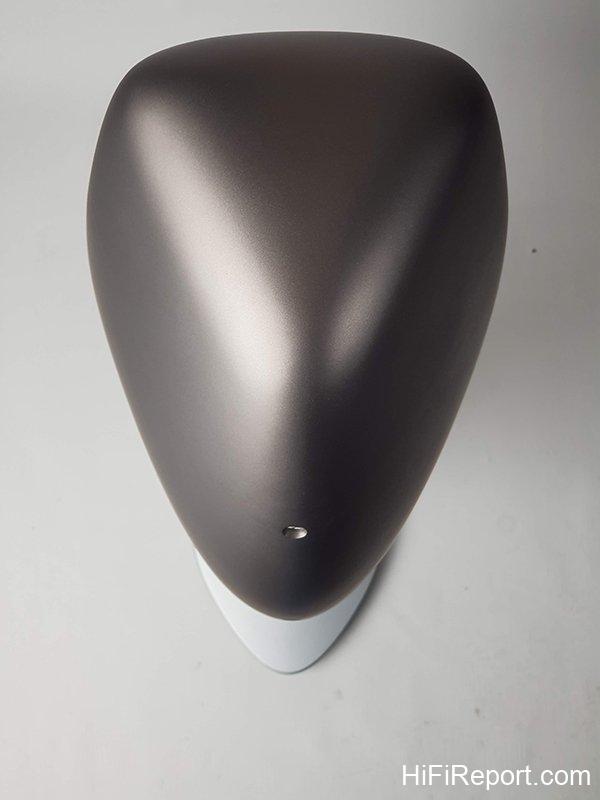
Like the flagship Giya series, Kaya cabinets employ a sandwich construction. The inner and outer layers are crafted from glass fiber, pressure-molded with varying techniques to enhance overall rigidity. A layer of foam material is sandwiched in between, formed using “double vacuum-pressured technology” borrowed from race car manufacturing. This process endows Kaya cabinets with lightweight, robust, and highly damped characteristics.
Therefore, when experiencing the Kaya 25 or any Kaya speaker, remember: you’re listening to technology derived from Formula 1 racing.
Furthermore, Kaya speakers incorporate a polymer material called Soric Foam as sound absorption. This material is strategically applied to the cabinet’s internal structure, absorbing reflections and reinforcing structural integrity.
The combination of a rigid, non-parallel cabinet and specialized sound-absorbing materials significantly reduces cabinet resonance and standing wave interference in the Kaya 25.
New Drivers Inherited from Giya Technology
The drivers in the Kaya series are descendants of Giya’s technological lineage.
The Kaya 25 is a 2-way, 2-driver design. The bass driver is a newly designed 125mm aluminum alloy cone, model C125D. This driver features a shorter magnetic gap and powerful rare-earth magnets, resulting in higher magnetic flux efficiency and more agile driver movement.
The tweeter is a 26mm convex dome. Recognizing that tweeter dispersion directly impacts perceived imaging and directionality, the Kaya 25 and other Kaya speakers incorporate a shallow waveguide around the tweeter.
This waveguide is pre-designed and seamlessly integrated with the cabinet. Beyond its elegant curve, it’s based on precise calculations.
Since the Kaya series targets smaller living spaces, controlling dispersion angles is crucial to minimize excessive reflections.
Vivid considered dispersion characteristics during Kaya driver development, and the waveguide further refines dispersion control. This not only allows for better integration within rooms but also ensures a smoother transition with the mid-bass driver.
Focused on Vibration Control and Back-Wave Absorption
Drivers are the source of speaker vibration, and internal sound waves can induce cabinet vibrations. Traditional speakers directly mount drivers to the cabinet, making it difficult to prevent vibration transmission and mutual interference.
Vivid’s solution for Kaya speakers involves non-memory silicone rings placed between the drivers and cabinet as damping elements. This reduces vibration-induced interference.
They also employ rear-mounting to secure drivers. Two hex screws visible on the Kaya 25’s rear panel are driver mounting screws.
They even addressed grille resonance.
The driver grilles on the Kaya 25, seemingly metallic, are actually made from a lighter composite material with superior damping.
The mid-bass driver grille is magnetically attached, easily removable with a slight twist to disengage the magnets.
While the speakers lack externally protruding tubes, the underlying technology remains, simply concealed within the cabinet.
The tapered tube loading is internal.
The tweeter has a pointed, conical tube behind it to eliminate back waves, and the same principle applies to the mid-bass driver. This design effectively absorbs driver back waves, minimizing cabinet resonance.
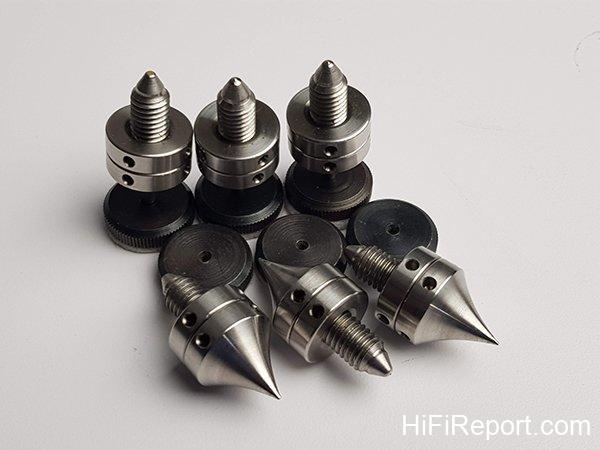
The cabinet’s shape, wider at the top and tapering downwards with flowing lines, rests upon a machined aluminum base. Metal spikes or soft pads can be fitted underneath, offering subtle sonic variations. Spikes generally enhance clarity.
Rich in Detail, Transparent, and Easy to Drive
Every design element of the Kaya 25 serves sonic performance.
Now, let’s discuss its sound.
Listening tests were conducted in HiFiReport’s listening room.
I experimented with various amplifiers available in the room, ultimately settling on the darTZeel LHC-208 integrated amplifier, which arrived concurrently.
This wasn’t a deliberate pairing due to coincidence, but rather because this combination yielded the most pleasing results.
darTZeel’s sound is characterized by high density, richness, and a certain brilliance, balancing speed and power. The LHC-208, compared to their higher-end models, possesses a touch more supple texture and warmth. Paired with the LHC-208, the Kaya 25 delivers both a solid, decisive sound and a hint of vivaciousness, lending an air of elegance.
The Kaya 25’s sound is instantly appealing. It boasts rich detail, refined texture, transparent imaging, vibrant energy, unrestrained power, and an expansive soundstage. Its overall performance perfectly embodies the brand name—Vivid—denoting liveliness and vibrancy.
Interestingly, despite a modest 85dB sensitivity rating from the manufacturer, the Kaya 25 isn’t difficult to drive. At equivalent volume levels, the Kaya 25 sounded even louder than the Dynaudio Contour 60, rated at 88dB.
My previous impressions of Vivid speakers were largely shaped by the Giya series. I remembered their speakers for their full, substantial bass, rendering music with grandeur and potency.
However, experiencing the Kaya series’ smallest floorstanding model, the Kaya 25, with its clear and balanced sonic presentation, revised my prior perceptions of Vivid Audio speakers.
Floorstanding Form, Bookshelf Speaker Essence
Considering the Kaya 25’s 2-way, 2-driver configuration, I’m hesitant to categorize it strictly as a floorstanding speaker. I’m more inclined to view it as a bookshelf speaker, albeit one with an integrated stand.
Is this accurate? In terms of frequency response specifications, yes. And based on the overall sonic character I perceived, also yes.
Further research confirmed that the manufacturer also views the Kaya 25 similarly. Its design, while inheriting Giya series principles, evolved from the Oval series, essentially integrating the Oval’s stand into the speaker itself.
Therefore, my understanding and judgment align with the speaker’s fundamental nature.
Balance Between Precision and Ease
So, how does it sound? The Kaya 25 presents a substantial yet precisely defined sonic image, rich in detail, conveying even subtle sonic nuances with clarity. However, it maintains a non-fatiguing, non-strident character, achieving excellent balance and effortless sound reproduction.
Precise yet effortless? Yes.
Take Holly Cole’s “Don’t Smoke in Bed” album as an example. This jazz album boasts exceptional recording quality and superb performances. Confession time: I’ve even used this album to persuade my wife to approve audio equipment purchases.
However, this album presents a challenge. Holly Cole’s vocals are incredibly detailed, capturing every breath, lip movement, and subtle vocal inflection. On systems that are overly analytical or emphasize the mid-high frequencies, some listeners might find it fatiguing.
But on a balanced system with a solid, full-bodied sound, the vocals, bass, piano, and saxophone sound remarkably real, creating a palpable sense of presence.
Listening on the Kaya 25, I was captivated by the exquisite vocals and instrumentation.
Holly Cole’s voice is dimensional, rich in articulation detail, with vocal inflections revealing the singer’s breath control and body resonance, creating diverse timbres.
The bass performance is equally compelling.
The Kaya 25, with only a 125mm mid-bass driver handling frequencies below 3000Hz, leverages its integrated cabinet design to produce a fuller, deeper, and more spacious bass than comparable bookshelf speakers.
The bass plucks are tangible, dynamic, and visually evocative, with a textured, articulate quality that’s truly satisfying.
Sometimes, less bass is more. Excessive or overly dense bass can obscure detail. The Kaya 25’s bass, in contrast, sounds healthy and natural.
Direct Sound, Free of Harshness
Although both tweeter and mid-bass drivers utilize metal diaphragms, the sonic character is surprisingly smooth, more so than I anticipated.
Listening to Rado Lupu’s piano performance and Andre Previn conducting the London Symphony Orchestra in Schumann’s Piano Concerto, the Kaya 25 fully captured the music’s tender and romantic essence.
The powerful opening chords are delivered with authority, the piano entering with a resolute, assertive statement. This striking introduction, as rendered by the Kaya 25, sounds both crisp and grand.
Then, the woodwinds take the lead, presenting the first theme, followed by the piano’s restatement, and then the strings. I perceived a clear, transparent soundstage.
The piano tone is warm, gently conveying Schumann’s affection for Clara.
As the piano cascades down in arpeggios, reaching the lower octaves, the Kaya 25, while stretching its capabilities, achieves a bass solidity approaching that of a mid-sized floorstanding speaker.
When the low strings swell, the sound possesses substantial weight, full yet not bloated, maintaining high sonic clarity throughout.
The Kaya 25’s sound is direct, yet free of harshness.
It presents music with minimal coloration, like objects illuminated by direct midday sunlight – unbiased, unembellished, and unreserved.
At this point, I’m even more convinced that pairing it with the darTZeel LHC-208 is an exceptional match. As mentioned earlier, this experience can serve as a valuable reference for your own system matching – prioritize amplifiers with high density and solid, full-bodied sound. This will complement the speaker’s inherent high resolution and transparency, further enhancing sonic performance and ensuring unconstrained music reproduction.
Excels in Brass Brilliance, Full of Musical Energy
The Kaya 25’s abundant sonic energy and brilliant timbral palette are evident in Sibelius’s Finlandia.
The version I listened to was Ashkenazy conducting the HiFiReport Orchestra, a recording renowned for its sonic excellence. The Decca 2CD reissue has a slightly brighter tonal balance, which is well-complemented by systems with a richer, warmer sonic foundation.
But would the metal-diaphragm, 2-way Kaya 25 sound strident? My answer is—magnificent! The Kaya 25’s bass extension might not match the 45 and 90, let alone the Giya series, but this piece demands a sense of unrestrained energy. The Kaya 25 delivers the piece’s rich colors and surging momentum fully.
When discussing Schumann’s Piano Concerto, I noted the Kaya 25’s metal tweeter lacked harshness and even possessed a touch of smoothness.
But now I hesitate; should I retract that statement? While I did perceive that quality with that CD, hearing the brass in Finlandia, with its spicy bite, it’s hard to describe as smooth. Instead, I’d say the Kaya 25 renders brass with metallic sheen. This sound is like warm sunshine, like the midday sun – a searing intensity emanating from the core.
Sibelius used music to ignite Finnish national sentiment against Russian autocratic rule. Hearing the passionately unrestrained brass, who wouldn’t rise up for their homeland? Listen to the timpani strikes, the drums rolling in from afar, interwoven with the orchestral tutti, each beat rendered with distinct clarity.
In this moment, the Kaya 25’s scale and impact rivaled that of larger speakers.
This is Finlandia, exhilarating and uplifting!
Crisp Definition, Agile and Lively Musicality
Switching back to chamber music, I put on Anne-Sophie Mutter and Andre Previn’s “Tango Song and Dance.”
Tango is a partner dance; one cannot tango alone. This piece is Previn’s heartfelt creation for his then-wife Mutter. Music transformed into dance, expressing profound affection.
Mutter’s violin playing is vibrant and lively, full of unrestrained emotion. The tactile texture of bow on string is vivid, with a touch of assertive quality, yet not harsh.
Compared to other speakers, the Kaya 25, in playing this piece, highlights the tango’s decisiveness, rigor, and exhilarating agility.
Not only is the violin sound direct and forceful, but so is the piano.
In tango, the male lead typically dictates, while the female partner follows, rhythmically mirroring his steps to develop the dance.
However, in this piece, Mutter and Previn seem to have reversed roles. The violin takes center stage, with the piano primarily providing accompaniment and support.
Yet, their synergy is remarkable. Mutter’s playing style perfectly complements Previn’s, their expression unified. The piano’s articulation is crisp and decisive when assertive, yet tender and nuanced when flowing gently.
In this interplay, the Kaya 25 delivers clearly defined contours, with both agility and precision.
It can expand and contract dynamically. Large-scale passages possess grandeur, while delicate passages reveal refinement. This is the Kaya 25’s strength.
Delicate Musicality at Low Volumes
Listening to this album, I also discovered that the Kaya 25’s transparent sonic character, paired with the LHC-208’s refined sonic texture, allows for comfortable low-volume listening with chamber music.
Even at low volumes, the music’s ebb and flow, its dynamic nuances, remain distinct. In a quiet environment, the music presented at low levels becomes even more captivating – the piano more crystalline, the violin more delicately nuanced.
This musical atmosphere is a refined pleasure, one you should experience.
Infusing Home with Happiness
Vivid Audio’s dedication to the Kaya series is evident in the Kaya 25.
Its “Vivid” vitality makes music listening thoroughly enjoyable.
And do you know the meaning of “Kaya”? It’s Zulu for “home.”
Do you desire your home to be filled with the joy of music and brimming with happiness? Try the Vivid Kaya series speakers. The approachable Kaya 25 might be the perfect starting point.
Specifications
* Type: 2-way, 2-driver bass-reflex floorstanding speaker
* Drivers: 26mm metal dome tweeter × 1, 125mm metal cone mid-bass × 1
* Frequency Response: 40Hz~25kHz (-6dB)
* Sensitivity: 85dB
* Impedance: 8 ohms
* Crossover Frequency: 3kHz
* Recommended Amplifier Power: 15~125 watts
* Dimensions: 1,160 × 263 × 340 mm (H×W×D)
* Weight: 24 kg