
W5800 Review
As previously mentioned, the most significant design difference between the W5800 and the W5700 lies in the light source. The W5700 utilized a lamp with a lifespan ranging from 4,000 to 10,000 hours, whereas the W5800 features a laser array light source with a lifespan of approximately 20,000 hours in Normal mode and around 25,000 hours in Eco mode.
Besides offering a longer lifespan and more stable light output, the laser source also boasts higher light output intensity and dynamic contrast ratio. The previous generation W5700 had a light output intensity of about 1800 ANSI lumens and a dynamic contrast ratio of roughly 100,000:1. The laser-powered W5800 elevates these figures to 2600 ANSI lumens and an impressive 2,000,000:1 respectively.
This represents not only an 800-lumen increase in brightness but also a staggering 20-fold improvement in dynamic contrast, underscoring this home theater projector’s enhanced capability for “ambient light projection.”
Color Performance
In 2019, the W5700 was BenQ’s first projector capable of achieving 100% DCI-P3 coverage. At the time, any home theater projector exceeding 90% DCI-P3 coverage was considered top-tier, which gives you an idea of how strong the W5700’s color rendering capabilities were. Five years later, effortlessly mastering DCI-P3 has become standard practice for BenQ displays, and for the current flagship home theater model, the W5800, it’s naturally a piece of cake.
The W5800 utilizes BenQ Cinematic Color as its core color rendering technology. This color management technology targets three crucial calibration goals: Rec.709, DCI-P3, and precise D65 color temperature. Under the training and certification of THX and ISF, the BenQ color tuning team strives to ensure that projectors employing this technology achieve 100% Rec.709 standard color gamut.
High-end theater models also target 100% DCI-P3 for color definition, meeting the wide color gamut standard of commercial digital cinemas.
Beyond color gamut, accurate color temperature and precise color calibration are also key focuses. With the W5800, BenQ provides a color accuracy report in the box, demonstrating that each unit undergoes an independent factory calibration process before shipping. This report uses measured data to confirm that 100% Rec.709 coverage and grayscale white balance performance meet a Delta E < 2 standard. It also complies with the ISFccc professional image calibration technology certification.
Picture Quality
High-end home theater models have always been the face of projector brands, and as a flagship product, the W5800 not only boasts a wide DCI-P3 color gamut and precise color calibration but also incorporates BenQ’s most advanced picture optimization technologies. Firstly, the W5800 features BenQ’s exclusive HDR Pro technology, which utilizes HDR Tone Mapping to optimize highlight and shadow details in HDR images, accurately restoring the appearance of the original HDR content.
Simultaneously, Local Contrast Enhancer (LCE) divides the picture into over 1000 fine zones for optimized contrast calculation in each area. This detailed zone adjustment ensures nuanced contrast effects and image clarity in both bright and dark parts of the scene.
Furthermore, the W5800 also employs a dynamic aperture to achieve full-picture light control. The projector detects different image content and scenes, controlling the projector’s optical system and adjusting the projection light output to deliver outstanding dynamic contrast. This results in a projected picture that closely resembles the viewing experience in a commercial cinema.
Calibration Features
The W5800 also comes equipped with a practical 11-step white balance correction feature. This advanced color temperature calibration technology, first seen on the W4000i and V5000i laser TVs, allows users to independently adjust R, G, and B levels by ±50 for 11 white balance IRE steps (5%, 10%, 20%… 100%). This enables more precise tuning for accurate color temperature effects.
Simultaneously, the W5800’s color management menu provides HSL (Hue, Saturation, Luminance) adjustments for RGBCMY, and independent RGB gain control for white, offering users a wide range of versatile picture calibration parameters.
Lens & Setup
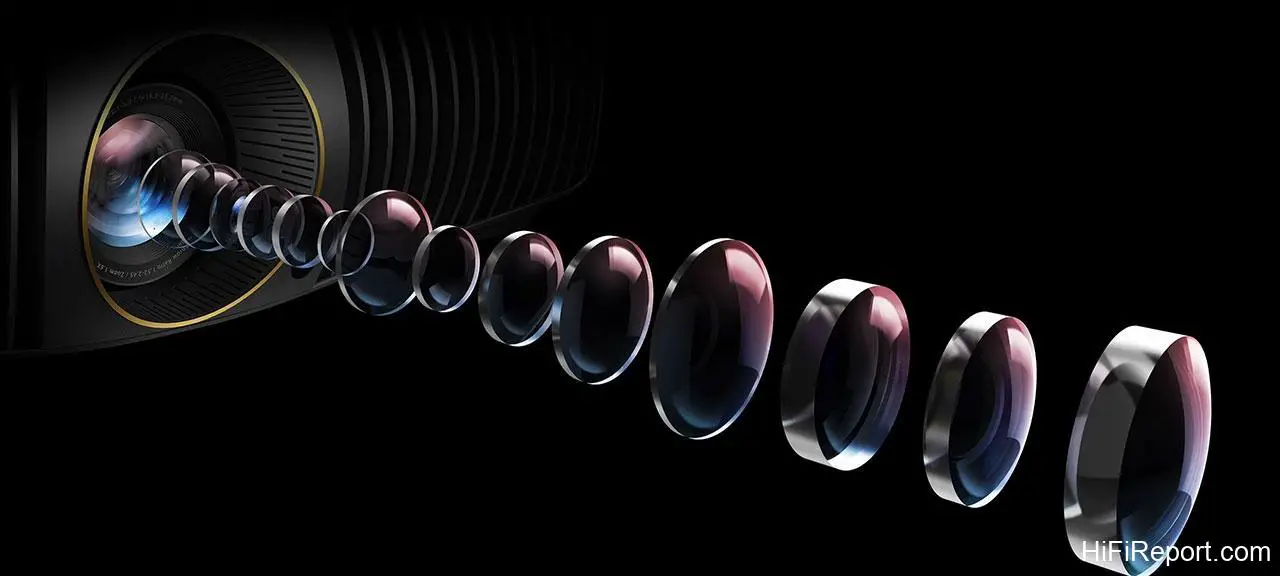
BenQ has always placed great emphasis on projector lens design, especially for high-end home theater models. The W5800’s lens module uses 14 custom-made elements, significantly different from the W5700’s 6 groups of 11 elements. Among the W5800’s 14 elements are aspherical lenses coated with low-dispersion materials, resulting in superior 4K image uniformity and clarity. This is why projecting a 200-inch picture is not an issue for the W5800.
The W5800 is equipped with both vertical and horizontal motorized lens shift, offering ±50% vertical and ±21% horizontal movement. This wide adjustment range provides flexibility for installation in different audiovisual environments. The W5800 also features 1.6x motorized optical zoom, further enhancing installation flexibility. The projector can project a 150-inch screen from a distance of 5 to 8.1 meters.
Connectivity & I/O
Unlike the context when the W5700 was launched five years ago, people today expect projectors to meet various multimedia entertainment needs. Besides watching movies and TV shows, why not use a top-tier home theater projector for gaming? Consequently, BenQ has paid particular attention to the W5800’s I/O planning. It features the standard configuration of “dual HDMI terminals” found on BenQ’s mid-to-high-end projectors.
Both HDMI ports support HDCP 2.2 high-bandwidth digital content protection, and the input lag can be as low as 13ms (1080p/120Hz). HDMI 1 also supports eARC and can transmit 7.1 channel and Dolby Atmos audio.
For USB ports, there is a pair of Type-A ports. Besides allowing access to USB device content, they provide 2.0A and 1.5A power supply respectively. The W5800 does not have built-in speakers, so in addition to audio transmission via eARC, the optical output is another option. The back panel also includes RS-232, LAN, and a 3D Sync output terminal, providing a comprehensive overall layout.
Viewing Experience
The W5800’s picture brightness is quite high. During my testing, I momentarily had the illusion of looking at an LCD display – that uniformly distributed brightness and the crystal-clear picture rendered by vibrant colors, showcasing the familiar premium visual quality characteristic of BenQ projectors.
In addition to uniform brightness, BenQ’s consistent standard D65 color temperature provides a natural foundation for the image, while the nuanced color reproduction fully highlights the high resolution capability of 4K quality.
Five years ago, the W5700 had a built-in “Dark Cinema” mode. This mode could expand the color gamut to approach 100% DCI-P3 through color space expansion, and further enhance the color gamut expansion effect for different modes (Rec.709, DCI P-3) using the “WCG” wide color gamut setting. The W5800 removes this feature.
Its native color gamut settings for different image modes are very clear: Bright and Bright Cinema correspond to 100% DCI-P3, while Cinema and Filmmaker define the color standard based on Rec.709. When paired with HDR, HDR10, HDR10+, and HLG content, it can present diverse picture effects.
If you’re using the W5800 in a living room or another open audiovisual environment at home where complete light blocking isn’t possible, I recommend using the Bright Cinema mode, which corresponds to 100% DCI-P3. This mode has a higher overall picture brightness, and the CMY settings are more accurate than the Bright mode.
You can also further refine complementary color accuracy using the advanced color temperature adjustment and color management menus to enhance the color effect when watching movies or TV shows. If you are using the W5800 in an audiovisual space with better light blocking, I recommend using the Cinema mode or Filmmaker Mode. With the native film color effect of Rec.709 and precise D65 color temperature, you can experience a viewing effect similar to watching in a cinema.
As a high-end home theater projector, the W5800’s HDR performance is naturally a key area of my evaluation. The W5800 maintains the fundamental characteristics of BenQ home theater projectors’ HDR images: vivid contrast, high continuity in bright and dark grayscale, and abundant detail information in highlights and shadows. These picture elements, combined with the high light output performance of the laser source, make the overall “brightness” of 4K HDR images even more pronounced.
High brightness has always been a strong point for achieving optimal HDR effect, and the W5800 fully leverages this advantage to make the bright and dark details of the picture stand out even more thoroughly.
Neon signs shining brightly on the street at night not only show clear text and pattern outlines but also, in shots where different colored signs and streetlights are interwoven, the sharp delineation between light and dark areas and color separation create a stunning and dazzlingly beautiful night view.
Visual Delight
This color characteristic, where adjacent tones do not bleed into each other and colors maintain high independence, naturally transforms into an unparalleled visual enjoyment when reflected in movie scenes. I’ll use an example from “Top Gun: Maverick”. We all know this movie is a sonic powerhouse, and previously it wasn’t often cited for its color visuals. But when I watched this movie on the W5800, many fleeting moments left a deep impression because of the prominence of the colors.
For instance, the vibrant colors on the pilots’ helmets highlighted each character’s expression in the cockpit. In the hangar under the morning sun, the translucent silver paintwork of the P-51’s skin and the lively red spray paint on its nose and tail gave this privately-owned Mustang fighter belonging to Tom Cruise a strong sense of physicality.
Watching the scenes of it soaring through the sky in the sunset, compared to the exciting air combat scenes, presented a unique sense of color harmony and warm atmosphere. Viewing it on a 120-inch projection screen with the W5800 brought back the memory of watching this film three times in the cinema.
Conclusion
Having tested projectors for a long time, I’ve gradually come to understand that a good projector has the ability to evoke cherished visual memories from the past. I haven’t encountered a product as delightful as the BenQ W5800 in quite some time. As soon as the movie starts, it immediately showcases its prowess.
It has everything a top-tier home theater projector should: vibrant colors that fully comply with the standard DCI-P3, crystal-clear picture quality rendered by advanced projection technology, and the added benefit of high brightness. If you asked me to recommend a home theater projector around the $5,100 USD price point this year, this one would absolutely be my choice.
Specifications
* Type: Laser 4K Home Theater Projector
* Light Source: Laser
* Light Source Lifespan: Approx. 20,000 hours (Normal mode), Approx.25,000 hours (Eco mode)
* Native Resolution: 3840×2160
* Light Output: 2600 ANSI Lumens
* Dynamic Contrast Ratio: 2,000,000:1
* Throw Ratio: 1.52~2.45
* Zoom Ratio: 1.6x
* Keystone Correction: Vertical ±35 degrees, Horizontal ±35 degrees
* Lens Shift: Vertical ±50%, Horizontal ±21%
* Terminals: HDMI×2 (one supports eARC), USB Type A×2, S/PDIF Optical Output×1, 3D Sync Output×1, RJ-45 LAN×1, RS232×1
* HDR Support: HDR10, HDR10+, HLG
* Picture Technology Features: HDR Pro technology, 11-step White Balance Color Calibration System, Filmmaker Mode
* Input Lag: 13ms (1080p/120Hz), 17.9ms (1080p/60Hz), 17.9ms (4K/60Hz)
* Dimensions: 525.2×145.7×392.2mm