
Wharfedale AURA Multichannel Speaker Review
If you’re familiar with Wharfedale, you’ll know they are part of the vast IAG Group, a powerhouse with immense audio resources. Their R&D capabilities and production scale are far beyond those of smaller audio manufacturers. This allows Wharfedale to create flagship-level speakers like the Elysian, employing top-tier craftsmanship and materials, while still upholding their tradition of high value. The result is high-end audio quality made accessible to enthusiasts on a more approachable budget.
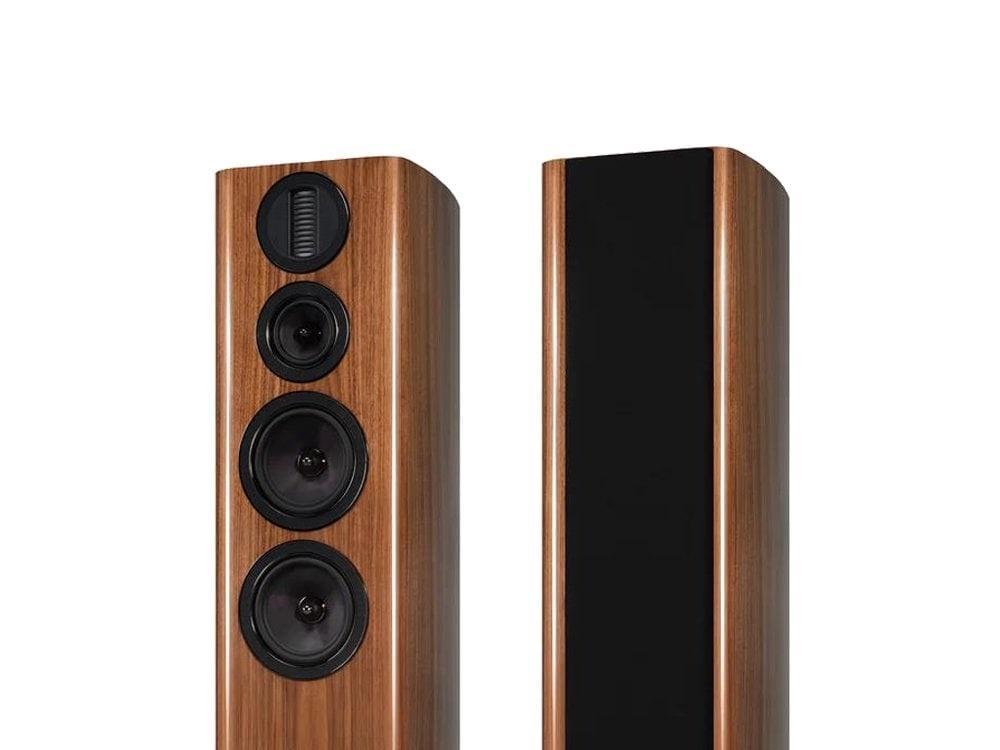
Recently, Wharfedale has once again pushed the boundaries of value with the introduction of the AURA series, positioned just below their flagship. While the AURA speakers differ from the Elysian in external design, most of their driver technology and cabinet construction are direct descendants of the flagship line. Take the AURA 3 floorstanding speakers reviewed here, for instance; their price is less than half that of the Elysian 4.
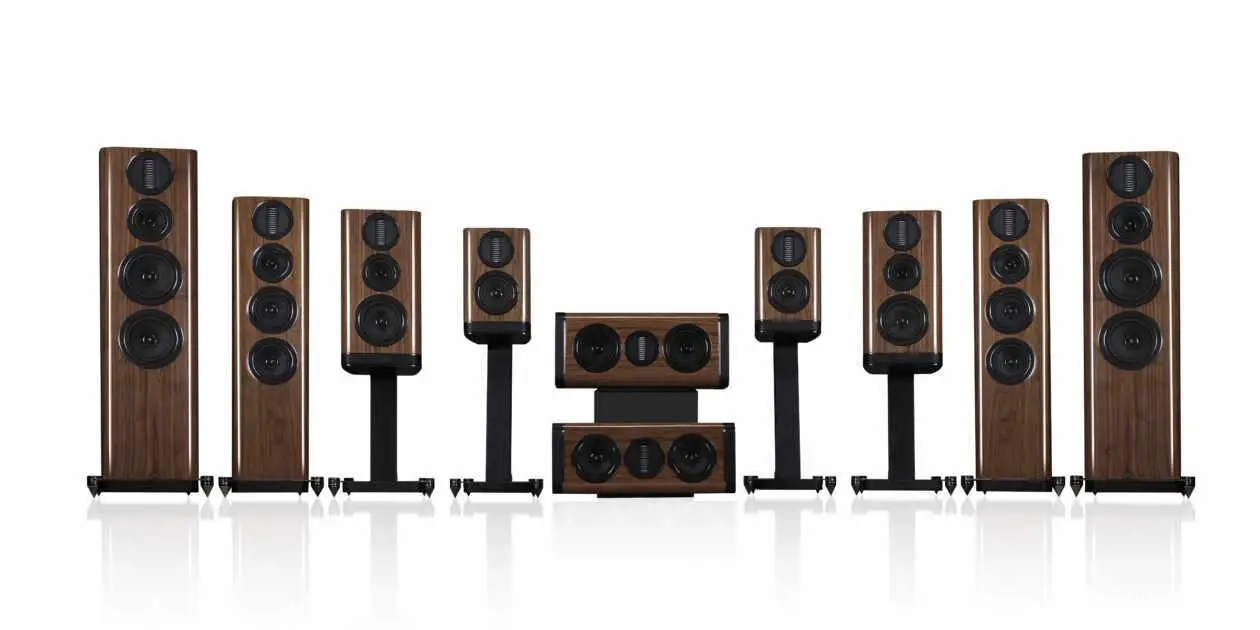
Furthermore, the AURA series boasts a more complete product lineup, including two floorstanding models (AURA 4 and AURA 3), two bookshelf models (AURA 1 and AURA 2), and even two center channel options (AURA C and AURA CS). This extensive range not only caters to two-channel listening but also fills the gap left by the Elysian series, which doesn’t offer a dedicated home theater solution.
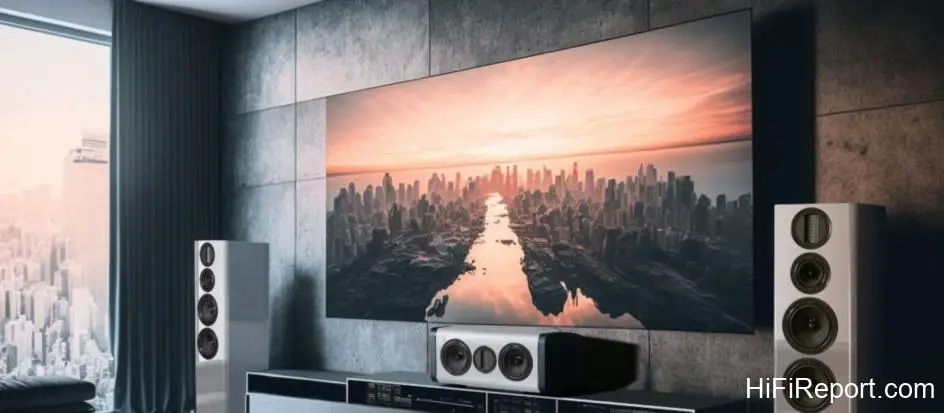
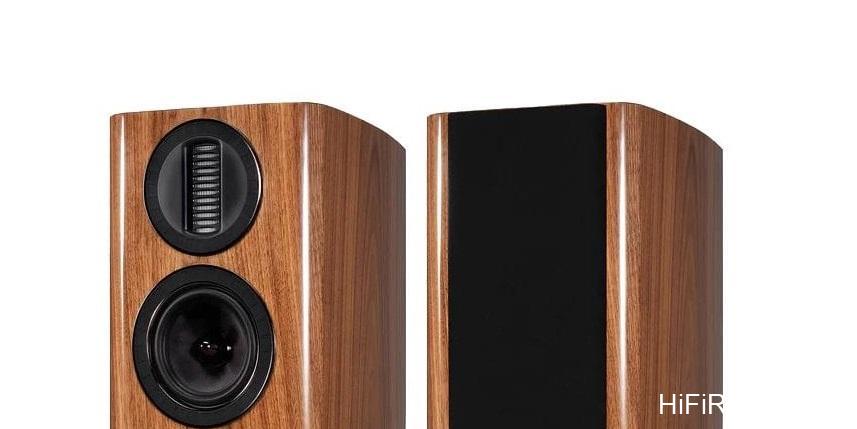
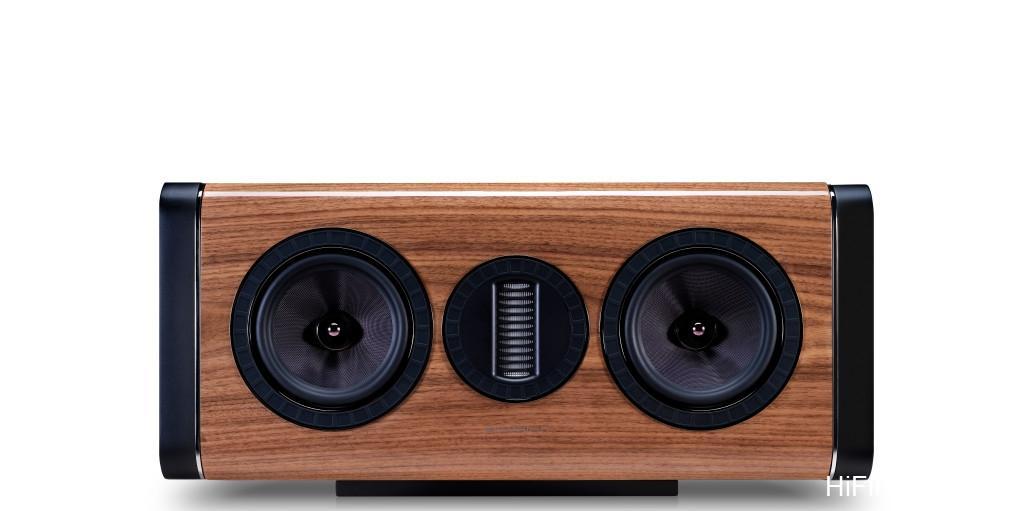
To address this, the distributor provided a 5-channel system for this review, featuring the AURA 3 floorstanders as the main L/R, AURA 1 bookshelf speakers for surrounds, and the AURA CS center channel. Home theater enthusiasts can finally experience the cinema prowess of Wharfedale’s top-tier speakers!
Design & Build
Upon seeing the AURA 3 speakers in person, a knowing smile crossed my face. They look remarkably like a “slimmer” version of the Elysian, sharing a very similar sophisticated aesthetic. The speakers are available in three finishes: Black, White, and Walnut Wood, each coated with six layers of piano lacquer. Every layer requires meticulous sanding before the next is applied, culminating in the final lustrous finish – a process just as labor-intensive as on the flagship models.
The AURA cabinets are constructed from multiple layers of different woods, a technique Wharfedale calls PROS (Panel Resonance Optimisation System). This system leverages the resonant characteristics of different materials to couple them effectively, significantly reducing cabinet resonance and resulting in purer sound quality. Like the Elysian, the AURA cabinets feature a curved design that is wider at the front and tapers towards the rear.
The purpose is to break up internal standing waves and minimize diffraction effects from the drivers, leading to more precise imaging and improved soundstage performance in a home theater setting.
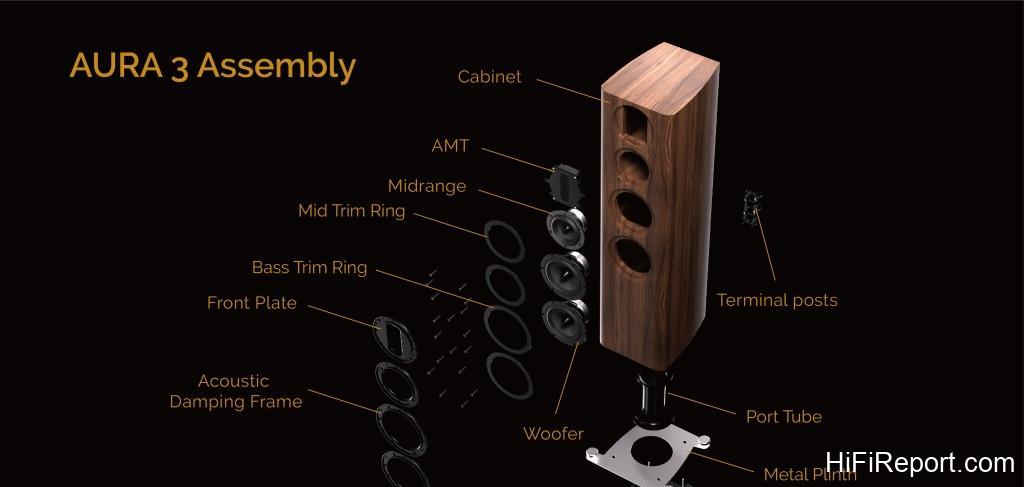
The AURA 3 floorstanders feature Wharfedale’s SLPP (Slot Loaded Profiled Port) bass reflex technology at the base. While having a downward-firing port isn’t uncommon, the AURA 3 adds a base platform below the port. The opening is located on the sides, creating a precisely calculated gap of about 3cm between the base and the cabinet bottom.
This gap and the port profile are meticulously designed by the engineers to optimize the coupling of internal and external air pressure, boosting the efficiency of the bass reflex system and allowing for deep bass extension down to 39Hz. Acoustic foam is inserted into the gap to minimize port noise and air turbulence. When paired with the specially designed steel spikes for the AURA 3, this system helps achieve cleaner bass with richer detail.
Driver Technology
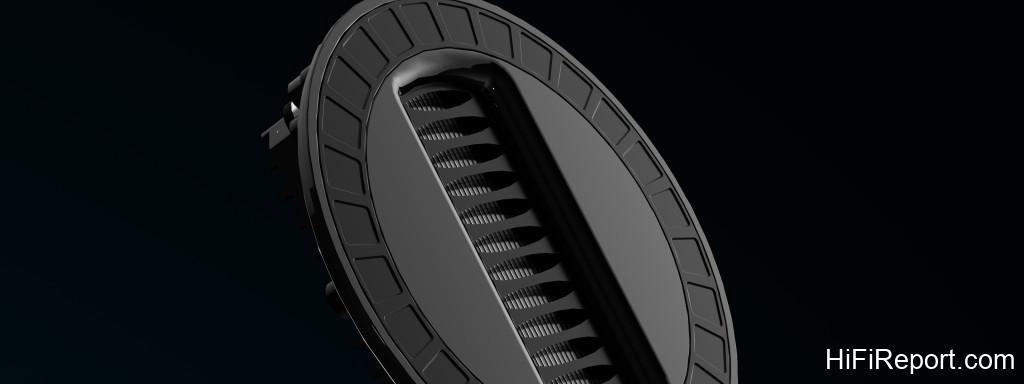
The most significant highlight of the AURA 3 is the direct inheritance of driver technology from the Elysian. It features a 3-way, 4-driver configuration, incorporating an AMT (Air Motion Transformer) tweeter. This tweeter utilizes a pleated diaphragm with printed coils, folded like an accordion. Changes in the magnetic field from the coils interacting with the magnetic system cause the pleats to compress and expand, displacing air and producing sound waves.
Compared to conventional soft dome tweeters, AMT diaphragms are lighter and thinner, free from the weight of a voice coil and former, offering faster response and avoiding the cone breakup distortion inherent in dynamic drivers. This naturally reveals more high-frequency detail.
Furthermore, if the AMT diaphragm were unfolded, its surface area would be many times larger than that of a traditional dome tweeter. Wharfedale’s AMT tweeter is even larger than typical AMT units, measuring 27mm x 90mm. This allows it to effortlessly move more air, resulting in higher sensitivity and a more open and expansive high-frequency presentation.
Looking at the AURA 3’s specifications, the crossover point is set at 3.3kHz, and the high-frequency extension is listed as 22kHz. This seems quite conservative for an AMT tweeter, but it’s intentional – designed to keep the AMT driver operating within its optimal range, minimizing distortion at its lower frequency limit. This approach, however, places high demands on the midrange driver’s upper frequency capability.
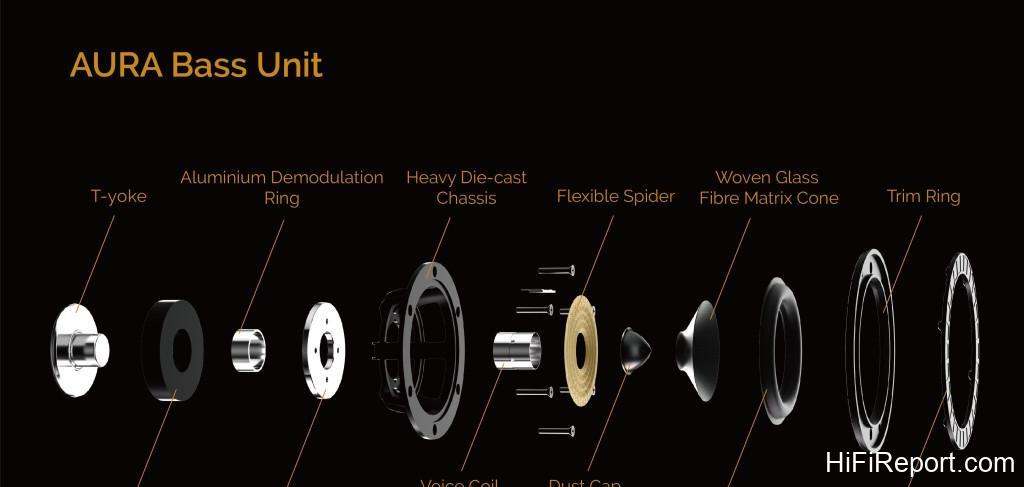
The AURA 3 is equipped with a 4-inch midrange driver and two 5-inch bass drivers. Wharfedale has developed a patented glass fiber woven diaphragm specifically for these drivers, paired with highly elastic rubber surrounds. To ensure maximum electromagnetic induction for the voice coil, they utilize copper-plated pole pieces to control eddy currents and inductance, thereby enhancing driver control and sensitivity.
Consequently, the AURA 3’s midrange driver can extend to higher frequencies. A phase plug is strategically placed in the center of the mid and bass drivers to refine their radiation pattern, ensuring a more uniform frequency response distribution and seamless integration with the tweeter – a key factor in the AURA 3’s excellent sound quality.
Internal Construction & Terminals
Beyond the drivers, the AURA 3 incorporates advanced internal construction. The magnetic systems are mounted onto cast aluminum frames, each secured to the cabinet with six high-strength bolts, providing a solid foundation for the drivers’ motion. A rubber isolation ring is positioned between the frame and the cabinet to dampen vibrations between the metal and wood, reducing coloration.
Turning to the rear, the AURA 3 features bi-wire terminals. The entire AURA series comes supplied with high-quality jump wires, which offer superior conductivity compared to standard jumper plates, ensuring optimal driver performance.
Center and Surround Speakers
Moving to the center and surround channels, the AURA CS center and AURA 1 surrounds both utilize a 2-way design. The AURA CS adds an extra mid-bass driver to reinforce the crucial midrange frequencies for home theater dialogue, enhancing the impact and solidity of frontal sound effects and voices. Both the center and surround speakers employ the same 5-inch mid-bass drivers as the main AURA 3 speakers, ensuring the most fluid channel transitions possible.
Combined with the broad sound dispersion of the AMT tweeter, this AURA multichannel system creates a denser, seamless surround sound field without audible gaps.
Listening Tests
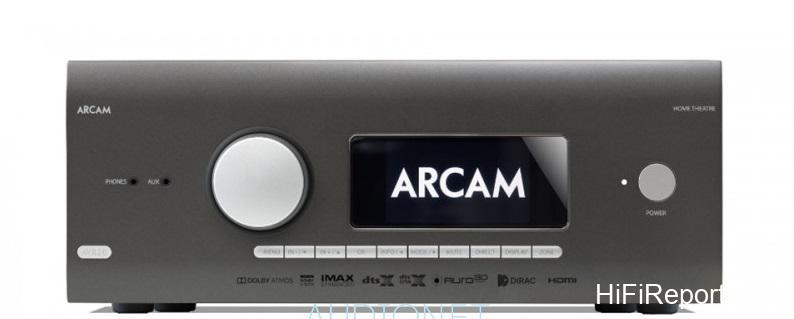
For the review, I used the Arcam AVR21 surround receiver to drive the AURA speakers, paired with our in-house Velodyne VI-Q12 subwoofer to form a 5.1 channel system. The source was a Sony A80J 4K OLED TV.
Starting with pure two-channel listening, the AURA 3’s sound leans towards warmth, but it exhibits excellent control in the lower frequencies. Compared to Wharfedale’s entry-level speakers, it’s more neutral and refined when playing music. With the benefit of the AMT tweeter, transparency and detail retrieval are significantly enhanced.
For example, listening to Hilary Hahn’s performance of “Brahms Violin Concerto,” the AMT tweeter immediately showcased its prowess. First, the speakers have excellent dispersion! The sense of space in the concert hall was finely rendered; subtle reverberations and the murmur of the audience sounded incredibly natural, making the speakers seem to disappear into the room. The speakers’ substantial mid-bass richness lent a full, weighty character to the opening string accompaniment.
The violin’s tone was smooth and sweet, without an overly emphasized sheen on the high frequencies, yet the rounded details of the bowing were clearly audible, highlighting the warm resonance of the wood. This approach made the intense passages less aggressive, adding a smooth, listenable quality to the music. When faced with orchestral dynamics, the speakers conveyed a strong sense of scale without excessive energy, allowing the details within each section to remain clear.
Furthermore, the AURA 3’s mid-bass region is taut and solid. Even without a subwoofer, the impact was quite potent. For instance, playing “Red Miso” by the progressive metal band Animals As Leaders, the rapid-fire kick drum rhythm hit like a barrage straight to the head. You could feel the weight and impact with every beat, hitting your chest. The electric bass had a springy texture, full of satisfying feedback.
While the bass was fast, a slight bloom in the tail end added fullness and body, making it incredibly satisfying for rock music.
Next, I tested the speakers’ home theater capabilities with a 5.1 setup. The AURA’s sound quality in this context is characterized by a relaxed yet refined style, and with the subwoofer’s assistance, the bass gained significant impact. Playing the Netflix movie “Midway,” the AURA’s portrayal of ambient sounds was incredibly immersive. As the Japanese officers strategized in the ship’s cabin, the confined space felt palpable.
The sound of waves and thunder from outside the ship distinctly appeared to come from beyond the listening room, creating a striking contrast with the narrow interior – it sounded remarkably realistic! I believe this is due to the seamless transition between channels, enabling such a detailed sense of envelopment.
In the aerial combat scenes, the familiar Wharfedale home theater power erupted, but this time with added exquisite detail and sonic density. As aircraft soared overhead, I felt not only their massive, solid presence but also the deep roar of their engines, conveying a powerful, overwhelming force! Simultaneously, the contrast between near and far sound effects in the surround field was very strong, and in 5.1 channels, the soundstage dimensionality was excellent!
Machine gun fire during the dogfights was explosive and impactful. Amidst the chaos, the trajectories of bullets whizzing by were both fierce and clear. What was even more impressive was how the speakers kept complex sound mixes well-organized, allowing me to clearly identify bullet sources and pinpoint sound effects. They even rendered the broad, sweeping background score beautifully, ensuring that the war movie wasn’t just impactful but also delivered refined detail and sonic artistry.
Whether for pure music playback or sound effect reproduction, the performance was remarkably close to that of the flagship Elysian speakers!
You can feel the manufacturer’s sincerity in this AURA home theater speaker system. It brings the expansive musicality of the flagship speakers into the realm of home theater sound, delivering movie soundtracks with both thrilling impact and subtle refinement. If you appreciate the musical quality of the Elysian, this AURA system allows you to easily acquire Wharfedale’s flagship-level home theater sound at a more accessible price point.
Specifications
**AURA 3 Floorstanding Loudspeakers**
* Type: 3-way, 4-driver, Bass Reflex
* Drivers: 1x 27mm x 90mm AMT tweeter, 1x 5-inch Glass Fibre woven cone midrange, 2x 5-inch Glass Fibre woven cone bass
* Frequency Response: 39Hz – 22kHz
* Crossover Points: 460Hz, 3.3kHz
* Recommended Amplifier Power: 25 – 150W
* Sensitivity: 88 dB (1W@1M)
* Maximum SPL: 104dBA (pair)
* Nominal Impedance: 6 Ohms (8 Ohms compatible)
* Dimensions (H.W.D. ): 40.827 x 9.685 x 13.779 inches
* Weight: 23 kg (50.7 lbs)
**AURA 1 Bookshelf Loudspeakers**
* Type: 2-way, 2-driver, Bass Reflex
* Drivers: 1x 27mm x 90mm AMT tweeter, 1x 5-inch Glass Fibre woven cone mid-bass
* Frequency Response: 48Hz – 22kHz
* Crossover Point: 2.9 kHz
* Recommended Amplifier Power: 25 – 100W
* Sensitivity: 86 dB (1W@1M)
* Maximum SPL: 103dBA (pair)
* Nominal Impedance: 6 Ohms (8 Ohms compatible)
* Dimensions (H.W.D.): 14.41 x 9.69 x 13.86 inches
* Weight: 12.5 kg (27.6 lbs)
**AURA CS Center Channel Loudspeaker**
* Type: 2-way, 3-driver, Bass Reflex
* Drivers: 1x 27mm x 90mm AMT tweeter, 2x 5-inch Glass Fibre woven cone mid-bass
* Frequency Response: 56Hz – 22kHz
* Crossover Point: 2.4 kHz
* Recommended Amplifier Power: 25 – 150W
* Sensitivity: 88 dB (1W@1M)
* Maximum SPL: 105dBA (pair)
* Nominal Impedance: 6 Ohms (8 Ohms compatible)
* Dimensions (H.W.D.): 9.92 x 24.21 x 13.86 inches
* Weight: 18.6 kg (41 lbs)