
Wireworld Oasis 8 Review
In recent years, the surge in audio cable prices has become a major headache for newcomers to Hi-Fi, especially when it comes to speaker cables. These typically require the greatest length within a system and are often the most expensive per metre among cables of a similar class.
For any brand with even a modest reputation, mid-range and higher speaker cables can easily cost hundreds or even thousands of dollars, often rivalling the price of entry-level sources or amplifiers, making them a difficult purchase for many. Yet, their importance cannot be overstated, as they directly impact compatibility with your speakers and the overall sound reproduction. If you use cables of insufficient quality, even the most capable audio system may struggle to perform at its best.
Therefore, choosing a speaker cable that is relatively affordable, tonally neutral, and of good quality is a priority for all beginner audiophiles.
Why Choose Wireworld?
If you were to ask me to recommend budget-friendly cables that sound excellent, Wireworld from the US would definitely be my top choice. Their product technology is transparent; not only do they provide clear diagrams for each cable structure, but they also publish testing data. Different grades of conductors are clearly labelled with their conductivity efficiency, and their shielding and insulation techniques are unique and highly sophisticated.
Furthermore, their cables uniformly boast a very simple appearance and sensible pricing, leaving no doubt about their value. Compared to many exorbitantly priced cables, Wireworld products offer greater peace of mind for the buyer.
Understanding Wireworld’s Range
Wireworld offers a wide range of speaker cable models, but the core manufacturing technologies are shared across different tiers, from flagship to entry-level. The primary differences lie in the number of conductor strands and their grade. The Wireworld Oasis 8, the entry-level speaker cable we’re reviewing here, is the successor to the Oasis 7. It uses an Oxygen-Free Copper (OFC) conductor, whereas the next step up, the Equinox 8, upgrades to a 7N OCC single-crystal conductor.
Oasis 8 Design and Technology
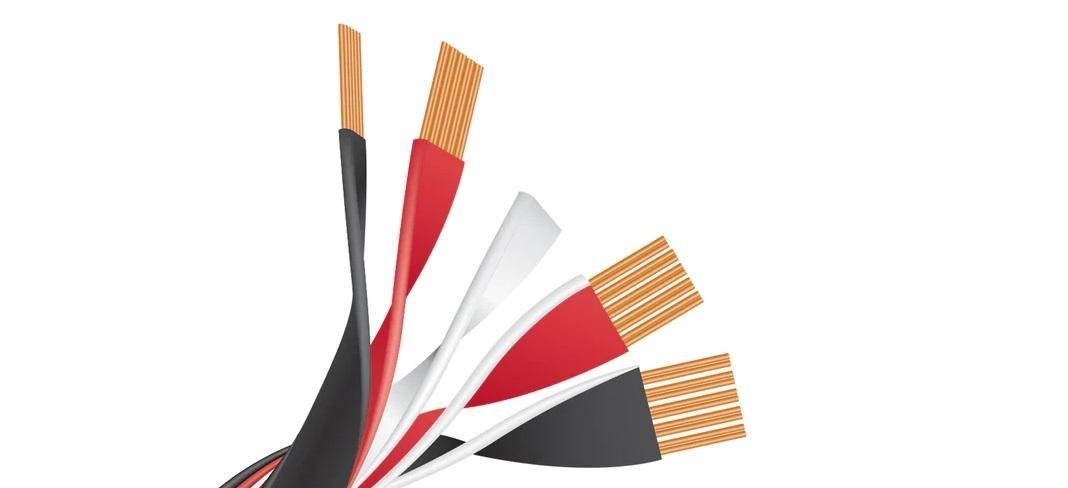
The Oasis 8’s internal wires use 11 AWG solid OFC core conductors. There are 5 pairs (a total of 10 conductors) grouped together, with an insulation layer over the surface to form a single wire. With four such wires, there are a total of 40 conductors, representing 60% more OFC than the lower-tier Solstice 8. This higher conductor count and thicker gauge allow for the transmission of richer information, capable of satisfying larger audio systems.
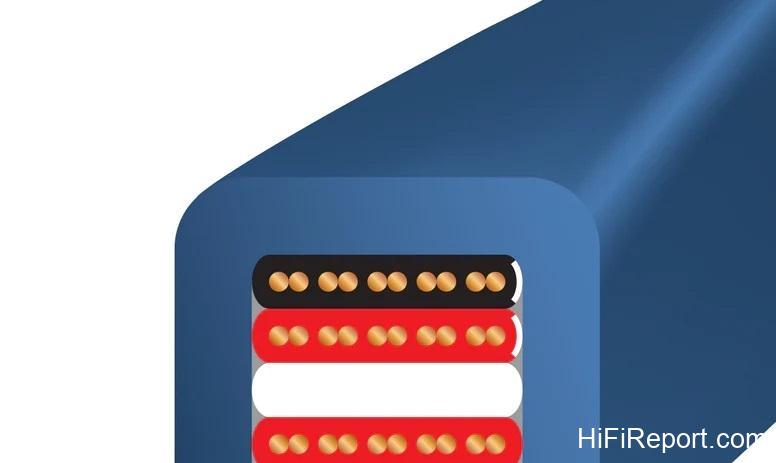
Looking at the cable’s cross-section reveals that the conductor arrangement isn’t the common concentric layout, but rather a flat, parallel arrangement. This is deliberately designed to reduce the “skin effect,” thereby improving the transmission efficiency of high frequencies. The cable structure also employs Wireworld’s renowned Quad DNA Helix technology, which involves stacking four flat conductor strands and twisting them into a spiral.
This design ensures the conductors are completely separated, reducing signal crosstalk between them and minimising the impact of noise on sound quality. According to the manufacturer, this unique technology, compared to the concentric conductor twisting found in standard cables, also prevents electromagnetic “eddy current” losses caused by the conductors, preserving more detail and dynamic impact in the music signal.
Furthermore, the Oasis 8 incorporates an extra layer of white insulation between the positive and negative conductors, making the DNA Helix structure even more compact. This feature is not found in the lower-tier Solstice 8 speaker cable. Just looking at the complexity of this Quad DNA Helix structure, it’s clear this is not something a small cable manufacturer could achieve.
Only companies like Wireworld, with their technology, machinery, and large-scale production capabilities, can implement such structures based on ideal scientific theory while keeping costs to a minimum. Although the Oasis 8 is an entry-level cable, its internal structure is identical to that of higher-end cables, making it a perfect gateway to experiencing Wireworld’s sophisticated cable manufacturing technology.
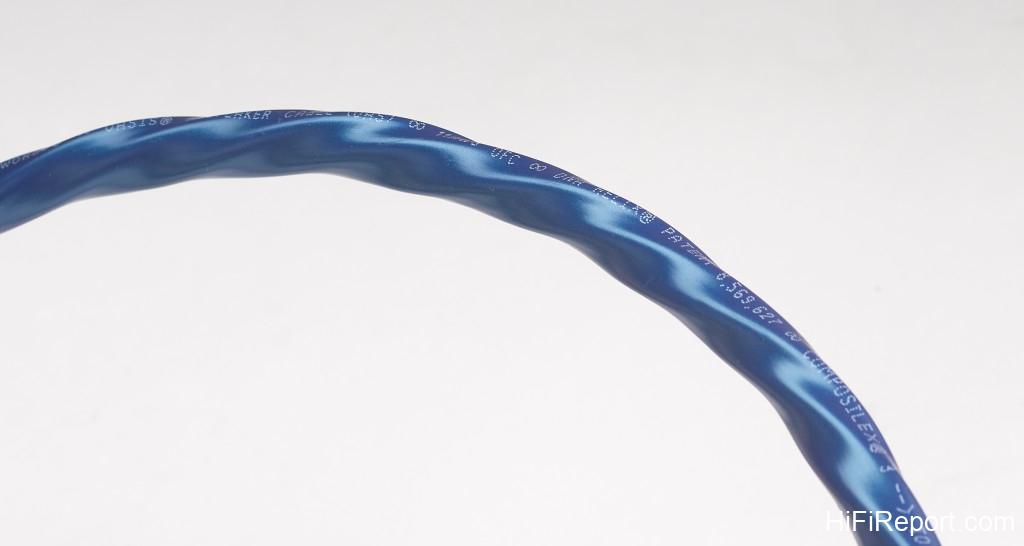
Besides its thicker gauge, the Oasis 8 also features a more refined exterior design than the Solstice 8. The deep blue sheath is made from the brand’s signature Composilex 3 insulation material. According to Wireworld’s research, this material offers superior resistance to electromagnetic interference compared to common materials like Teflon, ensuring minimal signal loss and significantly reducing current friction noise. This contributes to a cleaner musical background and improved focus.
Directionality and Terminals
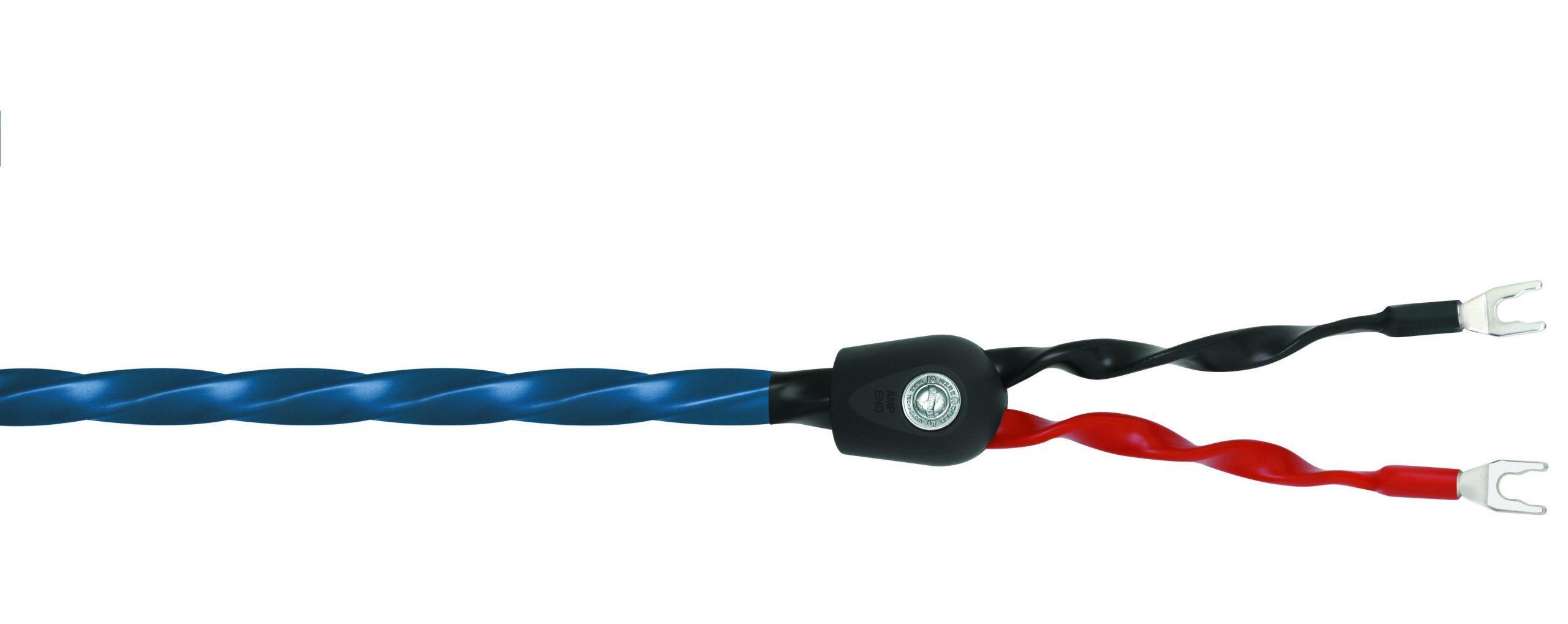
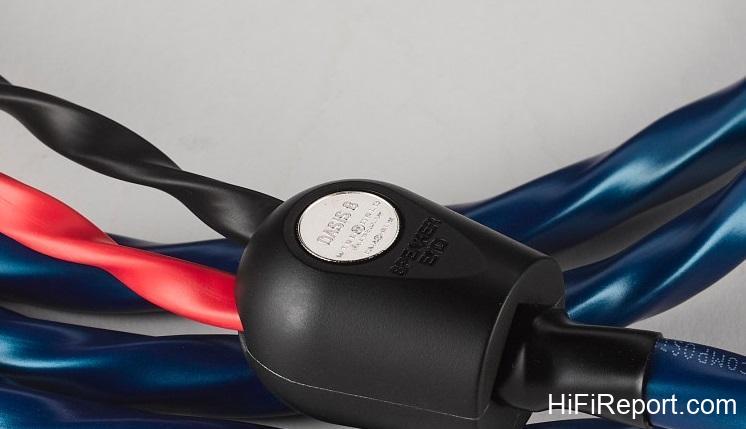
Wireworld also places great importance on conductor directionality. All conductors undergo a proprietary Grain Optimization technology during the metallurgy process, effectively controlling the structure of the metal’s crystal grains to align in a consistent direction. Therefore, the Oasis 8 cable features a finely crafted splitter at each end, clearly labelled “Amp End” at one end and “Speaker End” at the other.
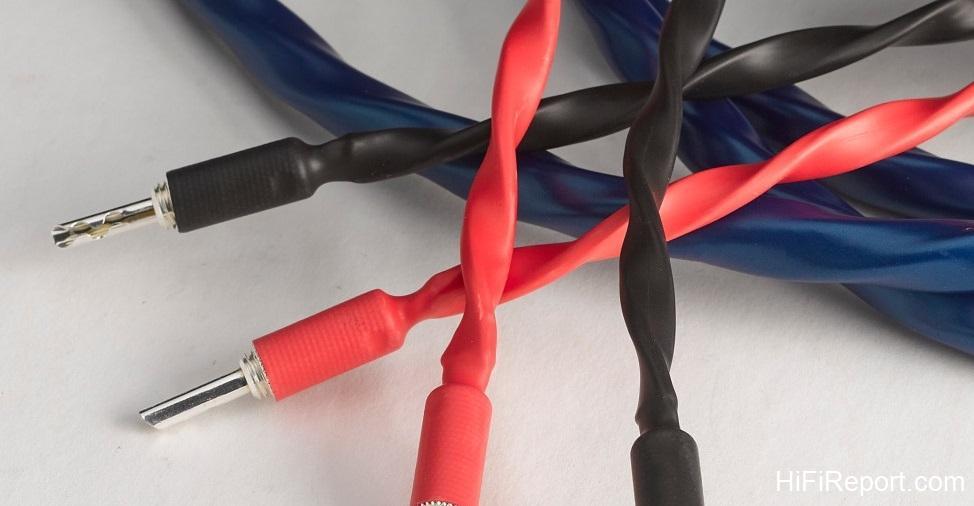
When you purchase the cable, remember to follow the directionality to achieve the best possible sound quality.
Finally, the Oasis 8 employs the brand’s specially made Uni-Term terminals. These are constructed from silver-plated Oxygen-Free Copper, offering better conductivity than common gold-plated brass terminals. And if you’re undecided between spades or banana plugs, the Oasis 8 offers both. The Uni-Term connectors feature a replaceable design, allowing you to purchase banana or spade plugs from Wireworld for quick swapping, accommodating any amplifier or speaker terminals.
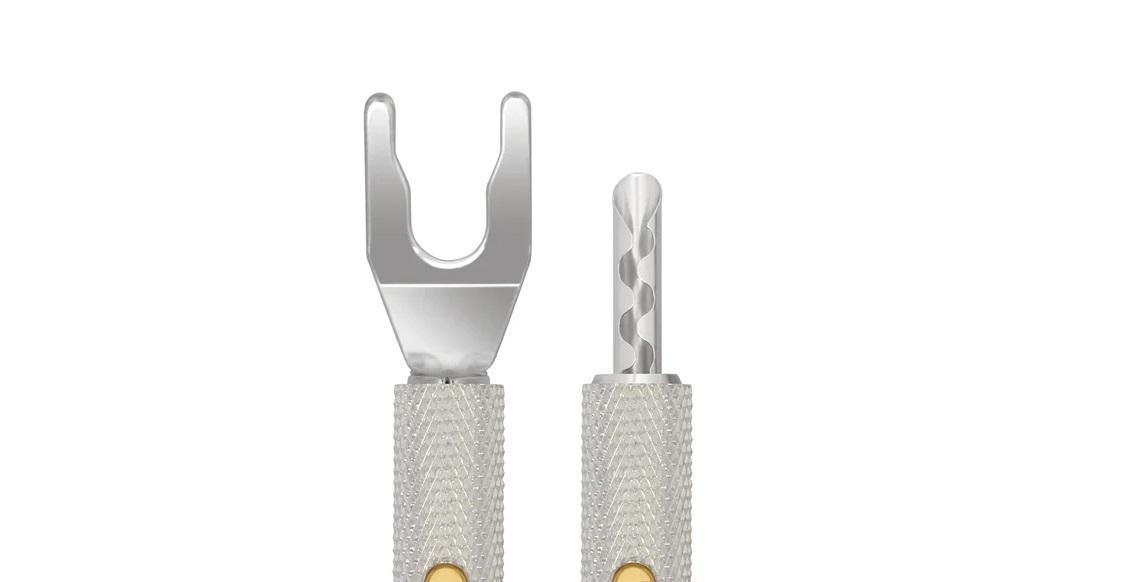
In practical use, I found the Uni-Term plugs to be very tight when inserted or removed, increasing the contact area and ensuring the most complete transmission.
Test Setup and Initial Impressions
Having discussed the design of the Oasis 8, for the testing phase, I used a system comprising a Lumin D2 network player paired with a Keces S300+ power amplifier, driving the resident Pioneer S-1EX floorstanding speakers that have served us well for a long time. I am very familiar with this setup. The D2 and S300+ lean towards a warm and full-bodied sound, while the S-1EX speakers are direct and precise, creating a nice synergy. I was eager to hear what changes the Oasis 8 would bring.
The cable proved to be very neutral, not emphasizing any particular frequency band. Initially, the sound didn’t undergo a dramatic transformation, but I could sense an increase in the music’s energy, a fuller sense of body, and slightly clearer positioning, while retaining the tonal character I was accustomed to. After a period of run-in, the system’s sound started to gain a fluid musicality on top of its existing character. At this point, the music sounded more alive and natural.
Detailed Listening Experience
When playing “Keith Jarrett – Standards Live,” the piano notes felt more cohesive and their outlines sharper. Previously, the piano tone could feel somewhat monochromatic, but now I could hear richer harmonic details, allowing the resonance of the piano itself and the room’s acoustic tail to fill the space, no longer sounding thin or empty. Keith Jarrett’s delicate keystrokes also became clearer, with micro-dynamic contrasts becoming more pronounced.
Unlike some copper cables that can exhibit a thick, coloured mid-bass, you don’t feel an increase in bass quantity with the Oasis 8, but the lower end becomes fuller and more solid. Bass plucks are taut and elastic, and you can hear the full shape of the low notes, with tails extending deeper without any sense of looseness.
Furthermore, the Oasis 8 doesn’t exaggerate the soundstage; instead, it faithfully portrays the positioning and distance of instruments. At the same time, you can perceive a blacker background, significantly reducing what was previously perceived as edge roughness and impurities, thereby highlighting the subtle nuances in the music.
When playing the “Brodsky Quartet – Golden Oldies” string quartet album, the soundstage was noticeably more three-dimensional, creating clearer separation between the four violins and rendering their positioning with greater precision.
The string playing through the Oasis 8 was incredibly fluid. While the density might not match Wireworld’s higher-end speaker cables, there was a more comfortable musical flow. Listening felt effortless and smooth, and the dynamics of the performance were excellent, allowing me to clearly perceive the changes in bowing pressure from the musicians. The violin tone was sweet, with more rounded extension in the upper registers and a more prominent sheen.
The cello’s nasal quality felt less sluggish, and I could hear more penetrating string vibration details, while the resonance of the wooden body was more relaxed.
Conclusion: A Highly Recommended Cable
This Oasis 8 is the highest cost-performance speaker cable I’ve heard recently, and I believe it is one of the most suitable cables for beginners. Its sound signature is completely unbiased; it won’t add any artificial “audiophile” characteristics to your system, but it will faithfully reveal the system’s inherent tonal character and sonic beauty. Its lively and natural qualities also help you focus on enjoying the music itself rather than getting fixated on audiophile effects.
If you’re looking for a natural-sounding, enjoyable, and reasonably priced speaker cable, I believe the Oasis 8 will not disappoint.
Specifications
* Product Type: Speaker cable
* Conductor: Oxygen-Free Copper (OFC)
* Conductor Gauge: 11AWG
* Technology: Quad DNA Helix Conductor Geometry
* Cores: 40 cores, 4 conductor groups
* Insulation Material: Composilex 3
* Terminals: Silver-plated Uni-Term (Banana or Spade)