
Yamaha CD-S303 Review
As streaming services continue to mature, offering a growing selection of lossless and high-resolution platforms, dedicated CD players have become increasingly rare on the market. So, what should music lovers who still cherish the stable sound quality of CDs do? Perhaps they should take a close look at the Yamaha CD-S303. This player not only handles CDs with aplomb but can also read audio files from a USB drive and even function purely as a CD transport.
Most importantly, its price is incredibly budget-friendly!
Yamaha’s Legacy in Audio
How does the CD-S303 manage to be so affordable? A glance at Yamaha’s extensive history might provide a clue. In Taiwan, everyone knows the Yamaha name; indeed, the company boasts over a century of history since its founding. After building their first organ in 1887, Yamaha embarked on its path to becoming a musical instrument empire.
Then, in 1974, Yamaha released the world’s first loudspeakers equipped with beryllium diaphragms, the NS-1000M and NS-1000 (the former for studio monitoring, the latter a home model). These speakers significantly impacted the high-end audio market, previously dominated by European and American brands.
Over time, Yamaha has introduced many accessible and affordable products. Whether it’s budget-friendly mini-systems, headphones, streaming players, or integrated amplifiers, their gear has consistently earned strong market praise for delivering Hi-Fi level performance at reasonable prices. Today, the brand’s product line spans high-end, mid-range, and entry-level price points. Regardless of the desired equipment tier, choosing Yamaha products generally guarantees excellent value for money.
Versatile Playback and Core Design Philosophy
Let’s circle back to Yamaha’s performance in the realm of affordable audio systems. They have released popular models like the MCR-N570, MCR-N670, and MCR-B270. These units feature various digital playback functions and consistently deliver Hi-Fi quality sound despite their accessible pricing, offering excellent value. This review’s subject, the CD-S303 player, also follows this affordable, entry-level approach while maintaining a remarkably high standard of Hi-Fi audio performance.
Looking closer, the latest Yamaha CD-S303 can play CDs, CD-R/RW discs, and also read audio files stored on a USB drive. It supports formats including MP3, WMA, LPCM, AAC, and FLAC. This means you can effortlessly enjoy both your cherished album collections and high-resolution audio files through this player. Of course, merely supporting multiple formats isn’t enough to claim high value. However, this player boasts features, circuit design, and hardware that punch well above its weight class.
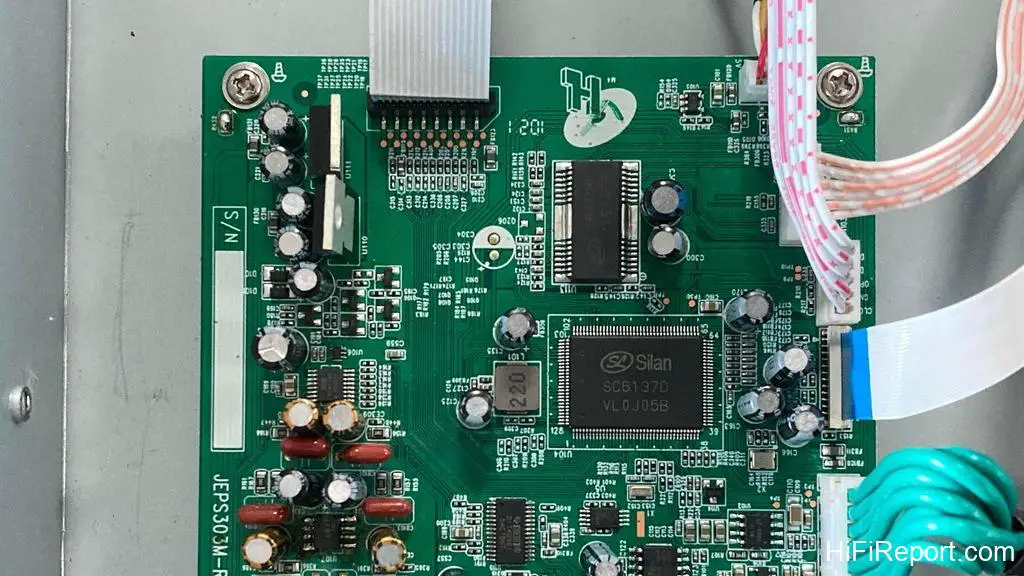
Attention to Detail: Internal Layout
Let’s delve into its design details.
Upon removing the top cover of the CD-S303, you’ll notice its incredibly clean internal circuitry. The digital decoding and analog output stages are laid out in a neat, organized manner. The components used for the power supply and digital transmission are also of high quality. Yamaha emphasizes that during the player’s design, special attention was paid to balancing the chassis weight.
This involved careful thought in routing the wiring and, importantly, placing the drive mechanism precisely in the center of the chassis. This central placement contributes significantly to improved stability, substantially reducing interference that could affect audio signal transmission.
Key Components and Technologies
Upon closer inspection, it becomes clear that Yamaha has put considerable effort into the circuit design of the CD-S303. Features like symmetrical layouts and extremely short signal paths allow the audio signal to transmit with minimal interference and in a more direct manner, resulting in sound quality that’s closer to the original recording. For digital decoding, this CD player is equipped with the Burr-Brown PCM1780 chip.
This DAC boasts an excellent signal-to-noise ratio and extremely low total harmonic distortion. It can decode audio up to 24-bit/192kHz, allowing it to easily play high-resolution audio files.
Anyone who has used a CD player is likely familiar with the experience of skipping or inability to read discs due to dust on the tray, scratches, or warping on the CD itself. Addressing this, Yamaha has specifically incorporated a dedicated CD DSP (Digital Signal Processor) in the CD-S303. This processor continuously monitors the CD reading status and instantly adjusts the laser head tracking and spindle rotation speed to compensate for potential errors and distortion during playback.

Furthermore, because the CD-S303’s laser pickup mechanism employs an independent, floating design, operation vibration is significantly reduced. This ensures high-quality audio signal transmission. The high-precision reading efficiency results in incredibly stable sound quality. According to Yamaha’s specifications, this CD player achieves a signal-to-noise ratio of 105dB, harmonic distortion of just 0.003%, and a dynamic range of 96dB. Its frequency response covers 2Hz to 20kHz.
These figures are notably outstanding among products in this category.
The “Pure Direct” Advantage
Remarkably, the CD-S303 also offers the “Pure Direct” function, a feature that will certainly catch the eye of seasoned audiophiles. This function is quite common in Yamaha’s amplifiers and represents a mature technology for the brand. However, it was typically reserved for mid-to-high-end equipment. Its inclusion in this affordable CD player demonstrates significant generosity. Engaging Pure Direct is simple: just press the button on the unit or use the remote control.
The player then automatically switches to the shortest possible signal path, aiming for more perfect original sound reproduction.
When Pure Direct is engaged, the player automatically turns off its digital output and display, allowing only the analog output to be used. When playing CDs, combined with Yamaha’s unique circuit design, this delivers an exceptionally authentic and undisturbed audio signal. Coupled with the extremely low signal-to-noise ratio, excellent dynamic range, and the ability to play files stored on CD-R/RW discs, this feature alone makes the CD-S303 highly recommendable.
These design considerations are quite rare in products at this price point.
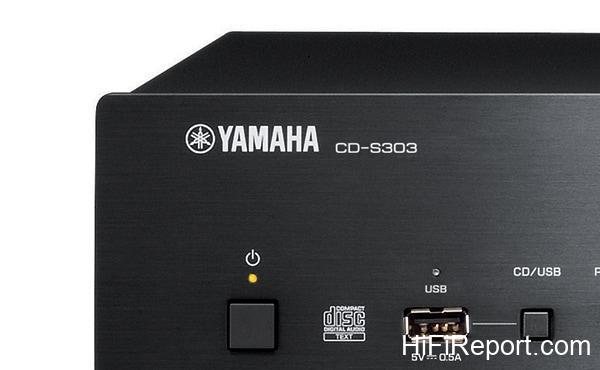
Audition: Listening Impressions
Of course, being satisfied with the design and specifications is one thing; whether it truly sounds good requires actual listening. For the test, I used the CD-S303 as the source, paired with an Audiolab Omnia integrated amplifier, and Monitor Audio Silver 300 7G floorstanding speakers, setting up a full two-channel stereo system.
I must mention that many CD players on the market use off-the-shelf CD-ROM drives, which often results in some lag when reading or switching tracks, and the operating noise of the drive mechanism during CD playback can be quite audible.
The CD-S303, however, utilizes Yamaha’s own independently designed drive mechanism. From the moment a CD is inserted until it’s read and the first track begins playing, I was impressed by its performance, which felt well beyond its class. Loading, ejecting, reading, and switching tracks are all remarkably fast, and the noise from reading the CD is very low. There’s also minimal delay when pausing tracks. These are qualities not commonly found in CD players at this price level.
In terms of sound quality, the CD-S303 certainly delivers stable audio. Listening to The Piano Guys’ self-titled album revealed very clean instrument sounds and an expansive soundstage with a strong sense of depth. The left/right and front/back extension were layered and detailed, with various instruments and sound effects exhibiting clear three-dimensionality and distinct placement within the soundstage.
Similarly, when listening to Christian Svarfvar’s chamber music album “Ullén: Infinite Bach,” I could hear sharp violin lines and a clear sense of distance between different instrumental sections.
A crucial aspect contributing to the CD-S303’s ability to render distinct spacing is its incredibly silent background during playback. This, combined with abundant high and low-frequency detail, ensures that instruments, whether playing loudly or softly, retain excellent definition. Taking the violin from the same album as an example, from the initial string vibration to the decay at the end of a note, I could hear a delicate, smooth texture.
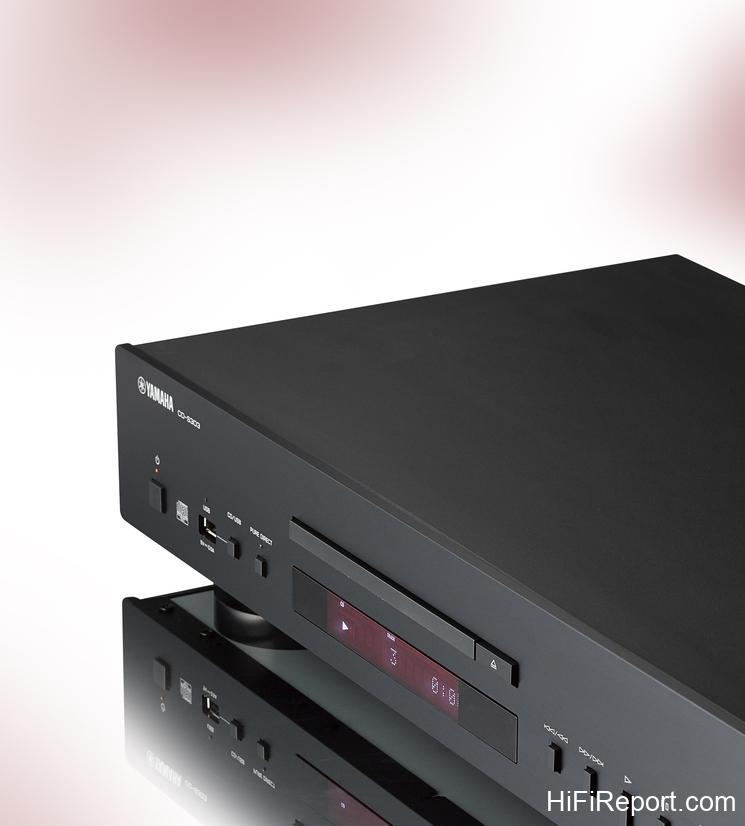
Even the subtle details of the player’s bow friction were audible, as if viewed under a magnifying glass.
Beyond the violin, the CD-S303 allows all instruments to exhibit more prominent and complete forms. When listening to large orchestral pieces, the soundstage remains well-balanced; even during sections where inner and outer voices play in unison, subtle details are preserved. When used for vocals, the player’s slightly warm and full character adds realism. Focused vocal imaging is precise, rendering cohesive, rich vocal textures with a natural quality for both male and female voices.
To be honest, I hadn’t expected a budget-friendly CD player like the CD-S303 to perform at this level. Its silent soundstage, in particular, was impressive – a quality typically heard only from mid-range or higher-end sources. But there’s more! Upon activating the Pure Direct function, I further discovered just how incredible the value of this player is! The reproduction of instrument details, instrument and object forms, and vocals all saw further improvement.
With Pure Direct engaged, vocals reveal significantly more performance nuance from the singer; subtle changes like breaths and impending vocalizations become audible, which is quite striking. Instruments gain even greater three-dimensional form; details like the vibration of violin strings and the pressure applied to piano keys are rendered with delicate texture. It’s truly hard to believe this level of sound quality is possible from a piece of equipment costing around $493 USD.
When listening to genres like jazz, pop, rock, or electronic music, the CD-S303 maintains a balanced soundstage and rich instrument/object detail. Furthermore, thanks to its excellent low-frequency extension, it delivers a full, textured bass that contributes to a lively stage effect.
Summary: Performance and Value
In summary, the CD-S303 presents abundant high and low-frequency details. The soundstage and imaging are very clear, instruments and objects have prominent forms, and vocals are rendered with rich nuance. For its price, it offers exceptional value for money. Of course, this high standard of performance is thanks to Yamaha’s careful research, development, and manufacturing.
High-grade audio capacitors, high gain-bandwidth operational amplifiers, and meticulously designed circuitry are all reasons why this CD player is highly recommended.
Specifications
* Type: CD Digital Player
* Frequency Response: 2Hz-20kHz
* Input: CD, CD-R/RW, USB
* Signal-to-Noise Ratio: 105dB (CD)
* Dynamic Range: 96dB
* Harmonic Distortion: 0.003% (CD)
* Supported Decoding: 24bit/192kHz
* Outputs: Optical, Coaxial Digital, RCA
* Dimensions (W.H.D): Approx. 43.4 × Approx. 8.6 × Approx. 26 cm
* Weight: 3.49 kg