
Yamaha R-N800A Review
In response to the needs of the modern consumer, Yamaha has progressively introduced three streaming integrated amplifiers since 2023: the R-N2000A, R-N1000A, and R-N800A. The latter is the most affordable model in the new series and was the last to be released. The R-N800A is incredibly budget-friendly, with an official price of just around $1150. Even students working part-time could save up for it in a few months.
Given such an accessible price point and its form factor as a streaming integrated amplifier (combining the functions of a streamer and an integrated amp), one might expect some features to be basic. However, after thoroughly testing the R-N800A, we discovered it’s far from basic. It integrates a wealth of Yamaha’s technology and offers an extensive set of features, making it exceptional value for money.
Unique YPAO Calibration
Let’s start with one of its most distinctive features: the YPAO automatic room calibration function. Yamaha is a brand with deep technical expertise, producing complex products like surround sound receivers. To ensure home theater systems deliver optimal, harmonious results, Yamaha developed its proprietary technology called Yamaha Parametric room Acoustic Optimizer, or YPAO.
While some manufacturers rely on third-party solutions for such technology, YPAO is developed in-house by Yamaha, making it a signature feature on their multi-channel decoding equipment.
MusicCast Streaming & Connectivity
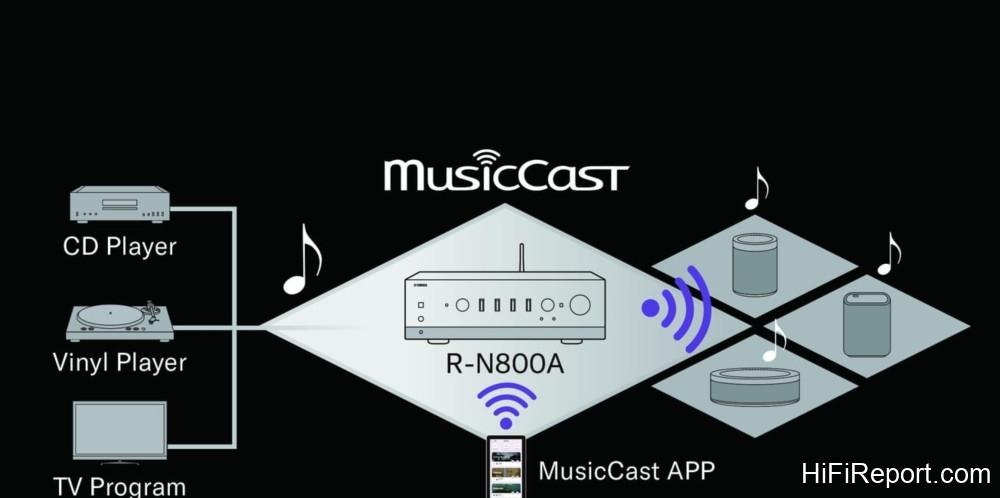
The R-N800A supports Yamaha’s exclusive MusicCast streaming playback feature. Via the MusicCast App, you can stream music from platforms like Spotify, Amazon Music, Deezer, and access internet radio stations. Notably, the R-N800A also supports Tidal Connect, allowing direct playback through the Tidal App without needing to open another application. This is a very convenient feature that some higher-priced streamers still lack!
Furthermore, the R-N800A supports AirPlay 2, catering to Apple device users.
Through MusicCast, the R-N800A can also play high-resolution music files stored on other devices within your local network. If you prefer not to use the network interface, it also offers a USB DAC function, allowing you to connect a computer or other digital transport to play high-resolution audio files.
High-Performance Audio Design
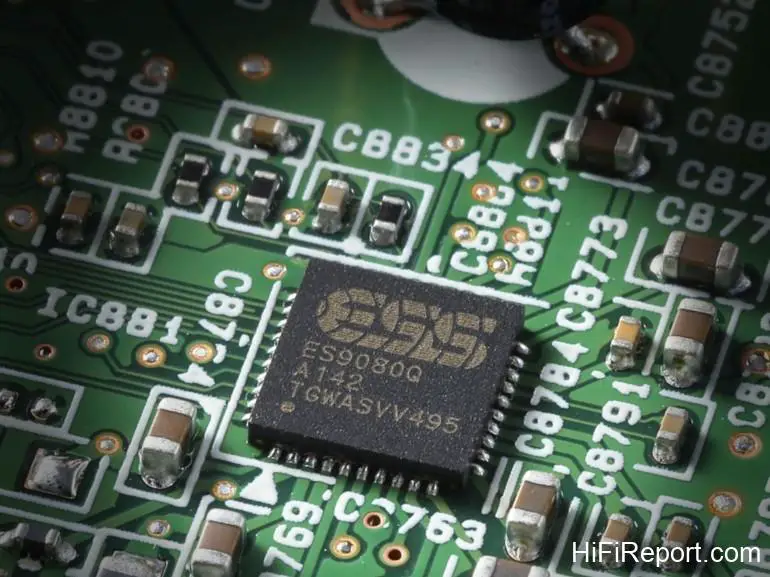
To provide consumers with the highest quality experience, the R-N800A is equipped with a high-performance DAC chip, the ESS SABRE ES9080Q. This enables the R-N800A to handle 384kHz PCM audio and DSD 11.2MHz audio, offering playback compatibility comparable to high-end models. Whether you prioritize convenience (streaming) or high fidelity (playing Hi-Res files), it supports both.
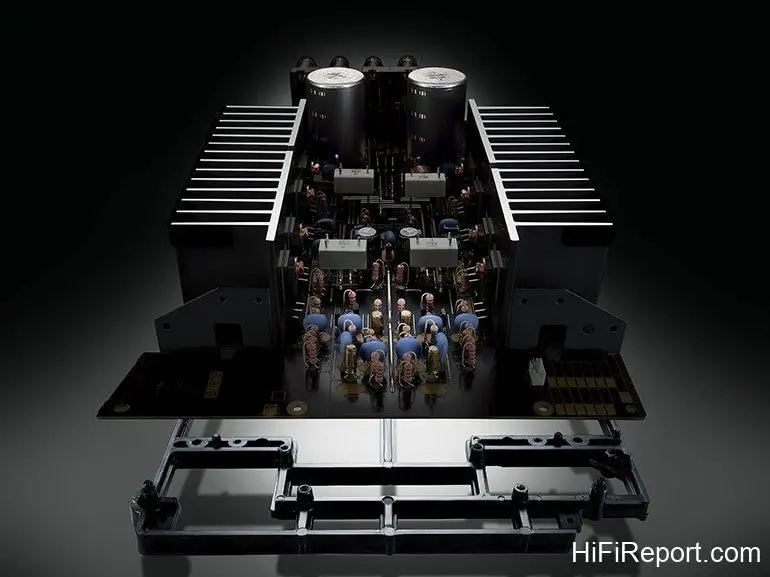
Having functionality is one thing, but professional design is crucial for achieving good sound quality. A key aspect of the R-N800A’s design is Yamaha’s ToP-ART (Total Purity Audio Reproduction Technology) circuit design. The core principle is the meticulous symmetrical arrangement of left and right channels to enhance channel separation. Additionally, the circuit layout is optimized for the shortest signal paths, reducing internal impedance and minimizing interference.
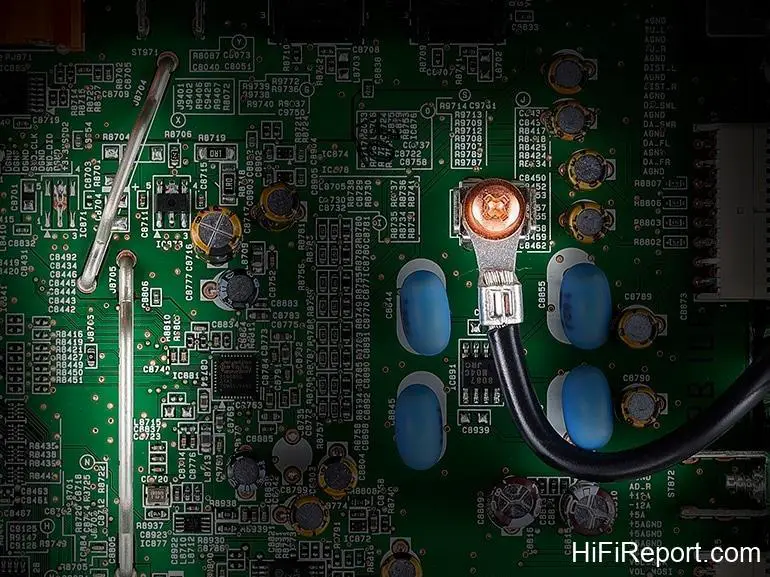
The R-N800A also incorporates thoughtful supporting design elements. For instance, it emphasizes grounding, using thick ground wires and even securing the power amplifier circuit with screws to significantly eliminate noise interference and enhance sound purity.
Robust Build Quality
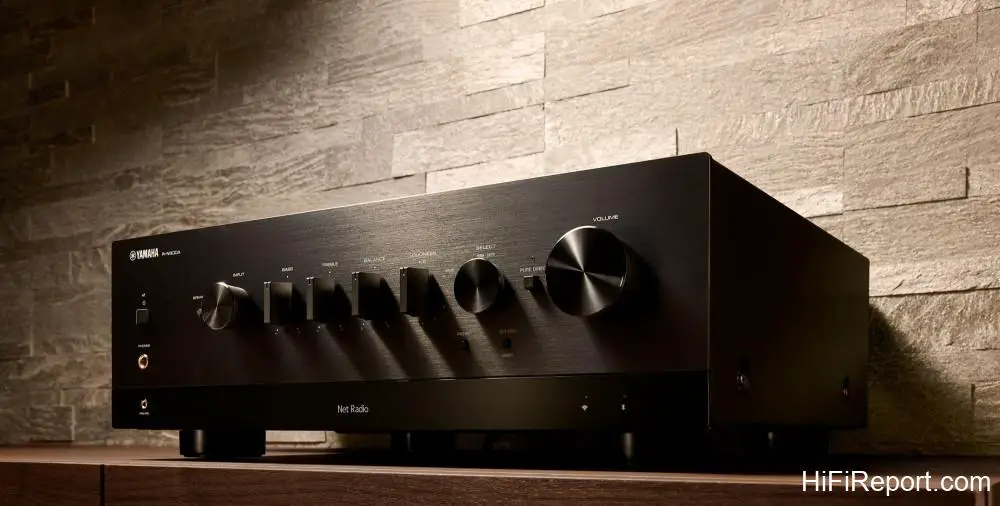
For the chassis, the R-N800A features a high-rigidity body with an internal special resin frame called “Art Base.” This helps absorb and block unwanted vibrations. Finally, the feet at the base feature a structure developed by Yamaha themselves. The outer ring has a curved design, while the inner part is straight, effectively dissipating vibrations and suppressing the transmission of excess energy. For an entry-level unit, having this level of attention to detail is truly commendable.
Comprehensive Connectivity
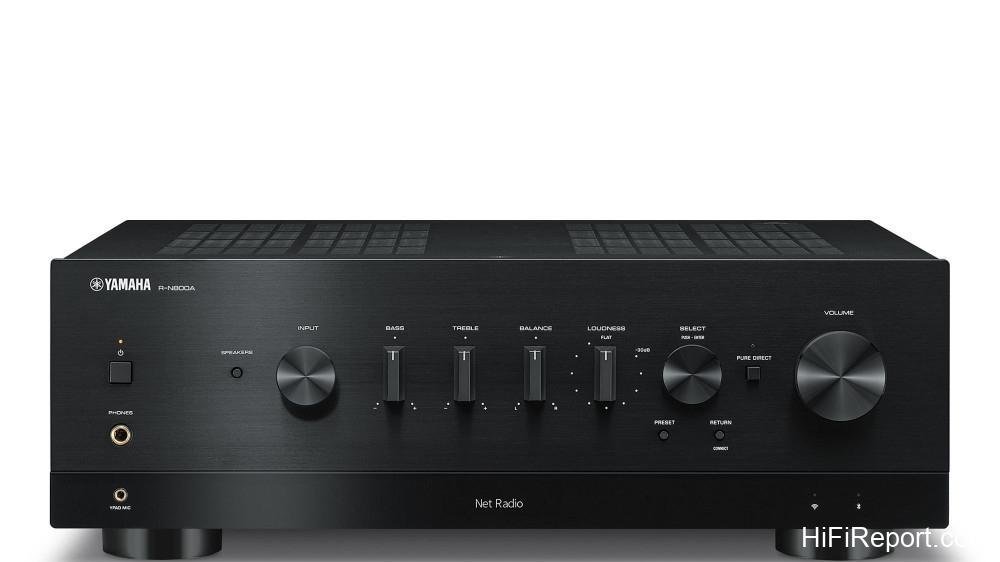
But there’s more! The R-N800A boasts a rich array of peripheral functions. If you ever tire of digital music, it includes a Phono input with MM cartridge support, allowing direct connection of a turntable. If you’re using bookshelf speakers and feel the bass is lacking, the R-N800A can connect to an active subwoofer.
Crucially, if you run the YPAO automatic room calibration, it automatically handles bass management, setting the subwoofer crossover point and volume level seamlessly, making subwoofer integration effortless. Many two-channel enthusiasts avoid subwoofers because they can be difficult to integrate into traditional two-channel systems, but the R-N800A eliminates this problem. For those who are more hands-on, parameters can also be manually adjusted via the MusicCast App.
Dual Speaker Outputs
The R-N800A’s rear panel features two sets of speaker terminals, labeled A and B. This allows you to set up a second pair of speakers in another room, sharing the R-N800A to drive them and listen to streamed music. Alternatively, you can connect two sets of speakers with different sonic characteristics in the same room and switch between them depending on the music genre – for example, one set for electronic music and another for classical.
Or, you can use the Bi-Wire method to connect a single pair of speakers (with A+B output combined). In this case, the speakers don’t need jumper cables to transfer the signal, theoretically leading to purer sound. The R-N800A’s AB output capability is another feature often absent in similar products.
Listening Impressions
Moving on to the actual usage experience, for this review, I paired the R-N800A with our in-house reference speakers, the Pioneer S-1EX floorstanding speakers. This simple setup is all that’s needed to start listening, highlighting the advantage of streaming integrated amplifiers: you only need a pair of speakers for a complete streaming audio system. This keeps the system neat and eliminates the hassle of matching components and dealing with numerous cables.
In terms of sound performance, the first thing to mention is that the R-N800A has decent driving power. It didn’t struggle with the large floorstanding speakers, never feeling weak or sluggish, although it didn’t deliver an overtly imposing soundstage either. However, during the initial listening, I felt the low frequency range was a bit excessive and somewhat indistinct.
With a traditional two-channel system, this would be a headache, potentially requiring significant speaker repositioning to resolve. But with the R-N800A, it’s not a problem because the YPAO automatic room calibration function can fix it. This situation was perfect for testing the effectiveness of YPAO.
YPAO In Action
The YPAO automatic testing process is straightforward. Simply place the test microphone at ear height in your listening position and plug it into the front panel of the unit. The system automatically enters the setup procedure. Then, press a button on the remote or front panel to start the test. The test is quick; the two speakers play test tones twice, and it’s done.
Afterwards, you can view the test results via the App, which shows corrections made to the distance and volume levels for the left and right channels, confirming the test was successful.
However, I searched the entire App and couldn’t find any other test information. Does it only perform distance and volume calibration for the left and right channels? This made me slightly concerned, thinking such a simple calibration might be insufficient. Fortunately, my concerns were unfounded.
In reality, the YPAO test encompasses the overall frequency response of the “speaker + room” combination and applies flattening equalization adjustments; this information just isn’t displayed in the App.
How did I confirm this? I used REW software and a third-party professional microphone to perform actual measurements, comparing the effect of Pure Direct mode (with YPAO and all unnecessary circuits off) and with YPAO enabled. The results showed that with YPAO off, the frequency response below the low-frequency range (100Hz) was indeed elevated, and there was a slight dip between 1kHz and 3kHz. This explained the perceived excessive and somewhat blurry bass.
With YPAO enabled, these two primary flaws were compensated for, resulting in a much flatter frequency response curve. The effect was significant and effective.
YPAO and Sound Quality
So, does using an automatic calibration function like YPAO negatively impact sound quality? I believe this is a common concern for audiophiles when encountering such features. I conducted repeated tests using violin, piano, cello, and jazz music, comparing the effect of Pure Direct mode and with YPAO enabled. In Pure Direct mode, the sound seemed slightly cleaner, but the difference was very subtle.
This indicates that the impact of YPAO processing on sound quality is minimal, which is highly commendable. I believe this effect is related to Yamaha increasing the YPAO processing precision to 64 bits, resulting in less degradation of sound quality during the process. This is key to YPAO’s advantage over similar technologies and its ability to maintain high sound quality.
With YPAO enabled, because the overall frequency response becomes flatter and excess low-frequency energy is controlled, the vocals in the mid-range and instruments like violins or others in the high-frequency range feel more prominent and forward in the soundstage. The balance between highs, mids, and lows is more harmonious, and the sound becomes smoother and more enjoyable.
Furthermore, with the flatter frequency response, it can handle a wider range of music genres without favoring any particular type. Clearly, using YPAO offers significant benefits, so I highly recommend using this function.

Balanced and Engaging Sound
Thanks to the YPAO calibration, the R-N800A delivers a very balanced and versatile sound with plenty of detail and a well-structured soundstage. You don’t feel vocals are recessed or that any instrument is lost in the background. Instead, all details and energy are presented appropriately. Because the foundation is better, even streamed music sounds great.
For example, when streaming Beethoven’s Trios led by Daniel Barenboim (with Barenboim on piano, accompanied by violin and cello) via Tidal Connect, you can perceive a clear fan-shaped soundstage behind the speakers. The three performers have distinct positioning. The violin sounds delicate and clear, while the cello has appropriate weight without being overly heavy.
At this point, you can also hear another sonic characteristic of the R-N800A: a gentle, slightly sweet sound that is relaxed and never aggressive. This is particularly evident in Barenboim’s piano sound. The piano sounds light, soft, sweet, with a touch of shimmer on the keypresses, yet never harsh – it’s truly captivating and suitable for extended listening sessions.
Furthermore, after the YPAO calibration, I felt that the image focus was more precise. With the originally excessive bass trimmed, the low frequency range still retained excellent solidity and elasticity, which greatly enhanced the listening pleasure. For instance, the track “Spring River Flower Moon Night” from the album “Zhao Cong – Listening to China” begins with a captivating pipa solo, immediately creating a deep and expansive soundstage space.
As other instruments enter, their positioning is also clearly defined. When the large drum enters later in the piece, the drum sounds are solid and powerful, and you can feel a clear layering of all the aforementioned instruments from front to back, with absolutely no muddiness.
Listening to such captivating space and bass performance, a more suitable track came to mind: “Bass & Drum Intro” from the Nils Lofgren Band Live album. As soon as the music played, the distinct live venue atmosphere was immediately apparent. The audience cheers and noise were incredibly natural and three-dimensional, feeling as if they were nearby, holding drinks and shouting towards the performers in the center, making me feel like I was actually at the show.
The electric bass playing in this performance was solid and powerful, with excellent body. The energy in the low frequency range was dense, and even though it was just an electric bass solo, the energy gracefully filled the entire space. In the latter half of the track, various drum sounds enter with great presence. There’s a section with rapid drumming that moves from left to right and then back from right to left, each beat distinct and full of elasticity – truly captivating.
Final Thoughts
In conclusion, in terms of absolute sound quality, the R-N800A is quite affordable, priced at around $1150, and I wouldn’t say it reaches the highest tier. However, because it has the YPAO function, it has a high probability of delivering a balanced sound, freeing you from the interference of your room environment. This feature surpasses products in the same price range and can even challenge more expensive units.
After all, if audio equipment is affected by the room environment, even better inherent sound quality is rendered useless, as unbalanced sound is never pleasant to listen to. The R-N800A avoids this problem.
After YPAO processing, the clear sense of space, precise image positioning, and solid bass make its sound very pleasing and highly enjoyable for listening.
Coupled with its ability to stream music, Tidal Connect support, USB DAC functionality, ability to play high-resolution files, phono input for turntables, potential for multi-room audio systems, and the provision of two sets of AB speaker outputs plus a subwoofer output… the features are truly extensive, almost too many to list, easily surpassing many competitors in the same price bracket. Offering such functionality at this price point is truly outstanding and highly recommended.
Specifications
* Supports YPAO automatic room calibration
* Can connect to an active subwoofer
* Supports MusicCast streaming interface
* Supports Tidal Connect playback
* Supports USB DAC functionality
* Can play high-resolution files like DSD256
* Includes Pure Direct high-quality audio mode
* Features a Phono input for connecting turntables
* Provides two sets of AB speaker outputs
* Left and right channel output circuits feature a balanced structure
* Design: Streaming Integrated Amplifier
* Output Power (20Hz-20kHz, 0.7%THD): 95W+95W (8 ohms)
* Dynamic Power (8/6/4/2 ohms): 105/130/170/215W
* Signal-to-Noise Ratio (CD in): 100dB
* Analog Inputs/Outputs: Phono, CD, Line 1, Line 2 / Pre Out, Subwoofer Out
* Digital Inputs/Outputs: Optical 1, Optical 2, Coaxial 1, Coaxial 2, USB Type-B, Network, Wi-Fi, Bluetooth
* Standby Power Consumption: 0.1W (Network standby on / Wi-Fi connection 1.8W)
* Dimensions (W.H.D.): 435×151×395mm
* Weight: 11.4 kg