
Advance Paris PlayStream A7 Review
The Advance Paris PlayStream A7 Integrated Streaming Amplifier: Refined, Spacious Sound – An All-in-One Masterpiece I Wish I’d Found Sooner!
Advance Paris doesn’t just excel in sound quality; a signature feature of their audio equipment is the pair of striking blue VU meters adorning the front panel. These allow users to monitor the left and right channel audio levels in real-time. Even in today’s era of network streaming, Advance Paris maintains this retro design touch, successfully setting itself apart from the crowd. This year, Advance Paris has been officially introduced to Taiwan by the distributor, Yun Cheng.
The first product sent to our office for review is the PlayStream A7, an all-in-one streaming amplifier that encapsulates the manufacturer’s technological prowess.
Design and Front Panel
Advance Paris boasts a diverse product line, with the PlayStream series dedicated to integrated streaming amplifiers. The A7 stands as the flagship model within this series. It seamlessly combines streaming playback, DAC decoding, phono stage, and integrated amplification capabilities. You only need a pair of speakers to get started, perfectly aligning with the modern audiophile’s preference for minimalist audio setups.
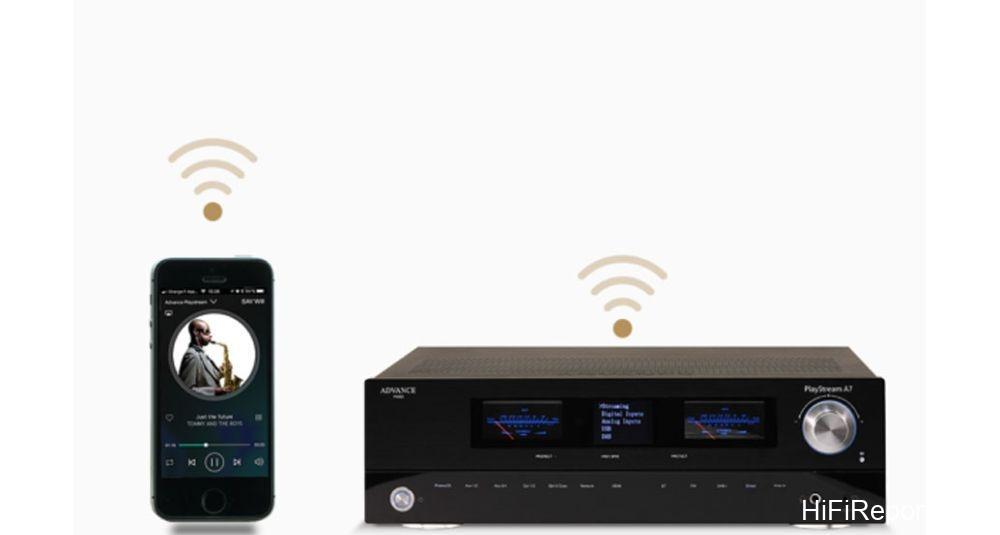
The PlayStream A7’s design is also quite refined; the seemingly simple black panel features a brushed finish on the upper half and a piano-like mirror finish on the lower half. Closer inspection reveals a delightful sense of layered texture. The upper section houses the two brightness-adjustable VU meters, which illuminate with a cool blue backlight upon power-up. In dim lighting, they look absolutely captivating!
A central LCD display on the front panel shows album and song titles. To the right of the black panel is an eye-catching metal knob for volume control, which offers a satisfying tactile feel when turned. The lower half of the panel features a row of illuminated touch buttons for selecting various input sources. On the right side, you’ll find both 3.5mm and 6.3mm headphone jacks, ensuring you can enjoy music at night without disturbing your family.
Digital Connectivity and Streaming Features
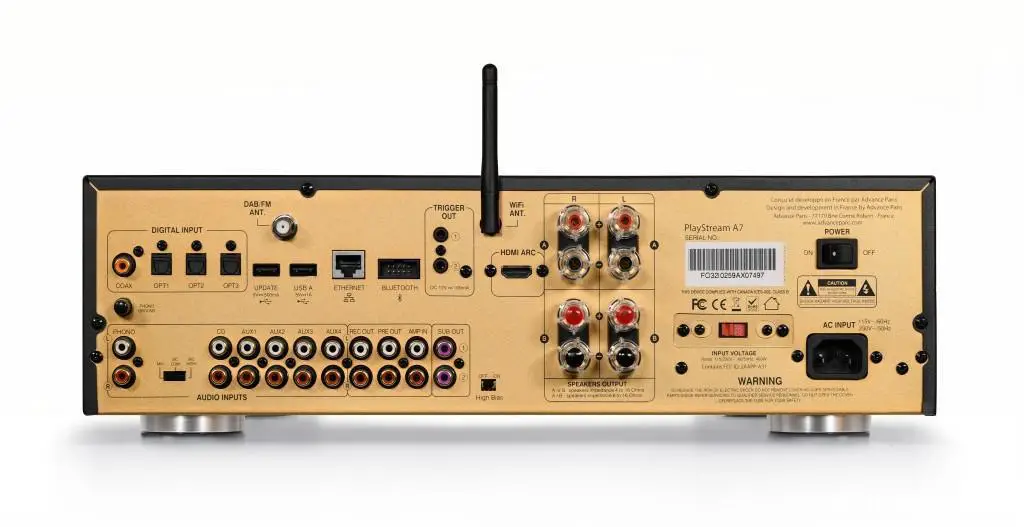
As an all-in-one unit, the PlayStream A7 offers impressive connectivity. Flipping to the rear panel, you’ll find an abundance of terminals almost comparable to a surround sound receiver! Starting with digital inputs, it includes three optical inputs and one coaxial input, allowing you to connect devices like CD transports or streaming players without built-in DACs. Naturally, it also features an RJ45 wired network port and Wi-Fi wireless connectivity.
Beyond playing music files from NAS or PC on your local network via DLNA/UPnP, the dedicated Advance PlayStream App designed for this series is remarkably user-friendly. It supports playback from Spotify, Tidal, Qobuz, and various internet radio stations. Even more impressive is how intuitive and lag-free the app is to use, with a fluidity that rivals applications from leading streaming audio manufacturers.
Furthermore, to accommodate modern setups using TVs as a source, it supports HDMI ARC functionality. This allows your audio system built around the A7 to replace the TV’s built-in speakers, providing significantly improved audiophile-grade sound when watching streaming platforms like Netflix or Disney+. The unit also includes two USB Type-A ports: one for firmware updates and the other for playing music files from a USB drive in environments without network access.
Analog Inputs and Configuration Flexibility
One design feature I particularly appreciate on the PlayStream A7 is its modular Bluetooth design. Users can optionally purchase Advance Paris’s X-FTB01 Bluetooth receiver. Simply plug it into the back of the amplifier to add Bluetooth capability to the A7. You can also swap it out for the higher-end X-FTB02 receiver, which supports aptX HD for high-quality wireless audio transmission.
The PlayStream A7 can also function purely as an integrated amplifier. It supports a total of six RCA analog inputs, including a Phono input. The built-in phono stage offers three gain settings (MM, MC Low, MC High), which is a rare and welcome feature for an amplifier’s built-in phono section, meaning it can connect directly to most turntables. Beyond serving as an integrated amp, the PlayStream A7 also offers pre-out functionality.
This allows you to use the unit as a “streaming player + preamplifier” and connect a more powerful external power amplifier to drive larger speakers. Alternatively, using the inverse Amp In function, you can treat the unit solely as a power amplifier, bypassing its source and preamp stages. If you’re a home theater enthusiast, this allows you to integrate the PlayStream A7 with your surround receiver, enhancing the sound quality and driving capability of your main front speakers.
If you crave more impactful bass, the unit also includes two Sub outputs, allowing you to connect active subwoofers for added low-frequency punch. Finally, the PlayStream A7 features two sets of speaker terminals (A and B), allowing you to switch between two pairs of speakers. If your speakers have bi-wire terminals, you can even use the A+B connection mode for bi-amping, enhancing the speakers’ driving performance. Note that speaker jumpers must be removed when using this configuration.

Internal Architecture and Bias Control
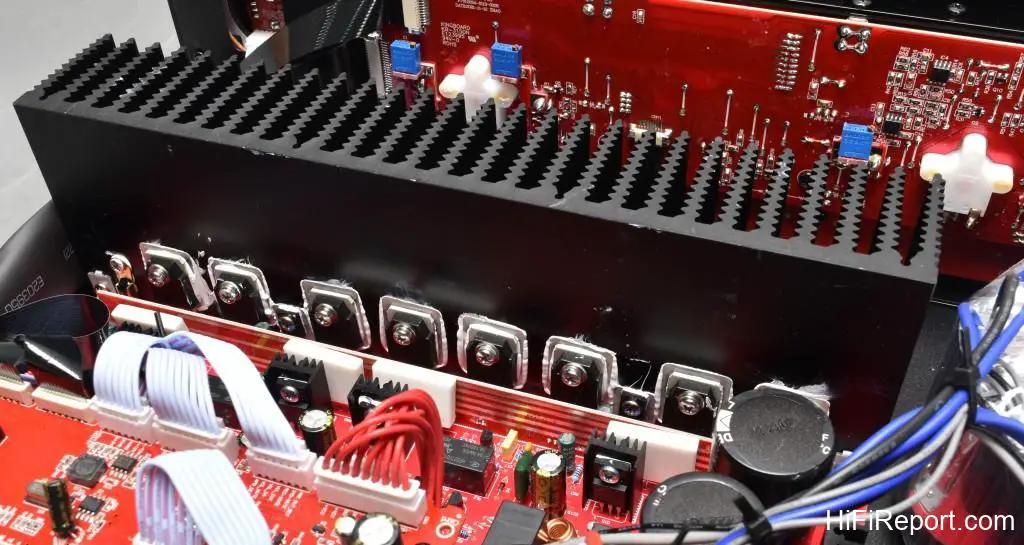
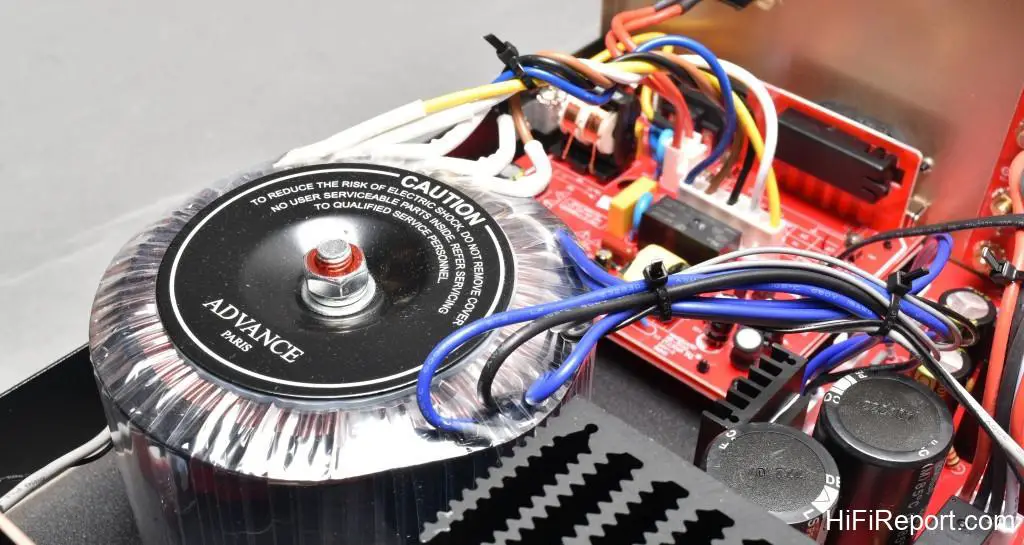
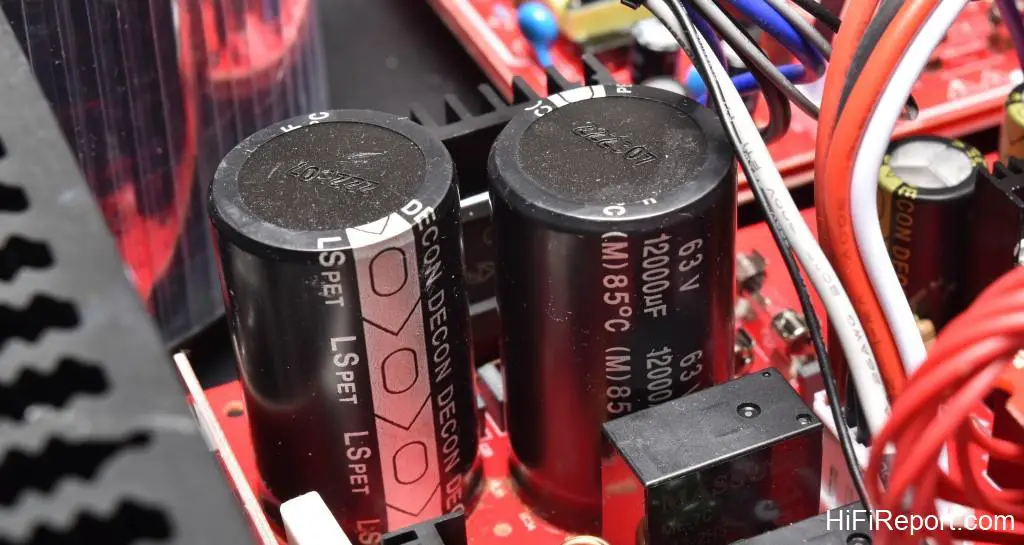
Opening up the PlayStream A7’s chassis reveals a very robust internal layout. Immediately noticeable is a large toroidal transformer, bearing the Advance Paris logo – undoubtedly a custom-made component. This transformer is not particularly wide in diameter but is notably tall, which allows for better utilization of chassis space while providing ample power to the audio circuitry.
Additionally, a separate switched-mode power supply handles secondary power needs for components like the network card, HDMI interface, and display, effectively implementing power isolation to minimize noise interference.
For digital audio processing, the heart of the PlayStream A7 is a Gigadevice gdS32f105 ARM chip. Decoding is handled by a Burr-Brown PCM 1796 chip for digital-to-analog conversion. Moving to the amplifier section, which is the unit’s core strength, you’ll find a pair of discrete power transistors per channel, forming an Class AB amplification circuit. Under an 8-ohm load, it delivers 115 watts per channel.
While this figure might seem standard, the PlayStream A7’s rear panel features a Bias adjustment switch. Amplifiers typically operate in Class AB mode, but when you switch to the “High Bias” setting, the amplifier operates in pure Class A mode for power levels up to 1 watt. This shares a similar principle with the “golden first watt” of tube amplifiers – it utilizes the transistor’s most linear and lowest-distortion operating state for amplification.
When playing chamber music or solo piano at low volumes, this significantly reduces distortion and allows you to enjoy the purest audio performance. However, if you desire speed and dynamic impact, switching to the “Low Bias” setting will be more suitable. It’s definitely worth experimenting with both settings.
Listening Experience
For my listening test, I paired the A7 with our in-house Pioneer S-1EX floorstanding speakers. I started by listening in the “High Bias” mode.
High Bias Mode Performance
In this setting, the PlayStream A7’s sound was refined and transparent, with resolution and sonic density peaking. Musical details were revealed directly and openly, much like with a tube amplifier.
Listening to the Casals String Quartet’s performance of Haydn’s “The Seven Last Words of Christ on the Cross,” I could hear the four string instruments spread out across the center of the soundstage. The space between the instruments was truly black, devoid of any blurring, making the contours of the performance sharper. The violin lines were delicate and full of texture, and high-register passages had a lovely sheen without any hint of harshness or sharpness.
The cello had a tight, solid presence, revealing rich bowing details and wooden resonance. During tutti passages, the ensemble sound wasn’t just a flat block of energy; I could distinguish the unique timbre of each instrument and the intricate threads of individual lines, making the chamber music dialogue much more vivid and layered.
Low Bias Mode Performance
When I switched to the “Low Bias” setting, the sound lines became smoother, and while resolution wasn’t as high as in High Bias, the soundstage became more expansive and dynamics were stronger. For instance, listening to Krystian Zimerman’s performance of Beethoven’s “Piano Concerto No. 1,” the instruments had more weight in the Low Bias setting.
The orchestral texture was relaxed and natural, and tutti passages sounded incisive and fast dynamically, brimming with elasticity and devoid of any stiffness. The PlayStream A7’s advantage of a wide, transparent soundstage also created distance between different sections of the orchestra, making even the faint brass parts in the inner voices remarkably clear! Naturally, the unit’s smooth and rounded style is also adept at portraying piano textures.
Zimerman’s piano sound was crystal clear, and his keystrokes had a light, nimble feel. Rapid passages flowed effortlessly like water over stones, and I could discern each note with distinct clarity. During heavy strikes on the low keys, I experienced a powerful sense of scale and impact, perfectly capturing the beauty of Zimerman’s performance!
Engaging the Low Bias setting also resulted in fuller, more impactful bass. Even driving our large Pioneer speakers, the sound had ample body. For example, playing the jazz-rock album “Aja” by Steely Dan, the electric bass had a tight, punchy quality. Coupled with the explosive dynamics of the drum solos in the track, the double bass drum hits landed squarely, each one hitting your chest without any hint of weakness.
Simultaneously, within the ample low-frequency energy, the guitar and vocals remained clear and substantial, with performance details never being obscured by the energy.
Finally, when I played Seiji Ozawa’s rendition of Shostakovich’s “Symphony No. 4,” the opening orchestral blast exhibited tremendous power. The low-frequency foundation provided a stable base for the music, making the large-scale symphonic work not only grand and majestic in energy but also dynamic in its ebb and flow. The localization of instruments, both near and far, was clearly delineated. Regardless of the scale of the arrangement, everything remained orderly and never felt cluttered.
Based on past experience, achieving such dynamic performance from an all-in-one amplifier usually requires top-tier models costing tens of thousands of dollars. It’s safe to say the PlayStream A7 offers incredible value!
Conclusion
For me, this PlayStream A7 is truly a unit I regret not encountering sooner. In a market crowded with formidable all-in-one audio systems, it emerges as a dark horse, possessing capabilities that punch far above its weight class in sound quality. In terms of features and connectivity, it’s virtually unmatched in its price range. If you favor a minimalist audio setup, the PlayStream A7 is undoubtedly a top choice among integrated amplifiers at this price point!
Specifications
* Product Type: Integrated Streaming Amplifier
* Output Power: 115 W per channel into 8 ohms
* Frequency Response: 20Hz-80kHz
* Distortion: < 0.004% * S/N Ratio: > 98 dB
* Voltage: 115/230V, 50/60Hz
* DAC Chip: PCM 1796
* Digital Inputs: Wi-Fi, RJ45 x1, HDMI ARC x1, Optical x3, Coaxial x1, USB Type A x1
* Analog Inputs: RCA x5, Sub Out x2, Speaker Outputs x2 pairs (A/B)
* MM Phono Gain: 38 dB / Impedance 47k ohms
* MC Phono Gain: Low Gain 38 dB / Impedance 47k ohms, High Gain 58 dB / Impedance 47 ohms
* Supported Bluetooth Modules: X-FTB01 (Optional), X-FTB02 (Optional)
* Dimensions (W×H×D): 430×135×370mm
* Weight: 9.3 kg