
AIM NA9 Network Cable Review
AIM, originating from Japan, is more than just a cable brand; it’s a reputable and long-standing professional cable manufacturer. Operating as Aim Electronics Co., Ltd. since 1983, their primary focus is on networking and information communication solutions. Their product range encompasses network cables, fiber optic cables, data transmission lines, video cables, and HDMI cables, among others, and are trusted by numerous prominent Japanese companies.
AIM also established a consumer cable division to cater to the demands of high-end audio-visual transmission. Their product line includes HDMI cables, audiophile-grade network cables, and audiophile-grade USB cables. The NA9, reviewed here, is their flagship network cable.
Unique Four-Layer Shielding
AIM currently offers three network cable models: NA2, NA6, and NA9, with the NA9 being the top-of-the-line model.
The conductor used in the NA9 isn’t particularly special; it’s standard OFC (Oxygen-Free Copper). Each strand is slightly thicker, reaching 22AWG.
As a professional cable manufacturer, AIM’s focus isn’t on exotic conductor materials, and understandably so. OFC’s conductivity is already excellent. So, what does AIM emphasize? Shielding.
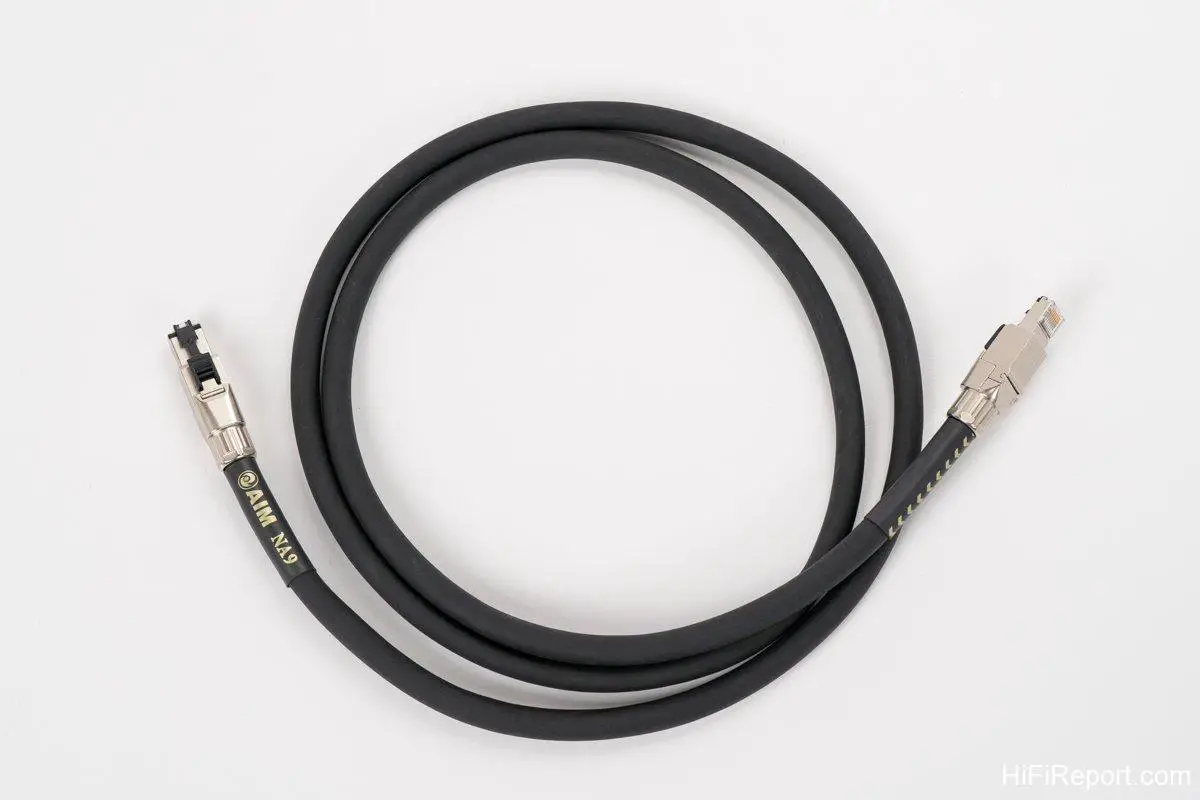
The NA9 incorporates AIM’s exclusive “SHIELDIO” technology, utilizing a newly developed “Hoplon” shielding structure. This structure employs four different materials to create an extremely rigorous shield, ensuring the most thorough isolation for signals transmitted within the cable.
What are these four different shielding layers? The first layer is Pulshut MU, wrapped around each twisted pair. This is a special material developed by Asahi Kasei Corporation of Japan, designed to eliminate electromagnetic noise interference generated by the cable itself. Each twisted pair is then further wrapped with a layer of aluminum foil, prized for its excellent shielding against high-frequency noise.
An RJ45 network cable contains four twisted pairs. Each pair is first treated with the aforementioned two layers of material. After insulating these four pairs, they are then wrapped in a layer of copper foil. Copper foil provides excellent shielding against noise across the entire frequency range, especially effective in the audio frequency band. Finally, a layer of high-density copper braid is applied to further enhance shielding against low-frequency noise.
After such a series of rigorous shielding measures, one might expect the NA9 network cable to be thick and stiff, making it difficult to bend and use. However, this is not the case. The NA9’s final overall diameter is 10mm, similar to, or even slightly thinner than, typical high-end audiophile network cables. Importantly, the cable body is quite flexible, making it easy to handle.
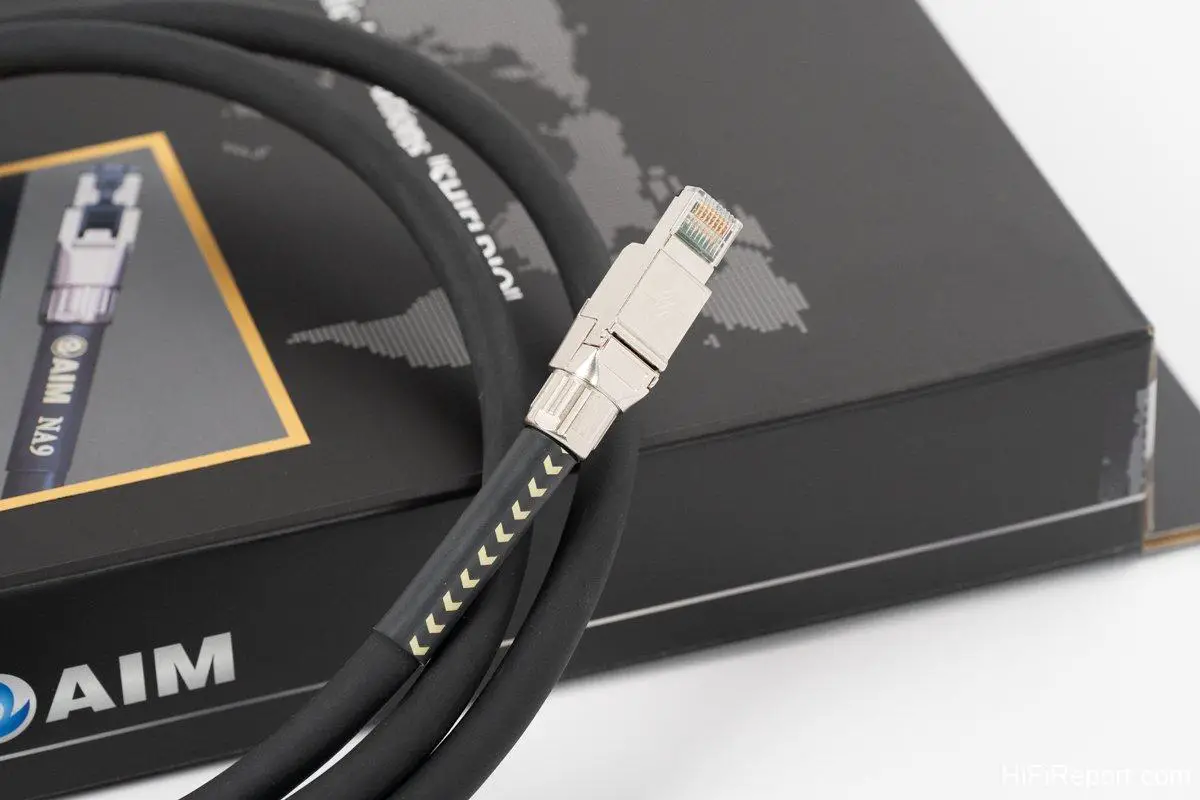
The connectors at both ends are, unsurprisingly, from the renowned German manufacturer Telegartner. The housings are entirely metal and nickel-zinc plated, providing 360-degree shielding even at vulnerable seams.
Improved Detail and Imaging
The NA9’s design is indeed unique, which explains why it was selected as the 2022 Grand Prix Award and the 2022 Winter Best Buy Award by Japanese audio-visual magazine HiVi immediately upon its release. What kind of sound performance does it deliver? Let’s find out through listening tests! The listening tests were conducted in my home, using a PC computer with Volumio system installed as the streamer. It was connected to an Audiobyte Black Dragon DAC via USB. The PC was connected via a network cable first to a Qnap QWS-308S network switch, then to a wireless router. The NA9 was used between the PC and the QWS-308S.
Other equipment included a Holo Audio Serene preamplifier, NuPrime Evolution One power amplifier, and Aurum Cantus Grand Harmony speakers.
First, I played track 6, the Andante from Mozart’s Piano Concerto No. 21, from the “Tutti!” orchestral compilation. The piece begins with a serene unison string section, underpinned by pizzicato double basses. Through the NA9, I perceived the sonic images of different string sections to be more distinct and defined, improving the separation between sections and resulting in a more organized soundstage structure.
The pizzicato notes also became more articulate, enhancing the sense of rhythm and making the music livelier and more buoyant.
Furthermore, the string textures became smoother and more refined, the timbre more transparent and brighter, resulting in a cleaner overall sound.
Piano key strikes were crisper, and the piano tone had improved brilliance and clarity. The tonal texture was noticeably better, with a more luxurious feel, and the piano sound seemed to bloom.
In terms of soundstage, the NA9 demonstrated improvements in 3D dimensionality, as well as in soundstage height and width.
Generally speaking, based on past listening experiences, good network cables tend to bring about changes in this direction, and the NA9 is no exception.
These listening impressions were all obtained through A/B comparisons with a reference cable, the Linkomm CAT-8 network cable. The NA9 clearly elevated the sense of sonic refinement. In comparison, the reference cable’s timbre was somewhat veiled, lacking clarity and not fully revealing the inherent nobility of string instruments. Furthermore, the sonic images of different sections were flatter, their relative relationships were less clearly defined, and the dynamic nuances were less pronounced.
Simply put, the reference cable sounded flatter and duller, while the NA9 was more vibrant and texturally richer.
Expert in Emulating Live Performance
Next, I played “Apollo,” which features cello and guitar duets of famous classical pieces. The music is exceptionally beautiful, and the recording is quite natural.
Using this simply orchestrated music for comparison, the difference between the reference cable and the NA9 became even more pronounced. The cello’s sonic line through the reference cable was flatter, with a larger sonic image, positioned further back, and with a lower center of gravity. The textural density was slightly loose, and the perceived coherence was just average.
Switching to the NA9, the texture gained a more realistic quality, yet became smoother and more fluid. The lines were clearer and more three-dimensional, and the dynamic variations were more distinct.
Furthermore, the texture of bow-string friction became clearer without any harshness, and the reverberation and ambience were richer, making the sense of space more realistic.
The intuitive feeling was that it sounded more real.
For another example, listening to track 1, “Autumn Leaves,” from the test disc “Supreme Sessions 2” with the NA9, not only could I clearly hear all the advantages mentioned in the previous two musical pieces—including sonic image outlines, separation, localization, the relative relationships of front and back and left and right, the tangibility of the soundstage, textural richness, etc.—but there was also a significant sense of “live” presence.
This album is known for using only two microphones placed in front to capture the performance, recording directly to master tape without mixing, striving to capture the atmosphere of the performance as accurately as possible, simulating the listening experience of human ears. The NA9 enhances this directness, providing the listener with a greater sense of being there.
Confidence Built on ICT Expertise
Does the NA9 reproduce more of the recording’s live atmosphere because of its unique four-layer shielding? Or is it due to the solid technology rooted in network and information communication cables? I don’t know, but I am convinced that AIM has a strong foundation and has created a good cable that is worth trying.
Specifications
* Type: RJ45 Network Cable
* Conductor: OFC
* Diameter: 10mm