
Analysis Plus Gold Oval Micro Signal Cable Review
Let me introduce you to a noteworthy brand, a “new old brand” – Analysis Plus.
Why do I call it a “new old brand”? It’s new because most audiophiles, including myself, may be hearing about this brand for the first time. It’s old because Analysis Plus has been around for 30 years, already a seasoned and mature brand.
This time, I became acquainted with Analysis Plus through their Gold Oval Micro flagship signal cable, and I felt a sense of discovering a hidden gem.
Patented Hollow Oval Design
Hailing from the USA, Analysis Plus was established in 1992, marking its 30th anniversary this year. This brand boasts two main characteristics: firstly, it operates in both Home Audio and Pro Audio domains; secondly, it employs a unique Hollow Oval cable structure.
The Analysis Plus website is clearly divided into two sections: Home Audio and Pro Audio.
Home Audio encompasses consumer audio cables and so-called audiophile cables, including interconnects, speaker cables, power cords, digital cables, phono cables, and more. Pro Audio covers professional audio cables, such as microphone cables, guitar cables, patch cables, power cables, speaker cables, digital cables, etc.
While the target audiences and usage scenarios for cables in these two sections differ, both utilize the patented Hollow Oval cable structure.
The Hollow Oval structure can be considered the “foundation” of Analysis Plus. Founder Mark Markel initially discovered the benefits of Hollow Oval cables, patented the design, and subsequently established Analysis Plus.
Addressing Traditional Conductor Issues
What makes the Hollow Oval cable structure so remarkable? In the knowledge base section of the Analysis Plus website, they dedicate considerable space to explain, through empirical testing, why Hollow Oval conductors are superior to traditional round or rectangular conductors. Simply put, Hollow Oval conductors not only eliminate proximity and skin effects but also ensure that cable impedance remains constant regardless of signal frequency changes, thus preventing distortion of the original music signal.
Furthermore, Hollow Oval conductors exhibit lower inductance, which is advantageous in minimizing EMI influence and reducing noise.
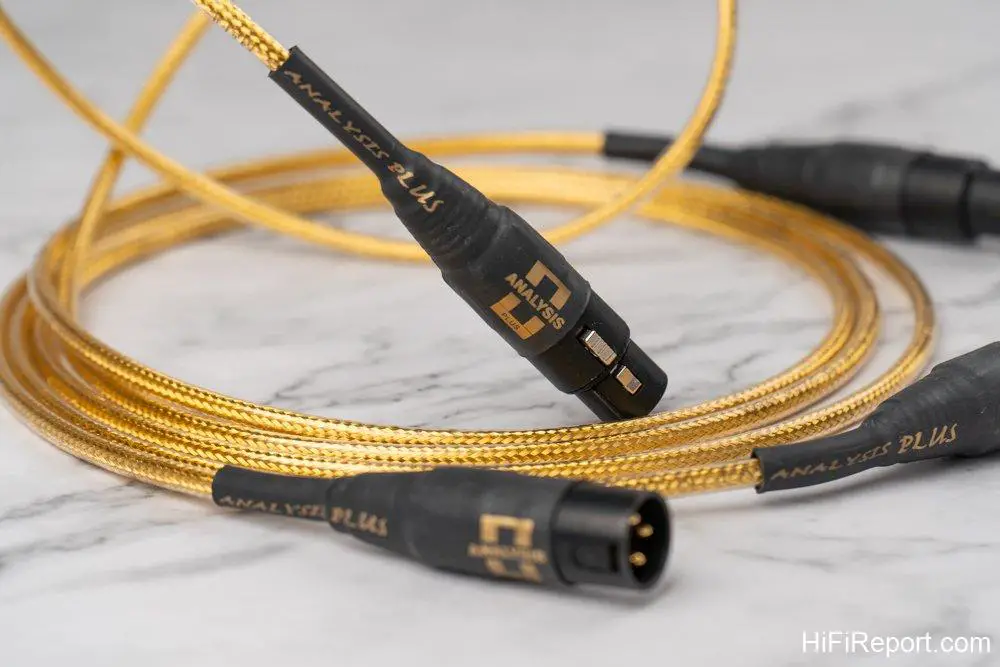
With these cumulative benefits, Analysis Plus believes that Hollow Oval cables are the best choice for audio applications.
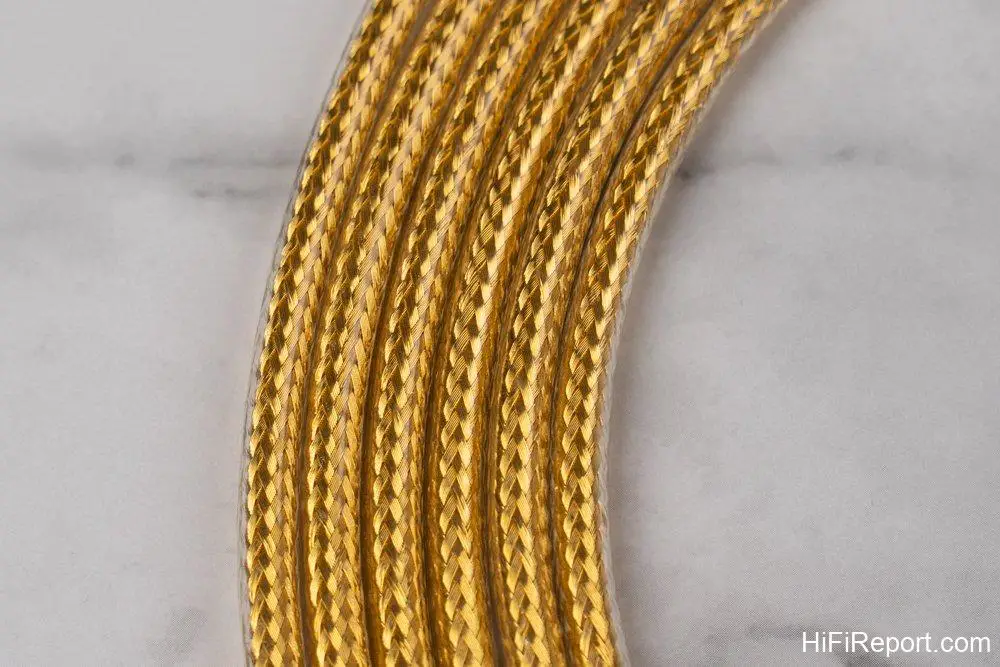
So, how are Hollow Oval conductors manufactured? One might assume that such a unique hollow structure would require solid conductors, but that’s not the case. They are made using braided conductors, where fine strands are woven into a Hollow Oval shape. Analysis Plus argues that braided conductors are superior to solid core conductors for two main reasons.
Firstly, braided conductors are demonstrably more reliable than solid core conductors. Braided conductors are more flexible and resilient, better able to withstand twisting or deformation caused by continuous bending.
When a solid core conductor is bent, it can alter its original geometry, leading to changes in cable characteristics and signal distortion. Braided conductors, however, maintain their shape even when bent.
Secondly, Analysis Plus employs a specific braiding technique in their braided conductors to minimize proximity effects. This ensures a more even distribution of current density among the strands, and the resistance remains highly stable across different signal frequencies, demonstrably outperforming solid core conductors.
Advanced Technology and Design
Now, let’s turn our attention to the protagonist of this review: the Gold Oval Micro signal cable.
Currently, Analysis Plus offers approximately ten analog signal cable models, including subwoofer cables. They share a fundamental structure, all utilizing the patented Hollow Oval conductor technology. The differences lie in conductor materials, gauge, insulation, and shielding, resulting in varying price points.
The Gold Oval Micro signal cable belongs to the distinct Gold Oval series, representing Analysis Plus’s flagship interconnects. The Gold Oval series also includes Gold Oval speaker cables.
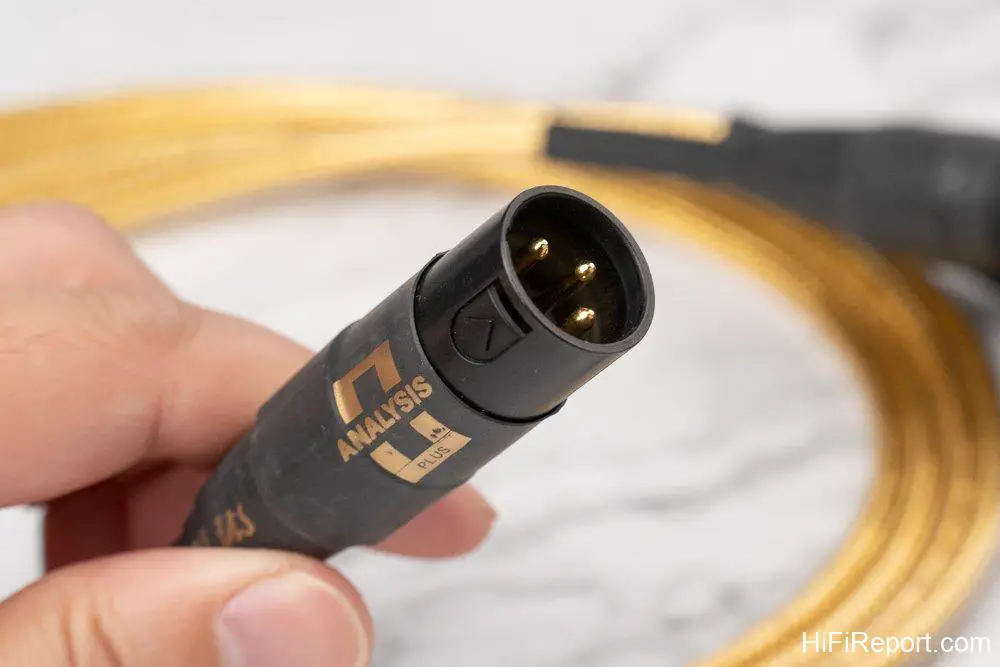
Price-wise, the Gold Oval Micro signal cable is significantly more expensive than other cables in their lineup. For instance, the Silver Apex, their next-in-line signal cable, is priced at $879 USD per 0.5m, while the Gold Oval Micro signal cable commands $2,999 USD per 0.5m – more than double the cost. Given that the primary differences are in conductor and insulation, why such a substantial price gap? Firstly, the Gold Oval Micro signal cable utilizes oxygen-free copper conductors plated with pure gold, resulting in high material costs. Secondly, it incorporates a cutting-edge design featuring a hollow oval within a hollow oval structure, which accelerates rise time and enhances shielding effectiveness. Moreover, the Gold Oval Micro signal cable has a smaller gauge, further contributing to improved performance.
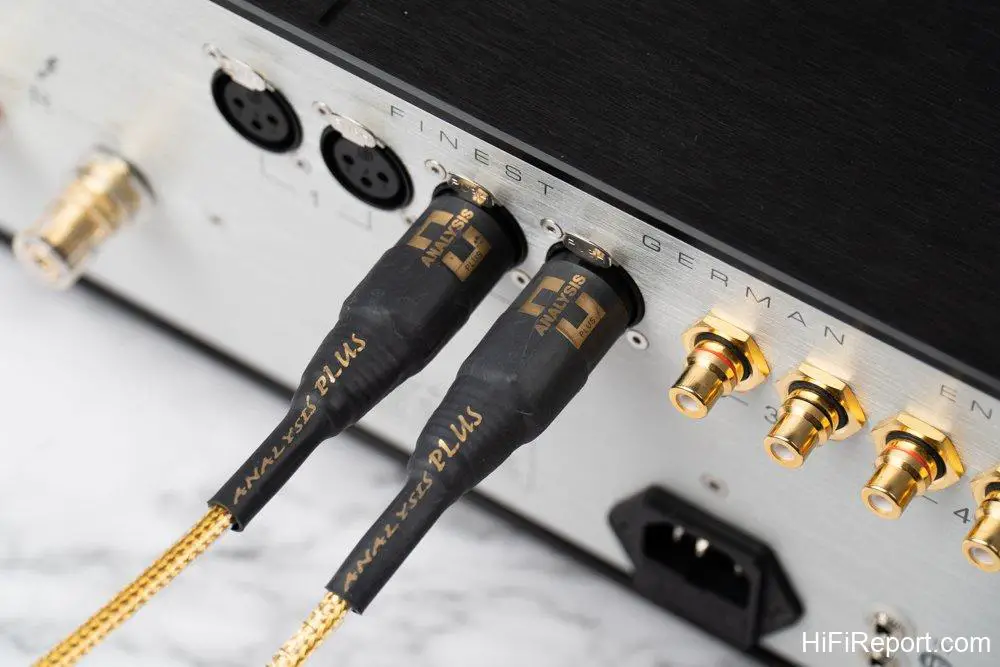
The Gold Oval series cables cannot be manufactured using Analysis Plus’s standard equipment; dedicated tooling and exclusive production processes had to be developed. These factors inherently elevate the production cost of the Gold Oval series, hence their premium pricing.
Initial Sound Impression
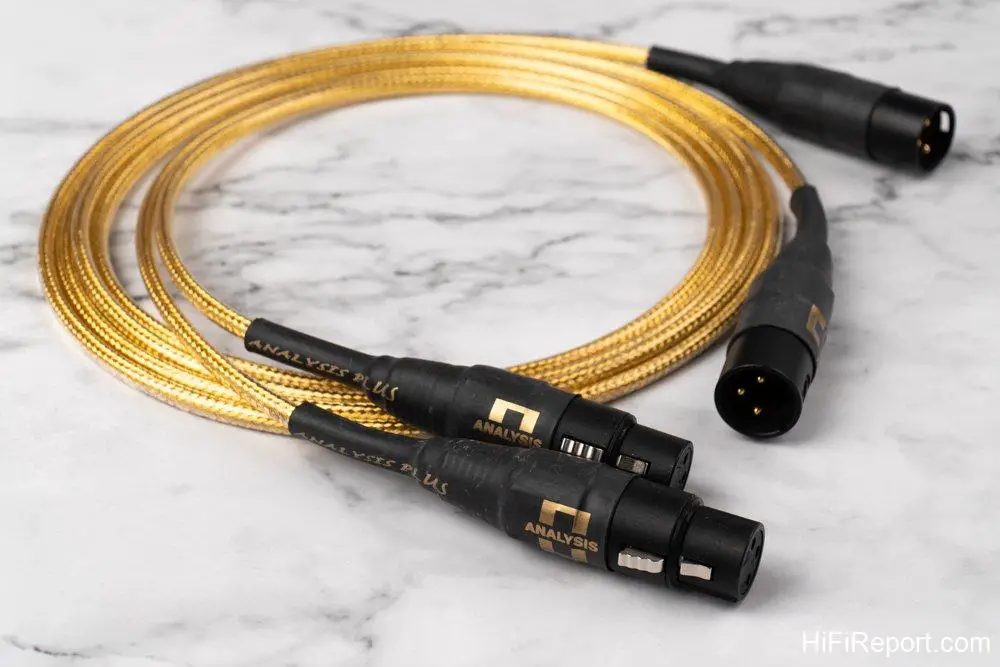
The Gold Oval Micro signal cable indeed has a very slender profile, perhaps even thinner than the notoriously slim Crystal Cable, and it is even more pliable. It navigates tight spaces effortlessly, making cable management a breeze. Even before hearing its sound, its user-friendliness already earned my favor.
The listening session took place in the HiFiReport listening room. The initial setup included the Linear Acoustic LA-V120 integrated amplifier and Wilson Audio Alexia 2 speakers, with a Telos EMP server player and North Star Design USB DAC32 as sources, and a Diva network switch.
From the first notes, a distinct impression arose: exceptional performance, truly impressive cables! Its imaging, localization, separation, soundstage, frequency response, and overall sonic structure—everything was remarkably well-defined. It presented a precise, objective, and realistic sonic picture, yet with a beautiful and luxurious tonality that immediately captivated. The Gold Oval Micro signal cable possesses a remarkably clean sonic foundation without sacrificing warmth or appropriate body. It maintains a touch of warmth, neither too intimate nor too distant, striking a perfect sense of spatial perspective.
It felt as though it meticulously dissected the sound, exhibiting a sense of composure, yet it was far from being cold. It conveyed the inherent temperature of the recording, the music, and the performance, allowing the passion of the music to shine through.
Balanced Speed and Pace
Take, for example, jazz drummer Tony Williams’s trio album “Young at Heart,” featuring piano and bass alongside drums.
The opening track, “Promethean,” is an upbeat and energetic piece, with all three musicians playing at a rapid pace. Through the Gold Oval Micro signal cable, even in the most densely packed passages, the bass and drums retained incredibly clear outlines, forms, and trajectories. The low-frequency extension was just right, neither excessive nor lacking, perfectly balanced, and light-footed. The speed wasn’t particularly fast, but just perfectly paced, harmonizing seamlessly with the piano’s mid and high frequencies. This synergy rendered the music tight yet fluid, like flowing water, natural and vibrant.
Another example is Starker’s rendition of Bach’s Unaccompanied Cello Suites. Listening immediately revealed the Gold Oval Micro signal cable’s exceptionally transparent tonality. The cello’s resonance was pure and delicate, while its form was tangible and prominent, with outlines and sonic lines as clear as engravings.
Evidently, the Gold Oval Micro signal cable excels in both the physicality of sonic images and the depiction of spatial contours. Moreover, the sound possesses remarkable penetration, creating a sense of live presence.
Beyond this, the Gold Oval Micro signal cable’s resolution is also outstanding. The texture of bow-on-string friction was rendered realistically and delicately, and subtle sonic nuances and micro-dynamics were amplified, imbuing the music with greater vitality.
Exceptional Resolution
With the Gold Oval Micro signal cable in place, the Linear Acoustic LA-V120 integrated amplifier seemed to emphasize resolution slightly excessively, leaning towards a less relaxed and smooth presentation. Therefore, I switched the amplifier to the Electrocompaniet EC 4.8 preamplifier and EAR 509 vacuum tube power amplifier, connecting the Gold Oval Micro signal cable between the DAC and preamplifier, to observe any changes in the sonic character.
Replaying Starker’s Bach Cello Suites, the initially pristine and clean tonality gained a touch of warmth, the high frequencies became more hydrated and refined, and the sonic palpability intensified.
The cello’s sonic outlines softened slightly, acquiring a sweeter and smoother texture, akin to applying a soft-focus effect to a photograph.
Even so, the instrument’s imaging remained excellent, still tight, focused, and refined. The sonic character remained resolution-oriented, with the clarity, transparency, and precision clearly being hallmarks of the Gold Oval Micro signal cable.
Another example was the audiophile recording “Antiphone Blues,” featuring saxophone and pipe organ duets of famous blues and traditional melodies.
Through the Gold Oval Micro signal cable’s abundant detail retrieval, the tonal nuances became vividly audible. I discovered the surprising richness of the pipe organ’s sounds; some bright and sharp with a metallic sheen, others mellow and deep with a woody character, some expansive and profound, anchoring the lower registers of the soundstage, while others were delicate and seemingly emanating from above.
Regardless of frequency range, the sounds were exceptionally clear and remarkably clean, devoid of any sense of impurity. Especially when the organ played multiple keys simultaneously, with melodies in different frequency ranges and timbres sounding together, the sound never became muddled. The distinctness of forms and localization remained clear, allowing for effortless discernment of individual sonic lines.
Spatial information was equally abundant, with long decays and reverberations conveying a clear and profound sense of space.
The saxophone’s timbre was meticulously detailed and solid, rather than soft, with outlines that were even slightly sharp, leaving no room for ambiguity.
Furthermore, the Gold Oval Micro signal cable distinctly brought the saxophone’s position closer and emphasized its substantial form and sharp outlines, while simultaneously enhancing the organ’s sense of distance.
From “Antiphone Blues,” it was also evident that the Gold Oval Micro signal cable portrayed dynamic contrasts with remarkable clarity. Quiet passages were rendered with exceptional detail, while loud passages delivered instantaneous energy, repeatedly highlighting the audiophile quality of this recording.
Expressive Musicality
Next, I played Brendel’s performance of Beethoven’s Piano Concerto No. 4, with Rattle conducting the Berlin Philharmonic.
Listening through the Gold Oval Micro signal cable, the air was pristine, transparency was excellent, and large-scale orchestral music became more visually evocative. It was as if every sound and instrumental section was treated with utmost care and precision, possessing clear forms, superb separation, and localization. The soundstage depth was also outstanding, with distinct layers from front to back.
This layering was also evident in the string sections, where layers of strings built upon each other without any sense of congestion.
In the low-frequency domain, the balance was exceptionally precise, devoid of any superfluous elements, and remarkably stable. The downward extension was effortlessly natural, also exhibiting clear and rich layering.
The pizzicato notes of the double basses were clearly defined, possessing both excellent elasticity and clear extension, undoubtedly demonstrating top-tier low-frequency performance.
Moreover, the Gold Oval Micro signal cable’s high-frequency performance was also impeccable. Brendel’s piano produced a beautiful tone, as if the entire instrument was illuminated, with lingering resonances filling the air.
The string timbre was drier, not particularly lush, but even the faintest sounds of bow hair on strings were clearly audible, accompanied by room ambiance, reverberation, and lingering decay, conveying a realistic sense of atmosphere.
The Gold Oval Micro signal cable also excelled in forte passages. Its dynamic contrasts were striking, with energy and dynamics delivered without hesitation. The sound was cohesive and focused, precisely capturing the intense atmosphere of loud passages and rendering musical expressions with remarkable vividness.
Legitimacy of Hollow Oval Technology
Frankly, when I first received the Gold Oval Micro signal cable and learned of its price, I was somewhat taken aback. Analysis Plus has long been known for offering high C/P ratio products in both home and professional audio. However, the price difference between the Gold Oval Micro signal cable and their entry-level interconnects is 50-fold. Could the sonic performance truly reflect this price disparity? I was uncertain. But after listening, I have no doubt that the Gold Oval Micro signal cable possesses genuine Hi-End cable capabilities. Furthermore, I am convinced that their Hollow Oval conductor technology is not mere hype but rather a legitimate approach to overcoming conductor transmission bottlenecks.
Therefore, even if the Gold Oval Micro signal cable is beyond your budget, other Analysis Plus cable series also incorporate the same technology, and I believe they are all worth exploring.
Specifications
* Type: XLR Balanced Analog Signal Cable
* Conductor Gauge: 18AWG × 3 strands
Reference Equipment
* Sources: Telos EMP Music Server Player / Diva Network Switch
* DAC: North Star Design USB DAC32
* Amplifiers: Linear Acoustic LA-V120 Integrated Amplifier / Electrocompaniet EC 4.8 Preamplifier / EAR 509 Power Amplifier
* Speakers: Wilson Audio Alexia 2
* Cables: Tromba Mandolin XLR Signal Cable / Tromba Marina OCC-1 Speaker Cable / Xsymphony Precision One Power Cable
* Accessories: Tiglon TMR-2 Audio Rack / MYSTJ Audio CMS Audio Rack / ASI Tuning Devices