
Apple AirPods 4 Wireless Earbuds Review
Overview
Apple’s AirPods 4 represent a meaningful evolution of the company’s entry-level true wireless earbuds. Released in September 2024 alongside a more feature-rich Active Noise Cancellation variant, the standard AirPods 4 bring modern Apple audio technology to an open-ear design that entirely forgoes silicone ear tips. At their core, these earbuds are built around the Apple-designed H2 chip—the same silicon found in the more expensive AirPods Pro 2—and promise improved sound quality, a redesigned fit, and a suite of capabilities that narrow the gap between budget and premium offerings.
The open-ear design is the defining characteristic here. Unlike in-ear models that create a seal within the ear canal, the AirPods 4 rest just outside it, allowing ambient sound to pass through naturally. This makes them well suited for users who find traditional ear tips uncomfortable or who need to remain aware of their surroundings during daily activities. The trade-off, as multiple expert reviewers observed, is that the lack of a seal limits isolation and allows external noise to interfere with audio fidelity.
What makes the AirPods 4 noteworthy is how much Apple has packed into this open design. Personalized Spatial Audio with dynamic head tracking, hands-free Siri with gesture-based interactions, Voice Isolation for calls, and an IP54 dust and sweat resistance rating all feature here. The question is whether these capabilities add up to a compelling package for users who don’t need active noise cancellation—or whether competitors offer a more complete feature set for a similar investment.
Design and Build Quality
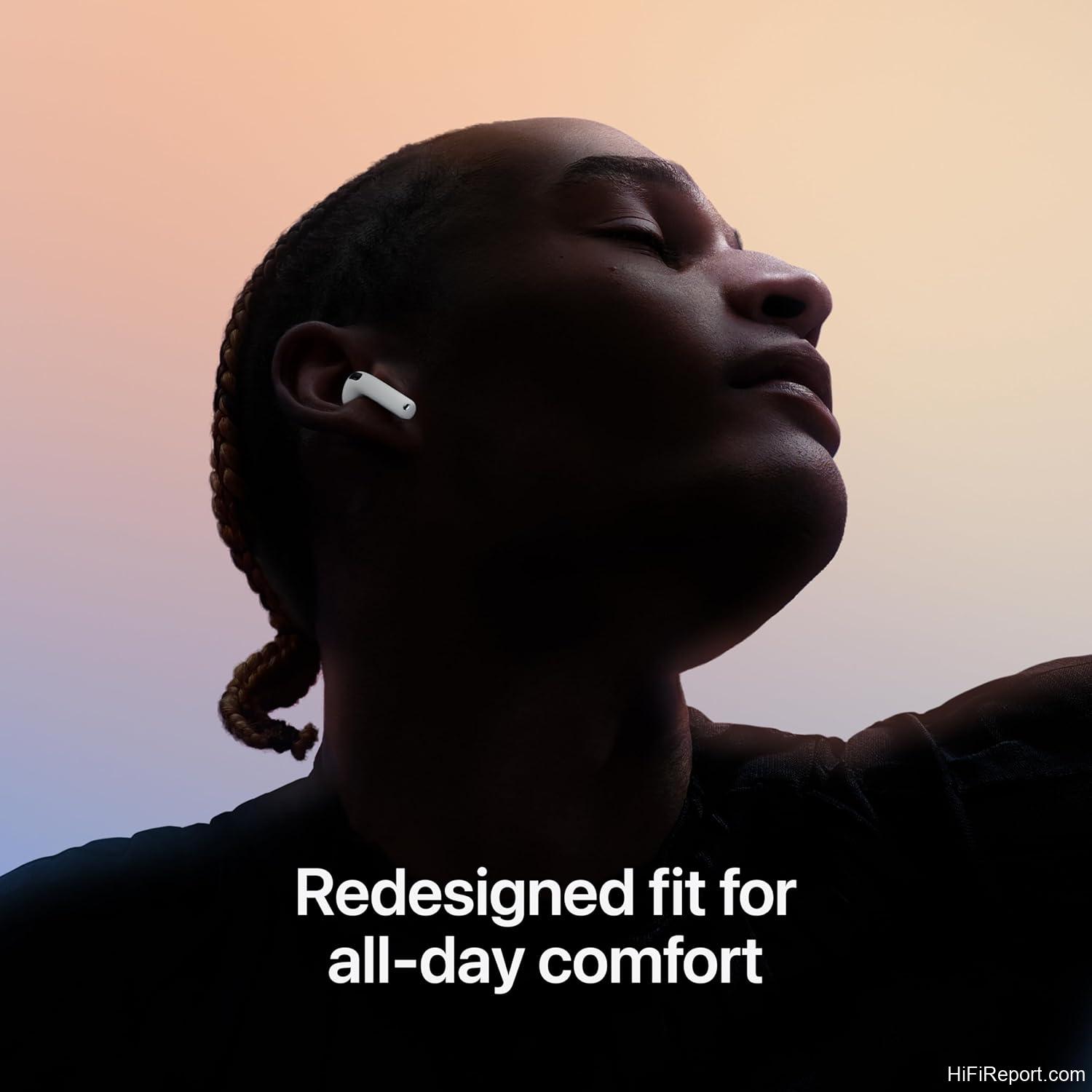
The AirPods 4 inherit the iconic white, glossy aesthetic of their predecessors but introduce a meaningfully redesigned shape. Apple has recontoured the buds with a more angled profile, shortened the stems, and repositioned the black vents and acoustic grilles. The result is a bud that sits more securely in the ear, with a refined silhouette that looks both familiar and fresh.
SoundGuys praised the improved fit and comfort in their lab testing, noting that the redesign succeeds in being secure and lightweight. TechRadar echoed this assessment, calling the fit “remarkably stable” for an open-ear design that lacks ear tips. The quick-press force sensor controls on the stem handle playback, calls, Siri activation, and track navigation, replacing the older tap-based interface with a more deliberate physical interaction that TechRadar’s reviewer particularly appreciated.
This article is the original property of hifireport.com. All rights reserved. Unauthorized reproduction is strictly prohibited.
However, the one-size-fits-all approach remains a fundamental limitation. PCMag observed that while the updated shape is secure when properly placed, the buds “can still fit inconsistently from ear to ear, which creates potential sound imbalance issues.” SoundGuys echoed this concern, listing the one-size-fits-all design as a key drawback. The absence of interchangeable ear tips means that fit quality is entirely dependent on your ear geometry—a reality that makes trying before buying strongly advisable.
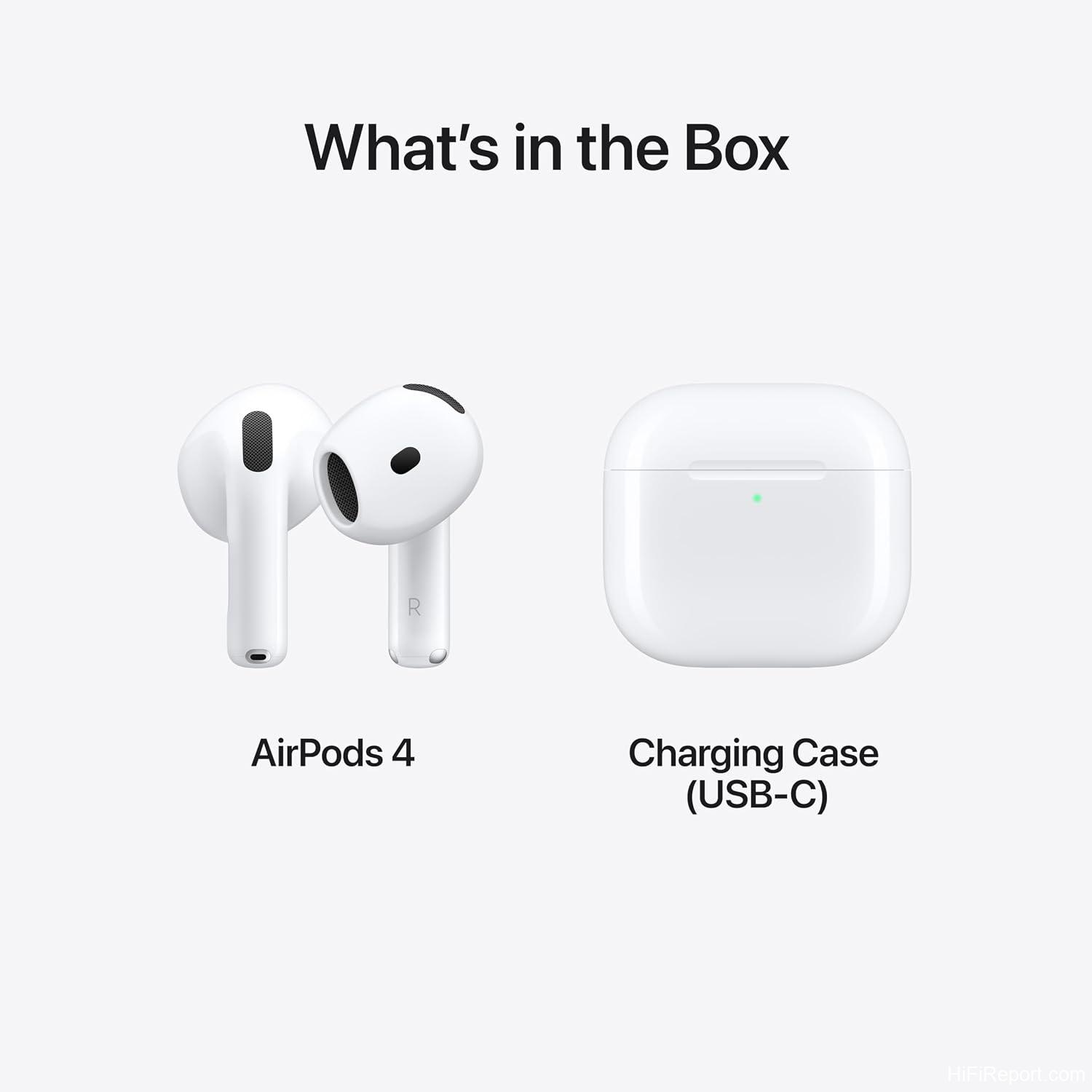
The charging case has also received attention. It is more than 10 percent smaller by volume than the previous generation and now uses USB-C, finally retiring Apple’s proprietary Lightning port from this product line. However, the standard AirPods 4 case lacks wireless charging support—a feature reserved for the ANC variant—and omits the built-in speaker that enables audible Find My chirping on the more expensive model. These omissions are worth noting if you’ve grown accustomed to the convenience of dropping a case on a charging pad.
Durability is a genuine bright spot. Both the earbuds and the charging case carry an IP54 rating for dust, sweat, and water resistance, meaning they can withstand rain and heavy workouts. This is a meaningful upgrade over previous entry-level AirPods and brings the standard model in line with what fitness-oriented users expect from modern wireless earbuds.
Sound Quality and Performance
Audio performance is where the AirPods 4 make their strongest case. Despite the open-ear design—which inherently allows sound to leak in and out—Apple has engineered a surprisingly capable listening experience. The H2 chip works in concert with custom 11mm high-excursion drivers and high dynamic range amplifiers to deliver sound that PCMag described as having “impressive bass response and crisp highs.”
The ability to reproduce sub-bass is particularly noteworthy. PCMag called it “a notable advancement for an open-ear design,” since low frequencies typically suffer most when there is no seal in the ear canal. The redesigned venting system and the relocated H2 chip—now housed in the stem—contribute to improved airflow and acoustics that help compensate for the absence of a physical barrier.
TechRadar found the sound “fulsome and fairly dynamic” with “superb balance between frequencies,” making it enjoyable across a wide range of musical genres. However, the same reviewer noted a “lack of fine detail compared to the mid-range competition” that prevents music from achieving the realism and depth available from sealed in-ear designs. The open design allows ambient noise to leak in, which inevitably interferes with fidelity—especially in noisy environments where external sounds compete with your music.
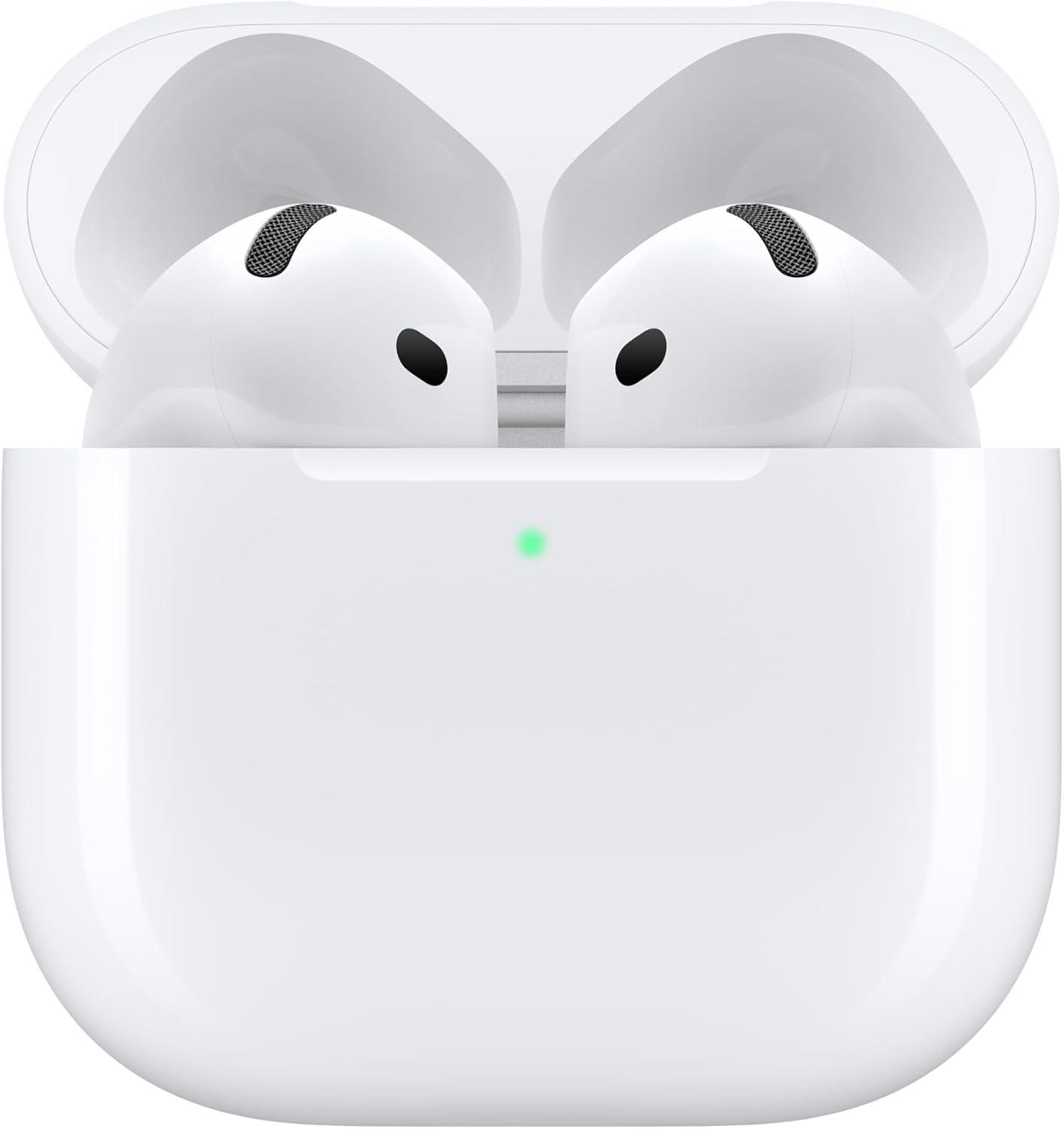
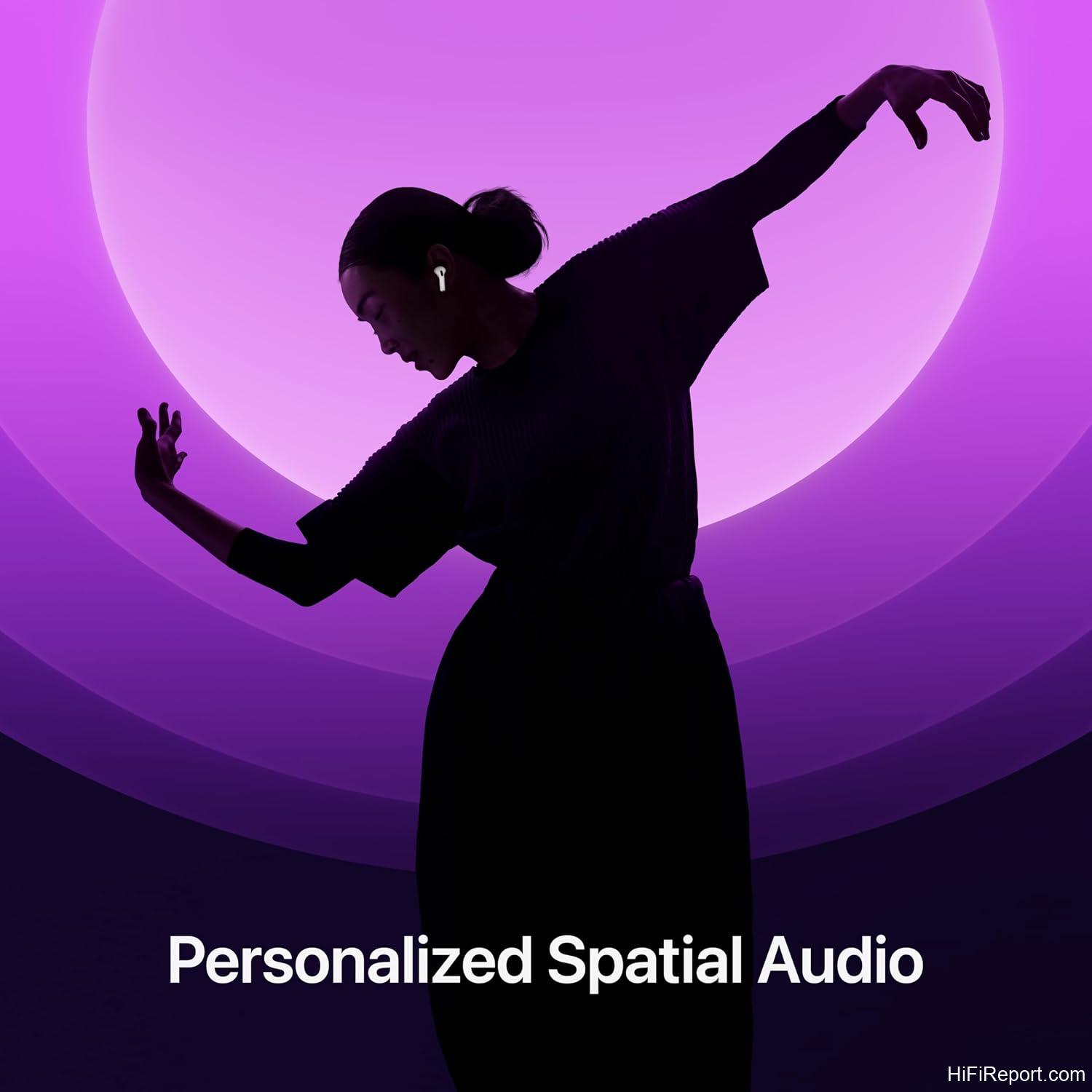
Personalized Spatial Audio with dynamic head tracking is a standout feature. The technology creates a theater-like listening experience by mapping sound to your head movements, and multiple reviewers praised its effectiveness—particularly for movies and TV shows. TechRadar called spatial audio “great,” and the immersive quality is further enhanced when sharing audio between two sets of AirPods, a feature that works seamlessly within the Apple ecosystem.
It’s worth noting that the standard AirPods 4 lack active noise cancellation, Transparency mode, and Conversation Awareness—features available on the ANC variant. If you frequently listen in noisy environments like trains, planes, or busy offices, the open design’s inability to block external sound will be a significant limitation. For quiet settings and casual listening, though, the audio quality is more than satisfactory.
SoundGuys gave the AirPods 4 an overall rating of 6.4 out of 10, with particularly strong scores for portability at 9.6 and features at 8.7, but notably weak scores for isolation at 2.3 and comfort at 4.5—the latter reflecting the fit inconsistency issue. Their MDAQS sound quality assessment rated timbre at 3.7, distortion at 3.5, and immersiveness at 3.8, yielding an overall audio score of 3.6. These measurements underscore the central tension: the AirPods 4 do many things well, but the open design fundamentally caps their audio potential.
Features and Ecosystem Integration
The AirPods 4 shine brightest when used within Apple’s ecosystem. The setup experience is characteristically effortless: simply place the earbuds near your device and tap Connect on the screen. From there, the integration is deep and intuitive. Auto-device switching allows the AirPods to move between your iPhone, iPad, and Mac without manual reconnection—a feature that TechRadar highlighted as “really useful” and one that competitors struggle to replicate.
Hands-free Siri is a welcome addition to the entry-level AirPods. You can activate Apple’s voice assistant by saying “Siri” or “Hey Siri” to play music, make calls, or check your schedule. The new Siri Interactions feature adds a clever layer of hands-free control: you can respond to Siri by nodding your head yes or shaking it no, which is genuinely useful when your hands are occupied or when you want to respond discreetly in a quiet setting.
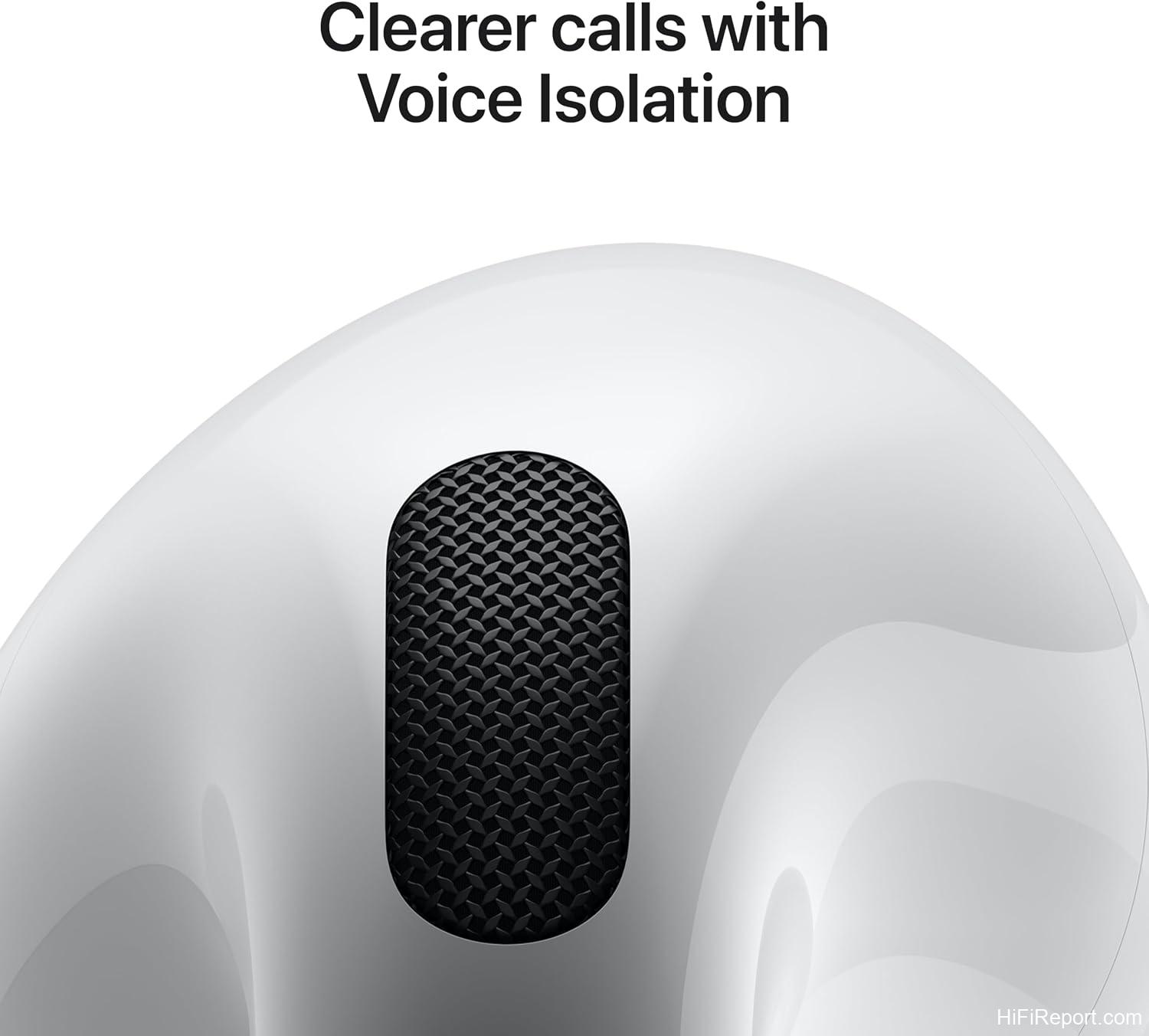
Voice Isolation is another feature borrowed from Apple’s higher-end models. Using the H2 chip’s computational audio capabilities, it reduces background noise during phone calls while isolating and clarifying your voice. This is a practical improvement for anyone who takes calls in noisy environments, and it demonstrates the value of having the H2 chip even in a non-ANC model.
The optical in-ear sensor is a small but genuinely useful feature. It detects when you’re wearing the AirPods and automatically plays audio only when they’re in your ears, pausing playback when you remove them. Find My support helps you track down misplaced earbuds and the charging case, though the standard case lacks the built-in speaker that would make it chirp audibly—a feature exclusive to the ANC version.
Audio sharing is another ecosystem-exclusive feature worth mentioning. You can easily share a song or show between two sets of AirPods, which is a delightful capability for couples, friends, or family members who both own AirPods. It’s the kind of small convenience that reinforces the value of staying within Apple’s walled garden.
The most significant limitation is the absence of standard Bluetooth multi-point pairing. TechRadar flagged this as a major drawback: without it, you only get seamless device switching within the Apple ecosystem. If you want to use the AirPods 4 with a Windows laptop, Chromebook, or Android device, you’ll need to manually reconnect each time. Nearly all competitors at a similar level offer multi-point pairing, making this a notable gap for anyone who lives outside a purely Apple environment.
SoundGuys also noted that many features are limited to iOS, which reinforces the AirPods 4’s positioning as a product primarily for Apple users. The lack of user-adjustable EQ, flagged by PCMag, means you’re stuck with Apple’s default sound signature—a limitation that some competitors address with companion apps offering extensive customization options.
Call Quality and Microphone
Call quality benefits substantially from the H2 chip’s computational audio capabilities. Voice Isolation is the headline feature here, and it works by analyzing incoming audio in real time to separate your voice from ambient noise. In loud conditions—windy streets, busy cafes, or while walking—the difference is noticeable, with background sounds significantly reduced and vocal clarity improved for the person on the other end of the call.
The force sensor controls make managing calls straightforward. A quick press can answer or end a call, and the same controls handle music playback and Siri activation. The physical feedback of the force sensor is more reliable than touch-based controls, which can be accidentally triggered when adjusting the earbuds’ position in your ear—a practical advantage that shouldn’t be overlooked.
While none of the third-party reviewers conducted extensive dedicated call quality testing, the consensus is that the AirPods 4 perform competently for phone calls and video meetings. The open-ear design means you can hear your own voice naturally during calls, avoiding the occlusion effect that makes sealed earbuds feel like you’re talking inside a tunnel. This is a subtle but meaningful advantage for users who spend significant time on calls throughout the day.
Battery Life
Battery life is one area where the AirPods 4 draw consistent criticism. Apple rates the earbuds at up to five hours of listening time on a single charge, with the case providing additional charges for a total of up to 30 hours. PCMag’s specifications list a slightly more conservative 25 hours with the case, which may reflect different testing conditions or a different interpretation of total capacity.
Tom’s Guide called the battery life “average” and noted it as a particular area where they wished for improvement. For comparison, the AirPods Pro 2 offer similar per-charge battery life but benefit from more efficient power management in certain modes. The standard AirPods 4 lack the efficiency gains that active noise cancellation models sometimes achieve through adaptive audio processing.
In practical terms, five hours per charge is adequate for most daily use—commutes, workouts, and casual listening sessions—but falls short of what some competitors offer. Many similarly positioned earbuds from other manufacturers provide six to eight hours per charge, making the AirPods 4’s endurance unremarkable rather than class-leading.
Charging is handled via USB-C, which aligns with the broader industry standard and means you can share a cable with most modern devices. The case lacks wireless charging support on the standard model, so you’ll need a physical cable for every charge cycle. This is a practical limitation if you’ve invested in wireless charging pads for your other devices and expected the same convenience here.
What Customers Are Saying
The Amazon listing for the AirPods 4 shows a strong aggregate rating of 4.5 out of 5 stars, drawn from over 34,500 ratings. While the specific review content wasn’t accessible due to Amazon’s login restrictions, a rating this high from such a large sample size suggests broad satisfaction among buyers.
A 4.5-star average typically indicates that the majority of users find the product meets or exceeds expectations, with relatively few genuinely negative experiences. For earbuds, this level of satisfaction often reflects comfort, ease of use, and sound quality—the areas where the AirPods 4 demonstrably excel based on expert testing. The large number of ratings also suggests strong adoption, consistent with Apple’s brand recognition and the AirPods’ established reputation in the market.
However, aggregate ratings can mask specific pain points. Based on the expert reviews, the most likely sources of dissatisfaction would be fit inconsistency, since the one-size-fits-all design doesn’t work for every ear shape; the lack of noise isolation in loud environments; and the limited cross-platform functionality. Users who primarily use Apple devices and listen in relatively quiet settings are the most likely to be satisfied, while those with non-Apple devices or who need noise blocking may find the experience underwhelming compared to alternatives.
Pros and Cons
Pros:
- Impressive sound quality for an open-ear design, with notable bass response and crisp highs
- Apple H2 chip enables advanced computational audio features
- Personalized Spatial Audio with dynamic head tracking is excellent for movies and media
- Redesigned shape offers improved comfort and stability over previous generation
- Hands-free Siri with head gesture interactions is intuitive and genuinely useful
- Voice Isolation significantly improves call quality in noisy conditions
- IP54 dust, sweat, and water resistance for both earbuds and charging case
- Seamless pairing and device switching within the Apple ecosystem
- Compact USB-C charging case, over 10 percent smaller than the previous generation
- Audio sharing between two sets of AirPods is effortless
Cons:
- One-size-fits-all design means fit quality varies significantly by ear shape
- No active noise cancellation, Transparency mode, or Conversation Awareness
- Open-ear design allows significant ambient noise interference
- No wireless charging support on the standard charging case
- No standard Bluetooth multi-point pairing for non-Apple devices
- Most advanced features require Apple devices to function properly
- No user-adjustable equalizer
- Battery life is average rather than class-leading
- Sound lacks fine detail compared to sealed in-ear competitors
- Case lacks built-in speaker for audible Find My alerts
Verdict
The Apple AirPods 4 are a thoughtfully executed update that brings genuine improvements to Apple’s entry-level wireless earbuds. The H2 chip, redesigned shape, Personalized Spatial Audio, and Voice Isolation collectively deliver an experience that feels modern and capable—especially for users entrenched in the Apple ecosystem who value the seamless integration that AirPods uniquely provide.
The sound quality is the standout achievement. Reproducing meaningful bass from an open-ear design is no small feat, and the balanced, dynamic sound signature makes for an enjoyable listening experience across genres. Spatial Audio with head tracking adds a layer of immersion that competitors at this level rarely match, particularly for video content and movies.
The fundamental limitation is the open-ear design itself. If you need noise isolation—whether for commuting, focused work, or simply blocking out a noisy environment—the AirPods 4 cannot deliver it. The one-size-fits-all approach also means that fit is a roll of the dice, and an inconsistent fit directly impacts sound quality and comfort. These are inherent trade-offs of the design philosophy rather than product flaws, but they’re real considerations that should inform your decision.
For Apple users who dislike ear tips, want a secure and comfortable fit, and primarily listen in environments where ambient noise isn’t a significant problem, the AirPods 4 are an excellent choice. They offer the most accessible entry point into Apple’s modern AirPods ecosystem without the silicone tips that some users find uncomfortable for extended wear. For everyone else—particularly those who use non-Apple devices or who need active noise cancellation—competing earbuds offer sealed designs with noise cancellation, multi-point pairing, and comparable or better sound quality.
The AirPods 4 succeed at what they set out to do: they’re the best open-ear AirPods yet, and for the right user, they’re a genuinely compelling option. Just be honest with yourself about whether you’re that user before committing.
© hifireport.com – Original review content by hifireport.com. Reprinting without written permission is not allowed.
Specifications
- Product: Apple AirPods 4 Wireless Earbuds
- Manufacturer: Apple
- Model Number: MXP63LL/A
- ASIN: B0DGHMNQ5Z
- Release Date: September 2024
- Type: Open-style true wireless earbuds
- Chip: Apple-designed H2
- Drivers: Custom 11mm high-excursion
- Amplifiers: High dynamic range
- Bluetooth Version: 5.3
- Connection Type: Bluetooth
- Controls: Force sensor (calls, playback, Siri, track navigation)
- Spatial Audio: Personalized Spatial Audio with dynamic head tracking
- Siri: Hands-free with gesture-based interactions (nod/shake)
- Voice Isolation: Supported via computational audio
- Water/Sweat/Dust Resistance: IP54 (earbuds and charging case)
- Battery Life (earbuds): Up to 5 hours listening per charge
- Battery Life (with case): Up to 30 hours total per manufacturer claim
- Charging: USB-C
- Wireless Charging: Not supported on standard model
- Earbud Dimensions: 30 x 18 x 18 mm
- Case Dimensions: 46.2 x 50.1 x 21.2 mm
- Earbud Weight: 4.3g
- Case Weight: 32.3g
- Product Dimensions: 3.25 x 3.25 x 1.5 inches
- Product Weight: 1.6 ounces
- Batteries: 3 Lithium Ion (included)
- In-Ear Sensor: Optical sensor for auto-play/pause
- Find My: Supported (case lacks built-in speaker on standard model)
- Audio Sharing: Supported between two sets of AirPods

- REBUILT FOR COMFORT — AirPods 4 have been redesigned for exceptional all-day comfort and greater stability. With a refined contour, shorter stem, and quick-press controls for music or calls.
- PERSONALIZED SPATIAL AUDIO — Personalized Spatial Audio with dynamic head tracking places sound all around you, creating a theater-like listening experience for music, TV shows, movies, games, and more.*
- IMPROVED SOUND AND CALL QUALITY — AirPods 4 feature the Apple-designed H2 chip. Voice Isolation improves the quality of phone calls in loud conditions. Using advanced computational audio, it reduces background noise while isolating and clarifying the sound of your voice for whomever you’re speaking to.*