
Arcam PA240 Review
Audiophiles often harbor a special fondness for the sonic signature of British audio brands. Indeed, many amplifiers and loudspeakers celebrated as “classics” hail from the UK. Perhaps it’s because British audio products often adhere to traditional design principles, resulting in conservative and understated aesthetics that remain etched in the memories of seasoned enthusiasts. Conversely, when stacked against modern audio equipment, they might appear somewhat lacking in visual novelty.
However, not all British brands follow this pattern. Arcam, also hailing from the UK, stands apart. Their product design consistently breaks from tradition, embracing modern aesthetics and demonstrating a forward-thinking technical approach.
Arcam’s Pioneering History
Speaking of visionary design, one cannot overlook Arcam’s launch in 1988 of the Black Box, the world’s first standalone DAC specifically designed for CD transports. This separated DAC and transport design allowed the vibration-prone mechanical structure of the transport to be isolated from the sensitive decoding circuitry, reducing noise interference. Even today, this remains the configuration of choice for the most demanding audiophiles.
The fact that Arcam conceived this concept right at the dawn of the CD era truly highlights their pioneering mindset.
Following this, in the 1990s, Arcam officially ventured into the realm of home theater. In 1995, they released the world’s first audiophile-grade AV amplifier, enabling consumers to replicate movie theater sound at home and solidifying their irreplaceable position in the AV world. By 2009, Arcam had fully integrated Class G amplifier technology into their amplifier designs, making it a hallmark feature of their products.
While perhaps less widely known in certain markets, Arcam has long been a highly respected name in Europe and North America. In recent years, a new distributor has brought them back to Taiwan, allowing a new generation of enthusiasts to discover the brand.
Introducing the Arcam PA240
Arcam’s amplifier lineup predominantly features multi-channel designs. However, the PA240, the subject of this review, is their flagship power amplifier and their sole pure two-channel power amp.
PA240 Physical Design and Connectivity
Let’s start with the exterior. I personally appreciate the PA240’s impeccably clean and minimalist design. The chassis is constructed from dark grey metal, while the front panel uses a heavier, thicker steel plate.
It features a subtle curved line across its surface, adding a touch of modern flair to its otherwise rectilinear form.

The front panel layout is refreshingly simple, featuring only “Standby” and “Mute” function buttons and a power switch. There’s no volume control, maximizing the use of negative space and resulting in a very clean look.
The true functionality of the PA240 resides on its rear panel, offering more versatile connectivity than typical two-channel power amplifiers. In addition to standard RCA and XLR analog inputs, it also includes analog outputs. Combined with the “Mode” selector, it provides three operational modes: ST (Stereo), Bridge (Bridged Mono), and DM (Dual Mono for bi-amping). The Bridge mode allows you to combine two PA240 units into a single, higher-power monoblock.
The DM mode facilitates bi-amping, where two PA240s separately drive the high and low-frequency binding posts of your speakers, enhancing driver control. It also features adjustable “Gain” output with two settings: 31dB and 25dB, allowing for fine-tuning based on the partnering speakers.
Understanding Class G Amplification
Before delving into the PA240’s circuitry, it’s essential to discuss Class G amplification, Arcam’s proudly featured amplifier technology. Class G amplification is essentially a variation of the Class AB design. How does Class AB work? As is widely known, a pure Class A amplifier uses a single power transistor to amplify the full waveform signal. Theoretically, it avoids crossover distortion but suffers from low efficiency, with roughly 70% of the current wasted as heat.

To overcome Class A’s inefficiency and high energy consumption, Class B amplification was developed. This employs a pair of power transistors in a push-pull configuration, where one transistor operates while the other is completely off. While improving efficiency, this switching between transistors introduces significant “crossover distortion,” which is undesirable.
This led to the invention of Class AB amplification. It also uses a pair of power transistors to amplify the positive and negative halves of the signal, respectively. To reduce the crossover distortion caused by transistor switching, the bias voltage of these power transistors is slightly increased, keeping them in a state of “incomplete shut-off.” When one transistor is operating, the other still contributes a small amount, ensuring seamless transition between operating points.
This reduces crossover distortion and significantly improves efficiency, making it a theoretically ideal amplification format widely adopted by amplifier manufacturers.
So, what is Class G? It fundamentally modifies the power supply to the Class AB output transistors. Class AB transistors receive a fixed voltage supply, resulting in maximum efficiency only at peak power output and lower efficiency at low to medium power levels. In contrast, Class G output stage power transistors receive a variable power supply. Simply put, the voltage can be set to two levels: high and low.

A 100-watt Class G amplifier can modulate between behaving like a 50-watt or 100-watt Class AB amplifier. What’s the advantage? When the output power is, say, 50 watts, the amplifier can operate on the lower voltage supply, reducing power consumption. This lightens the load on the power supply circuitry and minimizes unnecessary heat generation. Conversely, when the music encounters significant dynamic swings, the power transistors receive a more ample power supply.
Therefore, Class G is theoretically more efficient than Class AB, making the most effective use of every bit of the amplifier’s power supply. Looking at Arcam’s recent trio of surround sound receivers – the AVR31, AVR21, and AVR11 – only the flagship AVR31 features Class G amplification. The step-down AVR21 and AVR11 both use Class AB, indicating that, for Arcam, Class G is indeed a more ideal and, consequently, more costly amplifier topology than Class AB.
Inside the PA240
Opening the PA240’s chassis reveals a complex, three-dimensional circuit layout. Power first enters through the main power board, connecting to a specially designed toroidal transformer. This is a standard product custom-ordered by Arcam from the renowned manufacturer Noratel. This transformer is not particularly large in diameter but is remarkably thick, almost reaching the height of the chassis – a clear sign of a very robust design!
This approach retains the power supply capabilities equivalent to a much larger, “basin-sized” transformer while saving space within the chassis, achieving two goals simultaneously.

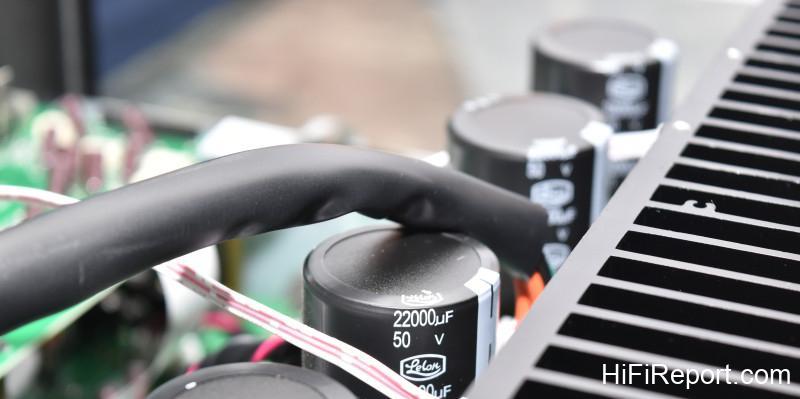
After being tapped, the transformer’s output proceeds to the core of the Class G amplification section. Two pairs of filter capacitors are employed to provide power to the left and right channels, respectively. Taking the left channel as an example, one capacitor is a low-voltage 50V/22000uF, and the other is a high-voltage 80V/10000uF. During normal music signals, the low-voltage capacitor supplies power.
When encountering large dynamics, it switches to the high-voltage capacitor supply, ensuring optimal energy efficiency.
Opposite the capacitors, you’ll find the input stage circuit board. This is where amplifier mode switching is controlled, along with system control links like RS232 and RJ45. At the bottom of the chassis, occupying the largest area, is the Class G power amplification circuit board. It employs a discrete design, utilizing a total of 6 pairs of power transistors for the left and right channels. These are five-pin temperature-stable transistors, likely providing more consistent output quality.
Under an 8-ohm load, it delivers 225 watts of power output, and into 4 ohms, it reaches 380 watts. The power transistors are mounted on a large heatsink. Even with higher efficiency, the attention to detail is no less meticulous than commonly seen in Class A/B designs.
Listening Impressions
Having thoroughly examined the design of the PA240 power amplifier, I was eager to experience its sonic performance, especially given that Class G amplifiers are not commonly encountered. For the testing, I tried to pair the PA240 with equipment I was familiar with. I first chose the Lumin D2 streaming player, known for its warm and smooth sonic character, to serve as the preamplifier. As I am a Lumin D2 user myself, I am quite familiar with its sound.
To challenge the PA240’s driving capability, I also selected the Pioneer S-1EX floorstanding speakers, which have served long-term in our listening room, as the reference. These speakers are quite substantial and have a neutral, uncolored sound profile, which I believed would allow the PA240’s strengths to shine through.
I began with J.S. Bach’s Sonatas and Partitas for Solo Violin, performed by Italian violinist Giuliano Carmignola. The sound struck me as neutral, yet far from bland. The entire frequency range possessed a warm, rounded quality that was completely non-aggressive, while still retaining excellent resolution. Through this, I could discern the PA240’s outstanding control.
It not only faithfully reproduced the Lumin D2’s sonic characteristics but also imparted a better sense of speed to the front-end. The subtle dynamic nuances of the violin performance were clearly presented. The violin itself sounded refined, with a soft extension in the extreme high frequencies. Overtones were rich and full. Even during technically demanding passages, there was no hint of sharpness, only direct, unmasked bow-on-string texture and a radiant sheen.

Next, I played “What a Difference a Day Makes” sung by jazz vocalist Renee Olstead. Renee’s sweet voice, interpreted by the PA240, sounded remarkably neutral, without any artificial coloration. The nuances of her lips and mouth shapes felt more stable and smoother, with a refreshing sweetness in her articulation. Sibilant details were present just right, never exaggerated, sounding very natural and creating a closer sense of intimacy with the listener.
When she transitioned rapidly between chest voice and head voice, it sounded equally smooth; the high notes never felt strained or piercing, remaining consistently fluid and listenable.
Listening to the Ethan Iverson Quartet live at the Village Vanguard was another revealing experience. From the opening notes, I immediately perceived a spacious soundstage, with the instruments of the quartet spread out spatially. Although the PA240 possesses a warm tonal foundation, the musical background remained remarkably quiet and free from impurities.
This allowed the subtle sounds of audience chatter and the clinking of glasses in the jazz club to be heard with striking clarity, creating an extremely well-defined sense of image localization. Ethan Iverson’s trumpet led the performance, its brass tone pure, natural, and utterly uncolored. The musician’s subtle performance dynamics – the elasticity of his breath control, the friction of air against the horn walls – were rendered with incredible finesse.
Beneath the trumpet’s gentle main melody, the rhythm section was by no means obscured. The springy impact of the drums and the distinct metallic texture of the cymbals were easily discernible. Concurrently, the PA240’s low frequency response demonstrated excellent speed and appropriate quantity, giving the plucked bass a satisfyingly woody character with enhanced string detail.
The piano exhibited clear percussive attack and keybed resonance, particularly in the lower register where a deep, captivating woody timbre was evident, allowing one to comfortably sink into the live musical atmosphere.
Sonic Summary
The PA240 itself doesn’t possess an assertive character. It simply faithfully reproduces the “original flavor” of the music, adding more smoothness and gentle musicality to the inherent sound quality and tonality of the front-end equipment. If you already own a satisfactory preamplifier and DAC and are seeking a comfortable, listenable, and completely non-aggressive power amplifier, I believe this Class G amplifier could be an excellent piece of equipment to accompany you for a long time.
Specifications
* Type: Two-channel power amplifier
* Frequency Response: 20Hz-20kHz (±0.05dB)
* Amplification Type: Class G
* Signal-to-Noise Ratio: 110dB (50W into 8 ohms)
* THD: 0.001% (8 ohms, 80% output), 0.2% (8 ohms 225W, 4 ohms 380W, 20-20kHz)
* Output Power: 225W (8 ohms), 380W (4 ohms)
* Input Terminals: XLR × 1, RCA × 1
* Output Terminals: Speaker × 1, RCA × 1 (Analog output for passthrough/bi-amping)
* Dimensions (W.H.D.): 433×177×425mm
* Weight: 18kg