
Arcam Radia A15 Review
Among the myriad of audio brands, I’ve always held a particular fondness for the British firm, Arcam. Their amplifiers boast unique technology and a sonic character that has captured the discerning ears of many seasoned audiophiles. However, one thing consistently troubled me: despite Arcam’s well-engineered products and reputable standing in the audio world, online discussions weren’t as fervent as those surrounding many newer brands.
After reviewing several of their products, I came to understand why. Arcam’s equipment offers outstanding sound quality and a consistently solid, no-frills aesthetic. This design approach is undoubtedly appealing to veteran audio enthusiasts. Yet, for the younger generation of listeners, the appearance might feel somewhat repetitive, lacking a touch of freshness.
Recently, Arcam clearly recognized this challenge and unveiled the entirely new Radia series. This marked a decisive move to break away from their long-standing design language, shifting towards a more youthful aesthetic. What’s more, the pricing is more approachable, signalling the brand’s clear determination to tap into the younger market segment. Beyond the eye-catching new look, the Radia product line is also remarkably comprehensive, featuring five new components.

Introducing the Radia Series
This includes three integrated amplifiers, tiered from high to low as the A25, A15, and A5, alongside two digital sources: the CD5 CD player and the ST5 streamer. Whether you’re a staunch traditionalist with a CD collection or a devotee of modern streaming, the Radia series has you covered.
A Closer Look at the Radia A15
Returning to the subject of this review, the A15, it’s an integrated amplifier featuring built-in digital decoding, sitting second from the top in the series. When I first laid eyes on its exterior, I honestly couldn’t believe it was an Arcam product! The familiar, staid silver-grey chassis was gone, replaced by the entirely new Radia design which exudes modernity. Firstly, the A15 foregoes any plastic, feeling incredibly solid with a weight of 10 kilograms.
Striking New Design
The chassis is still crafted entirely from aluminium alloy, but the surface now sports a striking matte black finish. The chassis design itself is quite distinctive; the rear edge of the top plate extends slightly outwards, complemented by yellow accents around the vent openings and along the side panels, sketching out sleek lines reminiscent of a supercar.
Turning to the A15’s front panel, Arcam has employed a unique frosted glass material. At its centre lies an OLED display, whose text glows with a subtle, hazy effect when powered on. Flanking the display are two large, aluminium alloy knobs: the left controls source selection, and the right handles volume control. These replace complex physical buttons, helping maintain the minimalist aesthetic.
The areas around the knobs are also accented with sharp yellow lines, creating a vivid contrast with the display. The cool, futuristic design instantly brings to mind several recent wireless audio products born from collaborations with sports car manufacturers – it’s bound to captivate younger buyers!
Comprehensive Connectivity Options
Flipping to the rear of the A15 reveals a generous array of connection options. It features a built-in 32-bit ESS ES9018 DAC chip, capable of decoding high-resolution PCM audio up to 24-bit/192kHz. While it lacks the USB Type-B input found on the higher-end A25, it still provides 1 optical and 2 coaxial digital inputs, allowing you to connect CD transports or streaming transports.
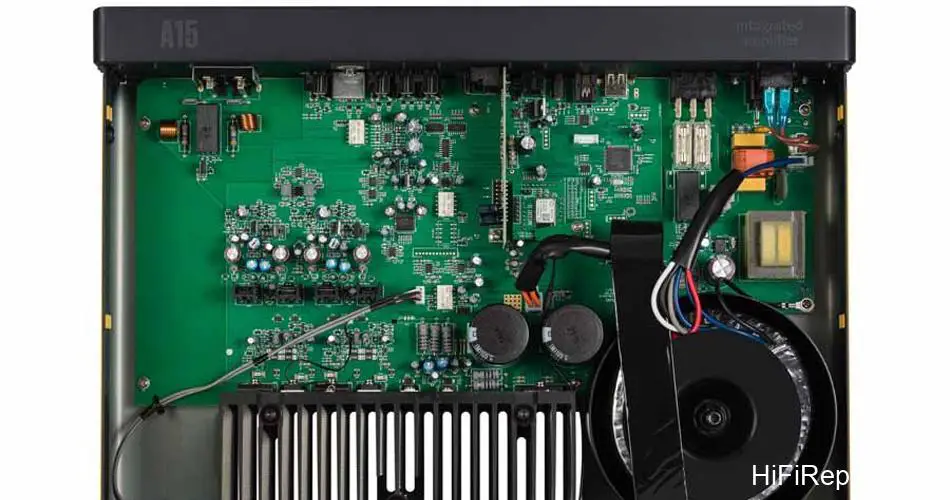
Furthermore, it offers 3 pairs of RCA unbalanced analog inputs, perfect for pairing with the Radia series’ CD5 CD player and ST5 streamer. Catering to the current vinyl resurgence, it also includes a Phono input, indicating a built-in MM phono stage – meaning you can directly connect a turntable for a purely analog music experience.
Additionally, the unit provides a Pre Out, so you can use it as a preamplifier with a better power amplifier, or connect a high-end headphone amp for private listening.
Wireless Capabilities
But what if you don’t connect external sources? Can the A15 still play music? The answer is yes, as it incorporates Bluetooth 5.2 wireless connectivity. It supports Qualcomm’s aptX Adaptive high-quality transmission standard, which automatically adjusts to the current signal conditions. Under optimal transmission quality, it acts like a “sound quality first” mode, while ensuring playback stability even when transmission quality is poor.
Moreover, the A15 boasts bi-directional Bluetooth functionality. It can receive music from your mobile device and simultaneously transmit audio to Bluetooth speakers or wireless headphones, offering excellent flexibility in usage. For amplification, the A15 doesn’t employ Arcam’s renowned Class G technology like the higher-end A25. However, it utilizes a Class A/B amplifier circuit, generally considered by audiophiles to deliver better sound quality.
Amplifier Performance
It’s rated at 80 watts per channel into an 8-ohm load, providing 60% more driving power than the entry-level A5 and offering more versatility in speaker matching.
Setting Up for the Listening Test
Alongside the A15, the distributor also sent over the Radia series CD5 CD player as a source, allowing for a complete evaluation of the new series’ capabilities. For the listening test, I used the medium-sized listening room at the office, pairing the amplifier with KEF LS50 bookshelf speakers. The A15’s sound is remarkably neutral, without any artificial emphasis on specific frequency ranges. It retains Arcam’s characteristic clear and refined sound quality advantages.
Sound Quality and Performance
The mid and high frequencies exhibit excellent resolution, the soundstage is open and three-dimensional, and the bass is clear and agile. It doesn’t overly emphasize quantity but offers plenty of elasticity. This sonic character is absolutely captivating for playing small jazz ensembles or chamber music!
For instance, listening to Gil Shaham and Goran Sollscher’s Paganini “Violin and Guitar Duos,” the A15 rendered the violin lines smoothly and with a beautiful sheen. Against a backdrop of ethereal hall ambiance, the violin’s resonance consistently carried a captivating sense of airiness. Even the faintest details of bow touching string were clearly presented.
The classical guitar sounded sweet, the plucks were wonderfully elastic, and the phrasing carried a warm, wooden resonance that contrasted sharply with the bright, unrestrained strings. Another example is “Little Girl Blue” from the second track of the “Keith Jarrett – Standards In Norway” live album. The A15 created an open, fan-shaped stage behind the speakers, and the musical background was incredibly transparent, highlighting the excellent separation between the instruments.
This made the simple trio sound wonderfully three-dimensional and vivid, as if I were right there in the performance space! The piano notes were transparent and rounded, the key strikes possessing a light, airy quality. The shimmer of the cymbals had a metallic gleam, while the accompanying double bass notes felt concise and elastic, the clear, fast plucks full of satisfying “beef” without any boomy energy. This lent a lively atmosphere to the laid-back jazz.
The A15’s transparent and refined sound character also proved perfectly suited for female vocals! When I played Hong Kong singer Priscilla Chan’s “By Heart” album, the A Cappella chorus in the first track, “Still Feel You’re the Best,” presented the voices with appropriate body size, sharp definition, and prominence without feeling overly inflated.
Priscilla Chan’s voice was fresh with a hint of sweetness, yet free from excessive coloration, allowing the singing details to be faithfully reproduced. Furthermore, the A15’s soundstage positioning was very precise; I could clearly distinguish the high, mid, and low vocal parts layered together, truly able to count the individual male and female voices. The timbres were distinct and never messy, making even the unaccompanied pure vocal chorus sound full of layers.
However, don’t mistake the A15 for a delicate lightweight; it handles rock music with equal explosiveness! When playing the first track, “6:00,” from progressive metal band Dream Theater’s “Awake” album, the opening drum roll flew by, each hit rendered with solid body. Then, the powerful electric guitar riffs entered the track. With an amplifier lacking sufficient transient response, this could easily devolve into chaotic noise. But the A15’s rendition was different.
I could clearly hear the distinct plucks, and the explosive distorted guitar tone sounded tight, full, and powerful. When faced with the rapid-fire double bass drumming in this track, the A15 surprisingly passed the test with ease. While the sheer weight wasn’t particularly prominent, the dynamic effect was quick and incisive, and the energy felt firmly controlled, delivering a highly impactful low-frequency rhythm.
Conclusion
The A15 integrated amplifier truly demonstrates Arcam’s commitment. Not only has the exterior design been completely revamped to align with the aesthetic tastes of a younger audience, but its sound performance is also that of a versatile all-rounder, equally adept at playing various music genres. It also shows significant enhancements in audio characteristics sought after by modern audiophiles, such as resolution, spatial imaging, and transient response.
If you are a listener particular about design and favour a clear, transparent, and fast sound signature, the Arcam A15 will absolutely not disappoint you.
Specifications
* Type: Integrated Amplifier
* Power Output: 80W (8 ohms), 120W (4 ohms)
* Frequency Response: 20Hz-20kHz (± 0.2dB)
* Harmonic Distortion: 0.002%
* Signal-to-Noise Ratio: 106dB
* Digital Inputs: Optical x 1, Coaxial x 2
* Analog Inputs: RCA x 3, Phono x 1
* Analog Outputs: Pre Out x 1, Speaker terminals x 2 pairs
* Dimensions (W x H x D): 431 x 344 x 98mm
* Weight: 10kg