
Arcam Solo Uno Review
For many seasoned audiophiles, myself included, seeing the Arcam brand evokes a sense of familiarity and affection. Their equipment consistently features high-quality build and robust components, giving them a significant presence in the audio market as far back as 20 or 30 years ago. My personal connection stems from my first self-owned system being composed of used Arcam gear, further cementing my fondness for the brand.
However, recognizing that younger audio enthusiasts might be less acquainted with their products, let’s delve into a brief introduction.
Arcam’s Storied History
Hailing from the UK, Arcam boasts a long and storied history, dating back to 1976 when they launched the A60 integrated amplifier. This particular model is said to have sold over 30,000 units and continues to grace listening rooms around the world today. The A60’s slim, minimalist design and easy-to-pair characteristics solidified Arcam’s position in the global audio market.
Long-time enthusiasts will undoubtedly know that their equipment is consistently built with substantial components and has often been at the forefront of technological innovation.
Regarding their innovative spirit, Arcam introduced the first CD player designed and manufactured in the UK in 1986. This marked the beginning of their expansion into source components. By 1988, they unveiled a dedicated DAC specifically tailored for CD players – the “Black Box.” This type of component was quite rare at the time.
It featured the now-classic Philips TDA1541A chip, known for its R2R architecture, which excels at reproducing natural, smooth audio quality with a particularly full-bodied midrange, making it a cherished piece for many veteran audiophiles who are still reluctant to part with it.
Furthermore, starting in the 1990s, Arcam began developing specialized audio equipment for home televisions and commenced production of AV surround amplifiers in 1995. Not stopping there, they leveraged their experience in CD player design to independently develop DVD players, which were also reportedly exceptional in sound quality. In recent years, Arcam has garnered numerous international awards for its excellent products.
While their equipment had lower visibility in the domestic market for a few years, their introduction by distributor Carmen now provides fans of the British audio aesthetic with a truly outstanding option.
Design and Features
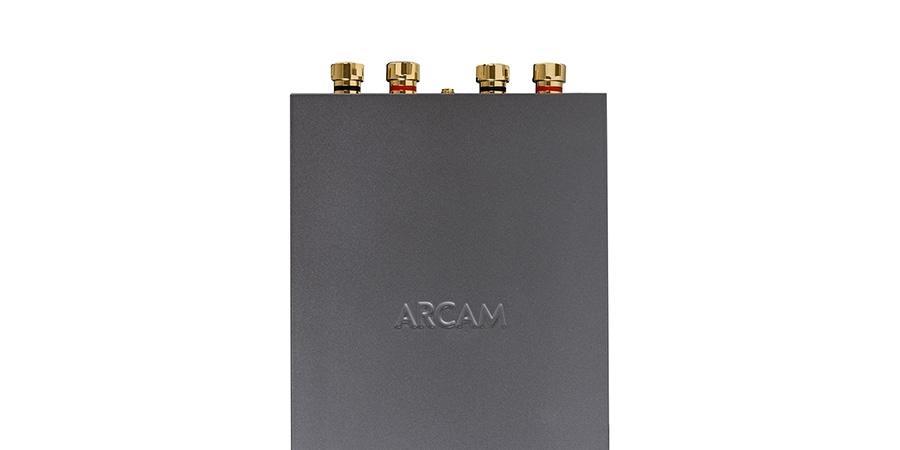
Turning our attention to the Arcam Solo Uno, despite being positioned at an entry-level price point, it clearly showcases the brand’s refined craftsmanship. First, let’s talk about the aesthetics. It features a remarkably compact form factor, easily held in an average adult’s hand, making it absolutely no problem to use even in confined listening spaces.
Moreover, the chassis of this streaming integrated amplifier is milled from aluminum alloy, boasting an elegant, streamlined design that highlights the user’s discerning taste and sense of style – perfect for those who prioritize their home decor.
Amplification & Digital Processing
The amplification circuit within this diminutive Solo Uno is a Class D design. It’s capable of delivering 50 watts of output power into a 4-ohm load and 25 watts into an 8-ohm load, making it perfectly suited for driving bookshelf speakers and building a small-space 2-channel stereo system. Although the manufacturer doesn’t provide specific details, after extensive research, I estimate that the DAC chip onboard is likely the Burr Brown PCM1802.
Paired with Arcam’s proprietary amplification circuitry, the signal-to-noise ratio reaches an impressive 117dB, which is an outstanding level for this price range.
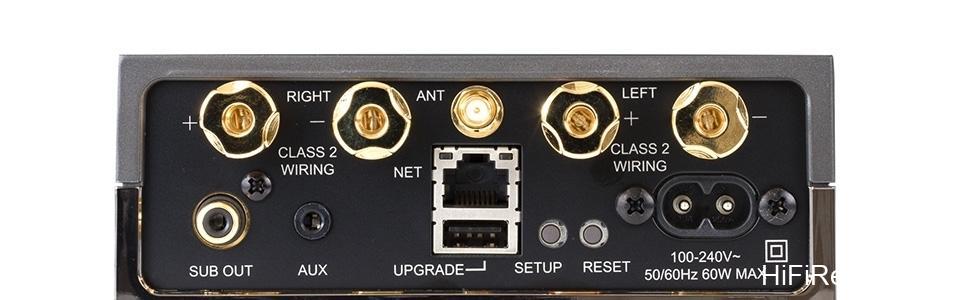
As a streaming integrated amp, the Solo Uno simply requires a network connection upfront and a pair of speakers at the back. You can then effortlessly stream music from platforms or stored on a NAS within the same network using AirPlay 2, Roon Ready, UPnP, and Google Home. Arcam also states that if the streaming platform you’re listening to offers MQA-encoded audio, this integrated amp is capable of full decoding, providing listeners with more authentic and natural high-resolution sound quality.
Additionally, it supports analog input via AUX, allowing direct connection and playback from phones or tablets.
Operation and User Experience
In terms of practical operation, the Solo Uno features a large silver button below the front panel, which serves as the power switch. Simply press it to turn the unit on. Once connected to the network and powered on, it automatically performs updates, requiring no manual intervention. Above the power switch is the volume control, and in the center of the volume knob is the mute/AUX input mode selector.
It’s incredibly simple and intuitive, and even just sitting there, it exudes a fine sense of quality, suitable for users who appreciate both stylish aesthetics and high-level sound quality.
Once powered on, simply pick up your phone or mobile device and connect via the streaming services mentioned earlier. I tried connecting using AirPlay 2, Google Home, and third-party apps like M-Connected, and the user experience was excellent across the board. For speakers, to fully evaluate this amplifier’s control over bookshelf speakers of different sizes, I paired it separately with two pairs: the Sonus Faber Lumina I and the Dynaudio Emit 20, which have differing physical characteristics.
Listening Impressions
Upon first listening with the Solo Uno system, you immediately sense Arcam’s signature warm character, with a particularly prominent midrange vocal performance. Listening to Adele’s “30” album, I could hear the vocalist’s large vocal image centered precisely in the soundstage, imbued with a palpable sense of moisture, and the gentle, nuanced singing details were revealed with stunning clarity.
When listening to male vocals, such as the album “Sadder Than An Art” by Taiwanese indie band Sorry Youth, frontman Xu Zhengtai’s large vocal image was equally prominent. I could hear his raw, direct, and unrestrained vocal lines, with incredibly vivid details in his phrasing and breaths, conveying genuine emotion.
While this amplifier leans towards a warmer sound, it still exhibits impressive low-frequency speed. Listening to “Zankyou Sanka” performed by the renowned Japanese singer Aimer, I could hear the raw intensity of rapid electric guitar strumming and forceful drum hits – it was incredibly satisfying. This characteristic also makes it quite impactful for listening to movie scores.
For instance, the soundtrack to “No Time to Die” reveals a tremendously grand sense of low-frequency scale, yet the forms of instruments in other frequency ranges remain distinct. The smooth textures of violins and the thick, airy quality of brass instruments highlight this amplifier’s excellent control.
Listening to Daniel Barenboim conducting the Vienna Philharmonic’s “New Year’s Concert 2022,” I could distinctly hear the details of different instrumental sections. Honestly, if listening blindfolded, you might even mistake the performance for that of a small pair of floorstanding speakers. Perhaps that’s a slight exaggeration, but the instruments it reproduces have a palpable presence.
For example, the bass drum’s size in the soundstage varied according to the player’s force, and even when internal and external string sections played in unison, there was a three-dimensional quality to the bowing details. The thick, airy texture of the brass instruments was present throughout.
It’s worth noting that the Solo Uno’s treble is on the warmer side, with a subtle sweetness that brings to mind the character of older Arcam equipment. Listening to “John Williams Live in Vienna,” I heard wonderfully smooth and fluid bowing details from the violins. Regardless of the player’s technique, whether applying light or heavy force, the minute variations were clearly audible, inviting repeated listening.
Or, with Jan Lisiecki’s “Night Music” piano album, the piano notes were focused and crystal clear, dancing smoothly and naturally within the soundstage – truly pleasant and easy on the ears.
Usage Tip and Conclusion
One thing to be aware of when using the Solo Uno is that even when connected remotely via the app, you initially need to set the maximum volume on the unit itself before you can adjust the full volume range on your phone or mobile device. Otherwise, remote control will be limited to half volume.
I suspect this design is a safety feature to prevent users from accidentally blasting the volume to maximum immediately upon connecting, serving as a foolproof mechanism to protect both speakers and the amplifier. Considering such a subtle usage detail demonstrates Arcam’s thoughtfulness.
In conclusion, Arcam’s Solo Uno streaming integrated amplifier delivers a spacious and open soundstage that belies its size. Within this soundstage, every instrument and object has a distinct, palpable form. Its characteristics – a slightly sweet treble, full-bodied midrange, and an overall warmer presentation – are reminiscent of their highly cost-effective integrated amplifiers from the past.
It’s essentially more than capable of handling most entry-level to mid-range bookshelf speakers with ease. If you’re currently putting together a system and struggling with amplifier matching, consider giving this British-born brand a chance! As a side note, if you wish to upgrade later, this streaming integrated amp can also connect to an active subwoofer to easily build a 2.1 channel stereo system.
Specifications
* Type: Streaming Integrated Amplifier
* Frequency Response: 10Hz-20kHz
* Amplifier Type: Class D
* Signal-to-Noise Ratio: 117dB
* Output Power: 50W (4Ω), 25W (8Ω)
* Inputs: RJ45 Network port, AUX analog input, AirPlay 2, Roon Ready, UPnP, Google Home
* Outputs: Speaker terminals, Subwoofer output
* Crossover Point: 80Hz
* Dimensions (W.H.D.): 140×52×213mm
* Weight: 1.5kg