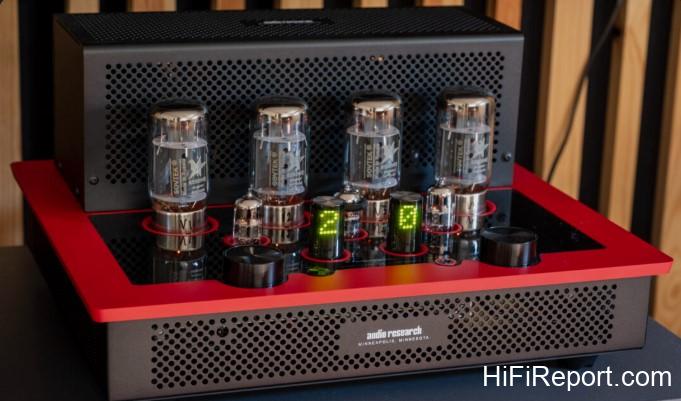
Audio Research I/50 Integrated Amplifier Review
I first encountered the Audio Research (ARC) I/50 integrated amplifier at the audio show in late 2021. Its youthful and innovative design was immediately striking, sparking an instant desire to bring it home for a listen. However, due to global shortages, the initial batch was completely sold out, and I was asked to wait. That wait turned into nearly half a year before it finally arrived last month. In my opinion, the I/50 is the most exciting new piece of equipment in recent years, representing a fresh and vibrant start for ARC.
Revitalized ARC: A Spectrum of Colors
Why did the I/50 capture my attention so strongly? Firstly, its striking appearance. The I/50 breaks away from ARC’s traditional silver and black color palette, offering a total of six color options. Secondly, it marks a return to the 6922 signal tube and 6550 power tube design, paying homage to ARC’s earliest amplifier circuits. Thirdly, the unexpectedly approachable price point signals ARC’s foray into the realm of “affordable Hi-End” audio.
Let’s begin with the I/50’s vibrant aesthetics. While silver and black remain signature ARC colors, four new options have been introduced: white, red, gold, and blue. These are all vivid, youthful hues, clearly aimed at a younger demographic. The vintage charm of vacuum tubes combined with these bold colors creates a “Neo-Vintage” style that is undeniably appealing.
Introducing Ceracote Finish
The I/50’s diverse and vibrant colors are not achieved through anodization, but rather through a Ceracote ultra-thin ceramic coating. This process applies a ceramic layer to the metal chassis, resulting in a luxurious and colorful finish.
This change required a significant investment from ARC. They acquired new metal surface treatment equipment and installed it in their Minnesota factory. As a result, the I/50 is the first amplifier to be 100% manufactured in ARC’s own factory.
Were previous ARC products not made in their own factory? Rest assured, all ARC equipment is manufactured in the USA. However, the anodization of metal chassis had to adhere to strict environmental regulations, and the ARC factory in Minnesota did not have this processing capability. This meant outsourcing the process. To achieve the diverse colors of the I/50, ARC expanded its production line with Ceracote ceramic coating capabilities. This ensures the I/50 is entirely manufactured in-house.
This investment in a new manufacturing process suggests that future ARC products will likely feature a wider array of colors, potentially even offering custom color options. With the new Ceracote line, it makes sense for ARC to fully utilize it. However, when it comes to these potential future developments and higher-end equipment ARC is currently developing, the company remains tight-lipped, focusing intently on the launch of the I/50.
Return to 6922 and 6550 Tubes
The second key feature of the I/50 is its return to the 6922 and 6550 vacuum tubes, mirroring the tube configuration of the CA50 integrated amplifier from 1997.
Looking back at ARC’s history of integrated amplifiers, the CA50 is arguably the model that first established their reputation in this category. However, the CA50’s chassis still adhered to the traditional ARC aesthetic: a cream-white faceplate with black handles, quite different in appearance from the I/50.
In 2003, ARC introduced the VSi 55, essentially a VSi 55 power amplifier combined with input switching and a volume control, transforming it into an integrated amplifier. It also used 6550 power tubes, but switched the signal tubes to 6N1P. The VSi 60, launched in 2008, maintained a similar appearance to the VSi 55 and was considered its successor. It upgraded the signal tubes to 6H30, aligning it with the higher-end Reference series.
From an industrial design perspective, the I/50 bears the closest resemblance to the VSi 55 and VSi 60, both of which were among ARC’s best-selling vacuum tube integrated amplifiers. The I/50 aims to inherit this legacy of success.
ARC also produced two other integrated amplifiers, the VSi 75 in 2013 and the GSi 75 in 2015. However, their appearance diverged significantly, featuring larger chassis and incorporating more high-end vacuum tube circuit technology. For example, the VSi 75 used KT120 power tubes, increasing the output power to 75 watts, while the GSi 75 employed even more powerful KT150 tubes, although the output power remained at 75 watts, prioritizing improved linearity and headroom.
Considering generational lineage, the I/50 has a weaker connection to these two models and is more accurately seen as a successor to the VSi 60.
Surprisingly Affordable Price Point
Finally, the I/50’s price is a pleasant surprise. While the initial US retail price was even lower, the current price is around $5,500 USD. Due to pandemic-related disruptions, global port congestion, and chip shortages, costs have increased significantly. Consequently, the price was adjusted upon release. With a retail price of approximately $5,920 USD (converted from 185,000 NTD), the I/50 offers exceptional value. In this price range, finding a vacuum tube integrated amplifier that is entirely designed and manufactured in the USA is incredibly rare.
Since the VSi 60 in 2008, ARC has not introduced an integrated amplifier priced below $10,000 USD. For over a decade, ARC has focused on high-end integrated amplifiers. However, the I/50, with its roughly $5,500 USD price tag, represents a significant price reduction compared to the VSi 75 and GSi 75 – almost half the price! Yet, it remains unmistakably an ARC product. It’s hard not to be excited about the I/50.
A New Classic: Bridging the Past and Future
While I consider the I/50 a spiritual successor to the VSi 60, it’s more than just an evolution. It’s a “new dawn” for ARC equipment. Beyond the novel Ceracote finish, which may extend to future ARC products, the I/50 also incorporates the charming Lexie Tube display, showing volume levels and input selection. While not directly related to the amplification circuitry, it enhances the design aesthetic of the unit. Whether this creative feature will be adopted in other new ARC models remains to be seen.
However, compared to the VSi 60, which was launched over a decade ago, the I/50 feels like a completely new design, not just an incremental improvement. Beyond the attractive and innovative Lexie Tube, the front panel features mesh ventilation holes, which are both aesthetically pleasing and functional for heat dissipation. By relocating the two control knobs from the front panel to the top, the I/50 achieves a smaller chassis footprint and a more vintage vacuum tube amplifier appearance. The top panel also features a glossy acrylic accent, creating a two-tone contrast with the Ceracote ceramic finish, subtly highlighting the I/50’s youthful spirit. Forget the stereotype of dull-looking tube amps; the I/50 is a refreshing change.
Modular Expansion for Future Flexibility
Another “forward-looking” design element of the I/50 is its modular expansion capability. Phono stage and DAC modules are planned for future release. However, due to the global chip shortage, these modules are not yet available. Nevertheless, it’s conceivable that ARC will adopt similar modular expansion concepts in future products, enhancing their price competitiveness.
After all, if you don’t need a phono stage or DAC, why be forced to pay for them as standard features? But for users who desire additional functionality, expansion modules offer a more cost-effective solution compared to purchasing separate components. This modular approach is a smart move by ARC, offering both flexibility and value.
Power Amplifier with Volume Control
From a circuit design perspective, the I/50, like the VSi 55 and VSi 60, is essentially a power amplifier with a volume control, lacking a dedicated preamp stage. However, ARC thoughtfully included a headphone amplifier circuit, enhancing the I/50’s versatility.
Some might worry that without a separate preamp stage, the I/50 might lack power. Rest assured, ARC has anticipated this. The first gain stage of the I/50 has been increased to 7dB, approaching the typical 10dB gain of a dedicated preamp.
The I/50’s tube configuration echoes the CA50, utilizing three 6922 signal tubes – one for phase inversion and two for the first gain stage – driving four 6550 power tubes in a push-pull configuration, delivering 50 watts of output power. Speaker output terminals for both 4-ohm and 8-ohm impedance are provided for greater speaker compatibility.
For inputs, the I/50 offers four sets: three RCA single-ended and one XLR balanced. The inclusion of a balanced input at this price point is a bonus.
100% Tested and Matched Vacuum Tubes
If you examine the I/50’s tube configuration closely, you’ll notice elastic damping rings on the 6922 signal tubes. This is a functional design feature, not just for aesthetics. When vacuum tubes operate, the flow of electrons generates vibrations, which can resonate with the glass tube, causing distortion or interference. ARC has incorporated damping rings, aligning with their high-end models, to mitigate this issue.
This seemingly minor design detail demonstrates ARC’s unwavering commitment to “High Definition,” even in a relatively more affordable product like the I/50.
Similarly, the 6550 tubes used in the I/50 are the new Sovetek 6550WE. However, all tubes undergo in-house testing and matching at ARC. During my factory visit in Minnesota, ARC specifically highlighted their tube burn-in and matching process. All purchased tubes are burned-in at the ARC factory for 48 hours, followed by testing and matching. This is why ARC factory tubes are slightly more expensive than retail versions. The 48-hour burn-in process helps eliminate weaker tubes, and ARC’s recorded tube data facilitates future maintenance. If tube replacement is needed, ARC can provide factory-matched tubes suitable for the unit.
Finally, the last step in ensuring the I/50’s “High Definition” performance is the final quality control check before shipment, overseen by veteran engineer Warren Gahl. Every unit is auditioned to ensure it meets ARC’s standards before being packaged and shipped.
Is this human ear verification in quality control unusual? Most manufacturers rely on instrument testing for final quality checks before shipping. Few are as meticulous as ARC, insisting on human ear evaluation, personally conducted by Warren Dahl. During my visit to ARC over a decade ago, Warren Dahl was already responsible for listening-based quality control, and he continues in this role today, ensuring every unit’s sound meets ARC’s high standards.
Drives Contour 60 Speakers Surprisingly Well
Regarding the I/50’s sonic performance, I must emphatically say: this is currently the most outstanding value ARC amplifier available! Its 50-watt output isn’t earth-shattering, but for typical home use, unless you’re planning a house party, 50 watts is generally sufficient and a very practical power rating.
During my listening tests at HiFiReport, the I/50 handled both bookshelf and floor-standing speakers with ease. For my final evaluation, I paired the I/50 with Dynaudio Contour 60 speakers, the largest floor-standing model in the Contour series. The I/50 drove them surprisingly well, instilling confidence in its driving capabilities.
However, the I/50’s volume control needs to be turned up a bit higher to achieve full sonic richness and impact. The I/50’s total volume scale goes up to 45, but my listening sessions were typically between 25 and 35. Compared to traditional volume knobs, this is well past the 12 o’clock position, reaching around the 2-3 o’clock mark. Don’t be hesitant; even at maximum volume, the I/50 didn’t distort or falter. At that level, the volume was far beyond comfortable listening levels, demonstrating the I/50’s robust build and headroom.
The Lexie Tube display serves not only as volume and input indicators but also features a startup “easter egg”. Upon powering on, the vacuum tubes illuminate, but playback isn’t immediately available. The Lexie Tube counts down from 48 to zero, indicating the soft-start completion and the I/50’s readiness to play music.
Powering off? It’s quicker, but the Lexie Tube still lights up and then fades, signaling that the I/50 is shutting down.
Punchy and Dynamic Mid-Bass
Paired with the Contour 60, the I/50 effortlessly delivered a full and punchy mid-bass. Listening to EggPlantEgg’s “Love Is More Important Than You Thought,” the kick drum in the intro was round and impactful, while the synthesized chords in the background and the hi-hats punctuated the rhythm with bright accents. Those familiar with ARC know that even for a tube amplifier, the I/50 is remarkably transparent and open. If you’re seeking a warm and mellow tube sound, the I/50 isn’t it. It embodies a youthful and energetic sonic character, with vibrant mid-bass and an open, transparent soundstage – the sonic equivalent of a bright, sunny personality.
Listen further to “Love Is More Important Than You Thought” as it builds to a lively crescendo. Two electric guitars, one playing a funky rhythm and the other a solo, enter the mix. The I/50 vividly portrays the layers and positioning within the soundstage. I initially expected the I/50 to sound slightly muddy in the low frequencies with the Contour 60, but it exceeded my expectations. The bass had excellent punch, while the mid-high frequencies retained rich detail and a bright sheen. This is the essence of ARC tube amplification – a warm midrange characteristic of tubes, yet maintaining “High Definition” clarity and resolution at both frequency extremes.
Both Authentic and Beautiful
Listening to Tsai Chin’s “Unheard Memory,” a familiar audiophile recording, the opening electric piano solo is beautifully rendered. The timbre is remarkably close to a real piano yet possesses an almost idealized beauty. The I/50 conveys this exquisite sonic texture. The midrange has a pleasing fullness, and the high-frequency extension is smooth and refined. When Tsai Chin’s vocals enter, the tube warmth of the I/50 becomes more apparent, with a touch of richness. However, the musical resolution remains excellent. This blend of tube warmth with near-solid-state clarity is ARC’s signature strength – balancing sonic truthfulness with musical beauty.
Using the I/50 to drive Contour 60 speakers is arguably a step beyond its intended pairing. 50 watts is sufficient, but I know the Contour 60s can perform even better with more powerful amplification. However, the I/50 driving the Contour 60s is already impressive. At reasonable listening levels, the I/50 fully reveals the musicality of these speakers.
Three Chopins, Three Interpretations
For example, listening to Chopin’s Piano Concerto No. 2, Barenboim’s version exhibits a fuller piano sound with greater dynamic force. Switching to Pires’ rendition, the piano timbre becomes brighter, with slightly less body, capturing the delicate touch of a female pianist. And with Zimerman’s version, known for its slower tempo, the sound is even richer and more romantic.
These three recordings of Chopin’s Piano Concerto No. 2, all from DG, are subtly differentiated by the I/50, highlighting the nuanced differences in each recording. This indicates the amplifier’s excellent resolution. Despite its tube amplification, it doesn’t overly color the recordings. Even while prioritizing “High Definition,” the I/50 still possesses a beautiful musicality, without completely erasing the inherent character of tubes. Listening to these three pianists playing Chopin, Barenboim sounds regal and confident, like a nobleman. Pires’ bright piano tone and delicate phrasing evoke the youthful passion of Chopin’s early love. And Zimerman’s version, with its exceptionally slow tempo, portrays Chopin’s profound melancholy.
Low Noise Floor, Excellent Headphone Amplifier
Finally, regarding the I/50’s sonic performance, I must mention its remarkably low noise floor. Regardless of your personal sonic preferences for the I/50, if you have the opportunity to audition it, listen closely to the speaker drivers. You’ll notice the I/50’s exceptionally low operating noise. This provides a quiet background for the music.
This low noise performance extends to the headphone amplifier section as well. Setting aside subjective sonic preferences, the I/50’s operating noise is impressively low, whether driving speakers or headphones.
Using Sennheiser HD 400 Pro headphones, any audible noise is likely inherent in older analog recordings, such as early Blue Note or Verve jazz records, where analog tape hiss might be present. However, with newer digital recordings, the I/50 presents a very clean musical background, reproducing music with minimal noise.
Therefore, the I/50’s headphone amplification is not just adequate; it’s excellent and can save you the expense of purchasing a separate headphone amplifier.
A New ARC Classic
Being able to acquire an ARC amplifier for around $6,000 USD is significant news after a long time. The I/50 represents a new generation of ARC – bridging the past and ushering in the future. I believe ARC will rapidly introduce new models in the coming years, showcasing a youthful and vibrant ARC aesthetic. The I/50 demonstrates the company’s ambition. With its surprisingly competitive price, it’s challenging to find a vacuum tube integrated amplifier that rivals the I/50 in the same price range. Coupled with its flexible modular design, the I/50 is undoubtedly poised to become a new ARC classic. I wholeheartedly recommend experiencing it firsthand to appreciate the truth and beauty of music as presented by ARC.
Specifications
* Type: Vacuum Tube Integrated Amplifier
* Output Power: 50 Watts per channel
* Vacuum Tubes: 6922 × 3, 6550WE × 4
* Frequency Response: 7 Hz – 30 kHz
* Input Sensitivity: 1.25 V
* Input Impedance: 100k Ohms (Balanced) / 48k Ohms (Unbalanced)
* Dimensions (W×H×D): 420 × 180 × 340 mm
* Weight: 18.1 kg