
Audiobyte Super Hub Review
Audiobyte has made a name for itself in the digital audio realm, starting with the Black Dragon DAC, which became a popular choice for its high performance-to-price ratio. They later introduced a three-piece digital source system: the Hydra Hub streamer, Hydra Vox DAC, and Hydra Zap super-capacitor linear power supply. This demonstrated their exceptional technical capabilities and product innovation.
Now, the Hydra series has been succeeded by the new Super series, and the first product, the Super Hub streaming transport, has finally arrived. Both its external design and specifications have seen improvements over its predecessor. Let’s take a look at what makes it stand out!
Versatile Streamer DDC
Like the previous Hydra series, the Audiobyte Super series will also consist of a streaming transport and a DAC. The difference is that the Super series components will have their own integrated power supplies, meaning there won’t be a separate linear power supply unit. However, they plan to release a Super Head headphone amplifier, bringing the series total to three components. The Super Hub streaming transport is the first to market, with the DAC and headphone amp to follow. It’s also worth noting that the Super series will have a dedicated audio rack designed to perfectly house these three components, which looks quite handsome in the photos released by the manufacturer and is something to look forward to.

The Super Hub is fundamentally a streaming transport, but strictly speaking, it’s a DDC (Digital-to-Digital Converter) with network streaming capabilities. It can accept other digital sources and use its internal digital processing technology to optimize the incoming digital signal. Users can then choose to output the signal via I2S, coaxial, or USB interfaces to a DAC for improved sound quality. Thus, the Super Hub is more accurately described as a digital interface integrator.
Proprietary System
Unlike many competitors who often use off-the-shelf solutions or hardware architectures like Raspberry Pi or standard computer motherboards, the Super Hub follows Audiobyte’s established practice: proprietary development.
The Super Hub’s processing core is an AMD Zynq 7000 series SoC (System on Chip), which includes an ARM-architecture processor and a programmable FPGA chip. This means both the hardware and software are fully customizable.
Audiobyte built the system from the ground up, investing countless hours to develop a dedicated Linux platform for the Super Hub that is solely focused on digital audio processing.
All the Super Hub’s functions and input/output interfaces are integrated onto a specially customized ten-layer circuit board (excluding the power supply board). This design aims to optimize signal paths for the best possible performance.
The AMD Zynq SoC is much more streamlined than a standard computer CPU, helping to avoid many factors detrimental to audio quality and unnecessary power consumption. Is this sufficient processing power? More than enough for the Super Hub.
The Super Hub can not only upsample input signals but also perform format conversion. For instance, PCM can be upsampled to a maximum of 768kHz or converted to DSD512, while DSD can be upsampled to DSD512 or converted to 768kHz PCM. Performing such operations smoothly requires significant system performance, which the Super Hub handles with ease.
Furthermore, the Super Hub employs a Phase-Locked Loop (PLL) circuit design. Its function is to modulate or demodulate the input signal, or to recover the original signal that has been disrupted by noise during transmission. This significantly reduces clock jitter.

I2S Output
In terms of network streaming functionality, the Super Hub offers comprehensive support. It’s compatible with UPnP / DLNA, AirPlay, Roon Ready, OpenHome, and HQPlayer NAA transmission methods. Even without its own dedicated remote control app, connecting to mainstream streaming music services is straightforward.
The Super Hub also features a rich array of digital input interfaces, including AES/EBU, Optical Toslink, Coax SPDIF, and USB B, supporting up to DSD512 (via USB input).

For outputs, the Super Hub provides three interfaces: I2S, SPDIF RCA, and USB. Among these, the I2S output is particularly appealing. While both I2S and SPDIF are standard interfaces for digital audio transmission, I2S differs by transmitting clock signals separately from audio data, which helps reduce jitter.
Additionally, I2S can support extremely high sample rates, potentially up to DSD1024, unlike SPDIF which is typically limited to 192kHz or DSD64 DoP. While USB can also transmit very high sample rates, it is not a dedicated digital audio interface, and the high-frequency noise it introduces from the source can be quite problematic.

Solid Aluminum Chassis
Another significant improvement compared to the previous generation is the Super Hub’s chassis.
The Super Hub’s enclosure is precisely machined from a single block of aluminum. The heat sinks on both sides are also carved directly into this block, which is not only aesthetically pleasing but also provides effective heat dissipation.
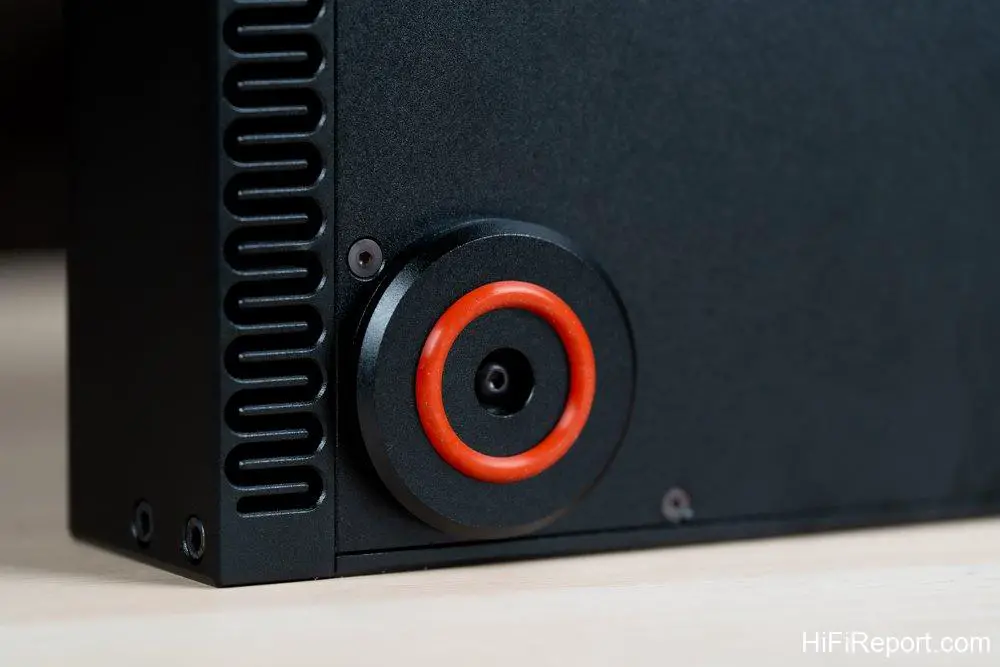
The unibody chassis minimizes seams, resulting in an incredibly robust structure that greatly reduces resonance and thus minimizes interference with the sound quality.
The Super Hub is packed with features, making the control interface particularly important. If daily settings are difficult to manage, having numerous functions is pointless.

To address this, Audiobyte designed two control interfaces for the Super Hub: a color touch screen and a control app, allowing users to choose their preferred method.
The Super Hub’s front panel features a 3-inch touch screen. Users can tap to access options and navigate through menus to perform all operations and settings.

However, a 3-inch screen is quite small, and the text isn’t large either. For someone wearing progressive lenses like myself, it can be a bit difficult to read. Fortunately, this is where the Audiobyte Super Hub Control app comes in handy. Available for both Android and iOS, it connects to the Super Hub via Bluetooth and offers a clear, intuitive interface that’s easy to use.
For a component with such diverse functions as the Super Hub, software updates are crucial. These include firmware for the system itself, playback software, or digital processing-related software. The manufacturer releases updates periodically, potentially including bug fixes, performance enhancements, new features, or even sound improvements. The app allows you to check for new software versions and perform updates, which is very convenient.

During my listening session, I performed one firmware update. Before the update, setting certain functions via the app was sometimes sluggish or took a long time. After the update, this issue was resolved, and the sound became even better – smoother and more natural.
(Left image: All Super Hub functions can be operated via the app. The screen shows settings for PCM upsampling and conversion, allowing upsampling up to 705/768kHz or conversion to DSD512.)

(Right image: DSD can also be set for upsampling or conversion to PCM.)
(Left image: The Super Hub offers a choice of three digital filter modes (phase response): Linear, Hybrid, and Minimum.)

(Right image: Currently, I2S interfaces are commonly implemented via HDMI, but pin configurations vary slightly between brands. The Super Hub provides different options to ensure compatibility with DACs from other manufacturers.)
(Left image: The Super Hub supports multiple network transmission methods, including UPnP, AirPlay, Roon Ready, OpenHome, HQPlayer NAA, etc., which can be switched via the app.)
(Right image: Software updates are important. Using the app to check for new versions and update is very convenient.)
Upsampling & Conversion Fun
The listening session was conducted in the HiFiReport listening room.
To facilitate my review, Audiobyte also sent over the Hydra Vox DAC and Hydra Zap power supply, ensuring I had a DAC with an I2S interface available.
The setup for the listening test included the German Physiks Emperor flagship preamplifier and the Ray Audio KT150 stereo tube power amplifier, driving Wilson Audio Alexia V speakers. My reference source for comparison was the Holo Audio Red streaming transport, which also has an HDMI I2S output, allowing me to compare using the same transmission interface.
The Super Hub boasts powerful upsampling and format conversion capabilities, so it would be a shame not to explore them. Before formal listening, I took a native 44.1kHz PCM file, upsampled and converted it to DSD256 format, and compared the audible differences.
Converting PCM to DSD tends to significantly reduce the volume, so it’s necessary to adjust the preamplifier to match the levels before comparing.
Upon comparison, the same piece of music sounded like different recordings. The DSD256 version had a narrower but deeper soundstage, with more condensed imaging, making the soundstage appear more three-dimensional. The sonic textures were smooth and refined, but the dynamic range was smaller. The PCM version sounded more expansive and lively. While the imaging was flatter and outlines less prominent, the dynamic fluctuations were greater.
Which one sounded better? I don’t think one is definitively superior; it depends on the original recording. It’s like having an extra option or function that allows the user to make adjustments based on music genre, recording quality, room acoustics, personal preference, etc., adding richness to the listening experience.
Detail & Resolution
For the formal listening session, I did not perform any upsampling or format conversion, sticking to the native format.
Comparing directly with the reference Red, I immediately noticed that the Super Hub offered excellent performance in terms of detail reproduction, transparency, sonic agility, imaging solidity, separation, soundstage openness, and other aspects.
Taking the track “Why can’t we live together?” by singer Sabina Sciubba and guitarist Antonio Forcione as an example, the beginning of the song features only a guitar accompaniment, with some percussion and bass added in the middle and later sections. The arrangement is simple, yet the sound reproduced is incredibly rich.
Through the Super Hub, I could clearly hear Antonio’s outstanding playing technique, with a colorful array of tonal and dynamic variations presented, even in the very soft passages. There’s also a part where he taps the guitar body to create rhythm. You can hear him using different parts of his hand to tap, resulting in distinctly different timbres depending on the tapping location – large or small taps sound different. While tapping, he also strums or slaps the strings simultaneously, blending various timbres together, accompanied by long and natural reverberations.
The overall musical atmosphere is incredibly vivid and engaging, making the listening experience fascinating. This demonstrates the Super Hub’s excellent detail retrieval and resolution, which are crucial for such an impression. Of course, some credit must also go to the Hydra Vox DAC; something would certainly be “missing” without it.
Precise, Realistic, Beautiful
Next, I listened to Ebene Quartet performing the third movement of Debussy’s Quartet in G minor, Op. 10.
This is a very slow piece with long, flowing melodic lines. Each violin takes turns playing the main melody, while the others provide harmonies, with their sounds interweaving. Impressionistic music often features unusual intervals and unique harmonic structures, giving the entire piece a sense of brilliant color and magical luminescence. At times the music is bright, at times deep, and at times sorrowful, with the emotional experience constantly shifting.
Through the Super Hub, the sonic lines of each instrument were clearly distinguishable, with no possibility of confusion, and their positioning was perfectly defined. Furthermore, the tone of each instrument was distinct, and the size of the images was clearly conveyed. The sound itself was realistic and direct, while the timbre was both beautiful and highly textured. Various sensations blended together, difficult to describe, but I’m certain that the music was incredibly captivating, prompting me to listen repeatedly, reluctant to stop.
After the string quartet, I listened to some music of different genres and recording eras and discovered another advantage of the Super Hub: its ability to accurately present everything in the recording.
What sort of “everything”? For example, the texture of old jazz recordings, including the slight background noise of analog recording and the slightly hazy quality in the timbre; the positioning of different instruments, their relative spatial relationships, separation, and distance; the layering of instruments from front to back, the distinction in image sizes; the sense of space, its scale, shape, depth, etc. Furthermore, the texture and timbre are clearly delineated by the Super Hub, without missing anything.
Capable Source
Let’s listen to an audiophile recording with a pop music arrangement. I chose “Uncompressed World VOL. III,” which features songs sung by various male vocalists. I’ve listened to these tracks many times and am very familiar with each one. As the music started, I had a very clear impression: “How neat and organized.” The sonic outlines were clear and distinct, and the tangibility of the images was excellent, giving the sense that the soundstage was very three-dimensional.
Furthermore, the separation was outstanding, the localization was precise, and the shape and scale of the soundstage were clearly conveyed. The frequency distribution was balanced, and the structure of the highs, mids, and lows was extremely well-ordered, leading to the sense of neatness. Actually, I had perceived these characteristics in previous tracks as well, but they were particularly noticeable with this album. Simply put, the Super Hub is precise; its jitter control is effective, and distortion is extremely low, enabling it to accurately reproduce digital music signals, resulting in such an organized sound.
What should a good source sound like? I believe detail, precision, and accuracy are essential and interconnected. The Super Hub easily passes on all three fronts, proving itself capable of serving as a high-quality source component. On the other hand, the Super Hub provides various types of digital input interfaces, making it easy to integrate other digital sources in your home and switch between them via the remote control app, offering great convenience. Furthermore, the Super Hub features upsampling and format conversion capabilities, as well as multiple digital filter modes. Proper utilization of these features can yield different timbres and listening experiences, adding further richness to the listening pleasure.
Specifications
* Type: Streaming Digital Transport
* Network Interface: Ethernet RJ45 (10 / 100 / 1000 Mbps)
* Digital Inputs: AES/EBU, Optical Toslink, Coax SPDIF, USB B
* Digital Outputs: I2S HDMI, Coax SPDIF, USB A
* Supported Streaming Functions: UPnP, AirPlay, DLNA, Roon Ready, OpenHome, HQPlayer NAA
* Dimensions: 300 × 62 × 290 mm (W × H × D)
* Weight: 6 kg