
Audiolab 9000Q & 9000P Review
Having established the 9000 series’ comprehensive feature set and ability to satisfy most audiophiles, what could Audiolab possibly do next to elevate the experience? The answer lies in pushing the boundaries of ultimate sound quality. This ambition has culminated in the recent release of the Audiolab 9000Q Preamplifier and 9000P Power Amplifier.
Through a deliberate separate-component design, these units achieve finer specialization in audio reproduction, significantly reducing operational load and minimizing circuit noise interference, thereby enhancing sound quality. When paired with a DAC-less streaming transport or music server, this combination promises an unparalleled sonic experience.
It’s crucial to understand that this split-component design isn’t merely the 9000A integrated amplifier disassembled into two units. The 9000Q, masterfully designed by Jan Ertner, the chief engineer behind the 9000 series, stands apart. Unlike many streaming DACs that treat the preamplifier function as a mere add-on with “digital volume control,” the 9000Q is a meticulously engineered preamplifier with comprehensively upgraded performance across the board.
9000Q Design & Connectivity
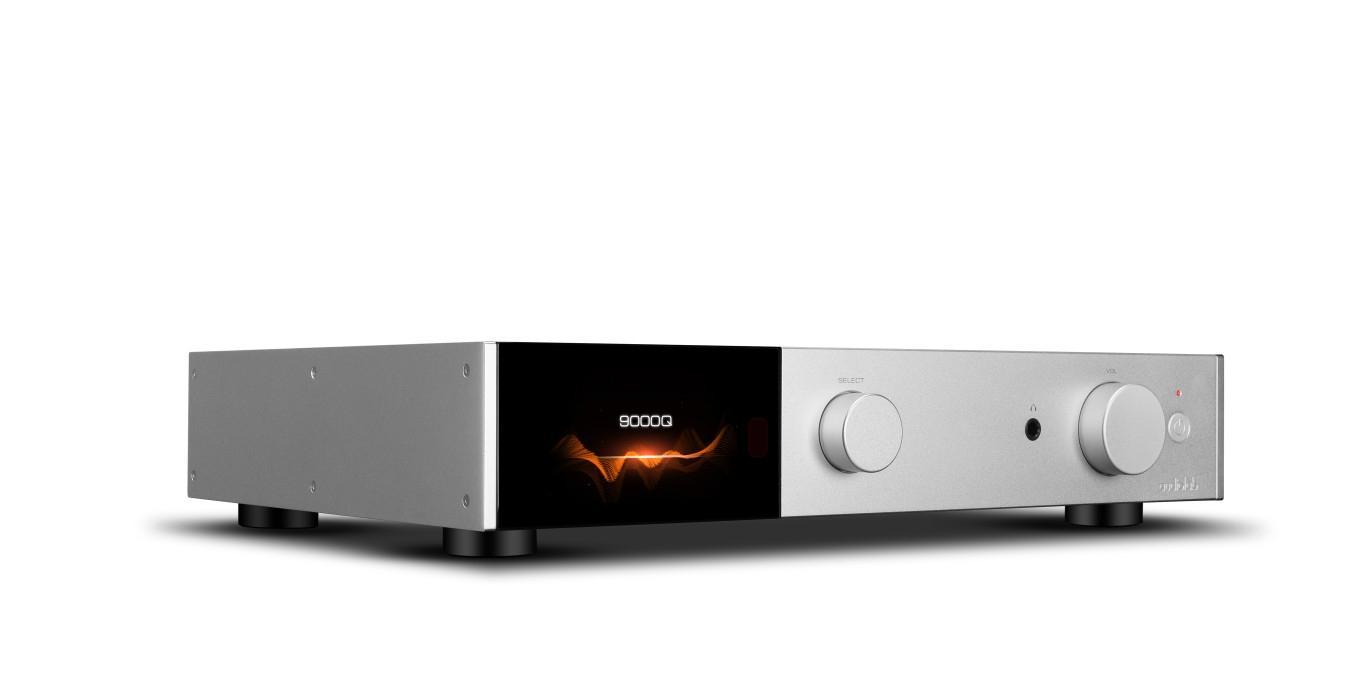
Visually, the 9000Q preamplifier shares its design DNA with the 9000N streaming DAC, adopting a minimalist and elegant aesthetic. Its precisely crafted rectangular chassis, constructed from aluminum alloy, not only bolsters structural rigidity but also effectively blocks external electromagnetic interference.
The left side of the front panel features a vibrant 4.3-inch IPS display, which can show album information and a vintage-inspired VU meter, adding a touch of classic charm to its modern facade—a distinctive hallmark of Audiolab components. Adjacent to the screen are two tactile rotary knobs: the smaller one for source selection and menu navigation, and the larger, intuitive one for volume control.
Completing the front panel is a 6.3mm headphone output, and with the 9000Q’s USB DAC capabilities, desktop users can easily connect it to a PC or music server and enjoy it as a high-quality headphone amplifier.
As a true preamplifier, the 9000Q’s rear panel offers a robust array of analog inputs, including one balanced XLR and three single-ended RCA inputs. This versatility allows it to function as a pure preamplifier when you have superior external sources or DACs. Additionally, a dedicated Phono input with MM (Moving Magnet) phono stage functionality means you can directly connect your turntable and spin vinyl without additional components.
For analog outputs, it provides one balanced XLR and two single-ended RCA connections for seamless integration with power amplifiers. A particularly thoughtful inclusion is a fixed-level RCA output, effectively bypassing the volume control and allowing the 9000Q to function purely as a streaming DAC if you prefer to use an even higher-end external preamplifier.
Digital inputs comprise a USB Type-B port for connecting to PCs, NAS drives, or music servers, and a USB-A port for connecting external hard drives, enabling playback of your music library even without an internet connection.
For home theater enthusiasts, the 9000Q includes an “AV Direct” function, seamlessly integrating it into a multi-channel home theater system. If wireless convenience is preferred, the unit boasts Bluetooth 5.1 with support for high-quality codecs like aptX HD and LDAC, allowing direct music streaming from your mobile device. Finally, the 9000Q is Roon Ready certified, ensuring effortless integration into the Roon streaming ecosystem for an even more intuitive and visually rich music experience.
9000Q Internal Architecture & Power
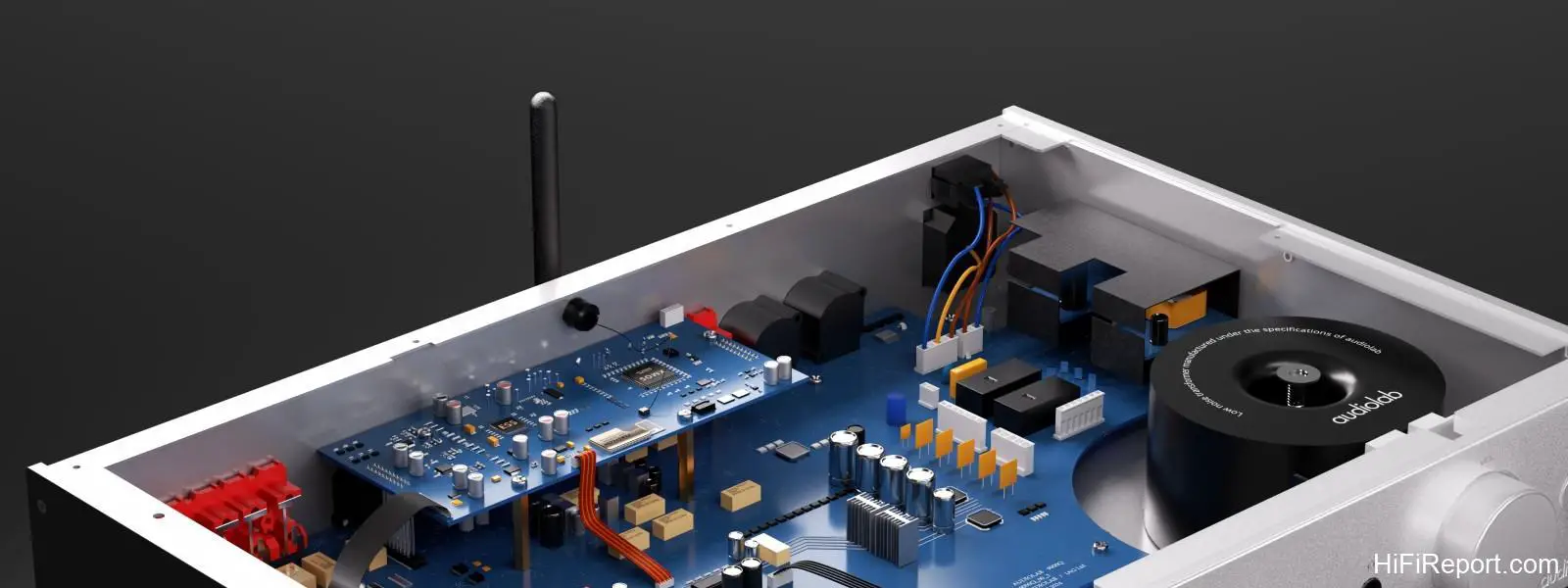
Under the hood, the 9000Q showcases meticulous component selection. The decoding heart is the ESS ES9038PRO DAC chip, a 32-bit/8-channel flagship Sabre DAC—currently the pinnacle of ESS’s product line. By dedicating an 8-channel chip to 2-channel operation, Audiolab dramatically improves the signal-to-noise ratio.
This is complemented by Audiolab’s proprietary HyperStream II architecture and Time Domain Jitter Eliminator technology, which together effectively boost dynamic range and reduce distortion, fully leveraging the advantages of high-resolution streaming audio. The 9000Q supports PCM resolutions up to 768kHz and DSD up to DSD512, along with MQA full decoding. Five built-in DAC filters offer tuning flexibility for audiophiles to fine-tune the sound to their preference.
Furthermore, the 9000Q provides EQ control for both low and high frequencies, with adjustments in 2dB increments, offering a total range of ±6dB.

The 9000Q’s power supply design is another highlight. It incorporates a substantial 40VA toroidal transformer, encased in a metal shield to minimize noise and vibration interference with the internal circuitry. Audiolab has ingeniously integrated its acclaimed DC Block mains power optimization and filtering technology directly into the power supply design.
This effectively eliminates RFI (Radio Frequency Interference) and EMI (Electromagnetic Interference) from the AC mains, ensuring pristine power delivery. The unit also employs a separate regulated power supply architecture, providing independent, phased power to the digital-to-analog conversion stages for both left and right channels, significantly enhancing channel separation.
For those connecting to a power amplifier via XLR, the “XLR Direct” mode, when activated, ensures the signal travels the shortest and most perfectly balanced path, reducing interference to an absolute minimum.
9000P Design & Power
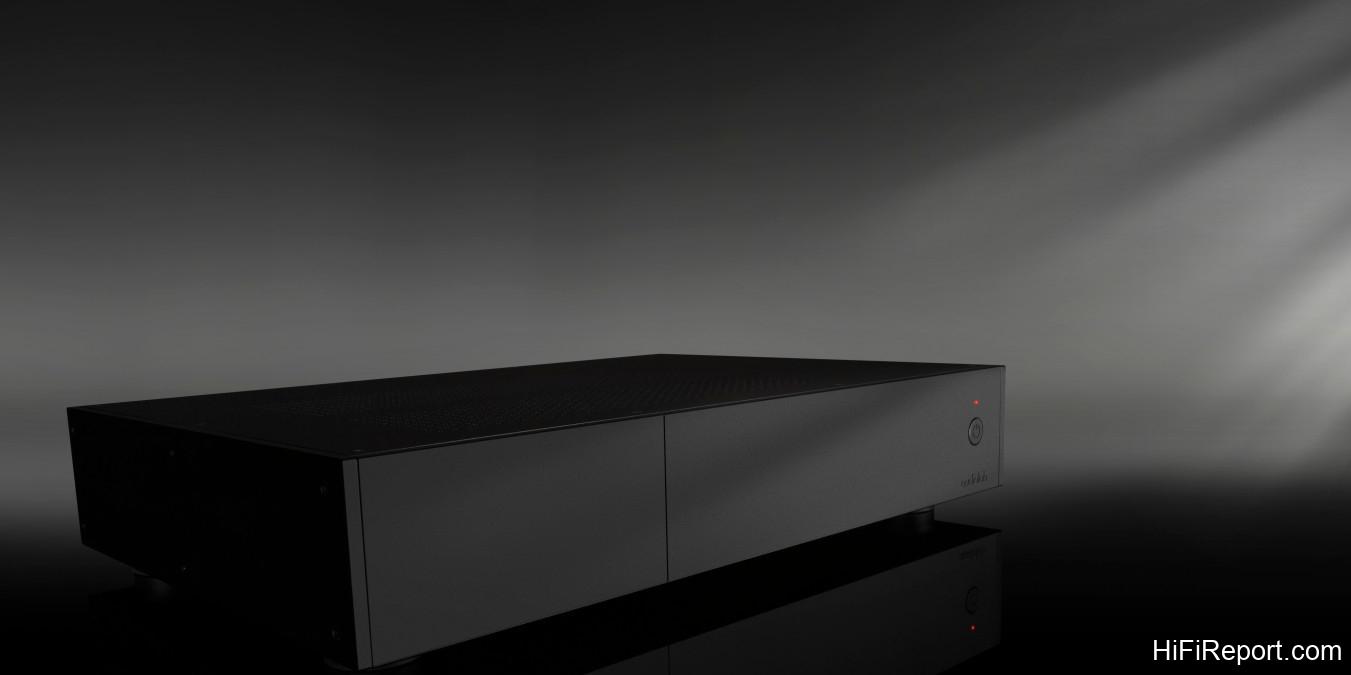
Moving to the 9000P stereo power amplifier, it shares the same robust aluminum alloy chassis as the 9000Q, allowing for convenient stacking. Unlike the preamplifier, the 9000P’s function is purely amplification, resulting in a cleaner, more minimalist visual aesthetic. The front panel features only a power switch, devoid of any volume control.
This deliberate choice avoids signal degradation from passing through two volume controls and allows the 9000P to specialize entirely in its amplification task, embodying the purist’s philosophy of component separation in high-fidelity audio. Despite its outwardly simple appearance, the 9000P’s internal circuitry is remarkably robust and meticulously engineered.
9000P Internal Architecture & Performance
Peeking inside the chassis reveals Audiolab’s custom-designed 320VA toroidal transformer, renowned for its high efficiency and low noise characteristics. This is paired with four substantial 15,000uF filter capacitors, forming a linear power supply with a total capacitance of 60,000uF. Each channel boasts an impressive current output capability of up to 15A, providing a powerful and unwavering foundation for dynamic musical transients.
Beyond ample power, the 9000P prioritizes power delivery efficiency. Each channel features an independent power supply module and incorporates a CFB (Complementary Feedback) amplification design. This innovative approach prevents transistors from drawing power when idle, ensuring they remain at low operating temperatures and thereby maintaining a more linear performance from the amplification circuit.
At the heart of the 9000P’s amplification stage lies a dual-mono Class AB amplifier design, which significantly improves the signal-to-noise ratio and enhances left and right channel separation. This translates audibly into heightened detail resolution, a wider soundstage, and a more three-dimensional sonic presentation. Under an 8-ohm load, each channel delivers 100W of output power (160W into 4 ohms).
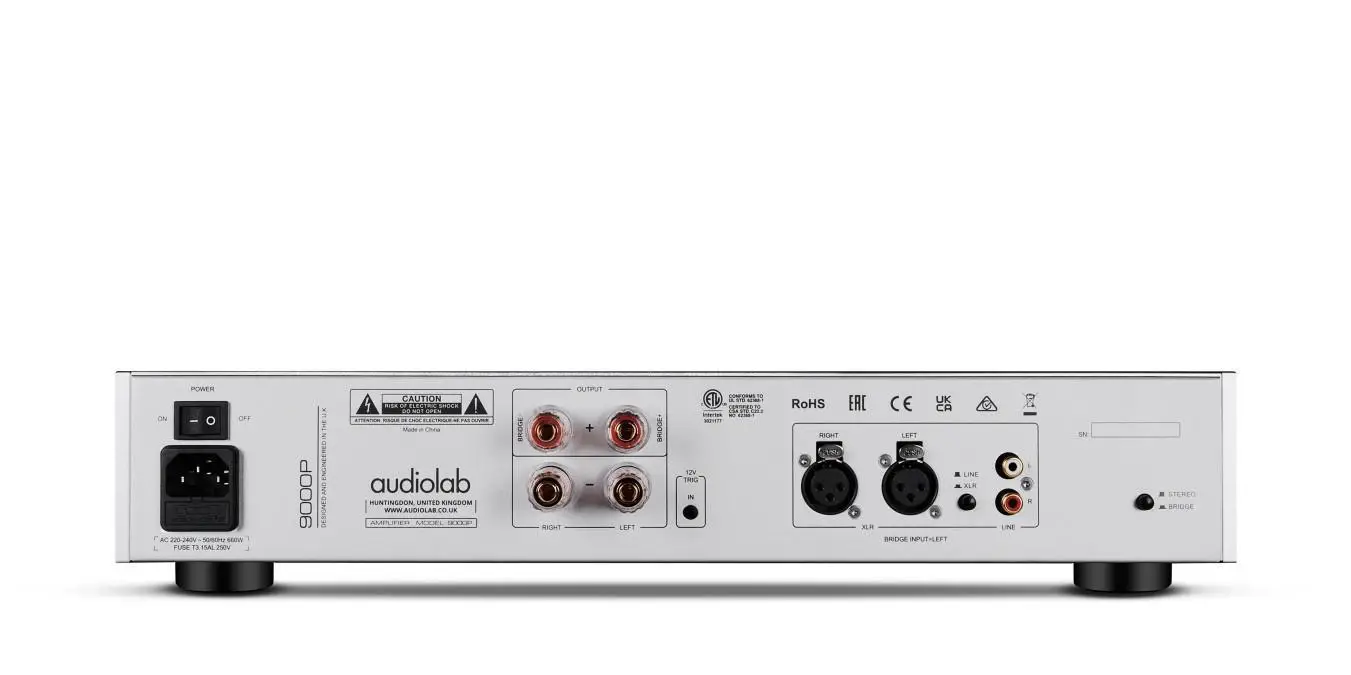
For those demanding even greater driving force, the 9000P can be configured for bridged mono operation, boosting the single-channel output to a formidable 300W into 8 ohms, more than capable of effortlessly driving even the most demanding loudspeakers.
Listening Impressions
Stereo Performance with Bookshelf Speakers
For this review, I conducted my listening tests in our 7-ping (approx. 250 sq ft) audition room. Initially, I paired the 9000P with our in-house Focal Utopia Diablo flagship bookshelf loudspeakers, using the 9000Q preamplifier connected via USB to an I-O Data Soundgenic music server as the source. The Diablo loudspeakers, known for their delicate and agile sound quality, are highly sensitive to the sonic characteristics of upstream components.
Audiolab has consistently focused on musicality, with their higher-end products adding refined transparency. This suggested a very synergistic pairing with the Focal speakers.
My listening sessions quickly confirmed my expectations. This Audiolab 9000 series pre/power combination delivered a smooth, refined sound with exceptional resolution and precise soundstage imaging. When I played Brahms’ “Piano Quartet No. 2” with Krystian Zimerman at the piano, I experienced the piano and string instruments arrayed across the soundstage, each immaculately positioned.

A palpable sense of space opened up between the instruments, and the musical background seemed to be vacuum-sealed, creating an uncanny quietness from which the string melodies emerged. Their lines were delicate, taut, and brimming with air, utterly devoid of any harshness. The violin texture, in particular, was captivating, revealing clear bow-on-string friction and a sweet, rounded delicacy in higher registers.
The piano sounded crystal clear, with every key press revealing a gentle elasticity and even the slightest touch dynamic rendered with pristine clarity. This system brought out a wonderfully “feminine” elegance when reproducing such small-ensemble chamber music.
Next, I cued up Bill Evans’ “Empathy” piano trio album. I noticed that this Audiolab 9000 system, even when interpreting older analog recordings, maintained an exquisite sonic finesse. In “Danny Boy” (track two), the piano’s raw edge seemed to be completely smoothed away; Bill Evans’s playing flowed effortlessly, and the individual notes sounded rounded and transparent. Meanwhile, the accompanying jazz drums showcased the system’s incredible detail retrieval.
The cymbal shimmer was incredibly fine, each strike resonating with a continuous metallic bloom that slowly dissipated into the air. The rhythm of the drum brushes revealed the coarse texture of the drum skin, with rich overtone details building an incredibly realistic soundscape.
Listening to jazz pianist Marcus Bartelt’s album “Still Here,” where instruments are recorded with a close, massive presence, the Audiolab 9000 system delivered an unprecedented sense of sonic density. In “Fragment III,” the saxophone was remarkably full-bodied with a powerful sense of physical presence. Even within its large contour, details filled the space, conveying the solid, dense force of the player’s breath.
In contrast to Bill Evans’s gentle expressiveness, the piano here sounded more assertive and masculine, with weighted key presses that exhibited excellent low-end extension and deep, clear string resonance. The bass was fast and agile, never lingering.

Bridged Mono Configuration
To truly unleash the full potential of the 9000 series, the distributor provided two 9000P power amplifiers, allowing me to configure them in bridged mono mode. The immediate impact on sound solidity was undeniable—it jumped a full tier! The sound became noticeably more composed and weighty. Compared to the single power amplifier setup, which was like a delicate, elegant sake, the dual-mono configuration was akin to a rich, mellow whisky.
The musical textures gained a fuller, more substantial body, taking on a quality closer to analog warmth. Playing “Devil May Care” from Diana Krall’s “Live in Paris” album, the piano’s individual notes became softer and more elastic. What previously sounded thin in the higher octaves now revealed a richer, more resonant woody character.
When the lower keys were struck forcefully, I felt the enveloping energy of the piano’s body resonance, showcasing the instrument’s tonal richness to its fullest.

The most significant improvement with two power amplifiers was the increased thickness of the mid-range. Diana Krall’s magnetic voice gained a newfound maturity and allure; her lips and mouth shapes became more palpable and intimate. What’s truly impressive is that even with the added body to vocals and instruments, the sound never felt crowded.
Instead, I perceived even greater three-dimensional layering within the music, meticulously separating the jazz trio’s components and rendering the stage positioning with astonishing realism.
Driving Floorstanding Speakers
Finally, I paired the system with Focal Sopra N2 floorstanding loudspeakers, which further showcased the advantages of the dual-mono power amplifiers. Driving these larger speakers proved effortless. Playing the Latvian violinist Baiba Skride’s rendition of Shostakovich’s “Violin Concerto No. 1,” the system conveyed an outstanding sense of space, creating a deep soundstage behind the speakers.

The orchestral low notes were profound and clear, while the solo violin sounded fuller and more hydrated, imbued with a warm woody resonance, and its higher notes were rendered with greater softness. During grand orchestral tutti passages, the dual power amplifiers exhibited even more formidable dynamic prowess.
Not only did I feel an imposing, enveloping sound, but the energy release and control were utterly precise, as if the amplifiers possessed an endless supply of power, yet maintained meticulous command over every note.
Heavy Metal Refinement
To cap off my listening, I put on “Espera,” the second track from progressive metal band Animals As Leaders’ “Weightless” album. The rapid-fire double bass drum kicks in this track delivered powerful, visceral impacts to the chest—yet they were exhilarating and never overwhelming. Even at blistering speeds, the distinct impact of the drum skin was audible, each kick massive and full-bodied, far from a blurry low-frequency rumble.
This demonstrated the system’s exceptional bass control and remarkable detail retrieval. Furthermore, the lightning-fast electric guitar solos in this piece are a true test for any system. Beneath the ferocious distortion, the guitar plucks remained incredibly articulate, each note rounded, transparent, and even possessing a hint of sweetness.
Accompanied by the tightly organized rock rhythm, it created an illusion of time slowing down, allowing me to savor every intricate detail of the instrumentals. This system elevated heavy metal from chaotic to exquisitely refined.
Conclusion
This 9000 series preamplifier and power amplifier combination has completely redefined my perception of Audiolab. Sonically speaking, it performs at a level often associated with much higher-end audio systems. Before knowing the price, I would have estimated each component to be well over $3,000. To my surprise, the 9000Q paired with the 9000P is priced at only around $3,125. Such performance for the cost is simply groundbreaking!

And if you decide to add a second 9000P power amplifier in the future, you’d only need an additional budget of about $1,556, achieving a luxurious dual-mono power amplification setup for a total of around $4,687. If you’re searching for an audio system that offers explosive value, incredible versatility, and can both deliver thrilling dynamics and exquisite finesse, the Audiolab 9000Q and 9000P should undoubtedly be your top choice!
9000Q Specifications
* Product Type: Two-channel Preamplifier
* DAC Chip: ES9038Pro 32-bit DAC
* Supported Sample Rates: Up to 768kHz / 32-bit PCM, DSD512
* Wireless Transmission: Bluetooth 5.1 (aptX/aptX HD/LDAC)
* Input Terminals: RCA x3, XLR x1, Phono x1, Coaxial x2, Optical x2, USB Type-B x1

* Analog Outputs: RCA x2, XLR x1, 6.3mm Headphone x1, 12V Trigger x2
* Frequency Response: 20Hz-20kHz, +/-0.1dB
* Total Harmonic Distortion (THD): < 0.001% (1KHz @ 0Dbfs) * Signal-to-Noise Ratio (SNR): > 113dB (RCA), > 117dB (XLR Direct)
* Dimensions: 444 x 90 x 328mm
* Weight: 8kg
9000P Specifications
* Product Type: Two-channel Power Amplifier
* Frequency Response: 20Hz-20kHz (+/-0.3dB)
* Amplification Circuit Type: Dual-mono Class AB Amplifier
* Signal-to-Noise Ratio (SNR): 110dB (50W 8 ohms)
* THD: <0.002% (1kHz) * Output Power: 100W (8 ohms), 160W (4 ohms), 300W (8 ohms mono bridged), 380W (4 ohms mono bridged) * Maximum Current Output: 15A * Input Terminals: XLR x1, RCA x1, 12V Trigger x1 * Output Terminals: Speaker Terminals x1 * Dimensions (W.H.D. ): 444 x 90 x 327mm * Weight: 10.6kg