
Aurender N30 Music Server Review
Perhaps the best-known audio brand from South Korea is Astell & Kern, famous for their portable players. Following closely are brands like April and Rose, which offer more budget-friendly audio gear. Frankly, in the global audiophile landscape, South Korea doesn’t occupy a dominant position. However, one Korean manufacturer specializing in music servers and streamers has managed to become a leader in this niche: Aurender.
Beyond this, there are also some ultra-high-end products less familiar to the general public, such as loudspeakers from Metal Sound Design.
Company History
Aurender was founded in 2010 by Harry Lee. A graduate of Seoul National University with a degree in Electronic Engineering, Harry Lee previously worked at LG and other IT companies, accumulating over 30 years of relevant experience. In 1997, he founded DViCO, a multimedia player company. He left DViCO in 2009 and established Aurender in January 2010. Initially named Widealab Inc., Aurender was the brand name, focusing on the design and manufacture of music servers and streamers.
Their first product, the S10 music server, debuted at the California Audio Show in 2011 with a price tag of $6,990 USD. This price point surprised many, as Korean-made audio equipment hadn’t typically commanded such figures.
Widealab Inc. was acquired by the Korean listed company TVLogic in September 2012, becoming a division within the company. TVLogic produces high-end monitors suitable for use in extreme climates. According to David Guo, Aurender’s Asia Marketing Director, who visited Taiwan for the 2019 TAA Audio Show, the owner of TVLogic and Widealab Inc.’s owner, K.K. Lee, were classmates at Seoul National University. Widealab needed capital for development, so they agreed on the acquisition.
Harry Lee became the Director of the Smart Audio Division, bringing all 17 Widealab engineers with him. However, in 2016, TVLogic was sold to another company, and Aurender officially became an independent entity: Aurender Inc.
Aurender’s Vision
Why did Harry Lee decide to create Aurender music servers? He believed that the servers available on the market at the time were merely modified computers, not true high-end audio solutions. Audiophiles were still plagued by the numerous issues inherent in computer architecture. His goal was to strip away the traditional computer structure and eliminate its negative impacts, creating a music server that met high-end standards.
This idea was simple yet hit the nail on the head. In an era when audiophiles were still busy downloading music files, Aurender foresaw the future of music servers and streaming, launching products controlled exclusively via iPad, notably without any included remote controls.
This approach allowed audiophiles to completely break free from the shackles of computers and avoid the frustrations of not being tech-savvy. Furthermore, although Aurender products contain computer servers and hard drives internally, their external appearance is that of conventional audio equipment, significantly lowering the psychological barrier many audiophiles had towards integrating computers into their systems.
It’s no wonder Aurender has become a dominant force in this field over the past decade. By the way, what does the name “Aurender” signify? According to the manufacturer’s promotional materials, it stands for: Innovation, Refined user experience, and Impeccable quality. Feel free to interpret the meaning for yourself.
Some people might still be unclear about what a music server actually is. Simply put, if a player has a built-in hard drive for storing music files (whether traditional HDDs or Solid State Drives SSDs), we can call it a music server. Since it’s called a server, it naturally contains a computer internally. Most audio-grade music servers use the Linux operating system.
However, because their task is solely to store and play music files – a relatively simple job – they don’t require extremely high CPU performance. Instead, they place the same demands on power supply, noise elimination, and vibration damping as other high-end audio components, aiming for the absolute best performance. Aurender specifically focuses on products that combine music server and streaming functionalities.
Aurender’s Unique Design Choices
Before purchasing an Aurender product, be prepared for some deliberate limitations. Their CPUs are not particularly high-performance. They don’t support ROON, nor do they support third-party UPnP apps, relying solely on their own. More surprisingly, they lack Wi-Fi, volume control, and Bluetooth. In reality, these “absences” are all designed in pursuit of superior sound quality.
We know that high-performance CPUs inevitably consume more power, generate more heat, and are more prone to producing noise. Dealing with these issues often requires significant additional cost from the manufacturer. In truth, a music server only needs to play music; it’s not launching missiles, so why would it need such high CPU performance? Aurender deliberately chooses not to use high-performance CPUs for the sake of better sound, not to save money.
As for why they don’t support ROON, is it simply because they dislike the platform? Again, this relates to the CPU. To be ROON Ready, a higher-performance CPU is required, which could potentially introduce noise. Thus, Aurender opts out. Fortunately, Aurender has developed its own “Aurender Conductor” app, which provides all the necessary features for organizing and playing music files, including data integration capabilities, which is more than sufficient for most users.
Why doesn’t Aurender open its platform to third-party apps? This is connected to Aurender’s internal playback method, specifically its “caching” feature. Aurender’s product pages prominently feature caching. Is this just a marketing gimmick, or do songs really start playing almost instantly after selecting them? It’s true. If you select a song you’ve played before on your iPad, it begins playing almost immediately, living up to the caching claim.
However, if it’s a track that hasn’t been played, it won’t start instantly. Why? Because the music file must first be transferred from the HDD to the SSD, and then played from the SSD. This process takes some time. So, songs that have been played before are stored on the SSD and can be played back instantly – this is the “caching.” By the way, why isn’t the music file played directly from the HDD? Because HDDs vibrate, whereas SSDs do not.
Here’s the crucial point: during this process where the music file moves from the HDD to the SSD for playback, the system needs to precisely control the HDD, shutting it down after the file is transferred to prevent vibration. This specific control functionality is only available through Aurender’s own app; third-party apps cannot execute it. For this essential feature, Aurender must politely decline the use of third-party apps.
Regarding the absence of Wi-Fi and Bluetooth, these are also intentional choices to minimize noise interference and timing errors (jitter) that can be introduced by these wireless transmission methods. The lack of volume control is to avoid introducing another stage of potential distortion. As you can see, Aurender’s fundamental design philosophy differs from other manufacturers – every decision is made in pursuit of the best possible sound quality.
Streamer vs. CD vs. Files
Next, many people constantly wonder: Which sounds better? Streaming? CD? Or high-resolution music files? Setting aside convenience and library size for a moment, based on what I’ve heard so far, I would rank them as follows: high-resolution music files, CD, streaming. However, I must qualify this by saying this ranking assumes streaming is used without higher-end power supplies, audiophile-grade network switches, or audiophile network cables.
If these higher-end components are incorporated, streaming might potentially surpass CD quality.
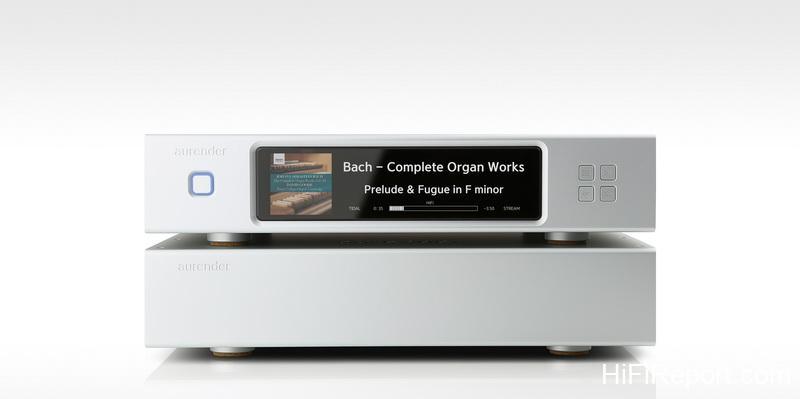
Why do I make this ranking? The primary reason is that there are significant differences in the design quality of streaming players and music servers. Having listened to the N30, I am now even more convinced that standard streaming players have considerable room for improvement. Many might think that a streaming player or music server is simple – just receive digital music via a network cable and play it back. However, the work involved is far more complex.
Streaming music comes in various formats, and music files also come in many different formats (such as WAV, AIFF, FLAC, ALAC, MP3, APE, etc.). If you’re using a streaming player without a built-in DAC, these different music formats, PCM, DSD, etc., must first undergo processing through a computer architecture, various conversion procedures, and an app before being output via USB or S/PDIF interfaces for the DAC to perform digital-to-analog decoding.
Both streaming music and high-resolution music files go through multiple processing steps. However, streaming relies on receiving music transmitted over the network from a distant server, which introduces more potential points of degradation compared to playing high-resolution music files stored locally. Therefore, when comparing high-resolution music files from your own NAS with streaming music, the latter is inherently at a disadvantage.
Moreover, purchased high-resolution music files can reach DXD (352.8kHz) and DSD256 specifications (though certainly some are not genuinely high-resolution recordings), further giving them an edge. While MQA can theoretically unfold to 24/352.8, whether it is truly lossless remains questionable.
Aurender Model Hierarchy
Having gained a basic understanding of music servers and streaming, let’s look at the N30. Aurender currently offers several products. To gauge the hierarchy of Aurender models, you can first look at the size and number of chassis. Two-chassis units are naturally the highest-tier flagships; currently, the only two-chassis model is the N30. Models with a half-sized chassis are typically more affordable than traditional-sized units, such as the N100 and X100L.
Next, consider external clock support. Models capable of accepting an external clock are higher-end, like the W20SE and N30; those without external clock support are a tier below, such as the N10.
Next, you can look at the model numbers; larger numbers generally indicate a higher tier. In the N series, the N10 is the most affordable, the N20 is in the middle, and the N30 is the most expensive. Finally, identify by the letter designation. ‘N’ stands for Network, signifying a network streaming transport and music server. ‘Transport’ means a model without a built-in DAC, offering only digital outputs, no analog outputs.
It requires connection to an external digital-to-analog converter, which is the case for both the N series and W series.
The N series also includes the N100H, N100C, and N100SC. These three models were introduced as computer replacements and all feature music server, streaming, hard drive storage, digital output, and music library functions. The N100H is the least expensive, followed by the N100SC, and the N100C is the most expensive. All three of these models have a half-sized chassis. Then there’s the A series, where ‘A’ hints at ‘All-in-One’. While not truly all-in-one, this series offers the most features.
A series models all have analog outputs, preamplifier functionality, a DAC, and built-in MQA decoding. The A30 even includes a CD Ripper. The A100 is a more affordable version of the A10.
Next is the ACS series, also designed to replace computer functions. These include a CD Ripper and can be used in conjunction with A, N, and W series models. This series includes the ACS10 and ACS100, with the latter being the more affordable version of the former.
Some series in Aurender’s lineup only have a single model, such as the W series with only the W20SE. Although it’s a single-chassis unit, it’s a flagship that requires an external DAC to produce sound. The X725 is a USB DAC combined with an amplifier, designed for use with the N100H. The UC100 is a USB to S/PDIF (coaxial) converter. The UT100 is a USB to S/PDIF (optical) converter.
Arranging all Aurender products by price, from highest to lowest, the order is roughly: W20SE, N30, N20, N10, A30, A10, A100, ACS10, ACS100, N100H/N100C/N100SC (prices may vary slightly within this group), X725, UC100, UT100.
Aurender also offers a battery-powered active wireless mini-speaker, the S5W, and the Cast-Fi 7, a portable HDMI Docking speaker. I don’t think typical audiophiles would be interested in purchasing these types of products; if they were, they’d likely opt for more affordable options.
Core Technologies and Design Principles
I was present when David Guo introduced the W20SE in Taiwan in 2019. I recall he emphasized Aurender’s four core concepts and five core technologies. The four concepts are: First, Quality; Second, Design; Third, User Experience; and Fourth, Stability. Quality, design, and stability are self-explanatory. What about user experience? From the beginning, Aurender developed its own app to provide users with convenient control.
They receive questions and suggestions daily from distributors in over forty countries and resolve them promptly. They also pay close attention to user suggestions for improvement received from various regions. David Guo mentioned they currently have over two hundred suggestions accumulated and are addressing and implementing upgrades for them one by one.
What are the five core technologies? They are: First, Reducing Noise. Second, Reducing Jitter. Third, Special attention to Power Management. Fourth, In-house App Development. Fifth, Rigorous Testing and Quality Control. In a presentation in China, David Guo slightly rephrased this, but the core meaning remained the same. He spoke of four cores: Signal Processing (including noise and jitter), Power Management, Support Solutions, and Testing Technology.
A music server/streamer must handle complex digital signals of different specifications, eliminate various types of noise, and ensure precise timing (jitter). This is what David referred to as signal processing. A music server contains a computer architecture, hard drives, and processes for reading various music files. These different components require distinct power management strategies. I believe every music server manufacturer dedicates significant effort to these two areas.
However, the N30’s approach is even more meticulous. For example, their power supply is not simply battery, linear, or switching; more importantly, it incorporates circuit designs that constantly monitor the stability of voltage and current supply – a robust power management mechanism.
Regarding timing precision, the N30 can connect to an even more accurate external clock. Even its built-in clock is OCXO (Oven Controlled Crystal Oscillator) grade. You might wonder why it’s written as OCXO instead of OCCO? Because the abbreviation for Crystal is Xtal. What are the advantages of OCXO? These quartz crystals are grown in precisely temperature-controlled ovens to achieve extremely accurate center oscillation frequencies.
Without this manufacturing process, standard quartz oscillators cannot meet such stringent precision requirements.
Currently, the most accurate are Cesium atomic clocks, with precision of 1×10⁻¹³ seconds. Next are Rubidium atomic clocks, with precision of 1×10⁻¹¹ seconds. Then comes OCXO, with precision of 1×10⁻⁹ seconds. Commonly seen TCXO (Temperature Compensated Crystal Oscillator) has a precision of 1×10⁻⁶ seconds. Even less precise XO (Crystal Oscillator) is 1×10⁻⁴ seconds.
However, OCXOs have two drawbacks: they consume more power, requiring better power supply and not being suitable for battery power; and they require several minutes after startup to reach their specified accuracy. However, this is not an issue for audiophiles.
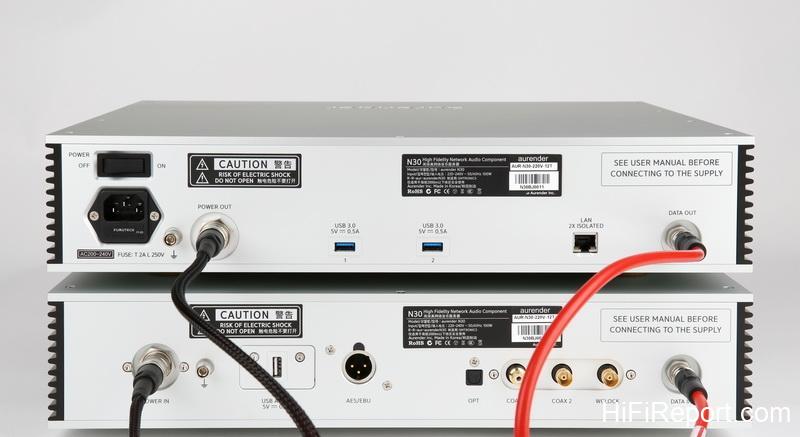
For noise reduction, the N30 employs every possible method in its internal circuitry. This is the primary reason the N30 is split into “dirty” and “clean” chassis. Additionally, the Ethernet port input on the N30 features a special double-isolation design to reduce noise entering from the network cable. This is the first time I’ve seen such a designation.
In-house app development, or “Support Solutions,” means Aurender has developed its own app from the beginning and receives feedback and addresses issues from distributors in over forty countries in real-time daily. Having their own software engineers allows them to resolve issues quickly. David Guo mentioned that out of their roughly thirty employees, over twenty are various types of engineers, highlighting their strong R&D capabilities.
Regarding rigorous testing and quality control, I believe every manufacturer conducts these, but to what extent? Aurender’s power switch is tested by cycling it 1,000 times. After manufacturing, units are placed in an environment chamber at 50 degrees Celsius (122°F) for three days to check for failures. Vibration testing is also performed. Furthermore, Aurender designs its own testing equipment for necessary tests at different stages of production.
N30: A Deeper Look
The full name of the N30 is Caching Music Server/Streamer. It contains internal hard drives but does not have a built-in DAC. Therefore, it requires an external digital-to-analog converter for use. What exactly does the N30 do? Its digital input and output terminals provide clues.
It can connect to the network to stream music platforms, connect to computers, external hard drives, and network attached storage (NAS) to play music files, and connect to an external clock for lower jitter.
Certainly, the biggest difference between the N30 and the previous N20 is its two-chassis design, specifically separating the “dirty” and “clean” sections, rather than an integrated unit. What are the “dirty” and “clean” chassis? The “dirty” chassis houses all circuitry that generates noise, including power supply, control circuits, and display circuits. The “clean” chassis contains only the circuits that process the music signal.
So, the chassis you see with the display on the N30 is not where the music signal is processed; it’s the power supply chassis. The other unit, with no display (not even a power button on the front), is where the music signal is processed.
Honestly, I find the N30’s model number a bit confusing. Since it’s the only two-chassis model, its tier should arguably be higher than the single-chassis W20SE. Why wasn’t it named W30? Moreover, despite being a two-chassis unit, the N30’s price is actually lower than the W20SE. Is 30 perhaps a sacred, untouchable flagship number? So, after the W20, even with significant improvements and upgrades, it could only be granted the “SE” designation? But the A series A30 isn’t that expensive!
Or perhaps, the number 30 is reserved for two-chassis designs, so even though the W20SE is priced higher than the N30, it can only be called “SE”? Will a two-chassis W30 be released in the future?
What are the differences between the N30 and W20SE? The W20SE has built-in MQA decoding; the N30 does not. The W20SE uses battery power; the N30 does not. The W20SE has two internal SSDs (1TB and 4TB), while the N30 has one 12TB HDD and one 480GB SSD. The W20SE’s USB output supports up to 768kHz, while the N30 supports up to 384kHz. The W20SE has two sets of AES/EBU digital outputs, allowing for dual-wire output to improve output specifications, while the N30 has only one AES/EBU output.
To clear up the confusion, I asked the local distributor to inquire with the manufacturer, essentially asking, “Why both Yu and Liang exist?” (a Chinese idiom similar to “Why two suns in the sky?” implying two nearly equal rivals). The answer I received was that the main differences lie only in single vs. dual AES/EBU and the hard drive capacity. If a user’s DAC has two AES/EBU inputs, the W20SE is recommended. If the user only has one AES/EBU input, the N30 is recommended.
However, this explanation also feels a bit strange, because USB output can reach PCM 768kHz or DSD512, while dual-wire AES/EBU can only reach 384kHz! Single-wire AES/EBU only goes up to 192kHz.
Therefore, if the external DAC has a USB input, you should definitely connect using a USB cable. You only need to consider an AES/EBU connection if the external DAC lacks a USB input. As for hard drive capacity, the N30’s built-in 12TB is certainly very convenient. If the internal capacity isn’t sufficient, you can also connect external drives via the USB ports.
Fortunately, the price difference between the W20SE and N30 isn’t huge, so those looking to buy should simply choose the one that feels right without internal struggle.
Design and Connections
Aurender products share a consistent design aesthetic. While seemingly simple and robust, the chassis thickness and weight are characteristic of high-end equipment. Both sides feature heatsinks, indicating thorough consideration for thermal management. The N30’s chassis is split into two: one with a display, the “dirty” chassis; the other with nothing on the front panel (not even a power button), the “clean” chassis.
The “dirty” chassis houses the computer system, power supply, hard drives, etc. The “clean” chassis contains only further power filtering and regulation, along with the music signal processing circuitry.
On the front of the “dirty” chassis, the power switch is on the left, and there are four square buttons on the right: play/stop, skip backward, skip forward, and display mode toggle (song information or playlist). Most users will control the unit via iPad or phone and rarely use the panel buttons. The front panel of the “dirty” chassis features an exceptionally large 8.8-inch non-touch AMOLED display with a resolution of 1920×480.
This large screen allows users to clearly see various information from their listening position, which is a thoughtful touch.
Turning to the rear of the “dirty” chassis, you’ll find one Power Out connector, one Data Out connector, two USB 3.0 ports, and one LAN port. Your home network cable should be connected to the LAN port. The USB ports can be used to connect to a NAS or simply plug in a USB drive containing music files for direct playback. It’s worth noting that the LAN port is labeled “2X Isolated,” meaning double isolation, designed to isolate noise transmitted from the network cable.
This marking is something I’ve encountered for the first time.
Moving to the rear of the “clean” chassis, you’ll see a USB output terminal, S/PDIF output terminals (including one RCA coaxial, one BNC coaxial, one AES/EBU, and one Optical), and one WClock port (for connecting an external clock). Additionally, there are Data In and Power In connectors. The USB terminal can connect to a DAC with a USB input, capable of transmitting up to DSD512 (Native) or DSD256 (DoP), and PCM up to 384kHz.
The S/PDIF terminals can also support up to DSD512 (DoP) and 32bit/384kHz (likely referencing dual-wire AES/EBU here, as explained earlier). Other S/PDIF connections typically max out at 32bit/192kHz. Dual-wire AES/EBU can indeed transmit 384kHz. Frankly, these specifications are well ahead of current mainstream capabilities. Streaming music platforms don’t offer 32-bit sources, and whether sampling rates truly reach 192kHz is questionable.
As for purchased music files, reaching DSD256 or DXD is already impressive; the highest quality files I personally own are in these formats, and I’ve never owned a DSD512 music file. On a side note, be wary of websites selling high-resolution music files, as they may simply be upsampled conversions via a DAC rather than recordings genuinely made at such high specifications.
Inside the Chassis
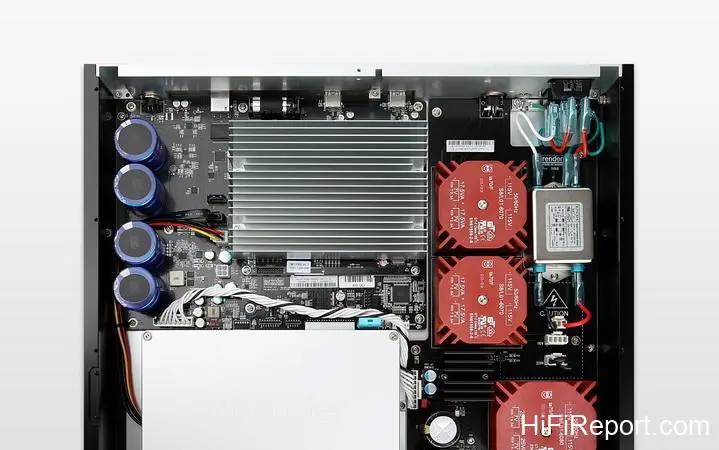
Lifting the top cover of the “dirty” chassis, you’ll find it packed with power supply circuitry. There are three toroidal transformers alone, plus four filter capacitors and voltage regulation circuits, indicating the use of linear power rather than switching power supplies. Inside the chassis, there’s a circuit board with a heatsink pressed onto it, and a sealed metal box.
Beneath the heatsink is the computer architecture circuitry – don’t forget the CPU (Intel N4200 Quad-core) also needs cooling; if it overheats, the entire computer architecture’s performance will degrade. The sealed metal box contains the HDD (for music file storage) and SSD (for caching and buffering).
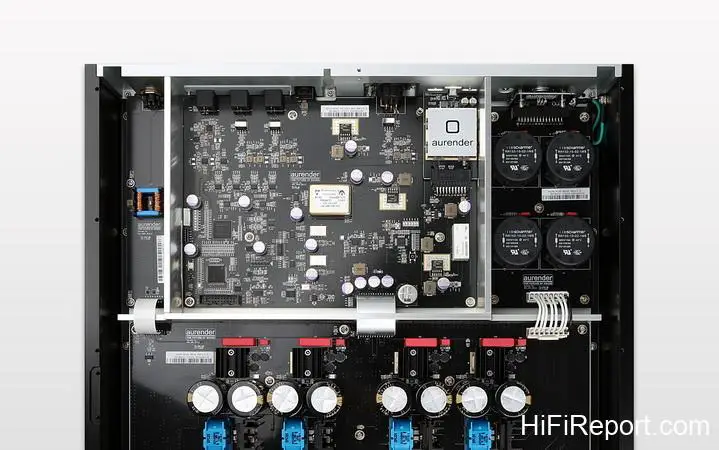
Inside the “clean” chassis, there are no power transformers. Instead, there are eight capacitors and four blue TDK Power Capacitors used as a UPS (Uninterruptible Power Supply) to prevent damage to internal music files or storage in case of sudden power loss. Additionally, there are four black toroidal chokes, indicating that the power supplied from the “dirty” chassis undergoes further filtering and four sets of regulation before being distributed to four different circuit blocks.
There’s an area framed by a metal plate within the chassis – that’s the most critical signal processing area.
Within this area, you can see a large OCXO quartz oscillator – the clock. Next to it is a Spartan-6 FPGA. There’s also an XMOS multi-core microprocessor. These two are clearly visible large, black components. I won’t go into the numerous other smaller ICs. Clearly, every aspect of the N30’s design employs top-tier practices, which explains its price point.
Listening Experience
I evaluated the N30 in my home’s open-plan living space, using a Weiss DAC502 digital-to-analog converter. However, the Weiss DAC502’s DSD support is limited to DSD128, so I couldn’t experience DSD256 or 512. I decided to connect the N30 to the DAC502 using an AES/EBU cable, which still allowed me to enjoy up to 24bit/192kHz, a very good standard.
The amplifier and speakers used were a Spectral DMC30SS preamplifier paired with ATC SCM100 ASL dual active loudspeakers, providing a revealing system to clearly discern the N30’s capabilities.
Essentially, this comparison was between the N30’s playback performance (both streaming and file playback) and the Weiss DAC502’s built-in streaming and file playback capabilities, since both were using the same DAC section. Frankly, the Weiss DAC502 costs around $15,000 USD, while the N30, without a DAC, costs over $24,000 USD. If the N30 couldn’t outperform the DAC502, Aurender wouldn’t have much of a case.
After connecting the N30 and downloading the control app, I opened the app and found many music files already on the internal hard drive – presumably left by the previous listener. There were more than enough files just to listen to those built-in. Of course, I also wanted to test streaming; I used Tidal. Initially, I found that DSD files wouldn’t play.
After consulting the local distributor, I learned that when transmitting via AES/EBU, DSD must be converted to PCM in the app settings, with a sampling rate of 88.2kHz or 176.4kHz selected.
After making this setting adjustment, DSD files played smoothly. A few days later, the distributor sent over a SOtM audiophile network switch and SOtM network cables. The purpose was for me to hear that even relatively affordable network accessories could have a beneficial effect.
Let me share my impressions of listening to music through the N30. Honestly, after listening to the first song, I knew instantly. As I continued listening, I became increasingly astonished. Why astonished? Because the sound quality was noticeably elevated – a full step up. I hadn’t expected a music server/network player to improve sound quality so dramatically! My Weiss DAC502 is not a cheap unit; it costs well over $15,000 USD, yet its sound quality performance was not as good as the N30.
Please don’t misunderstand; the Weiss DAC502’s sound quality is already excellent, which is why I bought it! But compared to the N30, I can only say that there’s always a higher peak to climb. Your ears don’t lie.
Next, I must mention the currently popular network switches and network cables. When I connected the SOtM network switch and cables, the sound quality improved another notch – perhaps not a full step like the N30 provided, but a noticeable improvement nonetheless. I believe if I can hear the difference, audiophiles should also be able to detect the enhancement.
N30’s Sonic Virtues
What makes the N30 so good? The sound quality is pure and beautiful, full, energetic, with substantial body, large lines, warmth, clear instrument decay, and a significantly expanded soundstage. What’s the evidence for better sound quality? Listening to Teresa Teng’s album “The First Time I Saw You” (or the closest English translation of which is Taiwanese folk songs), the violin, cello, piano, tenor, and soprano voices immediately sounded excellent, pure, and mellow.
Listening to Starker’s and Yo-Yo Ma’s cello recordings, the cello was truly wonderful – relaxed, supple, yet with great bow-on-string texture.
What’s the evidence for fullness and energy? Listening to several albums by Jody Chiang, you can clearly hear her voice is fuller, the kick drum “thump” is more substantial, and the overall music is more dynamic, yet without feeling compressed or aggressive. I attribute this to the N30’s inherent warmth.
This warmth is particularly evident in cello and violin performances, as the high frequencies sound more refined, the instruments have more woody character, and the resonance from their bodies is richer. These qualities together create a warm sound.
The clear instrument decay and expanded soundstage are linked; the tangible result is an excellent ability to reveal fine details. Why are details more prominent? Because the unit’s own noise floor is very low, details emerge like oil separating from water. Listening to various types of music through the N30, you consistently notice the clear instrument decay and the expanded soundstage. Of course, to fully appreciate these qualities, your listening environment must be quiet.
If your listening space is noisy, you won’t be able to discern these advantages. You might ask: Are other aspects of performance also improved? Simply put: Comprehensive improvement!
In writing about the Aurender N30, I’ve spent most of the space explaining Aurender’s product characteristics and the N30’s internal design, keeping the description of the listening experience relatively brief. I chose to write this way because the N30 is complex and needs thorough explanation so readers understand its design advantages.
The reason for the concise listening notes is that the N30 is only a transport; it requires an external DAC to produce sound, and much of its sonic performance is related to the external DAC. However, as I mentioned earlier, connecting the N30 immediately revealed a noticeable improvement in sound quality. As a transport, this is well worth the investment. Without a doubt, the Aurender N30 is the best music server/streamer I have heard to date.
Specifications
* Product Type: Two-Chassis Music Server/Streamer
* Release Date: 2021
* Maximum Supported Resolution: DSD512, PCM 32bit/384kHz
* Internal Storage: 12TB HDD, 480GB SSD
* Input Terminals: RJ45 x 1
* Output Terminals: USB 3.0 x 2, USB 2.0 x 1, AES/EBU x 1, Optical x 1, RCA Coaxial x 1, BNC Coaxial x 1, WClock x 1
* Weight: 27.2 kg (Two units)
* Dimensions (WHD): 430 x 96 x 353 mm (per chassis)
* Reference Price: Approximately $25,000 USD (based on 760,000 NTD)
Key Features
* Two-chassis design, separating noise-generating circuitry from digital processing circuits.
* Proprietary in-house developed app for ease of use.
* Built-in high-capacity 12TB HDD and 480GB SSD for caching.
* Excellent sound quality performance.