
Bluesound Powernode Wireless Streaming Amplifier Review
Having recently reviewed Bluesound’s highly acclaimed Node wireless streaming player, I was deeply impressed by its user-friendliness, operational stability, design aesthetics, overall build quality, and sonic performance. It was, frankly, hard not to recommend. Therefore, when the Powernode wireless streaming amplifier arrived at the office, I eagerly took on the review, keen to discover if this “Power”-enhanced “Node” was equally deserving of recommendation.
So, what’s the verdict? Let’s delve in.
Hypex UcD Amplification Inside
As the name suggests, the Powernode essentially takes the original Node and adds “Power,” equipping it with amplification capabilities to drive loudspeakers. In essence, pair the Powernode with speakers, and you have a complete audio system. This makes it an ideal product for homes where space or budget is limited.
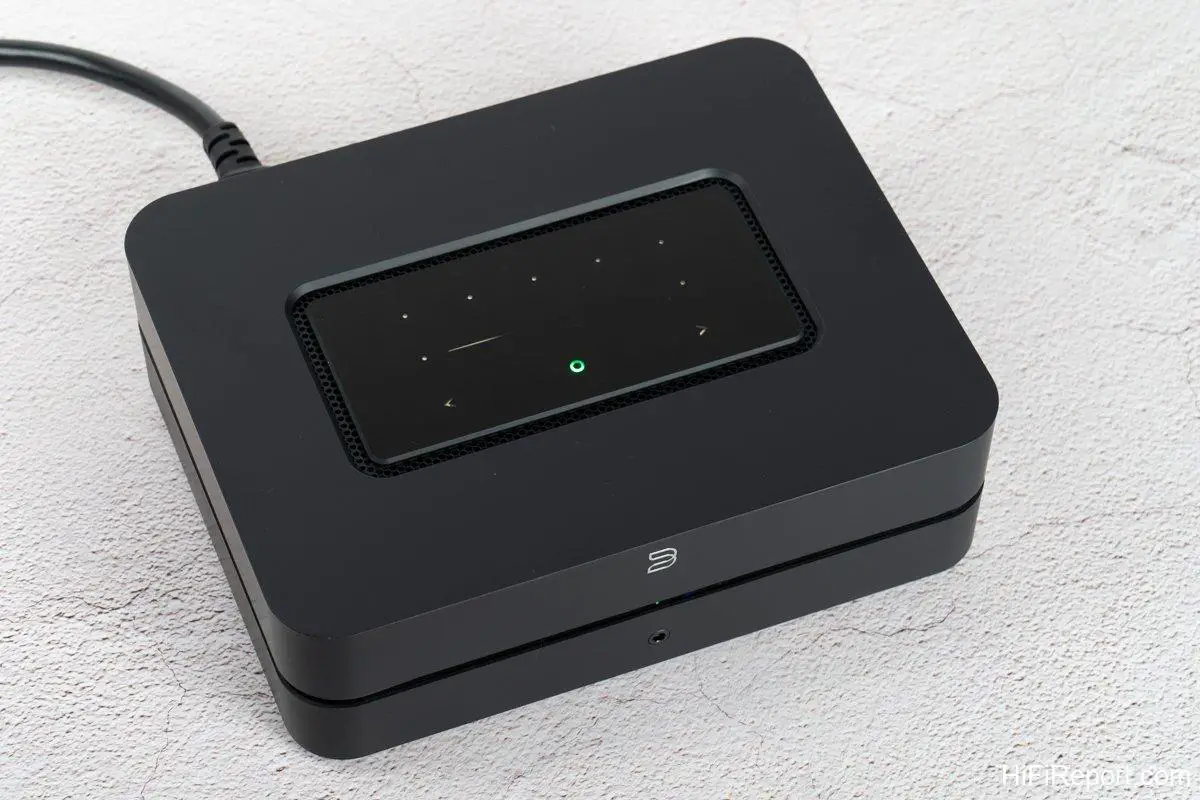
The Powernode maintains the same 22cm width as the Node but is slightly taller and deeper to accommodate the Class D amplifier modules, delivering 80 watts per channel into two channels.
Despite the modest increase in size, while the Node might be considered a small bento box, the Powernode is only a slightly larger one. It remains compact enough to be placed virtually anywhere without encroaching on valuable living space.
The Powernode’s power amplification section employs NAD’s “Hybrid Digital” amplifier technology, a similar approach used in NAD’s C-series amplifiers. This technology is based on Hypex UcD amplifier modules from the Netherlands, incorporating a carefully implemented feedback loop to reduce both Total Harmonic Distortion (THD) and Transient Intermodulation Distortion (TIM).
Looking at the specifications, the Powernode boasts a remarkably low THD+N of just 0.008% and a signal-to-noise ratio of -100 dBA, indicating excellent performance on paper.
Extensive Streaming Service Support
In terms of features, the Powernode inherits virtually all the functionalities of the Node.
The Powernode supports a wide range of third-party streaming protocols, including UPnP/DLNA, AirPlay 2, Spotify Connect, Tidal Connect, and Roon Ready. This means you are not restricted to using Bluesound’s proprietary BluOS app; you can utilize your preferred mobile app to access these services.
Furthermore, BluOS itself provides access to a vast array of streaming music services, including Qobuz, KKBox, Amazon Music, TuneIn, Deezer, iHeart Radio, Napster, and many more. Notably, KKBox support is still relatively rare among software and hardware platforms, making the Powernode a compelling choice if Mandarin music is a significant part of your listening repertoire.
The Powernode also integrates with Amazon Alexa, Google Assistant, and Apple Siri voice assistants, allowing for voice-activated playback – eliminating the need to even reach for your phone.
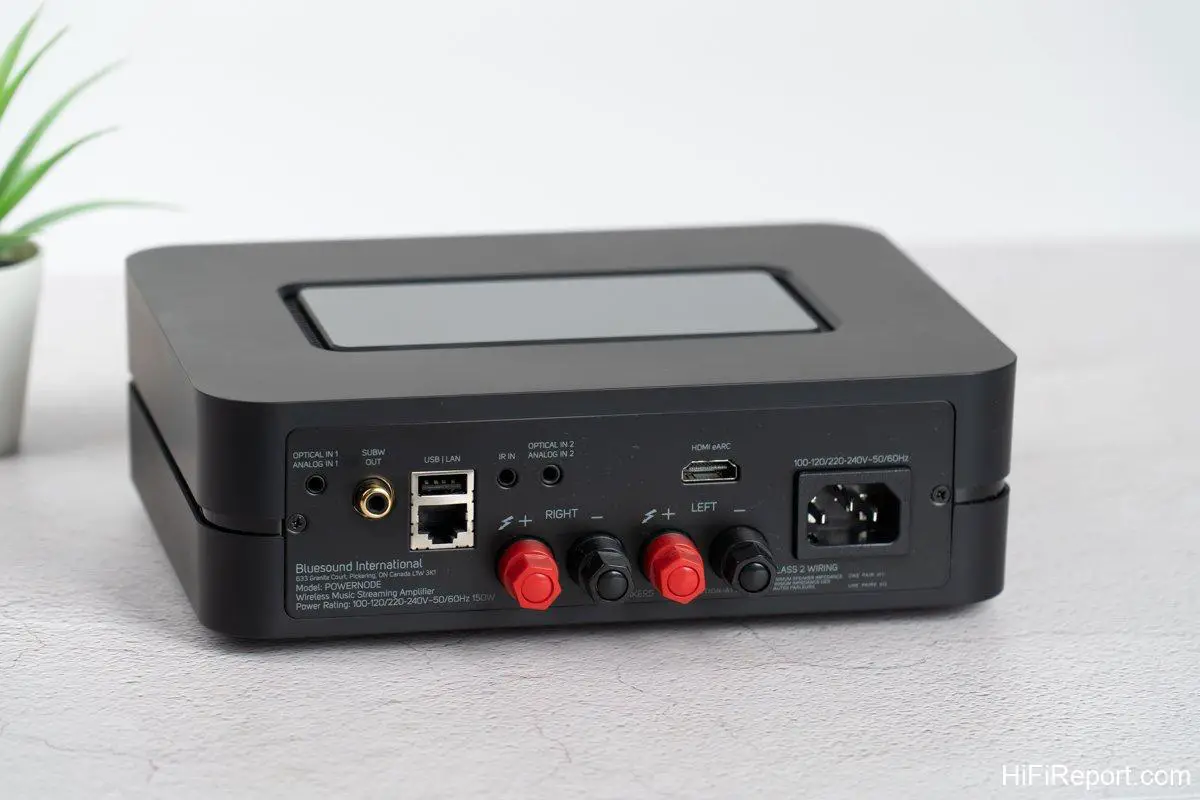
For connecting to other home entertainment devices, the Powernode offers a practical set of input and output options.
It includes an HDMI eARC port, enabling audio return from a connected TV, effectively turning your audio system into a soundbar setup.
Two mini-optical/3.5mm combo input jacks are provided for digital or analog sources.
Additionally, the Powernode features an RCA subwoofer output for adding a subwoofer to enhance low-frequency presence and extension.
Alternatively, the Powernode can wirelessly connect to Bluesound’s own Pulse Sub+ subwoofer, offering greater flexibility in subwoofer placement.
If Wi-Fi is not desired, the Powernode also provides Bluetooth connectivity with Bluetooth 5.0 aptX-HD, supporting two-way transmission for both receiving and sending audio, adding to its versatility.
Impressively, the Powernode also supports wireless Dolby Digital decoding. If you receive audio signals in Dolby surround sound formats, it can decode them, adding another layer of convenience.
Effortless Listening Experience
All Powernode operations are managed through Bluesound’s BluOS app, a feature-rich and powerful control application. For detailed insights into its operation, please refer to my previous review of the Bluesound Node wireless streaming player. I will focus here on the sonic performance of the Powernode.
During my evaluation, I used the Powernode with several pairs of speakers. In fact, my review of the LALS Classic 8M horn loudspeakers was written entirely using the Powernode as the amplifier. Now, focusing specifically on the Powernode, I brought it home to evaluate it in my familiar listening environment with my reference Aurum Cantus Grand Harmony floorstanding speakers.
Throughout the listening process, I used a Wi-Fi connection, avoiding a wired network connection, and streamed music exclusively from Tidal. This setup aimed to simulate a streamlined system and a convenient listening experience.
My overall experience listening to the Powernode was remarkably effortless, both in terms of operation and the sonic presentation itself.
The Powernode is incredibly user-friendly. It essentially lacks a power switch and remains always on. Once plugged in, there’s no need to interact with it further. It automatically enters standby mode when not in use, while maintaining network connectivity. When you want to listen, simply open the BluOS app, and it is instantly discoverable, waking up from standby and immediately ready to play music.
Provided your home network is stable, I never encountered any issues with the app failing to find the Powernode, demonstrating the maturity and reliability of the BluOS system.
Sound Beyond its Size
Sonically, the Powernode presents an open and balanced character. It offers excellent extension at both frequency extremes, delivering a sound that is both relaxed and natural, while maintaining solid image focus and tonal richness. Detail retrieval is abundant, and timbral accuracy is commendable. The high frequencies possess a pleasing sheen with ample brightness, making it a well-rounded performer across the board.
Furthermore, the Powernode exhibits ample power reserves. It demonstrated good control over the Grand Harmony speakers in most situations, delivering power effortlessly and allowing musical dynamics and contrasts to unfold naturally.
While its sonic texture might not be the absolute last word in refinement, its tonal character and background are clean, and transparency is impressive. Therefore, it’s crucial not to let its size and appearance mislead your sonic expectations.
For instance, listening to pianist Maria Joao Pires’ “Essentials” album, featuring works by Chopin, Mozart, Schubert, and Brahms, the Powernode rendered the piano tone with a pleasing blend of clarity and warmth, devoid of any muddiness or excessive thickness. The tonal weight was ideally balanced, avoiding any sense of sluggishness or heaviness.
While the articulation of each key strike might not be the most sharply defined, each note was imbued with a natural sustain, capturing the resonance of the piano body and resulting in a full and complete piano sound with a touch of ethereal quality.
The piano rendition highlighted the Powernode’s ability to fully showcase the excellent high-frequency performance of the Grand Harmony speakers, further validating the merits of NAD’s Hybrid Digital amplification technology.
Praiseworthy Vocals
While the Powernode’s piano reproduction was satisfying, its vocal performance was even more praiseworthy.
Listening to Nina Simone’s “Mood Indigo: The Complete Bethlehem Singles” compilation, featuring singles from her early career with Bethlehem Records in the 1950s, her voice, rich, deep, and warm, with its diverse vocal techniques and inflections, was rendered with clarity and nuance by the Powernode. The central vocal image was prominent and well-defined, possessing solid presence and nuanced dynamic gradations.
Similarly, with Simply Red’s “Picture Book B-Sides & Rarities – E.P.,” a digital release from 2020 featuring previously unreleased tracks from their 1985 debut album “Picture Book,” the Powernode clearly separated Mick Hucknall’s slightly raspy vocals from the instrumental accompaniment. The vocal image was forward and tangible, conveying the timbre and texture directly and unadulterated, creating a sense of immediacy and connection with the listener.
Moreover, the Powernode’s tonal richness ensured that both vocal and instrumental pieces were consistently enjoyable, avoiding any harshness or unpleasantness.
Music-Filled Life
Listening to Joe Hisaishi’s “American In Paris” album, where he conducts the New Japan Philharmonic Orchestra in performances of classic French film scores, the Powernode effortlessly conveyed the music’s flow and expansiveness. The soundstage unfolded in a stable and well-proportioned manner, exhibiting a satisfying sense of spaciousness without any hint of constriction or compression. The low-frequency foundation was solid, and the soundstage height was appropriately rendered, avoiding any sense of truncation or compression that could lead to a muffled sound.
When dynamics and volume were demanded, the Powernode responded smoothly and capably, unleashing power and control in equal measure, imbuing the music with its intended energy and vitality.
In summary, the Powernode is a well-rounded performer, excelling in all the factors that make music engaging, including detail retrieval, frequency bandwidth, dynamics, tonal richness, transparency, and accurate soundstaging. The sum of these qualities translates to a vibrant musical experience that is never dull. This underscores the effectiveness of Bluesound’s tuning and engineering expertise.
Beyond its sonic merits, the Powernode’s compact footprint, reasonable price point, comprehensive feature set, and user-friendly operation make it an ideal choice for those seeking a life filled with music, rather than solely pursuing the intricacies of hi-fi hardware. For a seamless and enjoyable musical lifestyle, the Powernode is undoubtedly a compelling option.
Specifications
* Type: Wireless Streaming Integrated Amplifier
* Output Power: 80 watts x 2 into 8 ohms
* Connectivity: Wi-Fi Dual-Band, RJ45 Ethernet, Bluetooth 5.0 aptX-HD, USB for storage devices, Mini-Optical/3.5mm combo input, 3.5mm headphone output, RCA Subwoofer output, HDMI eARC
* Hi-Res Audio Format Support: FLAC, MQA, WAV, AIFF, MPEG-4 SLS (up to 24bit/192kHz)
* Third-Party Streaming Support: AirPlay 2, Spotify Connect, Tidal Connect, Roon Ready
* Voice Control Support: Amazon Alexa, Google Assistant
* Dimensions: 220 × 70 × 190 mm
* Weight: 3.15 kg