
B&W 801 D4 Signature Review
Since its founding in 1966, B&W has bestowed the “Signature” designation upon just seven product ranges. These include the Silver Signature in 1991 (marking the 25th anniversary), the Signature 30 in 1996 (for the 30th anniversary), the Signature 800 and Signature 805 in 2001, the Signature Diamond in 2006 (the 40th anniversary), and most recently, the 801 D4 Signature and 805 D4 Signature in 2023.
When a B&W model receives the Signature badge, it signifies the pinnacle of achievement for that specific model, a true ultimate expression. If you’re considering one, acting quickly is advisable due to their special nature. As for the sonic differences between the Signature and standard versions, to be honest, that’s not the primary focus. With identical cabinet and driver designs, any sonic variations stem from subtle refinements elsewhere.
The differences might not be huge, but the biggest distinction lies in the sheer satisfaction of ownership. However, this time, the 801 D4 Signature sees revisions even to the crossover, suggesting the potential for more significant audible changes.
Comparison with Previous Models
I previously reviewed the standard B&W 801 D4 in issue 397 of Audio Art magazine. Here, I will briefly highlight the key aspects. Historically, the 800 Series did not feature an ‘801’ model; the D4 range, however, resurrected the 801, placing it at the forefront while omitting the previous flagship 800. Superficially, the 800 D3 and the 801 D4 appear quite similar.
Comparing their dimensions, the former measures 1217mm x 413mm x 611mm, while the latter is 1221mm x 451mm x 600mm – a difference imperceptible to the naked eye.
In terms of weight, the D3 was 96 kg net, whereas the D4 is 100.6 kg net. Frequency response remains identical at 15Hz-28kHz (±3dB). Sensitivity is also the same at 90dB, as is the nominal impedance of 8 ohms (minimum 3 ohms). There are slight differences in second and third harmonic distortion: the D3 measured <1% from 50Hz – 20kHz and <0.3% from 70Hz – 20kHz, while the D4 measures <1% from 30Hz – 20kHz and <0.3% from 100Hz – 20kHz, making them virtually indistinguishable in this regard. The drivers used in both models are also identical in size and material. Naturally, the 800 D3 and 801 D4 incorporated numerous refinements in manufacturing detail. For instance, the Turbine Head midrange enclosure, the cabinet construction, internal Matrix bracing, the length of the tweeter tube, the connection between the midrange and bass enclosures, and the plinth were all enhanced. Yet, from the outside and on paper, they remain remarkably close.
Signature-Specific Engineering and Fine Tuning
Comparing the 801 D4 and the 801 D4 Signature reveals their specifications are, in fact, identical! So, if you belong to the “specifications school,” the 801 D4 would suffice and is considerably less expensive (approximately $55,000 USD). However, given the Signature designation, the engineers were compelled to rack their brains to introduce some distinctions – this is what is meant by Fine Tuning.
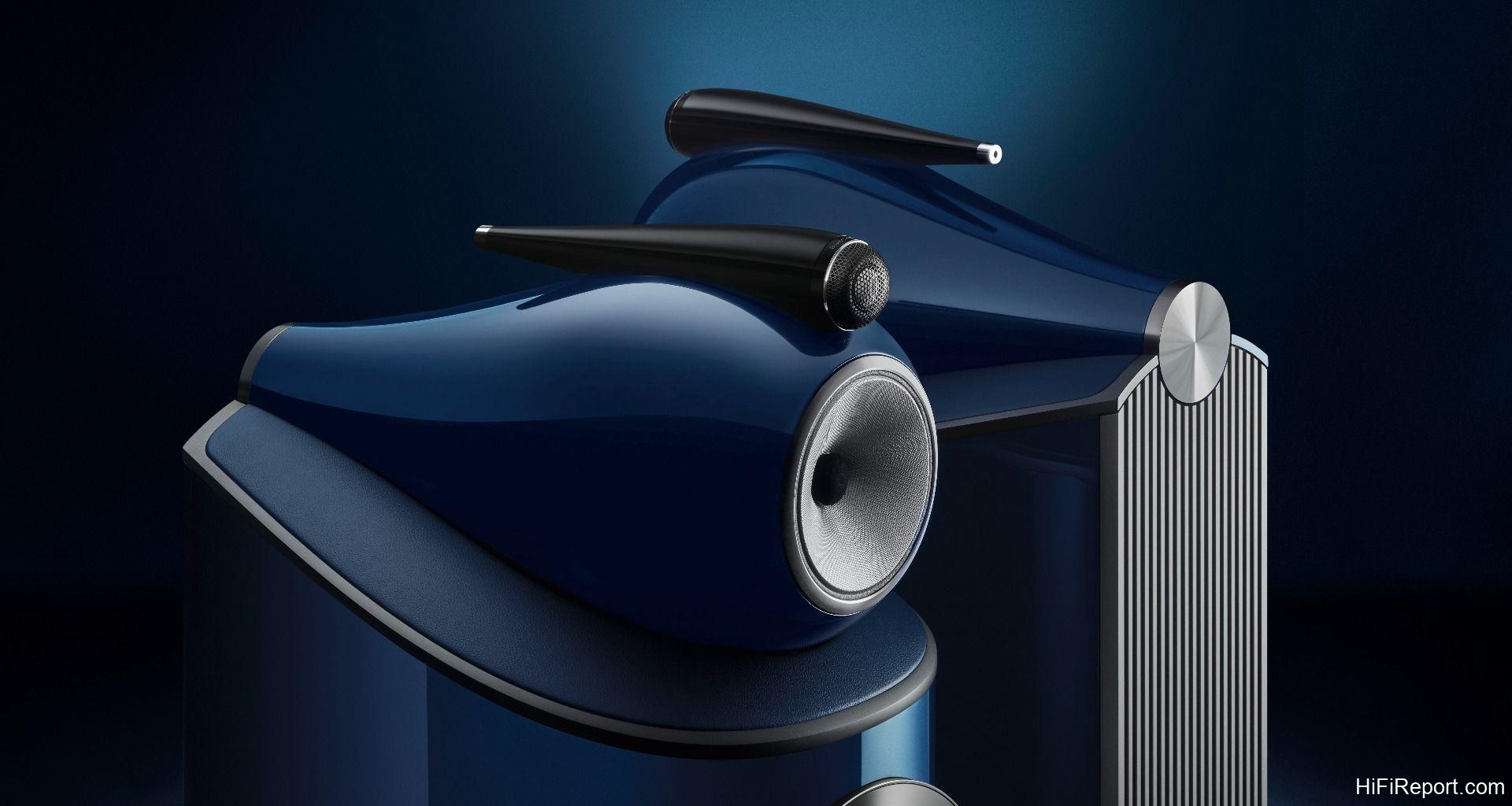
For example, to mitigate the effects of changes in driver inductance, the 801 D4 Signature improves the quality of the pole piece in the magnetic system, thereby reducing inductance variations.
For a tighter coupling between the Turbine Head and the bass cabinet, the 801 D4 Signature features an optimized connecting aluminum plate. Even the placement of bolt holes during manufacturing has been redesigned to further reduce resonance. Additionally, an optimized gasket at the base ensures an even more secure connection between the Turbine Head and the bass cabinet.
Furthermore, the bass reflex port opening, originally plastic, has been upgraded to cast aluminum to decrease port resonance. Undoubtedly, the most impactful improvement on sonic performance comes from the revised crossover. Refining a passive crossover is a delicate process where even small adjustments can significantly alter the final sound.
I am confident that in developing the crossover for the Signature model, the factory undertook extensive trials, finalizing the design only after achieving substantial audible improvements. Thus, it’s unfair to dismiss the 801 D4 Signature as merely a cosmetic upgrade because its exterior mirrors the 801 D4.
Exclusive Finishes and Construction Details
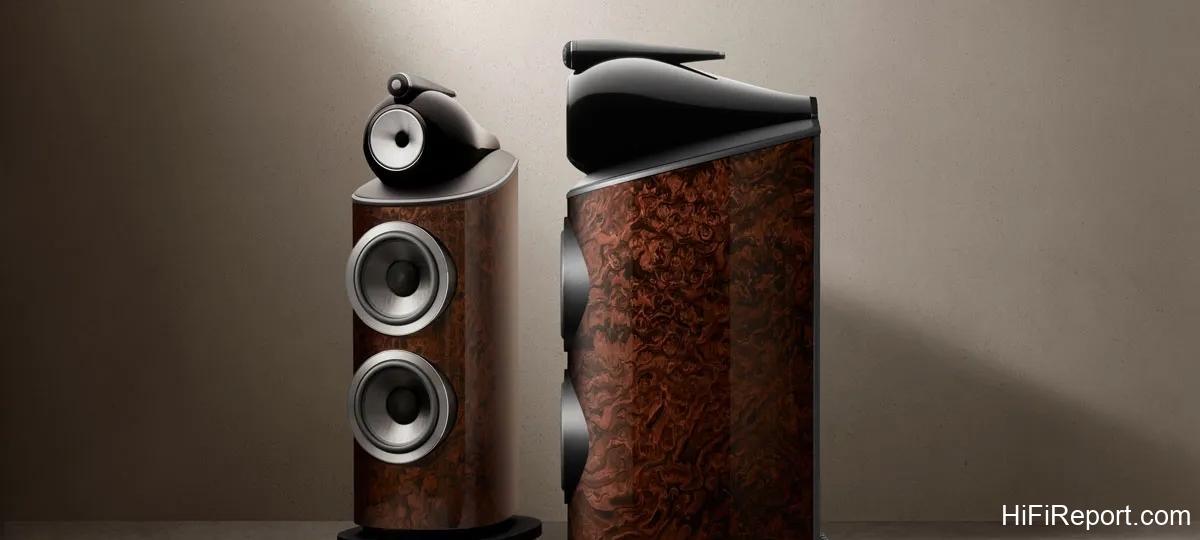
The 801 D4 Signature is currently offered in just two exclusive finishes. One is the striking Midnight Blue Metallic, a color previously seen on the iconic Nautilus loudspeaker. The other is the exquisite California Burl Gloss wood veneer. This particular veneer is meticulously selected by ALPI, a century-old Italian company renowned for its expertise in using modern techniques to create beautiful, high-pressure laminated thin wood veneers, some of which can be up to 10mm thick.
ALPI veneers are also featured in the interiors of BMW and Mercedes cars, as well as in many prominent furniture designs.
Crafting a cabinet in the California Burl Gloss finish requires a process involving 14 layers of lacquer and polishing, demanding over 24 hours of labor just for the finishing alone. The Midnight Blue cabinet also requires considerable time, at least 18 hours for 11 layers of lacquer and polishing. As for the leather topping the bass cabinet, it is famously sourced from Connolly, a supplier of premium leather used in high-end furniture and luxury automobiles.
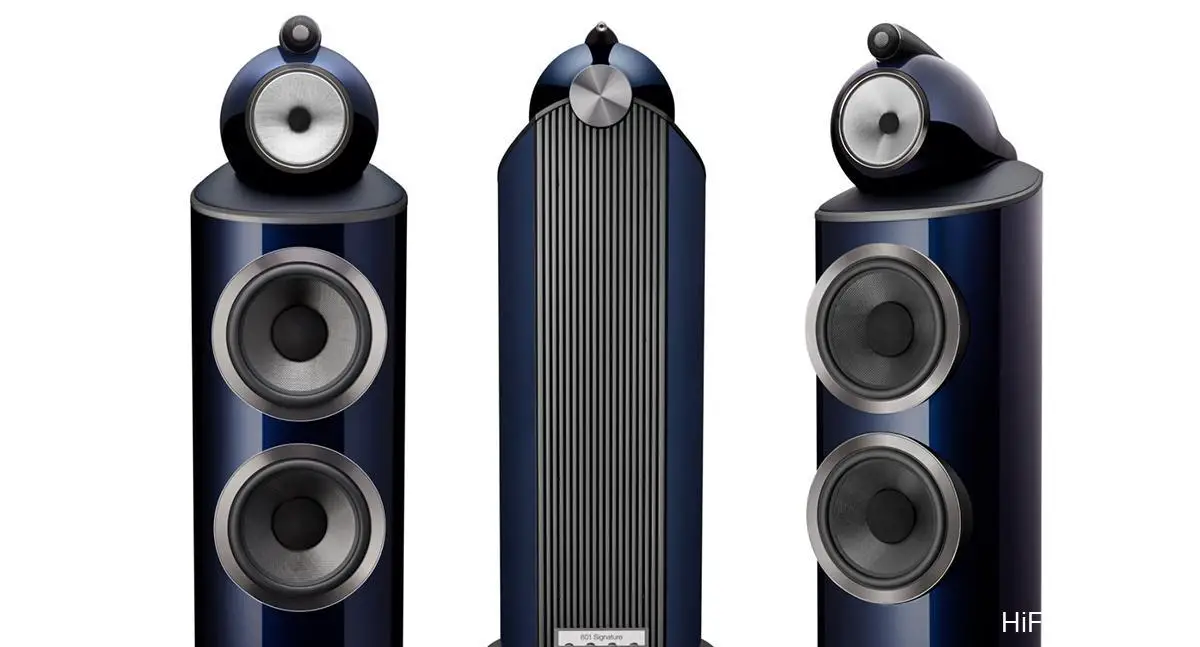
The driver complement for the 801 D4 Signature remains consistent: a 1-inch Diamond dome tweeter, a 6-inch Continuum cone FST midrange driver, and two 10-inch Aerofoil profile bass drivers. While the crossover points aren’t published, I estimate the bass-to-midrange crossover is around 300Hz, and the midrange-to-tweeter crossover is likely around 2,500Hz.
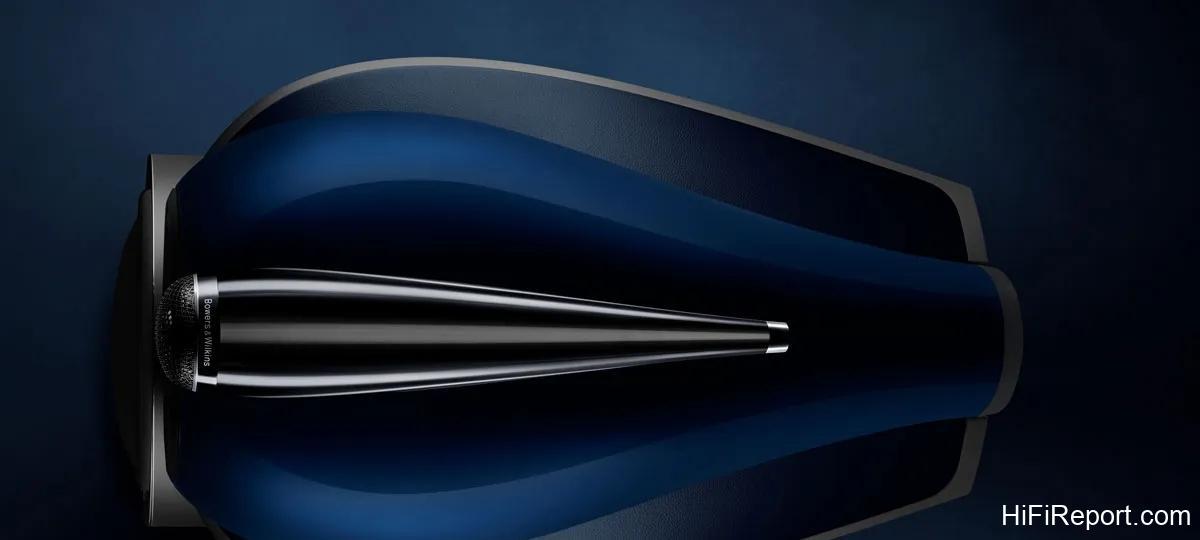
The entire rear panel of the 801 D4 Signature is crafted from aluminum alloy. This serves as a heatsink for the crossover components, which are directly mounted to the inside of this aluminum plate. Like its predecessors, the 801 D4 Signature is equipped with bi-wire terminals, allowing users to connect using dual speaker cables or bi-amp with two amplifiers.
Despite each 801 D4 Signature weighing a substantial 100.6 kg net, moving them after unpacking is relatively easy thanks to the pre-installed rollers on the plinth for shipping. Users can take several months to fine-tune the speaker placement before substituting the rollers with the included spikes to firmly couple the speaker to the floor. It’s worth noting that the 801 D4 Signature features a downward-firing bass reflex port integrated into the plinth.
Testing Setup and Amplifier Matching
My listening sessions with the 801 D4 Signature took place in my large, open-plan home listening space. For this review, Royden Audio (the distributor) provided two Classé Delta Stereo power amplifiers, the same models they often pair with B&W loudspeakers at audio shows. You might wonder why not the Delta Mono amplifiers? The simple reason given was lack of stock, hence the provision of two Stereo units.
Each Delta Stereo amplifier outputs 250 watts per channel into 8 ohms and weighs 46.4 kg net. The Delta Mono, by comparison, outputs 300 watts per channel, with two units weighing 88.6 kg, offering potentially greater driving capability than the Stereo version.
How to best utilize these two Classé Delta Stereo amplifiers? If your preamplifier offers simultaneous output via two sets of RCA or XLR connections, you could dedicate one amplifier to the bass drivers and the other to the midrange and tweeter. This was my initial plan, but strangely, my Weiss DAC 502 4ch couldn’t output simultaneously via XLR and RCA. So, I opted to use one amplifier per speaker.
In this configuration, each stereo amplifier effectively acts as a dedicated mono amplifier for one channel of the loudspeaker. This means the entire power supply of each amplifier is available for a single channel, resulting in enhanced driving force.
In addition to the Classé amplifiers, I also tried driving the 801 D4 Signature with my Pass X350.5 power amplifier. This amplifier outputs 350 watts per channel and has ample power. Surprisingly, when comparing it to the two Classé Delta Stereo amplifiers working in tandem, the Pass didn’t seem to have the same level of grip and control. Therefore, I quickly decided to proceed with the two Classé Delta Stereo units for the duration of the review.
In-Depth Listening Impressions
Bass Performance
Let me start with the bass performance. The 801 D4 Signature’s ability to plumb the low frequencies impressed me profoundly, delivering a level of bass performance that I recall as being significantly different from the standard 801 D4. Although this is a comparison based on memory and I didn’t have a pair of standard 801 D4s on hand for a direct A/B test, I can illustrate with specific musical examples.
Listening to Seong-Jin Cho’s performance of Saint-Saëns’ Symphony No. 3 ‘Organ’ conducted by Myung-Whun Chung, the deepest organ notes were reproduced with remarkable clarity and fullness. Furthermore, they possessed the tangible power to move air, creating pressure waves that I could feel on my skin – an experience I don’t recall having with the standard 801 D4. Frankly, even speakers with two 12-inch bass drivers per side don’t always reproduce this specific passage with such realism.
The 801 D4 Signature achieves this with only two 10-inch drivers, clearly demonstrating that its specifications aren’t merely figures on paper.
Driven by the two Delta Stereo amplifiers, the 801 D4 Signature exhibits vastly improved bass control. When listening to Boz Scaggs’ “Thanks To You,” the bass felt like a large, perfectly formed water balloon – taut, substantial, incredibly elastic, and with a palpable sense of downward energy. The sheer density and weight of the bass genuinely differ when compared to driving the speakers with a single stereo amplifier.
I must concede that I always considered the 801 D4 to be excellent, but after hearing the 801 D4 Signature, I am convinced that the Signature model surpasses the standard version in bass performance, particularly in its superior bass elasticity. On Leonard Cohen’s album “Ten New Songs,” the 801 D4 Signature renders the beauty of bass elasticity with an almost “unparalleled” quality.
The ability of the bass to be so solid, so full, so weighty, so cohesive, so agile, with such clear contours, so quick to decay, and yet reach so deeply, is not commonly encountered.
Concurrently, I gained a new appreciation for the Classé Delta Stereo. I previously perceived it as a refined and gentle amplifier. However, using two units to drive the 801 D4 Signature revealed that beyond its elegant qualities, its bass driving power and control were unleashed to their full potential. It’s no wonder that the forced-air cooling fans on the Classé Delta Stereo amplifiers were constantly running during my listening sessions – they were truly giving their all!
Midrange and Highs
When playing orchestral music, the 801 D4 Signature provides an exceptionally stable, full, thick, and elastic bass foundation. For instance, listening to Bernstein conduct Schubert’s Symphony No. 8 “Unfinished,” the underlying richness of the orchestra was particularly noteworthy.
With Maazel conducting the Cleveland Orchestra in Brahms’ “Academic Festival Overture,” although the music doesn’t explode in volume, the gentle taps of the timpani produced cohesive bass “smoke rings” that felt substantial enough to physically impact my skin.
When I listened to Andrew Lloyd Webber’s “Symphonic Suite,” the immense scale of the orchestra felt like an imaginary nuclear explosion, with air being pushed outward from the center, instantly filling the entire space. Hearing the track “Evita,” the initial timpani strike completely filled my ears.
When experiencing music with such vast scale and imposing presence, you begin to understand why the 801 D4 Signature needs to weigh 100.6 kg per speaker – such a heavy cabinet is necessary to withstand the powerful energy of the sound waves!
The exceptional bass performance of the 801 D4 Signature isn’t limited to classical music; it shines equally brightly with popular genres. Listening to Tracy Huang’s “Priceless,” the thud of the kick drum hit me right in the chest. Huang’s voice was reproduced with immense focus and density, standing out prominently. The overall tangibility and weight of the music were excellent, consequently increasing the perceived density of the entire presentation.
On John Campbell’s album “Howlin Mercy,” the track “Way Down In The Hole” had incredible rhythmic impact, with a palpable thickness to the music. The subtle decay and reverb tails of voices and instruments within the space were exceptionally clear, indicating superb spatial reproduction and detail retrieval.
Listening to Fink’s “Trouble’s What You’re In” from his album “Wheels Turn Beneath My Feet,” the sense of tangibility and density was again remarkable, with instruments and voices having a “cast” quality to their imaging.
Listening to the bass performance of the 801 D4 Signature with two Classé Delta Stereo amplifiers was simply thrilling. The thickness, quantity, impact, elasticity, and control of the bass were truly extraordinary for speakers of this size. Note that I emphasize “size”; the 801 D4 Signature is not particularly large physically, which only enhances my impression of its capabilities.
The 801 D4 Signature’s rendition of piano music is also captivating. The first alluring aspect is its incredibly beautiful and realistic piano tone and timbre. The second is its ability to handle even the most 폭발적인 (explosive or powerful) playing without discernible distortion. Many speakers reproduce piano sound without much character, making even a grand piano sound like a cheap upright.
The 801 D4 Signature renders piano sound with a beautiful timbre, reminiscent of a million-dollar instrument heard in a concert hall.
Beyond the beautiful tone, each piano note possesses weight and tangibility, whether it’s a high, mid, or low key. Listening to Schubert’s “Der Wanderer D. 489” (with Seong-Jin Cho on piano and Matthias Goerne, baritone), the warm, gentle, and expansive baritone voice is paired with luminous, distinct piano notes. In moments like these, you savor the exquisite quality of both the piano and the voice – a warm, resonant beauty imbued with a woody character.
When I listened to Katia & Marielle Labèque’s performance of Philip Glass’s “Les Enfants Terribles” for two pianos, the dynamics ranged from hushed whispers to moments where they seemed to be striking the keys with all their might. I felt apprehensive listening, but the 801 D4 Signature showed no signs of strain or distortion. Its capacity to withstand such forceful piano dynamics truly impressed me.
It’s important to remember that the majority of the piano’s range is reproduced by the 6-inch midrange driver. If this driver can handle such forceful piano transients, what music *can’t* it play?
The 801 D4 Signature also excels at reproducing the cello, delivering a beautiful blend of what I call “woody texture” and “nasal resonance.” The cello’s body resonance is rich and warm, possessing a sweet quality and sounding incredibly alive, never dull or heavy. Listening to Starker’s performances of Dvořák’s Cello Concerto and Tchaikovsky’s Rococo Variations (on Mercury), the warm and gentle sound produced by the 801 D4 Signature was truly captivating.
Listening to Rostropovich and Britten’s performance of Schubert’s “Arpeggione Sonata,” I honestly felt that the cello sound rendered by the 801 D4 Signature was closer to the inherent beauty of the original master tape. I wouldn’t claim it replicates the sound of an analog master, but I genuinely found this level of cello reproduction incredibly pleasing – a sense of ease and naturalness not often heard from conventional loudspeakers.
The double bass reproduction on the 801 D4 Signature is particularly outstanding. What makes it exceptional is its ability to reveal the incredibly subtle, light vibrations when the bow is drawn across the strings. When listening to the Oscar Peterson Trio’s album “We Get Requests,” the double bass on every track was simply breathtaking. Whether plucked or bowed, it felt remarkably close to a live performance.
Many speakers can reproduce the raw energy of a double bass being bowed forcefully or plucked with vigor; that’s not too difficult.
However, capturing the bowed double bass with the ethereal lightness of a dragonfly’s wing vibration is a different challenge, and the 801 D4 Signature’s double bass reproduction conjured precisely this image in my mind. That the 801 D4 Signature can render the double bass with such lightness while simultaneously producing the solid, full bass required for popular music is a paradoxical and difficult feat to achieve.
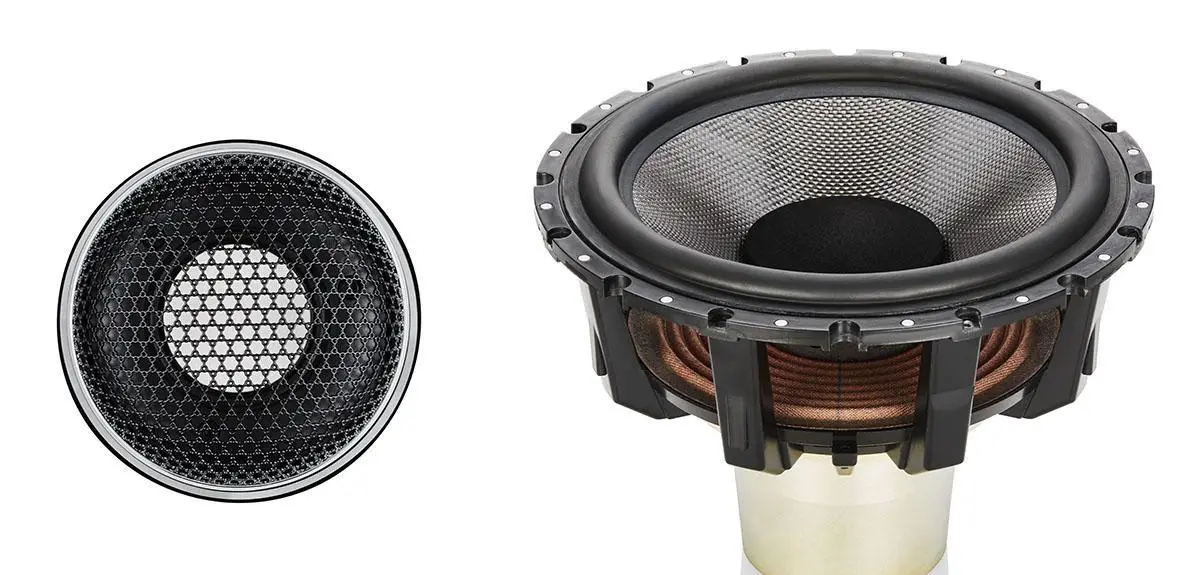
I can only conclude that those two 10-inch bass drivers on the 801 D4 Signature are truly remarkable.
The Diamond Tweeter and Crossover Synergy
Up to this point, I haven’t even mentioned the sonic beauty produced by the Diamond dome tweeter. I estimate its crossover point to be slightly above 2000Hz. This frequency range primarily contains the harmonics of instruments and voices. In essence, the Diamond tweeter’s main function is to create the beautiful timbre and texture of instruments and voices, while the fundamental tones are largely reproduced by the 6-inch midrange driver.
In fact, the Diamond tweeter and the 6-inch midrange driver are inseparable; their combined operation is essential for achieving beautiful sound. If isolated, the sound would be unpleasant.
During my listening sessions, I actually experimented by having the 801 D4 Signature only produce sound from the two bass drivers, and then only from the midrange and high-frequency drivers. Comparing the two, the sound emanating solely from the Diamond tweeter and 6-inch Continuum midrange, lacking the low frequencies, was simply unbearable – devoid of any beauty. Similarly, the sound from only the two bass drivers was muffled and equally unlistenable.
Yet, miraculously, when all four drivers worked together, the previously unpleasant sounds integrated into something truly beautiful. This strongly validates the crucial importance of the crossover network and the balance between the high, mid, and low frequencies in achieving sonic excellence. To use a more tangible analogy, the high, mid, and low-frequency drivers are like the primary colors of red, green, and blue.
Different proportions of red, green, and blue mixed together create different colors. Similarly, varying proportions of high, mid, and low-frequency energy mixed together produce different sounds. The “tuner” of the 801 D4 Signature is highly skilled, using the crossover to blend these elements precisely to achieve this astonishingly beautiful sound.
When I listened to Locatelli’s Violin Concerto in A Major, Op. 3, No. 11 (on Harmonia Mundi), Isabelle Faust’s violin sounded incredibly smooth, like silk, with a captivating sheen and sweetness. Furthermore, the string section of Il Giardino Armonico, conducted by Giovanni Antonini, was rendered with impeccable clarity, sounding bright, sweet, and pure. I believe this level of high-frequency beauty would be significantly compromised if an aluminum tweeter were used instead of the Diamond dome.
Another characteristic of the 801 D4 Signature’s violin reproduction is the definition of the lines – they are as solid and clear as a sharp knife cutting through the air, yet they never sound sharp or aggressive, retaining a delicate beauty. The violin sounds bright, and indeed, the overall sound of the 801 D4 Signature is bright. However, this brightness is never fatiguing or aggressive.
It’s like shining a strong light on a bottle of water; looking directly at the light is blinding, but focusing on the water within reveals its high transparency without causing discomfort. I feel the overall brightness of the 801 D4 Signature is like this. Due to this luminous quality, when the 801 D4 Signature plays orchestral music, the inner voices of the woodwinds and brass are rendered with exceptional clarity; there are no dark spots.
The harmonies are beautiful, the high frequencies are sweet and pure, the resolution is phenomenal, and the music sounds incredibly alive.
Signature Legacy and Value Proposition
From its founding in 1966 to the present, spanning several decades, B&W has released only seven Signature editions. The 801 D4 Signature represents the highest tier among these seven. I know many people might wonder: will the 801 D4 Signature be like a special edition car, with a new model following soon after? I believe the introduction of a new model is inevitable, although the exact date is unknown.
The appeal of the Signature edition lies in its genuinely improved sonic performance and its limited, rare nature. Products become precious because of their rarity, and this rarity also offers potential for retaining or increasing value. Isn’t this precisely the allure of a Signature edition?
Specifications
* Type: 3-way bass reflex floorstanding loudspeaker
* Introduction Date: 2023
* Drivers: 1x 1″ Diamond dome tweeter, 1x 6″ FST Continuum cone midrange, 2x 10″ Aerofoil profile bass drivers
* Frequency Response: 15Hz-28kHz (±3dB)
* Nominal Impedance: 8 ohms
* Sensitivity: 90dB
* Second and Third Harmonic Distortion: <1% (30Hz – 20kHz), <0.3% (100Hz – 20kHz) * Dimensions (WHD): 451×1,221×600mm * Weight: 100.6 kg * Approximate Reference Price: $80,000 USD * Import Distributor: Royden Audio (02-25928760)
Image Captions
① Exquisitely polished finish.
② Outstanding loudspeaker drivers.
③ Cabinet structure minimizes vibration.
④ Beautiful sound quality. Clean character, high resolution without aggression.