
Cardas Clear Power Cable Review
As an editor at Prime AV Magazine, my work typically involves reviewing home theater and two-channel audio systems. However, I spend a significant portion of my time in the office accompanied by headphones. My personal reference system is quite minimalist: it features a COS H1 integrated DAC and headphone amplifier paired with Focal Stellia over-ear headphones, with an I-O DATA Soundgenic music server as the source. The sonic signature of this system is quite defined.
Both the Soundgenic and the COS H1 DAC are very neutral with minimal coloration, making them generally versatile. The overall sound character, therefore, largely stems from the headphone amplifier and the headphones themselves.
Focal headphones are renowned for their exquisite, luxurious mid-high frequencies, while their bass tends to be tight, fast-paced, and somewhat restrained in quantity. The COS H1 headphone amplifier also exhibits a relatively conservative bass response. While this combination delivers excellent sonic quality, it does feel a bit lacking in weight and authority.
Consequently, cable matching becomes straightforward: I simply need to seek out cables with a warm sonic foundation and a fuller mid-low frequency presentation to achieve better system balance.
Choosing the Clear Power Cable
Recently, I decided to acquire a new power cable for my system. Immediately, my existing reference USB cable, the Cardas Clear, came to mind. Its sound is warm and rounded, seeming to sound good in almost any system. Furthermore, its flexibility and ease of bending make it highly practical, fostering my positive impression of Cardas cables. After careful consideration, I set my sights on the corresponding Clear power cable. My decision was based on three primary factors.
Firstly, its sonic character aligns perfectly with my system. Secondly, the Clear sits third in the Cardas power cable lineup, positioned below the near-flagship Clear Beyond and the flagship Clear Beyond XL. Higher-tier cables feature thicker gauges, better suited for high-power amplification equipment. As I intended to use it solely with my headphone amplifier/DAC, I estimated that the Clear would be more than sufficient, and its price point was also more accessible.
I borrowed this cable from the manufacturer via our sales representative, and trying it out, the Clear not only met but significantly exceeded my expectations! Let me immediately introduce its exceptional qualities.
Design and Construction
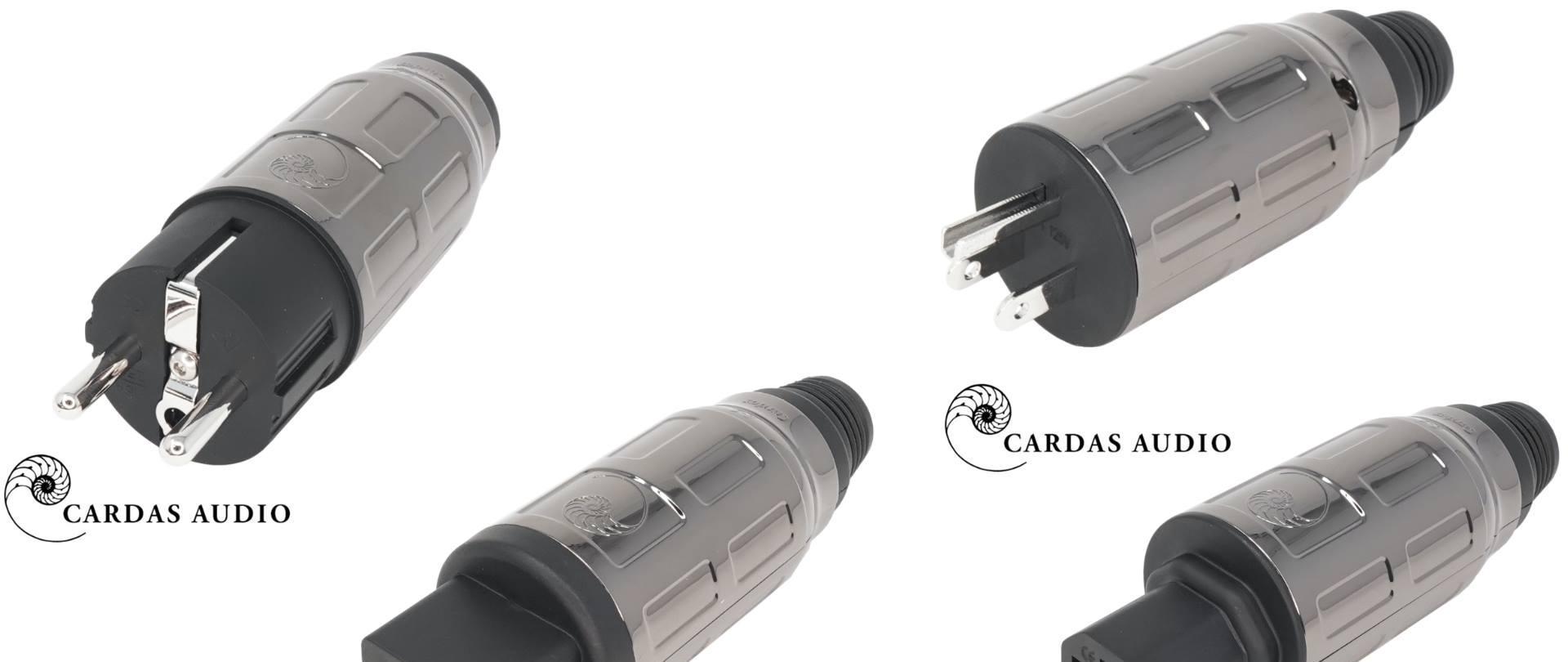
Before delving further, I must share some good news. The new version of the Cardas Clear power cable features upgraded power connectors. Instead of the previous Furutech CR3455R plugs, it now utilizes Cardas’s proprietary E-5 connectors. Previously exclusive to the flagship Clear Beyond XL and Beyond models, these plugs boast a structure of pure copper plated with silver, then rhodium, ensuring optimal conductivity and enhanced durability.
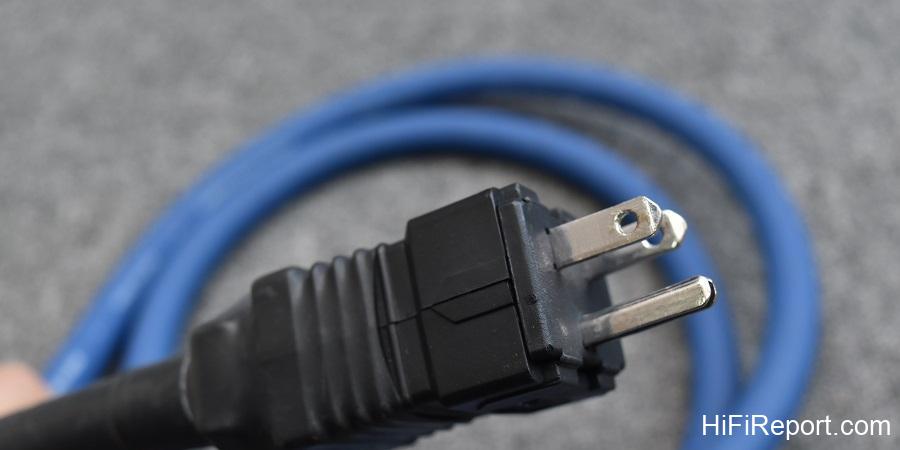
The connector shells are also crafted from metal, featuring a transparent coating that imparts a brilliant black and silver sheen. Adorned with Cardas’s signature Nautilus logo embossed on the surface, they exude a sense of premium quality. Additionally, there is a second inner shell within the plug for anti-magnetic properties and excellent resonance characteristics.
The male plug also incorporates Cardas’s hallmark filter ring at its end, designed to mitigate RFI and EMI noise from entering the audio equipment through the cable, thus ensuring the cleanest possible power delivery.
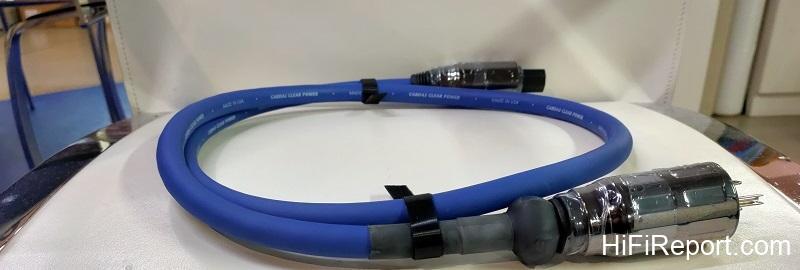
Upon receiving the Clear power cable, I immediately noticed its substantial girth, yet it possessed an unusual degree of flexibility, surprisingly similar to my Clear USB cable! While I’m unsure how the manufacturer achieves this, for users like myself with desktop setups or limited space, this significantly enhances cable routing convenience.
The cable jacket features Cardas’s distinctive deep blue Alcryn thermoplastic rubber sheathing. Internally, it employs Litz conductors made from 4N-grade OFC (Oxygen-Free Copper), which are individually insulated to minimize skin effect. The central core is formed by the finest gauge conductors, with other conductor gauges arranged concentrically outwards according to the “Golden Ratio” of 1:1.618.
This is combined with Cardas’s proprietary “Cross-Field” geometry, which involves winding conductors in opposing directions to cancel out subtle vibrations caused by magnetic fields.
Outside each layer of conductors, the manufacturer incorporates air tubes made of PTFE (Polytetrafluoroethylene) for vibration damping. Even the ratio of the air tubes to the central conductors adheres to the Golden Ratio. To achieve the lowest possible internal impedance, they also employ their patented “Matched Propagation” technology.
This technique pairs the conductor material with the most suitable dielectric material to optimize current transmission efficiency, resulting in improved musical dynamics.
Observing the Clear power cable’s unassuming exterior, it’s genuinely difficult to imagine the intricate internal structure it houses! What’s even more remarkable is how this complexity is achieved while maintaining the cable’s flexibility and practical advantages – a true testament to design driven by technical mastery.
The distributor kindly provided both the older version with Furutech plugs and the new version with E-5 plugs for review. Comparing the two, the overall sonic character remained largely consistent. The most significant improvement with the E-5 plug version was a considerable enhancement in dynamics and more extended high frequencies.
This demonstrates the continuous evolution of Cardas’s sonic quality, moving from an earlier focus primarily on mid-low frequencies towards an increasingly balanced presentation.
Listening Impressions
During my listening tests, I connected the Clear power cable to my DAC and compared it against my usual reference power cable. The sound of the Clear power cable still exhibits a slightly pyramidal distribution, with warm, full-bodied mid and low frequencies. The somewhat lean and cool sound signature I previously heard from my headphones transformed into something much warmer, completely eliminating any harshness.
The transitions between frequency bands flowed seamlessly, like clouds drifting effortlessly. I could feel an endless supply of energy, creating a very dense and rich musical foundation. In comparison, the Clear’s high frequencies felt a bit more reserved, as if the apex of the pyramid had been smoothed, resulting in a more rounded and pleasing sound. While the ethereal quality of the Focal headphones was slightly tamed, it was replaced by a smoother, more hydrated high-frequency texture.
Starting with small-scale vocals, I played “Dedicated to You” from the album “John Coltrane and Johnny Hartman.” Thanks to the Clear’s excellent soundstage capabilities, the sense of space in the recording environment became more three-dimensional, rendering reverberation naturally and expansively. Coupled with a very quiet musical background, the localization of vocals and instruments became clearer, allowing even small-ensemble music to exhibit incredibly distinct layering.
At the opening, the vocal seemed to gently emerge from a pure black background, its outline vivid and palpable. The Clear’s warm characteristic also made Johnny Hartman’s voice sound more substantial, with a rich, texture between words, much like fine coffee. The vibrato tails in his singing became more elongated, lingering in the air, intensifying the emotional expression and making it more captivating.
The accompanying saxophone also presented a warm brass resonance; the sound of the reed breaking through wasn’t overly sharp but instead shone with a beautiful, sunset-like metallic glow, utterly enchanting!
If you think the Clear is merely a docile and delicate cable, you’d be completely mistaken! It was only when I played Giuliano Carmignola’s performance of “Vivaldi Con Moto” that I truly grasped the Clear’s prowess. It delivered a power and grandeur I had never before experienced with this system! In the opening string tutti passages, I felt an immense sound pressure that was effortlessly controlled, releasing energy that was both powerful and stable.
Despite the strong dynamics, it sounded very gentle, completely non-aggressive. What’s even more impressive is that even with large-scale orchestrations, the Clear could still neatly separate and clearly present all instruments. Without needing to strain my focus, I could leisurely appreciate the beauty of the timbres. The string lines were full-bodied and rich with moisture, while the harpsichord plucks were crisp, pleasant, and possessed a slight springiness.
What I found most satisfying was the violin texture; every articulation was rounded and smooth, with rich bowing details but not a hint of sharp edges. I could also hear the warm resonance of the wood, which was utterly delightful.
Finally, I put on a heavy metal album I frequently listen to, “Megadeth – Rust In Peace.” The Clear did not disappoint. The recording of this album is inherently a bit dry, but listening to it this time was completely different. In “Tornado Of Souls,” the full-bodied energy underpinned the entire track. The distortion tone of the rhythm guitar sounded a bit softer, the heavy power chords were deep and impactful without being obscured by the vocalist’s roar.
The drum kit offered a solid, tactile feedback with every strike, and the electric bass plucks were large, full, and bursting with energy! Marty Friedman’s aggressive guitar solos, no matter how fast, remained articulate, delivering a machine-gun-like stream of notes that were both clear and full-bodied. All the harmonics, vibratos, and other playing techniques felt more vivid and exciting – it was simply exhilarating!
System Synergy and Conclusion
During my listening sessions, I also experimented by swapping out my CrystalConnect Diamond USB cable. Immediately, I heard a more luxurious high-frequency texture. This experience highlights how, with the Cardas power cable providing a robust foundation for the music structure, you can easily bring out the unique characteristics and beauty of any other cable you swap into the system.
Therefore, I believe that regardless of your preferred sound signature, a power cable like the Cardas, with its substantial foundation, is an indispensable component in any system.
Specifications
* Type: Power cable.
* Internal construction incorporates multiple Cardas patented technologies, including Matched Propagation, Golden Ratio, Cross-Field geometry, Litz conductors, and Perfect Mirror Quadaxial construction.
* Outer jacket: Alcryn thermoplastic rubber sheathing.
* Connectors: Cardas top-tier E-5 plugs (male and female), featuring pure copper conductors plated with silver and then rhodium.