
Dali Oberon 7 Floorstanding Loudspeaker Review
Oberon, the name evokes images of the King of the Fairies from Norse mythology. Depictions of his appearance vary wildly, some portraying him as fearsome and terrible, while others depict a handsome and dashing man.
He famously appears in Shakespeare’s “A Midsummer Night’s Dream,” where he is portrayed as a handsome, charming, and playful fairy king. He also takes form in the epic poem “Nibelungenlied,” which Wagner adapted into the monumental opera cycle “Der Ring des Nibelungen,” where Alberich is another facet of Oberon’s identity and persona.
As the King of the Fairies, Oberon is a figure of legend.
Today, Dali has invoked the name of this legendary king to create a legend in loudspeakers.
Dali, short for “Danish Audiophile Loudspeaker Industries,” is a prominent and long-established Danish loudspeaker manufacturer.
Founded in 1983, with 35 years of history, Dali has become intimately connected with audiophiles worldwide. Their loudspeakers are renowned for their high performance-to-value ratio—delivering high-level sound reproduction without demanding exorbitant prices.
In an era where audio equipment prices are steadily climbing, Dali manages to maintain relatively accessible pricing. Even their flagship Epicon 8 is significantly more affordable than flagships from many other manufacturers, yet its sonic performance is undeniably exceptional.
Extending downwards through their various product lines, the value proposition becomes even more compelling.
In 2018, Dali introduced the Oberon series loudspeakers, positioned as their entry-level range. Compared to the earlier Spektor and Zensor series, the Oberon boasts a more refined appearance, aligning better with the aesthetic sensibilities of modern consumers. Furthermore, a significant competitive advantage lies in the incorporation of SMC technology—a feature typically found in higher-end models—into this entry-level product line, substantially enhancing sound quality.
Dali: Bridging Music and Life
In 2018, Dali launched the Oberon series loudspeakers, positioning them as entry-level models. Compared to the Spektor and Zensor series from previous years, the Oberon boasts a more attractive design, more in tune with the aesthetic preferences of today’s consumers. Crucially, it incorporates SMC technology, usually reserved for higher-end ranges, into an entry-level product, marking a significant step up in sound performance and a major competitive advantage.
The manufacturer places considerable importance on this product line.
At this year’s Munich High End Show, two highlights stood out at the Dali booth. One was the new addition to the Katch series—the Katch One Soundbar.
This “stretched Katch,” the Katch One, delivers outstanding sonic performance. Having auditioned its musical and cinematic capabilities on-site, I can confidently say it is among the best-sounding stereo soundbars in its price range that I have ever heard.
The other highlight was the Oberon 7, positioned prominently within the booth, inviting attendees to sit down and listen attentively.
Dali decorated their booth with an artistic flair, blending industrial chic with pop art sensibilities, perfectly capturing a modern, lifestyle-oriented home aesthetic.
The booth conveyed a clear message: music is an integral and inseparable part of life.

And Dali’s role is to act as a bridge, connecting music with your everyday existence.
This is not merely a slogan; it reflects their genuine commitment to the connection between music and audio.
How do we know this? Evidenced by their continued release of in-house record albums.
To date, they have released five compilation albums, featuring tracks they believe best showcase the characteristics of Dali loudspeakers and represent excellent recordings worthy of being used as sonic reference material for evaluating audio systems.
In this regard, the Oberon 7 alone sufficiently demonstrates Dali’s serious dedication to music.
Aesthetic Appeal: Minimalist and Modern
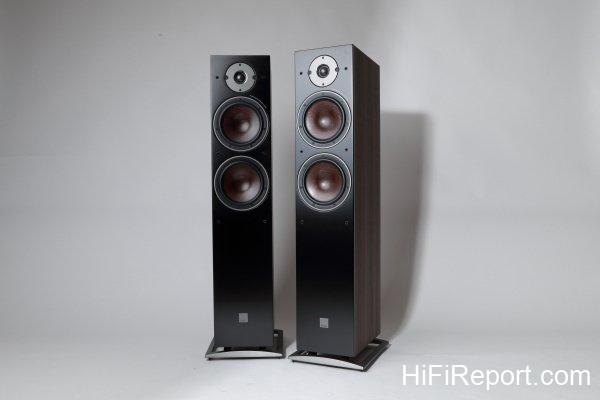
In terms of aesthetics, the Oberon series maintains a traditional, rectangular form factor. The Oberon 7, the largest model in the series, houses two 7-inch woofers, yet retains a relatively compact footprint. Standing just over a meter tall and roughly the width of a hand span, it integrates seamlessly into most home environments without appearing intrusive.
The review sample arrived in a walnut veneer finish with a matte black front baffle, exuding an air of elegance and understated sophistication.
They also offer a white oak veneer version with a white baffle, as previously reviewed by Dong Hongjun for the Oberon 3.
For those who prefer an even simpler aesthetic, non-veneered smoked oak and white finishes are also available.
This time, they have specifically chosen a coarsely woven fabric from Northern Europe for the grille cloth, enhancing its fashionable appeal.
Browsing the promotional photos on the manufacturer’s website, showcasing the speakers in various home settings, the Oberon almost transcends being merely a loudspeaker; it becomes a piece of high-end furniture.
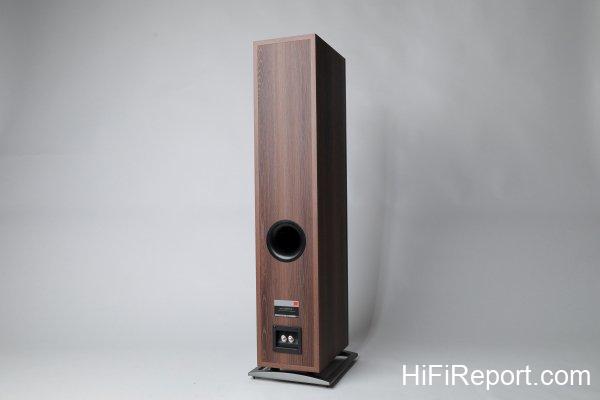
This angle highlights the walnut veneer of the Oberon 7, lending the speaker an elegant and refined appearance.
Design Philosophy: High-End Inspiration, Technology Trickle-Down
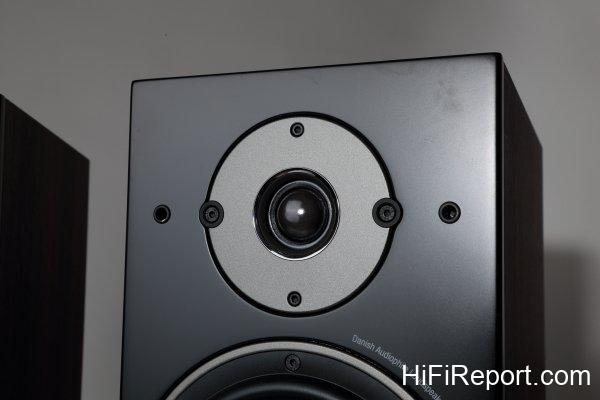
Regarding its design, the Oberon 7 employs a 29mm soft dome tweeter. Dali states that for the Oberon series, they developed an entirely new lightweight soft dome diaphragm, weighing a mere 0.060mg per square centimeter. This mass is approximately half that of conventional tweeters of comparable size, implying that the Oberon tweeter is significantly more responsive.
Why opt for such a large dome size? Conventional dome tweeters are often around 25mm, and some are even smaller at 21mm or 19mm, aiming for faster transient response.
However, Dali chose a 29mm diaphragm for the Oberon.
The manufacturer explains that the larger diaphragm area allows the tweeter to produce sufficient sound pressure with less excursion, thus enabling it to operate within its most linear range with minimal distortion.
Magnetic fluid is incorporated into the magnetic gap for cooling, enhancing its power handling capability.
Behind the diaphragm, a soft dome-shaped damping material is added to absorb back waves.
The front baffle geometry of the tweeter draws inspiration from the higher-end Rubicon and Opticon series, contributing to improved high-frequency extension and dispersion.
The Oberon 7 utilizes a 29mm soft dome tweeter, featuring a newly developed lightweight silk diaphragm specifically for the Oberon series, weighing only 0.060mg per square centimeter, roughly half the mass of typical tweeters of similar size.
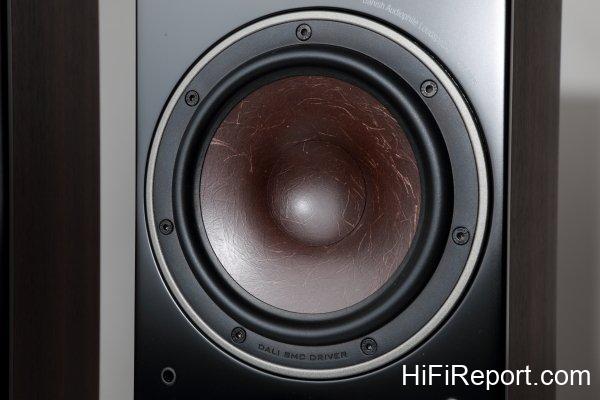
For the two 7-inch woofers, Dali’s signature wood fiber paper cones are employed. These cones are inherently lightweight and rigid, coupled with low-loss surrounds and spider конструкции, enabling the Oberon 7 to reproduce subtle details with precision.
Dali uses 7-inch woofers in both the Oberon 7 and Oberon 3, which are larger than those found in many similarly sized speakers on the market. This allows the woofers to produce comparable sound pressure with less cone excursion.
The voice coil features a four-layer winding, constructed from copper-clad aluminum wire, combining the lightweight properties of aluminum with the mechanical strength of copper.
In the magnet assembly, the entire Oberon series incorporates SMC technology.
What is SMC? It stands for “Soft Magnetic Compound.” In simple terms, it utilizes a “magnetically conductive but non-electrically conductive” central pole piece to minimize “hysteresis” and eddy current effects.
What are the benefits? According to the manufacturer, the implementation of SMC technology allows the Oberon loudspeakers, despite being entry-level, to possess a spacious midrange and rich detail retrieval, while also ensuring long-term listening comfort without fatigue.
Is this truly the case? The white paper makes these claims, which I cannot independently verify through measurement. However, the proof is in the listening.
I will share my sonic impressions shortly.
The two 7-inch woofers feature Dali’s signature wood fiber paper cones, inherently lightweight and rigid, paired with low-loss surrounds and spider structures, enabling the Oberon 7 to reproduce minute details accurately.
The cabinet is constructed from MDF boards, with internal bracing added to enhance overall structural rigidity.
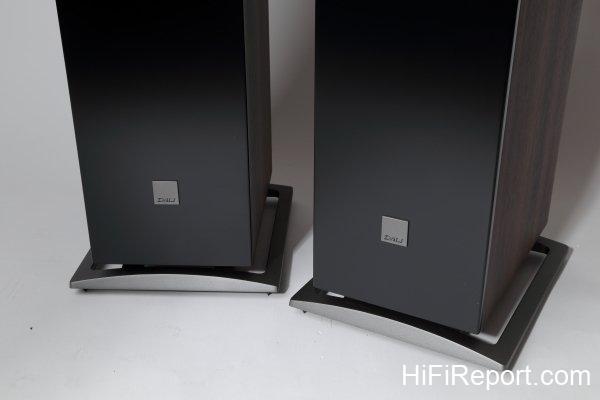
The base is an aluminum frame, with adjustable spikes at each corner for speaker leveling.
The manufacturer also specifically points out that they have applied damping material to the top, bottom, and sides of the Oberon 7’s interior, but not behind the front baffle.
Why? This is to enhance the direct coupling between the woofer and the bass reflex port, preventing damping from reducing low-frequency impact.
The rear-firing bass reflex port contributes to a cleaner front baffle aesthetic and utilizes wall reflections to enhance low-frequency response.
The manufacturer also states that through the design of the crossover and drivers, the Oberon series loudspeakers exhibit excellent sound dispersion. Therefore, users are not confined to a very narrow listening sweet spot.
Even for an entry-level loudspeaker series, Dali has authored a 14-page white paper for the Oberon. This level of dedication is commendable and a hallmark of Dali’s approach.
Sonic Performance: Exceptional Value
In terms of sonic performance, I believe there’s no other fitting description for the Oberon 7 than simply—exceptional value.
To be even more precise, it’s “outstanding value.”
Does this sound like hyperbole? Critics who write such seemingly exaggerated praise often attract reader skepticism.
However, regardless of whether you, the reader, are already tempted to jump to online forums or social media platforms to anonymously critique my assessment, I must reiterate: the Oberon 7 offers incredible value.
These speakers retail for $1465.6 in Taiwan (approximately $1465.6 USD after conversion from 45,800 NTD at a 0.032 exchange rate). But the aforementioned aesthetics and technology are not the primary reasons for its exceptional value.
The value lies in its sound.
I never expected to encounter such sound quality in a speaker at this price point—clean, articulate, dynamic, energetic, and expressive. Even these descriptions feel somewhat inadequate.
Let Radu Lupu and Robert Schumann illustrate the point.
The cabinet is constructed from MDF boards, with internal bracing added for enhanced structural rigidity.
The base is an aluminum frame, with adjustable spikes at each corner for speaker leveling.
Clean, Transparent, and Textured Piano Sound
When I played Schumann’s Piano Concerto, with Lupu as soloist, and adjusted the volume on the Linear Acoustic LAV-60MK2 amplifier to an appropriate level, the opening orchestral tutti and the powerful piano entry in the first movement were immediately captivating.
It’s not the most expansive, grand, or authoritative sound; the Wilson Audio Alexia 2 in the listening room surpasses it in those aspects. Nor is it the most forceful, potent, or incisive presentation, as the Dynaudio Contour 60, another of our editorial reference speakers, also outperforms it in those areas.
However, I have never encountered this level of performance in a loudspeaker priced under $1500 USD.
The power of the orchestral tutti and the piano fortissimo passages is palpable. If the sound were diffuse, the impact would be lost. The Oberon 7 avoids the typical looseness often found in budget speakers; the sound is focused, impactful, and dynamic.
Subsequently, the oboe enters with the main theme, exhibiting commendable imaging precision and a vivid, clear sonic picture of the instrument.
Then, the piano solo reiterates the theme, the notes clean and focused, possessing a delightful, crisp texture, with a bright and shimmering tonal quality.
Even without Dali’s signature ribbon/soft dome hybrid tweeter module found in their higher-end models, the piano sound remains remarkably transparent and beautiful. Within just a few minutes of listening, the Oberon 7 has already demonstrated its exceptional value.
As the music progresses, orchestra and piano intertwine and build towards a crescendo, the Oberon 7 unleashing abundant sonic energy.
In my experience, Dali floorstanding speakers have consistently been expansive and majestic. My listening experiences with the Epicon and Rubicon lines confirm this.
This was my first encounter with an entry-level Dali floorstanding speaker. Listening to the Oberon 7, despite its significantly lower price compared to its higher-end siblings, the sound remains open, expansive, and unconstrained, lacking any sense of smallness or constriction.
During loud, complex passages (tutti), the listening experience is thoroughly satisfying. When the music recedes into quieter moments, whether a piano solo or the gentle whisper of strings, the sonic texture is truly remarkable.
So remarkable, in fact, that I questioned if the speaker was mispriced, perhaps it should cost $3000? Or was the listed price per single speaker? In terms of aesthetics, the Oberon series maintains a traditional, rectangular form factor. The Oberon 7, the largest model in the series, houses two 7-inch woofers, yet retains a relatively compact footprint. Standing just over a meter tall and roughly the width of a hand span, it integrates seamlessly into most home environments without appearing intrusive.
Dali’s Signature Spaciousness
When reviewing the Rubicon 8 in the past, I described its sound as “Caesar-like in its grandiosity.” While the Oberon 7 naturally lacks the sheer scale and power of the Rubicon 8, playing Ashkenazy’s rendition of Sibelius’ “Finlandia” still evokes a sense of passionate fervor.
The piece opens with a somber mood, heavy footsteps, and slow-moving low strings conveying the suffering of the Finnish people under Tsarist oppression. However, hope dawns with the arrival of daylight. As the brass section, with their brilliant and glorious voices, pierces the dark night sky, distant rays of morning light propel the music towards a new apex—a fierce struggle filled with hope and passion.
The Oberon 7 effectively conveys the emotional depth of this music. Through the low strings’ muted growl, the brass’s resounding roar, the rolling timpani, and the surging orchestral tutti, the passion embedded within the music is clearly articulated.
I have always perceived a unique spaciousness in Dali loudspeakers. The sound is never strained or constricted, even with small bookshelf models like the Royal Menuet.
The Oberon 7, with its two 7-inch woofers working in tandem, presents a rich yet effortless sonic texture. Even at high volumes during the climaxes and glorious finale of “Finlandia,” one perceives a wide soundstage and unrestrained energy, without any sense of strain or compression.
At what volume level was I listening? The volume knob on the LAV60 MK2 amplifier was barely turned to the 10 o’clock position, yet the sound pressure level was already substantial, demonstrating the Oberon 7’s easy driveability.
Speakers like these, really only cost $1465.6?
Realistic Vocals and Punchy Bass
If it excels with classical music, how does it fare with pop and rock? Based on my experience, Dali loudspeakers rarely disappoint with pop and rock genres. In fact, if your listening habits lean towards rock, jazz, and pop, Dali speakers should be high on your audition list.
Even the entry-level Oberon 7, when playing rock music, exhibits the same enthusiasm and dynamism as its more expensive siblings.
For instance, playing Dire Straits’ “Money for Nothing,” the ethereal opening vocal chant reveals clear vocal texture and breath sounds. The synthesizers weave a richly colored background, creating an almost dreamlike atmosphere.
Subsequently, the drum entrance abruptly ends this intro, and increasingly intense drumming propels the track towards its first climax. The electric guitar possesses substantial body and thickness, yet remains free from harshness.
Mark Knopfler’s vocals enter, and you immediately understand why I say Dali speakers are a safe bet for pop music. Like its higher-end counterparts, the Oberon 7 sound has weight and warmth, but without artificially emphasizing warmth at the expense of naturalness and transparency. The sonic balance is maintained, yet vocals remain clear, well-defined, and realistic.
The drums, prominent throughout the track, are solid, impactful, and possess excellent elasticity. The kind of drum sound that makes you want to turn up the volume.
As for the album’s title track, “Brothers in Arms,” the expansive sense of space created at the beginning, coupled with the distant, reverb-drenched thunder sounds, immediately made me envision how immersive a full Oberon home theater system could be for movies.
Detailed Yet Smooth Sound
Moving on to Eivør’s live album, the opening track “Min Modir” was featured on Dali CD 4.
The track begins with a wide sense of space. The drums are full and weighty. Eivør’s vocals are dynamic and varied throughout the song, with breathy passages particularly challenging for system balance.
This album and track have a very live and vibrant quality, but on less balanced systems, cranking up the volume can easily lead to harshness.
However, the Oberon 7 avoids such issues.
I could sense the live ambiance of the performance without any harshness.
Subtle sibilance from Eivør’s consonants is clear yet smooth and natural. If a system renders these sounds too polished or rounded, the sense of “live” realism is diminished.
Dali’s engineers have achieved a remarkable balance. The Oberon 7 provides a sense of live performance while remaining comfortable for extended listening.
If you have this CD, listen to the fourth track, “Sum Sólja Og Bøur.” During the song’s intense passages, Eivør’s close-miked vocals are rich in detail and dynamically explosive. This combination presents a significant challenge for any audio system.
The Oberon 7 passed this test with flying colors.
After all these listening impressions, can you understand my excitement? The Oberon 7 is not without its limitations. Compared to Dali’s higher-end speakers, its midrange and high-frequency texture and density are slightly less refined, and low-frequency resolution is not quite on par with its more expensive siblings.
However, considering the Oberon 7’s price point, and in comparison to similarly priced speakers from other brands, its performance is already top-tier. This is why, after listening, I repeatedly exclaimed “exceptional value.”
The bass reflex port is located on the rear panel, and the speaker terminals are single-wired.
Compared to Dali’s even more affordable entry-level speakers, the Oberon 7 incorporates a plinth base, enhancing stability.
Ideal for Music Lovers with Refined Taste
If your budget allows for more, of course, there are many more “perfect” options available. But if you’re seeking a pair of floorstanding speakers within a $1500 budget, please audition the Oberon 7 at your nearest dealer.
Without hearing them, you might dismiss my words as exaggerated praise. But once you listen, you’ll understand my enthusiasm.
This is not a speaker solely for hardcore audiophiles, but rather a speaker that deserves serious consideration from consumers who need music in their lives and appreciate refined taste.
If you’re looking for a pair of floorstanding speakers around $1500, please go and listen to the Oberon 7.
These speakers are truly exceptional value!
Specifications
* Type: 3-driver, 2-way bass reflex floorstanding speaker
* Drivers: 29mm soft dome tweeter x 1; 7-inch wood fiber cone woofer x 2
* Frequency Response: 36-26kHz
* Sensitivity: 88.5dB
* Impedance: 6 Ohms
* Maximum SPL: 110dB
* Crossover Frequency: 2.3kHz
* Recommended Amplifier Power: 30-180W
* Dimensions: 1015 x 200 x 340 mm (H x W x D)
* Weight: 14.8kg