
Denon AVR-X1800H Review
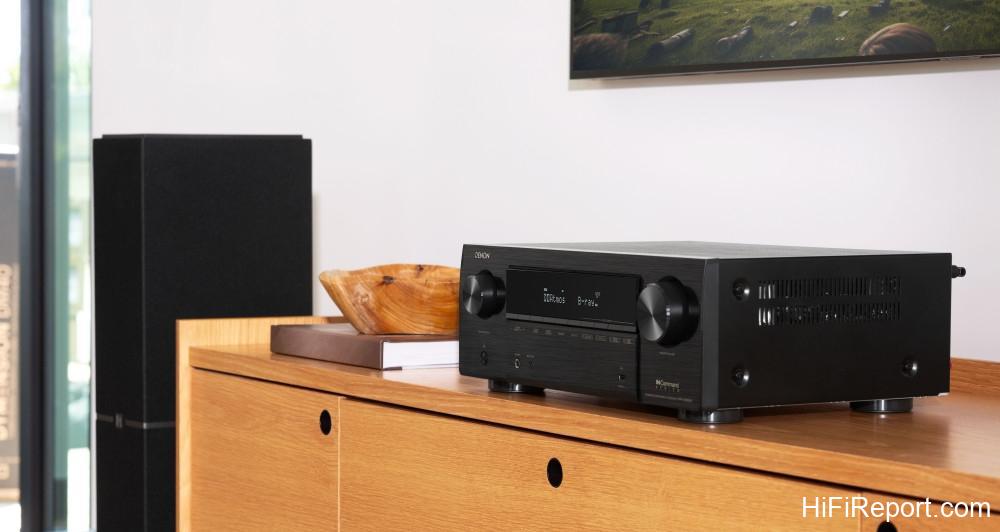
The Denon AVR-X1800H stands out as a feature-rich entry-level AV receiver, promising a vivid, immersive sound experience.
Channel Configuration and Setup
As a 7.1 channel receiver, the AVR-X1800H supports overhead channels, enabling a 5.1.2 system configuration. This allows you to install two speakers in the ceiling, creating a truly three-dimensional soundstage. Furthermore, it can connect to two active subwoofers, meaning it can effectively support a 5.2.2 setup. Building a system with both immersive 3D audio and powerful bass is entirely achievable with this receiver.
Audyssey Room Correction Benefits
Once your speakers are connected, a comprehensive measurement and calibration process is essential. The AVR-X1800H incorporates Audyssey MultEQ automatic room correction technology, a system Denon has collaborated on for many years. By using the included test microphone and following the on-screen instructions displayed on your TV, you can complete the entire calibration process.
After calibration, not only are parameters like speaker levels and distances accurately set, but the system also mitigates the negative effects of your room environment on the sound.

Enhancing the Listening Experience: Audyssey Features
Beyond basic calibration, the Audyssey system offers two convenient features for enhancing user experience. The first is Dynamic EQ. What does it do? Our hearing perception varies at different volume levels. For instance, at lower volumes, our sensitivity to low and high frequencies decreases, and quieter elements like distant surround effects become less audible.
Engaging Dynamic EQ automatically adjusts the frequency response based on psychoacoustic data, ensuring you can still perceive clear details, dynamics, and even the sense of surround envelopment, even at low listening levels.
The other useful feature is Dynamic Volume. This function automatically balances volume levels, preventing sudden, jarring increases, such as when commercials begin. Both features are incredibly practical for entry-level users who may have smaller listening spaces and frequently listen at lower volumes.

Solutions for Common Installation Constraints
For newcomers to home theater, bigger and more elaborate isn’t always better. Entry-level enthusiasts often face installation constraints, like budget limitations preventing overhead speakers or room layouts that simply don’t permit ceiling installations. In such cases, you might be limited to a 5.1 or 7.1 system.
Virtual Height Technologies
The good news is that the AVR-X1800H can still provide a 3D soundstage even without physical overhead speakers, thanks to its support for Dolby and DTS virtual height technologies – specifically Dolby Height Virtualization and DTS Virtual:X. These technologies use your existing planar speakers to simulate overhead effects, which is a highly valuable feature for entry-level consumers.
Flexible Multi-Room Audio: Zone 2
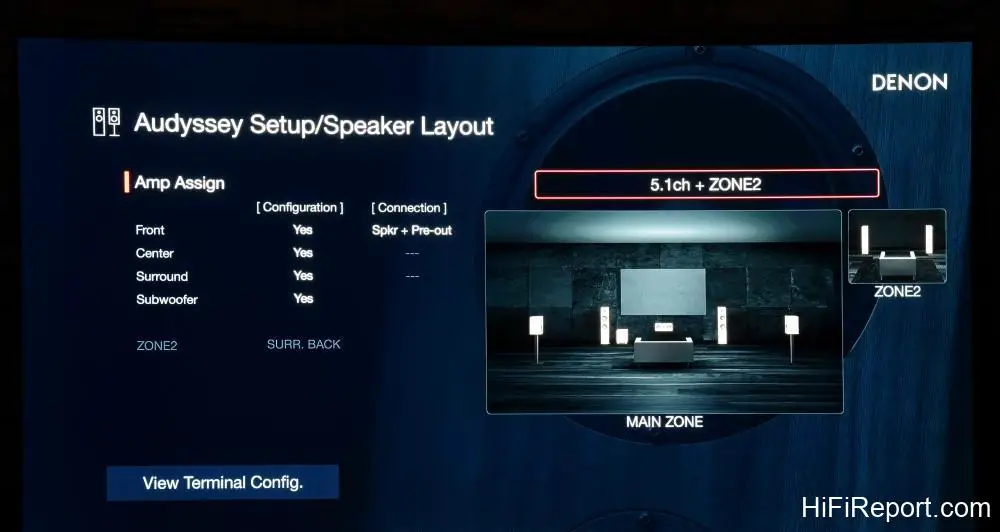
What if you have a very small room where only a planar 5.1 system is feasible? The extra two channels don’t go to waste, as the AVR-X1800H supports Zone 2 functionality. This allows you to use the unused speaker outputs to directly drive speakers in a second zone. So, if you have a pair of passive speakers in another area (like a study or bedroom), you can use them for listening to music without needing another amplifier. Control is simple using the dedicated apps.
App Control and Comprehensive Streaming
The AVR-X1800H supports two apps: the basic control app, Denon Remote App, and the HEOS App for streaming functions. Both apps make it easy to control power and music playback in the second zone.
Speaking of HEOS, this is Denon’s actively developed streaming platform. With HEOS, you can use the AVR-X1800H as a dedicated music streamer, potentially saving you the cost of a separate component. HEOS supports popular streaming services like Spotify and internet radio, and also includes DLNA functionality, allowing you to play music files stored on other devices within your local network. It handles audio resolutions up to 192kHz/24bit (ALAC, FLAC, and WAV) and DSD 5.6MHz.
If you’re an Apple user, you can also directly use AirPlay 2 to stream music from your Apple devices to the AVR-X1800H.
Video Capabilities and Advanced Connectivity
Beyond music capabilities, the AVR-X1800H is well-equipped for video. It features 6 HDMI inputs and 1 output, supporting high-specification video pass-through, including 8K resolution at 60Hz and content with Dolby Vision. Its HDMI output also supports eARC (Enhanced Audio Return Channel), enabling connection to compatible smart TVs to play audio returned from the TV, such as Dolby Atmos soundtracks from streaming platforms like Netflix.
Listening Impressions
Now, let’s discuss the actual review experience. I tested the AVR-X1800H with several speaker setups configured as 5.1.2 systems. Sources included a MAGNETAR UDP800 Pro Blu-ray player, an Apple TV 4K, and the built-in streaming features of a Sony smart TV. Regarding driving power, the AVR-X1800H is positioned as an entry-level unit, and its output power understandably differs from higher-end models.
However, when paired with appropriately sized and relatively efficient speakers, it delivers quite good results. The key is its support for 5.1.2 and its ability to manage sound allocation effectively. When properly calibrated, the AVR-X1800H is capable of producing a very good sense of surround envelopment and precise sound localization.
You don’t need overly bombastic action sequences to appreciate the AVR-X1800H’s performance. It demonstrates a nuanced and faithful surround effect even in mundane, everyday scenes. Take, for instance, the opening of the fifth episode of the Netflix series “House of Ninjas,” where the female protagonist is nearly pushed onto the train tracks. Right away, you perceive the vast space of the train platform.
The approaching train has a distinct physical presence and clear movement, making you feel as if it’s whizzing past right beside your seat, enhancing the sense of danger associated with falling onto the tracks.
The “Oppenheimer” 4K BD was also spectacular. When characters walked through the corridors of the congressional hall in the film, the sense of space was immediately palpable. The texture of footsteps moving down the hallway felt very natural. As the camera pushes open the doors to the hearing hall, a cacophony of voices rushes forward, followed by an incredibly realistic hall acoustic enveloping the entire listening room.
It felt like walking into a crowded, large space along with the camera, providing a truly immersive experience.
Incidentally, director Christopher Nolan insisted on providing only a DTS HD-MA 5.1 soundtrack for this film. However, when played through the AVR-X1800H, it can activate DTS Neural:X technology to upmix the audio, engaging all speakers. This still results in a spatial rendering with a sense of height. These detailed audio performances give the theater system a captivating charm, and should be quite a pleasant surprise, especially for entry-level users or those with small to medium-sized rooms.
During my listening tests, I also noted that the AVR-X1800H’s sound is neither overly aggressive nor does it feel compressed, making it well-suited for music playback. Besides using the HEOS App to stream various music platforms, I also experimented with Dolby Atmos Music tracks on Tidal, and the results were impressive.
For example, “But Not for Me” from Fred Hersch and Esperanza Spalding’s “Alive at the Village Vanguard” album showcased an excellent sense of space for a live jazz performance. The audience murmurs, the gentle clinking of glasses and dishes… it all created a feeling of being right there in the venue. When the vocalist began speaking and singing, and the piano started playing, the performers and audience had clear positions and distances.
During a section where the audience couldn’t help but laugh, you realize your listening position is right in the middle of the crowd. Both the vocals and piano exhibited clear details and high fidelity – something difficult to achieve with affordable AV receivers playing multi-channel music in the past.
Pop music was also handled remarkably well. In the Korean girl group Twice’s single “I Got You,” the initial electronic keyboard and other synthesized effects appeared lightly around the listening position, some distinctly behind the seats, and seemed to move through the air. When the main melody entered, the electronic drum beats were presented in a lively manner. While the impact and depth weren’t extreme, they were full of elasticity.
The lead female vocals were positioned in front of the listener. As the track progressed to the chorus, the vocals extended throughout the space, and combined with other electronic elements, completely enveloped the listening position. Crucially, the texture of the various sound effects was refined and smooth, making for a very enjoyable listen.
Conclusion
In summary, the Denon AVR-X1800H is a highly recommended choice for entry-level enthusiasts. With a price point under $1000 (around $950), it’s easily accessible. While its driving power may not be top-tier, its ability to output 5.1.2 channels provides full Dolby Atmos 3D spatial audio. Whether watching movies or listening to multi-channel music, you can enjoy a complete, immersive soundstage.
Additionally, features like Zone 2 support, the ability to connect two subwoofers, and integration with other HEOS components for a multi-room system add significant flexibility and practical value. I believe entry-level users will be genuinely impressed and satisfied.
Specifications
* Design: 7.1 channel AV receiver, supports 5.1.2, can connect two subwoofers
* Rated Output Power: 70W (8 ohms, 2ch driven)
* Frequency Response: 10Hz~100kHz (+1/-3dB, direct mode)
* Signal-to-Noise Ratio: 98dB (IHF-A, direct mode)
* HDMI Terminals: 6 inputs, 1 output (supports eARC/ARC)
* Audio Input/Output Terminals: Analog Audio Input ×2, PHONO Input (MM) ×1, Optical Digital Input ×2, Subwoofer Pre-out ×2, Headphone Output ×1 (front)
* Other Input/Output Terminals: Network ×1, USB-A ×1 (front), USB-A ×1 (rear), FM Antenna Terminal ×1, AM Antenna Terminal ×1, Setup Microphone Jack ×1 (front)
* Dimensions: W434×H215×D339mm
* Weight: 8.6 kg