
Integra DRX 2.4 Review
Integra’s AV receivers are positioned in the mid-to-high-end market, primarily targeting enthusiasts and professional users. They are known for supporting a wide range of automation control systems, catering to custom installation needs. Consequently, while the DRX 2.4 is considered Integra’s entry-level model, its price point might be seen as mid-to-high range compared to some Japanese brands.
However, the adage “you get what you pay for” holds true. The DRX 2.4’s value is clearly demonstrated in its comprehensive features and outstanding audio-visual performance, promising a rich home entertainment experience.
8K Upscaling Prowess
The DRX 2.4 boasts 7.2 channel output with 80 watts of power per channel. It supports object-based surround sound formats like Dolby Atmos and DTS:X, enabling you to build up to a 5.2.2 channel home theater system.
In terms of video, the DRX 2.4 supports 8K passthrough and HDR10+ specifications. It offers a generous 6 inputs and 2 outputs HDMI interface. Among these, 3 inputs are compatible with HDMI 2.1 8K/60, while the other 3 support HDMI 2.0b 4K/60.
The 2 outputs are designated as Main/Sub and Zone 2. The Main + Sub output configuration simultaneously supports 8K/60 and 4K/120, while the Main + Zone 2 output supports 8K/60 and 4K/60 respectively.
The main output is also equipped with eARC functionality, simplifying connection to TVs and enabling the return of audio signals from the TV to the DRX 2.4.
Furthermore, the DRX 2.4 features an impressive video upscaling capability. It can upscale incoming 4K video to 8K output, and 1080P video to either 8K or 4K, catering to increasingly sophisticated display devices in homes and allowing you to enjoy refined 8K picture quality ahead of the curve.
Extensive Network Features
Network functionality is another highlight of the DRX 2.4.
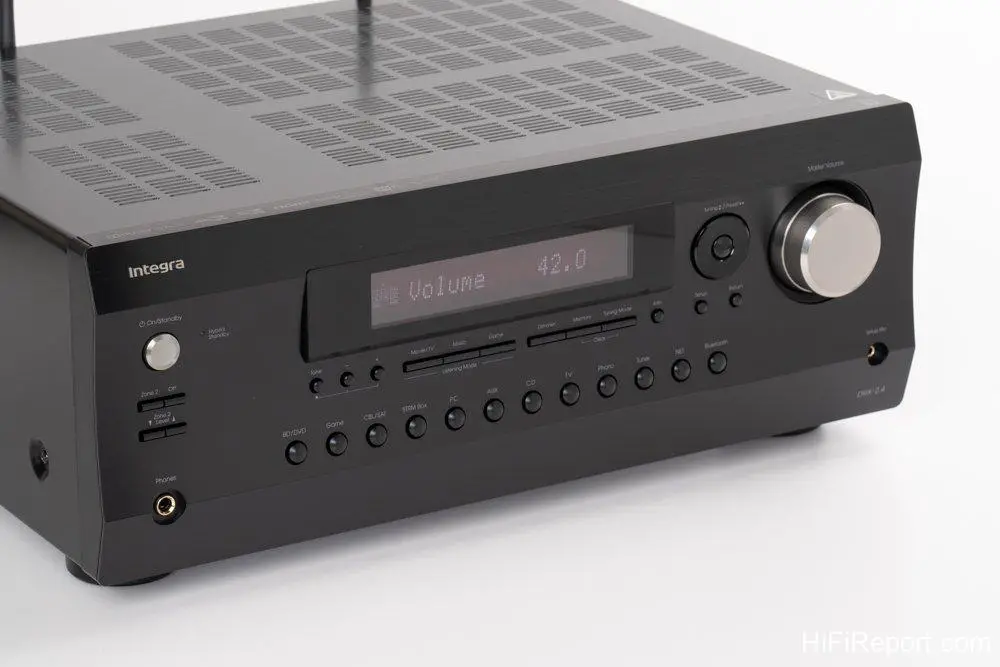
The DRX 2.4 can connect to the network via wired Ethernet or Wi-Fi, offering greater placement flexibility.
It supports a wide array of control methods, including DTS Play-Fi, Google Chromecast, Apple AirPlay 2, Sonos, Roon Ready, and more. Users can also utilize Integra’s proprietary remote control app to manage streaming music playback, providing ample choice for control.
Even voice control is seamlessly integrated. The DRX 2.4 supports smart voice assistants like Amazon Alexa, Google Assistant, and Apple Siri, allowing you to control music playback with voice commands – incredibly convenient! For even simpler operation, Bluetooth is available. The DRX 2.4 supports bidirectional Bluetooth transmission, ensuring every family member can easily stream music from their smartphones.
Through the DRX 2.4, you can access numerous streaming music services, including Amazon Music HD, Spotify, TIDAL, TuneIn, Pandora, Deezer, and more.
High-resolution audio is also well supported. Over network transmission, the DRX 2.4 can handle up to DSD 11.2 MHz and 24bit/192 kHz formats, fully meeting current high-resolution playback demands.
All-in-One Entertainment Hub
The DRX 2.4’s interface versatility extends beyond network capabilities.
It includes RCA analog inputs, digital coaxial inputs, and digital optical inputs, facilitating connections with various playback devices at home.
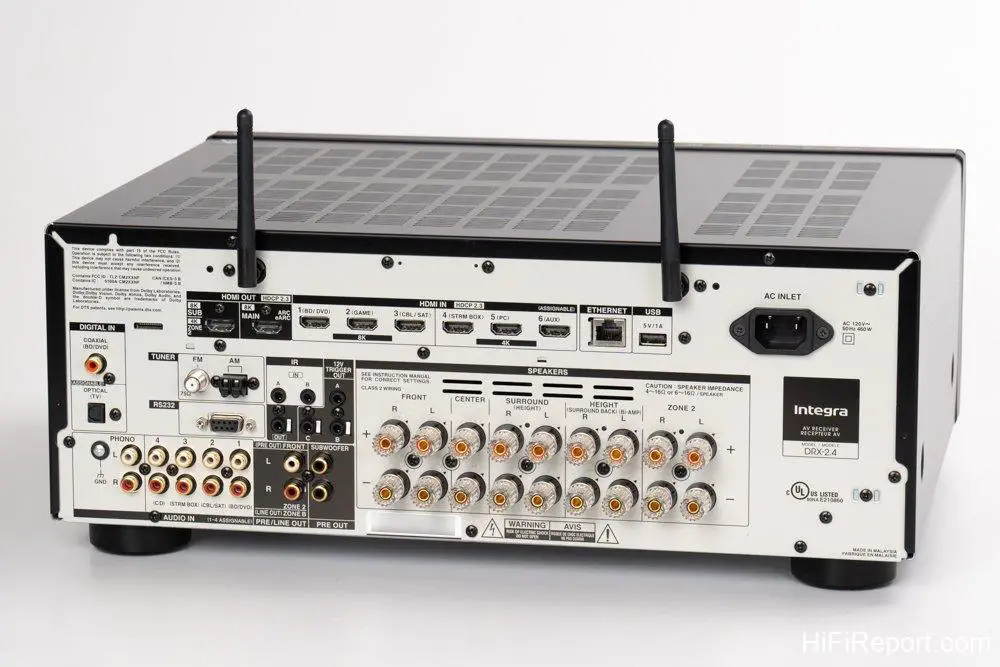
The DRX 2.4 also features a USB A input, enabling direct playback of music files from USB storage devices.
Moreover, the DRX 2.4 provides an MM phono input, allowing you to enjoy vinyl records for a touch of “audiophile” listening.
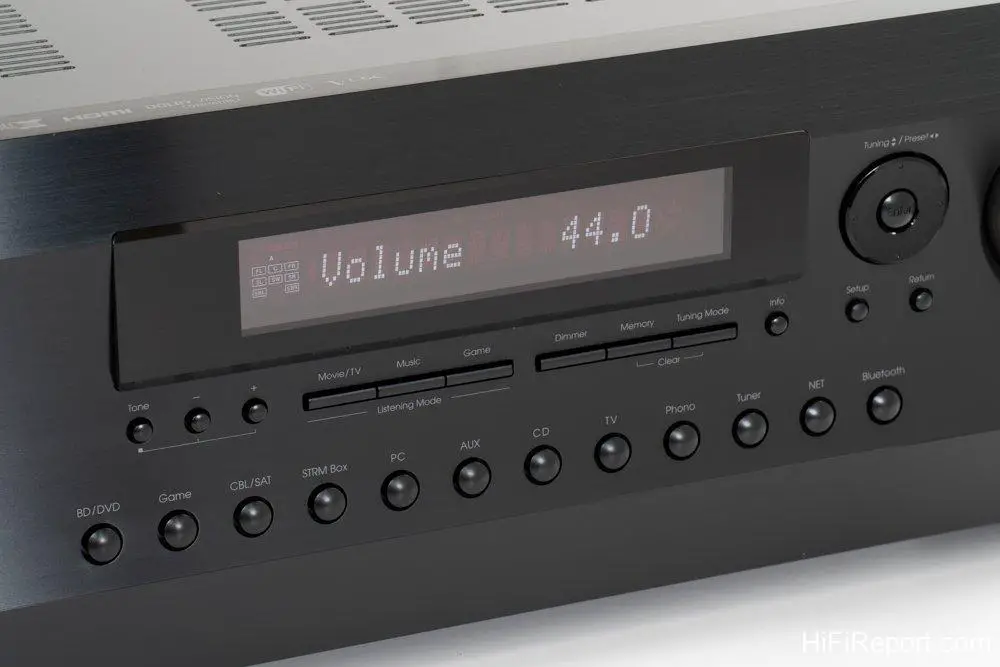
Want to listen with headphones? No problem. The front panel is equipped with a 6.3 mm headphone output for immersive private listening sessions.
The DRX 2.4 even incorporates FM and AM radio functionality, allowing older family members to easily access their favorite stations.
Essentially, a single DRX 2.4 can satisfy all your home entertainment playback needs. It provides a comprehensive set of audio-visual interfaces, accommodating both new and legacy devices. It can also establish a two-channel Zone 2 listening system and even directly drive Zone 2 speakers, offering versatile listening configurations.
Dedicated Atmos Enabled Speaker Optimization
Let’s examine the multi-channel speaker setup and automatic room correction.
The DRX 2.4 employs the AccuEQ automatic room calibration system. Using the included measurement microphone and following on-screen instructions, simply measure from one point – the primary listening position – to quickly complete measurement and automatic correction.
Before starting the measurement, you need to inform the DRX 2.4 about your speaker configuration. It supports various channel layouts, including 2.1, 3.1, 4.1, 5.1, 6.1, 7.1, 2.1.2, 3.1.2, 4.1.2, 5.1.2, and more, offering remarkable flexibility. For setups with overhead channels, you need to specify the placement of these speakers, such as in-ceiling front, middle, or rear, wall-mounted above the main speakers, or Dolby Atmos Enabled speakers placed on top of the main speakers.
Accurate speaker configuration input is crucial for the DRX 2.4 to perform precise assessment and correction.
Furthermore, if overhead speakers are not installed, the overhead channel outputs can be configured for bi-amping, allowing you to bi-amp the main speakers and maximize amplifier power utilization.
Many home theater environments are not conducive to installing in-ceiling speakers. This is where Dolby Atmos Enabled speakers come into play. These speakers are designed to be placed directly on top of the main speakers, projecting overhead sound signals upwards at an angle, relying on ceiling reflection to create the overhead audio effect. This way, even without in-ceiling speakers, you can still experience overhead sound effects through Dolby Atmos Enabled speakers.
The DRX 2.4 features a special function specifically for Dolby Atmos Enabled speakers called AccuReflex. It enhances the reflection energy of Dolby Atmos Enabled speakers and corrects their phase, resulting in more precise sound.
Effortless Immersive Sound Field
The listening test was conducted at HiFiReport’s listening room.
Due to the listening room’s suspended ceiling, in-ceiling speakers could not be installed. Therefore, a 5-channel configuration was used for the test. The main speakers were BestVox LS3/6 three-way bookshelf speakers, the center channel was a Divini KIT-M bookshelf speaker, and the surround speakers were Acoustic Energy AE100 bookshelf speakers.
Speaker placement followed the standard ITU-R layout. AccuEQ automatic calibration was performed first, followed by manual fine-tuning of each channel’s volume while listening. A cohesive and immersive sound field was achieved quickly.
The BestVox LS3/6, with its classic and British-inspired aesthetics, surprisingly proved well-suited for multi-channel use. Its 8-inch woofer and ample cabinet volume provide low-frequency extension down to 42 Hz, with substantial output. Even without a subwoofer, the low-frequency performance felt adequate, indicating the DRX 2.4’s sufficient driving power and sonic weight. Importantly, the sound was comfortable, smooth, and free of harshness or grain, with ample detail – a very satisfying performance.
Using the “Audiosphere” clip from a Dolby Atmos demo disc, which features a disc-like object on screen with light orbs pulsating to the music, illuminating and sounding notes at different locations to demonstrate sound directionality, timbre, and distance, the DRX 2.4 rendered the audio with a warm and rich timbre, full and rounded sound images, and satisfying thickness across the frequency spectrum. It also maintained necessary agility and dynamism.
While I acknowledge that the warm sonic character largely originates from the speakers, it still reflects the DRX 2.4’s commendable mid- and low-frequency weight and output, allowing these sonic qualities to be fully realized.
Performance Beyond Entry-Level
Next, the “Amaze” clip from the Dolby Atmos demo disc, featuring rainforest sounds with thunder and rain, was played.
Through the DRX 2.4, various sound effects were easily discernible, and the sense of movement, image size, and depth variations were rendered with clarity and detail.
Despite the absence of a subwoofer, the thunder sounds had impressive low-frequency scale and ample weight in the lower registers. High-frequency brightness was appropriate, and both upper and lower frequency extension felt effortless and natural. The DRX 2.4 demonstrated ample headroom.
Another clip, “Horizon,” with even richer and more dynamic sound effects, including spaceship flybys, speeding race cars, waterfall cascades, and concert crowd noise, was tested. I pushed the volume higher, and the DRX 2.4 continued to output power steadily and reliably. The overall presentation remained composed, with improved sonic weight and clear layering, avoiding muddiness or chaos. Everything remained under control. This demonstrates that despite being an entry-level model, the DRX 2.4’s capabilities are far from ordinary.
Specifications
* **Form:** 7.2 Channel AV Receiver
* **Output Power:** 80 watts per channel (8 ohms, 20 Hz–20 kHz, 0.08% THD, 2ch driven, FTC)
* **Frequency Response:** 10Hz – 100kHz / +1 dB, -3dB
* **Analog Inputs:** RCA High-Level x 4, MM Phono x 1, FM, AM
* **HDMI:** 6 in, 2 out
* **Digital Inputs:** Coaxial x 1, Optical x 1, Network RJ45, USB
* **Signal-to-Noise Ratio:** 106 dB (LINE, IHF-A)
* **Speaker Impedance:** 4 Ω – 16 Ω
* **Supported Audio Formats:** 5.1.2 Channel Dolby Atmos and DTS:X
* **Streaming Audio Sample Rate:** Up to 24 bit / 192kHz PCM, DSD 11.2 MHz
* **Dimensions:** 435 × 174 × 376.5 mm (Width × Height × Depth)
* **Weight:** 9.6 kg