
Denon AVR-X2800H Review
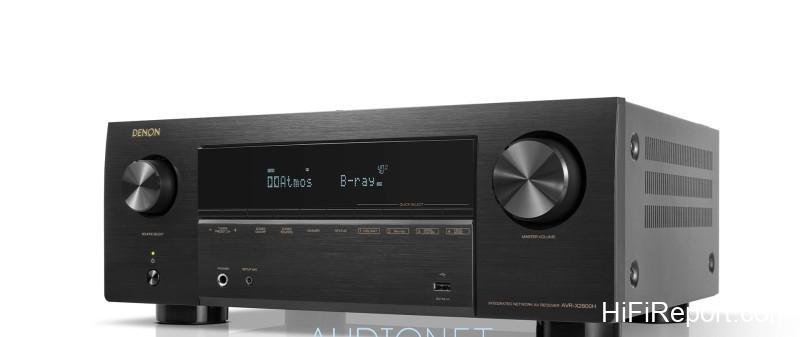
Manufacturers of surround sound receivers aren’t just focusing on flagship models; they’re also committed to serving entry-level enthusiasts. We’ve noticed significant advancements in many newly released budget-friendly AVRs. A prime example is the Denon AVR-X2800H, launched this year. As the most accessible model in Denon’s AVR lineup, it offers slightly fewer features than the AVR-X3800H we previously reviewed, but it still boasts full 8K video support and Dolby Atmos audio specifications.
Its more approachable price point makes it a perfect fit for newcomers. What pleasantly surprised me even more was that its sound quality inherits the tuning philosophy of Denon’s high-end models – the “Denon Sound Master” approach. It delivers sharp, clear imaging, high resolution, and a smooth presentation, truly surpassing all previous entry-level Denon models. This demonstrates the manufacturer’s genuine effort this time around, living up to enthusiasts’ long-held expectations!

Key Features and Audio Capabilities
The AVR-X2800H features 7.2 channels and supports object-based audio formats like Dolby Atmos and DTS:X, allowing for a standard 5.2.2 Dolby cinema setup. This lets entry-level users experience the vertical soundstage effect created by height channels. If installing ceiling speakers isn’t feasible in your space, don’t worry. The extra pair of terminals can be used for Zone 2 or connected to the main speakers via bi-amping.

This can drive your speakers more completely, enhancing music playback performance. Furthermore, the AVR supports DTS Virtual:X, which can virtualize a 3D soundstage from a planar setup, compensating for the lack of height.

Additionally, responding to the trend of “multiple subwoofers” in home theater over the past few years, this unit can connect two active subwoofers simultaneously (sharing crossover points). This reduces the load on the subwoofer amplifiers and improves low-frequency control. A slight drawback is that, unlike the AVR-X3800H, this model doesn’t offer the option to upgrade to Dirac Live (a paid feature).

However, for beginners, the powerful built-in Audyssey MultEQ XT automatic room correction is still extremely valuable. It analyzes measurement data from up to 8 positions based on speaker size, distance, and volume to reduce frequency response differences between speakers and minimize the impact of room modes, resulting in a more ideal theater soundstage and localization.

Video Performance and Gaming Features
The video capabilities of this unit are also impressive. It features 6 inputs and 2 outputs for HDMI. Among these, 3 inputs and 2 outputs comply with the HDMI 2.1 standard, supporting 4K/120p and 8K/60Hz video pass-through, as well as image formats like Dolby Vision, HDR10+, and HLG. It also includes gaming-specific features such as VRR (Variable Refresh Rate), ALLM (Auto Low Latency Mode), and QFT (Quick Frame Transport).
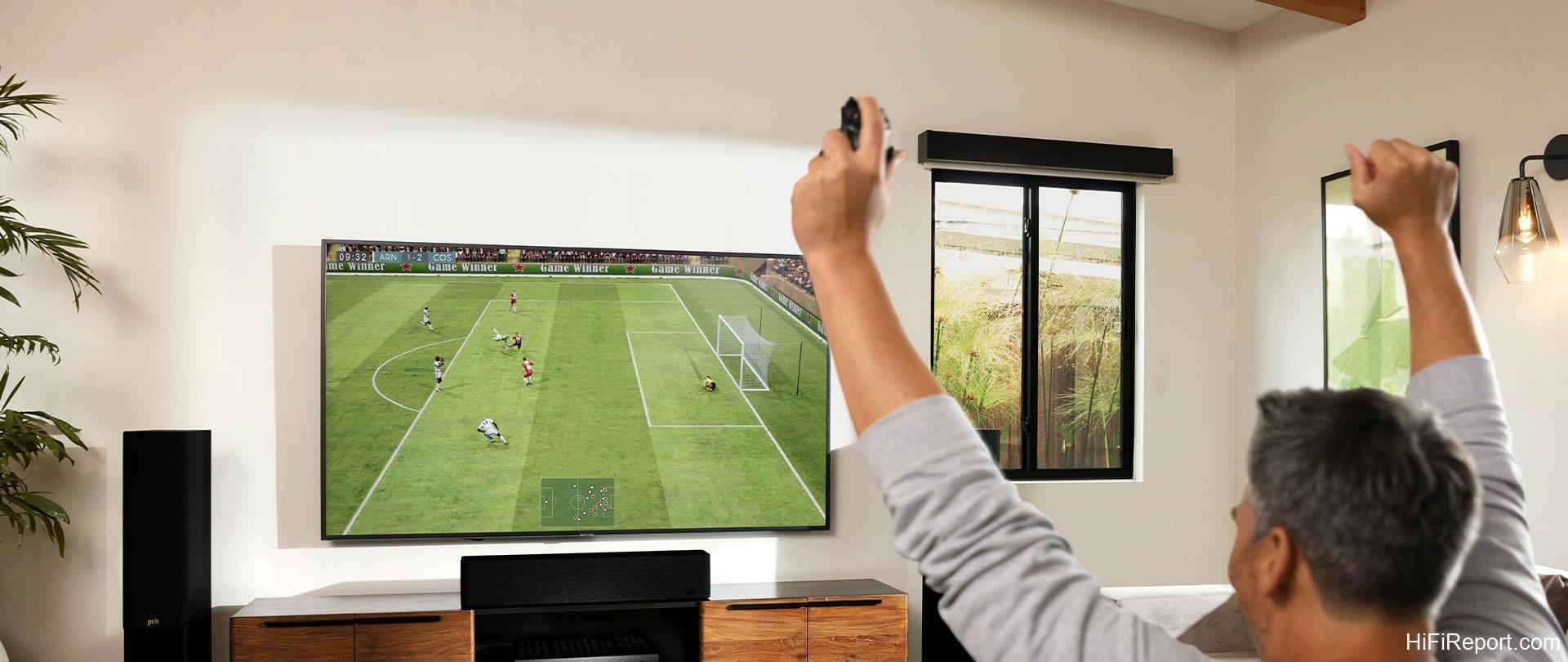
These features help reduce ghosting and screen tearing during gaming, allowing you to capture the finest game details. Of course, the output terminals also support eARC (Enhanced Audio Return Channel), enabling you to replace your TV’s speakers with your home theater system and perfectly reproduce Dolby Atmos audio from platforms like Disney+ and Netflix.
Network Streaming and Multi-Room Audio
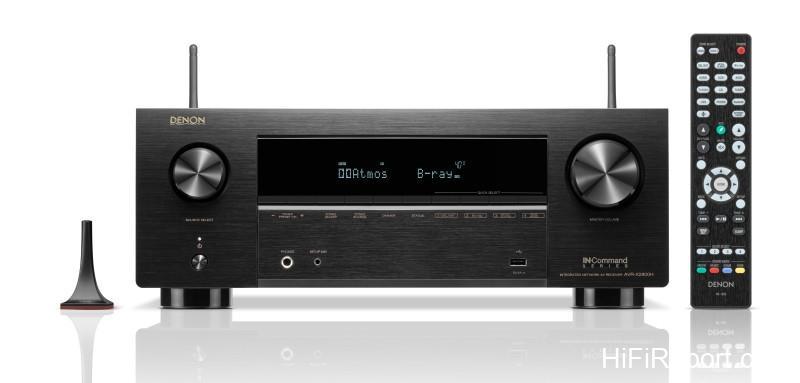
Regarding network streaming, the AVR-X2800H supports both wired and Wi-Fi connections, allowing access to a variety of streaming music services. You can play music files stored on PCs or NAS devices within your local network via UPnP. The native HEOS app lets you directly stream from popular platforms like Spotify and TIDAL. The streaming decoder supports high-resolution files up to PCM 24bit/192kHz and DSD 2.8MHz/5.6MHz, which is more than sufficient for current streaming music services.

The HEOS function also allows the AVR to wirelessly link with Denon Home wireless speakers or other HEOS-enabled wireless audio products in your home to play the same song, achieving multi-room music sharing. For Apple users, it features the familiar AirPlay 2 function, allowing you to mirror audio from your mobile device to the unit for playback. It also supports Apple Siri voice control.
Internal Design and Power
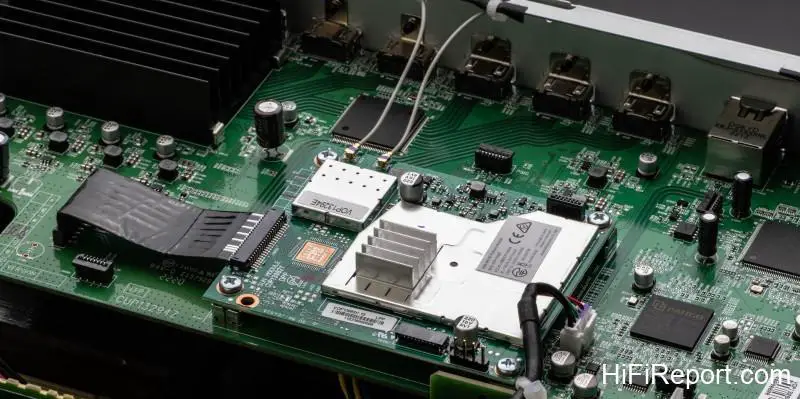
Naturally, diverse functionality requires robust hardware support, and the AVR-X2800H certainly delivers. Opening the chassis reveals a layered circuit architecture. The upper circuit board houses the new HDMI inputs and HEOS network interface, where you can see a dedicated heatsink structure ensuring the stability of 8K video signals.

After receiving digital signals, it utilizes the common Cirrus Logic CS49844A-CQZ DSP chip, responsible for digital audio processing, Audyssey MultEQ XT automatic room correction, and multi-channel EQ. For digital-to-analog conversion, theoretically, the 7.1 channel pre-out would only require a single 8-channel chip. However, to achieve Denon’s new tuning style, this unit employs four 32-bit two-channel TI PCM5102A DAC chips for decoding.

This enhances the signal-to-noise ratio, allowing movie sound to possess both resolution and smooth musicality.
Following the pre-amp circuitry, we arrive at the AVR-X2800H’s power amplification stage. Here, you can see that all 7 channels utilize discrete amplifier circuits. Each channel, like the AVR-X3800H, employs a pair of Sanken 2SD2560 / 2SB1647 power transistors, coupled with a large aluminum heatsink for optimal thermal efficiency. It delivers 95W per channel under an 8-ohm stereo load, with a single-channel peak output reaching 185W.

For an entry-level model, this is quite capable, easily handling most theater speakers.

Listening Impressions: Music
For this review, the AVR-X2800H was set up in our large listening room (approximately 7 ping, or about 23 square meters). We used our in-house Pioneer Excellence series speakers, Monitor Audio height speakers, and an SVS active subwoofer to form a 5.1.2 channel configuration, with a Sony A80J 4K OLED TV as the source. First off, the AVR-X2800H’s power output is quite good. As an entry-level unit, it didn’t feel weak or strained driving the large Pioneer theater speakers.
The sound had excellent fullness and density. Inheriting Denon’s strength in musicality, the sound quality was smooth and well-hydrated, without the thin, skeletal shortcomings often found in budget models. It didn’t overly emphasize resolution to the point of being overly analytical; instead, music playback consistently sounded smooth and pleasant to listen to.
For instance, playing a live performance by the Polish jazz trio Marcin Wasilewski Trio showcased the AVR’s expansive and natural soundstage. The piano playing flowed like water; while the detail wasn’t as refined as higher-end models, the notes had a smooth, sweet texture, completely free of the roughness commonly heard in entry-level units. Simultaneously, the pianist’s touch felt elastic, low notes were full of weight, and the resonant hum of the piano body had a good sense of scale.
The unit’s quiet background also highlighted the subtle harmonics of the instruments, allowing the charming decay of the notes to permeate the space, fully revealing the beautiful timbre of the piano. The unit’s mid-low frequency range leans towards a full and slightly fluffy style, with a hint of coloration. Both kick drums and double bass sounded fleshy and substantial, adding a stable and powerful rhythm to the jazz trio.
Listening to Hilary Hahn perform the “Brahms Violin Concerto,” the violin sounded smooth and sweet. One could hear the full body of the lines and the warm resonance of the instrument. The high-pitched passages had a rounded quality, without sounding harsh or piercing, even during intense phrases. When encountering passages with massed strings, the unit’s low-end control was definitely superior among budget models, exhibiting excellent scale and dynamic impact.
The bass didn’t feel uncontrolled or bloated. Even within the massive energy, the string playing remained delicate, and instruments had a three-dimensional, expansive sense of placement, without feeling cramped or constrained. Even large orchestral pieces were easily appreciated, allowing one to discern the layers of each section’s performance.
Listening Impressions: Movies
Moving on to the AVR-X2800H’s multi-channel test, its theater sound was even more impressive than its music performance! Besides demonstrating a high-density surround sound field, the addition of height channels made both the horizontal and vertical soundstages expansive and three-dimensional. Playing complex war or sci-fi movie soundtracks fully highlighted the advantages of Dolby Atmos audio. For example, while watching the Disney+ movie “Guardians of the Galaxy Vol.
3,” the first thing noticed was the exceptionally quiet background. In many scenes with spaceships traveling through space, one felt as if the surroundings were a vacuum, devoid of any noise. In these moments, even the smallest sound effects had a powerful presence, creating a seamless, immersive audio experience that realistically portrayed the film’s spatial environments.
Furthermore, the unit’s overhead effects were solid, not just a subtle presence like in many entry-level models. There was a clear sense of form and movement. For example, when Adam Warlock invades the Guardians’ headquarters and grapples with Groot, you could hear their massive bodies darting up and down within the listening room. The vertical movement, especially when descending from above, was strong and impactful.
The debris of destroyed structures in their wake also had clear detail, indicating very smooth transitions between channels and sufficient sound density. Similarly, when the High Evolutionary’s ship lifted off the ground, one could hear the massive object rise from the earth with both clarity and fullness, accompanied by intense subwoofer vibrations surrounding the listener, creating an earth-shattering sonic spectacle.
Speaking of which, I must also mention the gunfight scene where Star-Lord and Groot fight back-to-back in the villain’s base. You could hear fierce bullets radiating outwards from the center in all directions. The sound had a tight, solid form, allowing you to feel the clear trajectory creating the surround effect. When encountering explosion scenes, the unit’s dynamic performance was not to be underestimated.
With the subwoofer’s assistance, various bomb blasts and impact sounds exhibited full explosive power. Not only did the energy feel well-controlled, but even after the massive sonic outburst, the accompanying flying glass and debris also had clear definition, entirely free of clutter. This truly exceeded my expectations for an entry-level AVR!
Conclusion
From this entry-level AVR-X2800H, you can feel Denon’s considerable sincerity. Essentially, it’s a simplified version of the AVR-X3800H, only lacking two output channels and the possibility of a Dirac Live upgrade. However, the sound quality and effects are very close. Besides possessing more precise soundstage and localization, there’s a very tangible improvement, especially in the 3D effect sought by Dolby Atmos.
If your space is limited and you don’t require a high channel count, and you simply want better sound quality within a limited budget, the AVR-X2800H will allow you to easily experience the true charm of a Dolby cinema.
Specifications
* Design: 7.2 Channel Surround Receiver
* Output Power: 95W per channel (8ohm), 150W (6ohm)
* Supported Dolby Technologies: Dolby TrueHD, Dolby Atmos, Dolby Atmos Height Virtualization, Dolby Atmos Music
* Supported DTS Technologies: DTS HD Master, DTS:X, DTS Neural:X, DTS Virtual:X
* Supported Hi-Res Music Files: 24bit/192kHz (FLAC, WAV, ALAC), DSD (2.8MHz/5.6MHz)
* Inputs/Outputs: HDMI x6 In / x2 Out (supports eARC), RCA Analog Audio x5, RCA Phono x1, Optical Audio x2, Speaker Terminals x7, 6.3mm Headphone Jack x1, USB Type-A x1, FM/AM Antenna x1, RJ45 x1, Remote Control In/Out x1
* Dimensions (W x H x D): 434 × 167 × 341mm
* Weight: 9.5 kg

- IMMERSIVE 3D AUDIO, GEARED FOR 8K – Featuring 8K/60Hz pass-through, the Denon receiver 7.2 channel receiver AVR-X2800H 95W X 7 delivers video, while Dolby Surround and DTS Neural:X upmixer offer 3D audio and realism for content
- GET THE MOST OUT OF YOUR 8K TV – Enjoy 3D audio and video with this 8K AV receiver. With HDCP 2.3 and eARC support, this receiver serves as a surround sound system for TV and supports video formats like HDR10+, HLG, HDR, Dolby Vision, and Dynamic HDR
- UPGRADE YOUR HOME THEATER – This receiver is a Bluetooth amplifier with Dolby Height Virtualization and DTS Virtual:X for overhead sound in 7.1, 5.1, or 2.1 setups without height speakers, plus Dolby Atmos and DTS:X room-filling audio in 7.2 or 5.2.2
- CONNECT HD/UHD TV, SUBWOOFER, BLU-RAY PLAYER & TURNTABLE – Build a home cinema with this home theater sound system, an audio/video receiver: 8 HDMI ports (6 In/2 Out), (3) 8K inputs, analog/digital inputs, USB, and dual subwoofer outputs
- EXTEND THE REACH OF YOUR MUSIC TO ANY ROOM – Using this stereo receiver with bluetooth, create a multi-room surround sound system and stream music via built-in HEOS, Wi-Fi, or Bluetooth for Hi-Fi audio at home with Pandora, Spotify, and more