
Pioneer VSX-LX305 Review
If you’re a regular reader of our site, you’ve likely noticed our consistent emphasis on AV receivers that support Dirac Live room correction, especially since the start of this year. Any model featuring this functionality receives particular attention from us. But is Dirac Live really that magical? It’s well known that the current AV receiver market is highly competitive.
Even entry-level models are offering increasingly rich channel support, with Dolby Atmos specs now accessible on affordable AVRs.
However, with more channels comes a greater challenge for the AVR’s room correction capabilities. In the past, a few manufacturers developed their own auto-calibration features, such as Yamaha’s YPAO or Pioneer’s MCACC. Based on our years of experience, while these auto-calibration functions each have their merits, none truly felt “irreplaceable” until Dirac Live came along.
What is Dirac Live?
Dirac Live is a multi-channel room correction technology developed by Swedish acoustic software company Dirac Research. Unlike the auto-calibration functions used in typical Japanese AVRs, it requires operation via a laptop or smartphone. It not only boasts higher-grade processing power but also allows users to employ better test microphones, offering home theater enthusiasts more options for upgrades.
The results from Dirac Live are more detailed and can even display frequency response curves before and after correction via phone or computer. For more advanced users, the software allows the import of various target curves (such as the famous Harman curve) as calibration references, enabling the AVR to deliver a wider variety of sound characteristics. It is currently the most highly regarded room correction technology available.
Just last month, I reviewed Pioneer’s VSX-LX505 AV receiver and found that after applying Dirac Live calibration, the sense of soundstage localization and the overall spaciousness of the sound field were so impressive, there was simply no going back! Frankly, it was the first time I realized that an AVR at this price point could achieve such a high level of audio quality.
Introducing the VSX-LX305
The subject of this review, the VSX-LX305, is even more value-packed than the VSX-LX505 I reviewed last month. It comes at a more accessible price point and also features 9.2 channels of output, capable of building a standard 5.1.4 or 7.1.2 Dolby Atmos setup. Furthermore, it’s the most affordable Pioneer AVR currently equipped with both MCACC and Dirac Live dual systems.
This means even entry-level enthusiasts can easily experience what is arguably the best home theater technology available today.
Key Features and Connectivity
Beyond supporting audio formats like Dolby Atmos, DTS:X, and IMAX Enhanced, the VSX-LX305 also offers Dolby Atmos Height Virtualization for users unable to install physical height speakers. This feature uses digital audio processing to simulate the spatial height dimension of Atmos from flat-plane channels. Extra speaker terminals can also be configured for Zone 2, allowing you to connect a second set of speakers in another room for convenient multi-room music sharing.
In terms of video, the VSX-LX305 is equipped with 6 HDMI inputs and 2 outputs, all compliant with HDMI 2.1 specifications. This enables pass-through of 8K/60p and 4K/120p video, alongside support for High Dynamic Range formats including HDR10, HDR10+, HLG, and Dolby Vision. It’s fully compatible with high-definition content from streaming platforms and consoles like the PS5.
The outputs also feature eARC (Enhanced Audio Return Channel), allowing the unit to improve audio performance when watching streaming services like Disney+ or Netflix that offer Dolby Atmos multi-channel audio. Furthermore, the VSX-LX305 is highly focused on gaming-related video features, including Variable Refresh Rate (VRR), Auto Low Latency Mode (ALLM), and Quick Frame Transport (QFT).
These technologies help reduce ghosting and distortion while gaming, ensuring you capture every perfect detail.
Music Playback Capabilities
For music playback, the VSX-LX305 boasts comprehensive streaming capabilities, including Chromecast built-in, DTS Play-Fi, and AirPlay 2. Usage can be simplified by relying solely on the proprietary Pioneer Remote app, a trend for the future of AV receivers. This allows playback from various streaming platforms like Tidal and Spotify, as well as internet radio stations and music files stored on PCs, NAS drives, or music servers within your local network.
The unit’s built-in decoder supports high-resolution audio files up to PCM 192kHz/24bit and DSD 11.2MHz.
Additionally, the VSX-LX305 features two-way Bluetooth functionality with aptX HD high-quality transmission. You can stream music directly from your smartphone or transmit audio to Bluetooth speakers or headphones. Finally, the unit includes a 6.3mm headphone output, so you can enjoy movies or games late at night without disturbing others.
Internal Design and Components
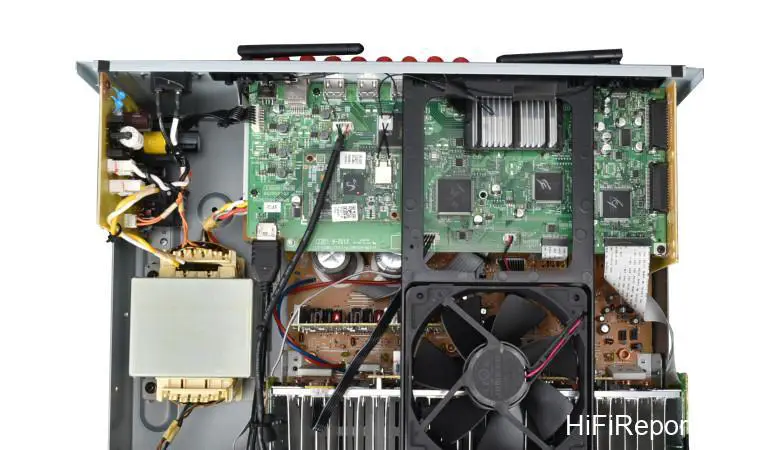
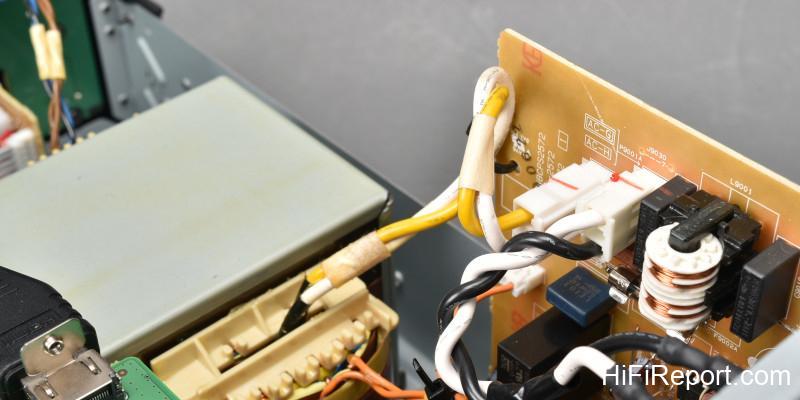
The VSX-LX305’s circuitry design largely follows that of the higher-tier VSX-LX505, with only minor component differences. Power supply for the audio circuits is handled by an EI transformer and two 10,000μF filter capacitors. Due to cost considerations, the size of the transformer and the capacitor capacity are slightly smaller than those in the VSX-LX505.
A separate switching power supply handles secondary power for video, display, and other functions, maintaining the classic separated power supply design common in high-performance AVRs.
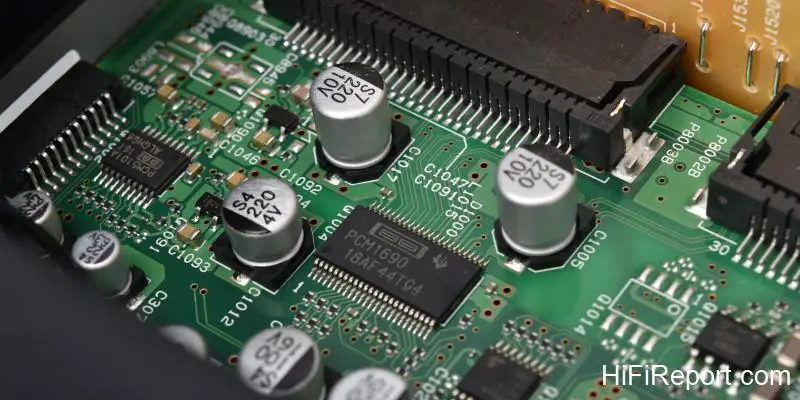
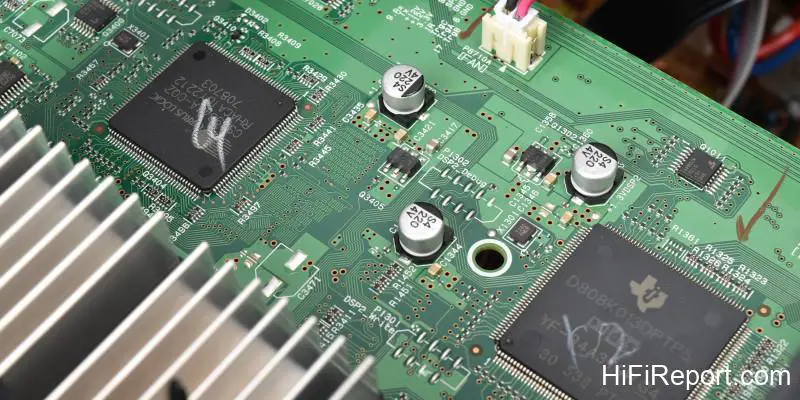
After the power supply section, the main board houses two 4-core 32-bit DSP chips, a Cirrus Logic CS49844A and a D808K013DPTP5. These are responsible for audio upscaling and spatial correction tasks like MCACC and Dirac Live. The audio decoding block features a 24-bit 8-channel Burr-Brown PCM1690 DAC chip for the main channels and a Burr-Brown PCM5101A for secondary channel digital-to-analog conversion, indicating two fewer decoding channels compared to the VSX-LX505.
Moving to the power amplifier circuit section at the bottom, this is identical to the VSX-LX505. It utilizes a discrete amplifier circuit design, with each channel employing a pair of Toshiba TTA0001 power transistors. Large heatsinks and a fan are included to ensure the power amplifier circuit operates at peak efficiency.

This allows the unit to deliver 100 watts per channel (8 ohms, two channels driven) within a reasonable cost framework, providing ample power to drive most home theater speakers effectively.
Dirac Live Calibration Experience
To fully experience the capabilities of Dirac Live, I performed automatic room calibration using both a smartphone and a laptop to compare the audio differences under different test conditions. Using just the Pioneer Remote app to run Dirac Live already produced a very significant improvement in sound quality. As shown by the software, it effectively eliminated standing waves across the full frequency range, resulting in a remarkably flat frequency response.
Subjectively, the sound became more neutral. Concurrently, the solidity of sonic images, localization accuracy, and purity of the soundstage were elevated by several levels.
Next, I used our in-house mini DSP professional test microphone paired with a laptop. To my surprise, the density and resolution of the sound improved even further. Mid-bass details became richer, and transient response was more agile. In comparison, the computer version of Dirac Live calibration delivered higher sonic accuracy, while the smartphone version sounded slightly softer and perhaps more listener-friendly over extended periods.
Immersive Movie Performance
Ultimately, I settled on the computer-based test results. First, when watching the “John Wick: Chapter 2” tunnel shootout scene on Netflix, the unit’s depiction of ambient sounds was outstanding, and the soundstage was incredibly transparent, devoid of any impurities. Footsteps and breathing were rendered with clear detail. The fierce gunfire shattered the silence, and beyond the impactful dynamics, I could distinctly feel the tangible presence of each bullet.
Their trajectories left long-trailing echoes, constantly conveying the oppressive spatial sense of the tunnel. Compared to most mid-range AV receivers, the VSX-LX305 emphasizes resolution without any sluggishness, revealing previously overlooked sonic details.
Similarly, during the final air combat sequence in “Top Gun: Maverick” (BD), the direction, altitude, and distance of objects in the vast sky were clearly discernible. The fighter jets had a substantial, vivid presence. Amidst the chaotic air battle, whether it was the constant flipping and shifting of the aircraft or the missiles streaking past, I heard solid sonic movement. With my eyes closed, I could easily pinpoint the location and shape of objects.
I could even feel the energy of oncoming jets impacting my chest, as if danger was imminent!
I believe this is thanks to the VSX-LX305’s expansive and layered soundstage and its precise localization, which create a cinematic scene that transcends the physical listening space. It accentuates the contrast between near and far and the difference in object size. From the massive, close-up fighter jets to the subtle ambient sounds in the distance, everything was remarkably clear, adding significant depth and layering to the audio.
Dirac Live Impact on Dynamics
When encountering bombing scenes, the power of Dirac Live was once again evident. The dynamic impact was strong and forceful, and the speed at which sound energy dissipated and compressed was sharp, entirely free from any sense of looseness or blurring. Without the booming standing waves in the room, the debris scattering after explosions revealed significantly more detail, rendering countless complex sonic images with precision and accuracy.
While the sheer impact and density might be slightly less than the higher-tier VSX-LX505, the addition of Dirac Live undeniably delivered an extremely accurate and detailed sonic quality – something previously unimaginable from mid-range AV receivers in this category!
Conclusion
My experience over the past two months reviewing Pioneer AV receivers leads me to believe that it’s not that affordable models inherently lack good sound quality, but rather that they are significantly affected by room modes. Excessive resonance and standing waves degrade audio quality, which is often the most challenging aspect to manage in typical living room spaces.
With Dirac Live room correction, you can simply hand over the problem to professional processing, minimizing these spatial variables and allowing the AV receiver to perform to its full potential. The VSX-LX305 is precisely the most accessible entry point to experiencing the power of Dirac Live.
Specifications
* Type: 9.2 Channel AV Receiver
* Output Power: 100W + 100W (8 ohms, 1 kHz, THD 0.08%, 2ch Driven)
* Audio Formats: MP3, WMA, AAC, ALAC, WAV, FLAC, AIFF, DSD
* DAC Decoding: PCM 192kHz/24bit, DSD 11.2MHz
* Connectivity: 9 x Speaker Terminals, 2 x USB Ports, 1 x 6.3mm Headphone Output, 2 x Subwoofer Outputs, 6 x HDMI In, 2 x HDMI Out, 2 x Zone B Pre-Outs, 5 x 2-channel Analog Inputs (including PHONO)
* Digital Inputs: 1 x Optical, 1 x Coaxial
* Antenna Terminals: 1 x FM/AM
* LAN Port: 1
* Wi-Fi Frequency: 5 GHz/2.4GHz
* Bluetooth Version: 4.2 (supports aptX HD)
* Dimensions (W.H.D.): 435×173×370.5 mm
* Weight: 10.4 kg

- DIRAC LIVE ROOM CORRECTION: State-of-the-art digital room correction technology improves overall audio performance across the full frequency band with no additional upgrade required.
- IMAX ENHANCED: Digitally re-mastered content for the home environment is created to provide the same sharp 4K HDR images and powerful sound just as the filmmaker intended.
- ENHANCED GAMING: Own your opponents with HDMI 2.1 enhancements for gamers: 4K/120Hz HDR pass-through enables ultra-fast motion -VRR (Variable Refresh Rate) eliminates lag, stutter, and frame-tearing for fluid gameplay. – ALLM (Auto Low Latency Mode) optimizes latency from source to screen – QFT (Quick Frame Transport) limits lag for a smoother experience.
- STREAMING MUSIC SERVICES AND FASTER WIFI: Works with Sonos, Chromecast built-in, AirPlay 2, and DTS Play-Fi; includes Spotify, Amazon Music, Pandora, TIDAL, Deezer, or TuneIn streaming services
- IMMERSIVE SOUND FROM YOUR TV APPS: E-ARC (Enhanced Audio Return Channel) simplifies connectivity and supports the latest high-bitrate audio formats including Dolby Atmos, DTS-HD Master Audio, DTS:X, Dolby TrueHD.